David Thom – The Number and Names of the Apocalyptic Beasts (1848)
THE
NUMBER AND NAMES
OF THE
APOCALYPTIC BEASTS
WITH
AN EXPLANATION AND APPLICATION.
IN TWO PARTS.
PART I.
THE NUMBER AND NAMES.
BY
DAVID THOM,
PH. D., A. M., HEIDELBERG,
MINISTER OF BOLD STREET CHAPEL, LIVERPOOL.
——-
LONDON:
H. K. LEWIS, 15, GOWER STREET, NORTH.
LIVERPOOL: GEORGE PHILIP.
MDCCCXLVIII.
[ii.]
LIVERPOOL:
PRINTED BY DAVID MARPLES.
[iii.]
AUGUSTISSIMO ET POTENTISSIMO,
PRINCIPI AC DOMINO,
DOMINO
LEOPOLDO,
MAGNO DUCI BADARUM, DUCI ZARINGIÆ,
ET QUAE SUNT RELIQUA,
RECTORI,
ACADEMIÆ HEIDELBERGANÆ MAGNIFICENTISSIMO;
VIRO AMPLISSIMO, ILLUSTRI
CAROLO HENRICO RAU,
JURIS UTR. ET PHILOS. DOCTORI, HUJUSQUE PROFESSORI, PUBL. ORD.
MAGNO DUCI BADAR. A CONSILIIS INTIMIS, ORDIN. LEON.
ZARING. BAD. PREFECTO,
PRORECTORI ACADEMIÆ MAGNIFICO;
DECANO 8ENIORI CETERISQUE SOCIIS ERUDITISSIMIS
ORDINIS PHTLOSOPHORUM ;
NEC NON
DOCTORIBUS, PROFESSORIBUS, REGENTIBUSQUE OMNIBUS
ORDINUM
THEOLOGORUM, JURISCONSULTORUM ATQUE MEDICORUM,
IN LITERARUM UNIVERSITATE RUPERTO-CAROLA,
HANC PARTEM PRIOREM
DISSERTATIONIS SUÆ,
“DE NUMERO ET NOMINIBUS BESTIARUM APOCALYPTICARUM,”
OBSERVANTIÆ GRATIA,
ET
CUM SUMMA TESTIFICATIONE ILLORUM IN SEIPSUM OFFICIORUM,
EDITOR,
NUPER IN TABULAS DOCTORUM PHILOSOPHIÆ HEIDELBERGANORUM
CONSCRIPTUS,
ANIMO LUBENTE, GRATO, BENEVOLOQUE,
DONO DEDIT AC DEDICAVIT.
[iv., blank page]
[v.]
TO
RICHARD ROE, ESQ., A.B., T.C.D.,
FORMERLY OF DUBLIN, NOW OF LONDON.
—————
DEAR Mr. ROE,
Many years have elapsed since I first announced to you my discovery of the name of the second Apocalyptic Beast — my intention to publish on the subject — and my wish to avail myself of the opportunity which would thereby be afforded, to give expression, in the form of a dedicatory Epistle, to the esteem and attachment — the veneration, indeed — of which your high intellectual and moral qualities, your great and varied attainments in literature and science, your love of truth, your inflexible adherence to its dictates,1 and above all your truly Christian deportment had in my mind been productive.
1 Evinced, among other ways, in your abandonment, many years ago, of the clerical character, with its rank and other advantages.
To this last proposed step, I was, in addition to what I have just stated, still farther influenced by the consideration, that the Apocalypse of John had particularly engaged your own attention; and that, treading in the footsteps of Bishops Lowth and Jebb, Mr. Boys, and others, you had, on the principle of parallelism, so ably and happily illustrated in their writings, constructed an “Analytical Arrangement” of this most wondrous of all the sacred books.2 Who, then, so well qualified as yourself, [vi.] by previous investigations, exercises, and pursuits, to enter on the examination of topics connected with prophecy, especially with the visions vouchsafed to the beloved apostle in the Isle of Patmos? True, you might not agree with me. Either in my premises, or in my conclusions, your acute and practised mind might spy defects, and detect fallacies. This might be. Notwithstanding, a candid treatment of myself and my views, I was certain to meet with at your hands. Concerning how few of those who have made the Scriptures their study, and who profess to be actuated by the spirit which they breathe, could I venture honestly thus to express myself?
2 “An Analytical Arrangement of the Apocalypse, or Revelation recorded by Saint John; according to the principles developed under the name of Parallelism,” &c., by Richard Roe. Dublin, Tims, 1834. — To the Biblical Student, let me earnestly recommend a perusal of your modest and unpretending, but learned and most instructive Preface.
Considering your advanced period of life, and the numerous and increasing disadvantages under which for years I have myself laboured, the realisation of my purposes, in regard to the book and yourself, had, I must confess, long appeared to me exceedingly problematical. Still, the design was never lost sight of, or abandoned. I never despaired. Amidst difficulties, discouragements, neglect, contempt, and opposition from a great variety of quarters, it has been to me a kind of polar star. Several works, since the resolution above spoken of was first adopted, have been composed and published.3 None of them, however, without a reference, and in subserviency to this present one. And at last, in the good providence of God, I am enabled both to announce a most important Apocalyptic discovery, and to dedicate the pages in which it is contained to you.
3 The “Dialogues,” “Divine Inversion,” and “Three Grand Exhibitions.”
As I have, in the Preface, given an account of the progress of this volume, from its first sketch as a pamphlet, to the full-grown size in which it now makes its appearance, any farther allusion to that subject seems to be uncalled for and unnecessary.
[vii.] To you, dear friend, with deep, heartfelt gratitude to God, for having spared me to publish, and you to outlive so long the four-score years which constitute the ordinary allotted term of man’s most protracted earthly existence, I hasten, with pleasure, and an affection which I find myself unable in words adequately to express, to inscribe this fruit of so many years’ thought, toil, and anxiety: — this work, the discoveries contained in which, however much at first they may be neglected, or whatever the opposition which they may encounter, are, I am satisfied, destined to exert no small degree of influence, not only on the true Church of God, but on mere nominal professors of Christianity in future times; and which will be the germ of an entirely new system of Apocalyptic, and thereby of Biblical interpretation.
The first part of my long projected work, however, is, as you will perceive, all that at present I have to offer. Shall you and I live — shall either of us? — I to publish, and you to witness the publication of the second? No matter. With God is the residue of the Spirit. We may both of us soon be removed. My ulterior designs, in so far as I personally am concerned, may prove abortive. But the mystery is now solved: to apply it is all that remains. And when you and I shall have quitted this sublunary scene — when our bodies shall have returned to the dust, from which they were originally taken — God’s infinite wisdom and power, which have honoured us by employing us to any extent in their service, can never be at a loss for instruments, prepared to carry on and perfect whatever is to be conducive to the spread and establishment of the Redeemer’s heavenly kingdom. This is enough.
You and I, dear Mr. Roe, may differ as to several points of Christian doctrine. Nay, I am aware that we do differ. Breach of mutual attachment, however, such differences have never yet, that I am aware of, given birth to. While Jesus is to both of us our Lord and our God, and while in his atoning sacrifice, and resurrection from the dead, we see our sins taken [viii.] away, and everlasting life freely bestowed upon us, we may lament our inability to see in all other respects eye to eye; but this inability shall not be productive of disputes, or rancorous feelings: at all events, not on your part. Your candid and generous disposition — your knowledge of the limited range of the human faculties, even at the best — your conviction that imperfection is thereby necessarily stamped on all the thoughts, schemes, enterprises, and productions of man — your Christian experience, combined with the calmness and gentleness of your natural temper — and, above all, your humble and modest estimate of self, as seen in the light of the transcendant glory of Jesus Christ — have prepared you for mistakes on the part of others, and have inclined you to make ample allowance for their infirmities. You can, therefore, without irritation, and without cherishing unkind feelings, bear to have your opinions called in question. Your rich and varied learning, instead of being employed harshly to silence, or crush an antagonist, have merely enabled you with truth, as well as with simplicity and dignity, kindly to suggest what had been previously overlooked, and thereby to convince. How often, in more respects than one, have I been benefited by your calm suggestions, and Christianly-expressed strictures.
We may differ, in regard to the Book of Revelation, and in our respective estimates of the value of my discovery. While to me, the Apocalypse is the opening up of the spiritual and heavenly nature of Christ’s character and kingdom, especially with reference to the period which elapses from his resurrection and ascension, till the end of this present world, when he shall appear again, the second time, without sin, unto salvation; and while I see in it allusions to earthly powers and objects which exist during the interval between his resurrection and second advent, although only for the purpose of being contrasted with himself and his heavenly Church; — to you, dear friend, it may appear that the contents of this wondrous book received their accomplishment, in a great measure, if not entirely, at the [ix.] æra of Jerusalem’s destruction. While to me, the following solutions are keys, and the only keys, to the interpretation of this portion of Scripture, doubts concerning their truth and applicability may suggest themselves to your mind. This difference of views — if we must differ — I shall regret. Our differences, however, shall be friendly. Whatever has a tendency to bring prominently under the notice of the Church of the living God, the value and importance of the inspired record, the purity of divine truth, and correctness of Christian practice, meet, I know, with your approbation. Mistakes committed, or supposed by you to be committed, you can kindly overlook, when the promotion of the glory of God, as revealed in the face of Jesus Christ, is conceived by you to be the honest, as it is the avowed design of an author.
Grieved have I always been, when I consider how little, comparatively speaking, your own literary and theological labours have been appreciated. Your work on “The Principles of Rhythm, both in Speech and Music,”4 gained you deserved applause; and your “Analytical Arrangement of the Apocalypse,” exhibits marks of ability, taste, and learning of so high an order, that acknowledgments to this effect, on the part of all who were competent to judge, it was impossible for you not to receive. However, from your modest, unassuming, and retiring nature, the advantages of popular approbation, and the homage due to superior merit, you have not courted. You have rather shrunk back from them, even when placed within your reach. You have not, like but too many literary men, been noisy and obtrusive. Rather than contend for that place which is confessedly your due, you have altogether declined the conflict; and have been content quietly and calmly to look on, while the bustling, the forward, and the presuming have passed you in their career. Your very pamphlets on the most important of all subjects, while admired, and found to be most [x.] instructive by others, you have, on account of real or supposed deficiencies, withdrawn from circulation and suppressed. Hence your comparative obscurity. Hence the fact of your works being in the hands of but few; when, had you been endowed with vanity and self-conceit, or had you armed yourself with a fixed determination to assert your own place, long ere this, that distinguished rank in literature which by some is known rightfully to belong to you, would at once and cheerfully have been conceded to you by all.
4 Dublin, printed by R. Graisberry, 1823. Published under the patronage of “The Royal Irish Academy.”
Amidst abundant reasons for regret, that your modesty should thus have been allowed to interfere with your literary success, it affords no small consolation to me to find, that a work to which you have devoted the evening of your days — a work upon which you have brought to bear all the powers and resources of your matured reflection, and which is replete with the stores of your learned and highly cultivated intellect — your “Arrangement of Scripture, with subjoined Notes,”5 is now almost ready for the press. Well can I imagine its value. Earnestly do I long to see it, and profit by its perusal. The good Lord spare you to carry it through, and witness its publication. Steps will, I trust, speedily be taken by you, to obtain that support, which may justify you in putting it into the printer’s hands; and God doubtlessly will bless the undertaking.
5 Upon the principle of Parallelism.
It remains for me only to repeat, in reference to yourself, the heartfelt wish, that for the end just mentioned, as well as for the advancement of His glory otherwise, and your own good, God may see meet to prolong yet farther your “green and hallowed old age.” And to express, in reference to the following work, my desire, that however quick the eagle eye of criticism may be to fasten on its defects, and however susceptible of improvement it may appear to be, even to the partiality of friendship itself, to it may be conceded the honour of drawing attention to God’s most blessed word — of suggesting the [xi.] hollowness of mere human conclusions in matters of religion — of throwing light on the utter impotency of man’s fleshly intellect, when attempting to understand the scriptures — and, above all, of leading others more highly gifted, more deeply taught, and enjoying greater advantages than myself, to present views of the import of that Book — a portion of which here occupies attention — profounder, more comprehensive, more accurate, more instructive, and more agreeable to the revelation of God, than have ever yet entered into the mind of him, who, with pride and pleasure, takes this public opportunity of subscribing himself,
Dear Mr. Roe,
With sentiments of sincere esteem and attachment,
Your obliged and admiring friend,
D. THOM.
P.S. — In the following pages, you will not fail to recognise, in more than one passage, the result of suggestions, for which I have been indebted to you.
3, ST. MARY’S-PLACE, EDGE-HILL,
LIVERPOOL, MAY 29TH, 1848.
[xii., blank page]
[xiii.]
PREFACE.
LITTLE do I intend to say respecting the following work, beyond stating its origin, adverting to the persons and authorities of whose aid I have availed myself in its composition, and returning thanks to the kind friends by whose suggestions, subscriptions, and support it has been enabled to see the light.
The spring of the year 1837 was the æra of my discovery of the name of the Second Beast. On Monday, the 12th day of December, 1846, I unexpectedly stumbled on the knowledge of the first-mentioned of the two symbolic monsters. Somewhat extraordinary were the circumstances connected with the former event. To a few private friends they have long been familiar. But in so far as the public is concerned, they are suppressed. That incredulity, that ridicule, that suspicion even of having derived their origin from the imagination of the relator alone, with which any statement of the details, however simple and truthful, would be received, and which constitute some of the wholesome checks imposed by the [xiv.] good sense of mankind in general, and of the English nation in particular, on the disposition to obtrude wonderful and unaccountable narratives on public notice, dictate this reserve. And, after all, it is with the truth or falsehood of the discovery itself, not with the mode in which I was put in possession of it, that my readers have to do. Certainly, the whole of the way in which my mind has been turned towards the subject of the Apocalyptic Beasts, and in which discovery after discovery has been the result, involves it in something very much out of the common run. This, however, is all that need be said regarding the matter.
Here is wisdom; let him that hath understanding count the number of the Beast. Such being the language of Holy Writ, and it being the object of the present work to proclaim that I have solved the enigma proposed, it may be imagined, that, in submitting these pages to the public, I labour under an impression of being endowed with superior worldly wisdom, and of having an understanding which has made more than ordinary proficiency in science and literature. Persons entertaining such notions concerning me, would do me grievous wrong. Neither to wisdom, nor to understanding, surpassing the average measure allotted to mankind, can I safely and truly say, do I make the slightest pretension. The almost accidental nature of my discoveries, precludes, in my own mind, the possibility of my ascribing merit on [xv.] account of them to myself. And the whole course of my procedure, public as well as private, is so stamped with indications of the reverse of what society has agreed to consider and denominate wisdom — the reverse of what is by common consent styled knowledge of the world, and of being actuated by a due regard to one’s own interests — that for me to lay claim to the possession of superior wisdom or understanding, would be to draw down upon myself deserved and unmitigated ridicule. Scripture, it is true, speaks of a wisdom which is from above. Some of the leading qualities of this it describes, James 3:17. This species of wisdom, and its fruits, it contrasts with the wisdom which it stigmatises as earthly, sensual,6 devilish.7 Ibid. 15. Whether any portion of the former may have fallen to my lot, and whether without it the discovery which it is the object of these pages to proclaim [xvi.] could have been made, are points which I do not undertake to decide, and which, therefore, are left to the reflections and judgment of each individual reader.
6 ψυχικὴ, soulical.
7 Query, Idolatrous? ᾿Ανδρες ᾿Αθηνᾶιοι, κατὰ πάντα ὡς ΔΕΙΣΙΔΑΙΜΟΝΕΣΤΕΡΟΥΣ ὑμᾶς θεωρῶ. Acts 17:22. See also 1 Cor. 10:4-22, in the Greek. Have my readers ever looked into Dr. Campbell, of Aberdeen’s, SIXTH PRELIMINARY DISSERTATION, PART I., entitled, “Διαβολος, Δαιμων, and Δαιμονιον?” If not, let them do so. Especially let them peruse with care sections 13-22. Covetousness, which is idolatry, Colos. 3:5, — and in the pursuits of covetousness, no ordinary degree of fleshly wisdom is often displayed — is language which must be familiar to all. I am not sure but that Thomas Carlyle has unintentionally thrown great light on this particular phase of the wisdom which descendeth not from above, in his “Heroes and Hero Worship.”
So important was the discovery of the name of the Second Beast seen by me to be — such was the light shed by it on the context, and on the Scriptures in general — and so decided, and, in a religious sense, so revolutionary were the consequences to which, among the followers of the glorified Jesus, it was evident that it must ultimately give rise — that I was not slow in adopting the resolution to make it public. Indeed, I felt bound in conscience to do so. Circumstances, it is true, seemed to me unfavourable for carrying my purpose into execution immediately. And, therefore, publication on the subject was deferred. But its practical influence upon my mind and conduct was instantaneous. It modified all my religious views. It modified also my procedure. Almost all my pulpit discourses I strove to render subservient to the suggesting of information to my friends concerning it. Works were projected, written, and published by me, such as the “Dialogues,” “Divine Inversion,” and “Three Grand Exhibitions,” keeping my discovery always in view, and bearing in mind that it was my intention, some time or other, if spared, to make the subject of the Beast’s number matter of a separate publication. At last, my mind was directed specially towards the investigation of the Apocalyptic and enigmatic number. Works were read. [xvii.] Authorities were consulted. A short pamphlet of seventy or eighty manuscript pages was written.8 Immediately followed my discovery of the name of the First Beast. New investigations were the result. And at last, after years of partial knowledge, years of enquiry, and years of reflection, the present work has emerged.
8 This took place in October and November, 1846.
To make the subject known in the most advantageous way possible, it appeared to me expedient to divide my projected work into two distinct parts, and to publish these parts separately. The first part, to treat of what for eighteen hundred years, in the shape of conjectures innumerable, had been attempted by the professing Christian Church: closing with a statement of my own discoveries. The latter part, to be devoted to the establishment directly on the basis of divine authority, of what I have found out, and in this present part make known; to some indications of the light which it sheds on other portions of the sacred record; to the wonderful connection subsisting between the two Beasts, and the grand twofold aspect of human religion which is suggested in the Gospels and Epistles; to the rise, progress, and consummation of the spurious and Anti-Christian system, which, in various forms, has so long been prevalent, which has so long domineered over the children of men, and under which the great majority of the followers of the [xviii.] Lamb themselves have so long and so painfully suffered; and to some applications and practical consequences of an exceedingly important nature, which the subject involves. Acting on this principle, I bring out the former part of my work, in the shape in which it now solicits public attention.
It consists, as will be observed, of an Introduction, and two Books. The Introduction speaks for itself. As to the Books, in the former, I treat of the Number, in the latter, of the Names of the Apocalyptic Beasts.
The proper method of drawing up the second of these Books, has cost me no small expenditure of thought. A brief, dry catalogue of solutions, with but few, if any explanatory remarks, similar to what occur in the works of Wolfius, Calmet, J. E. Clarke, and Wrangham, was all that at first I contemplated. Reflection, however, satisfied me of the repulsiveness, I may add, the comparative inutility of this. What, then, was I to do? Not, surely, enter at length on the consideration and discussion of every conjecture to which the brain of man had given birth, however absurd and insignificant the conjecture might be? This were out of the question. Le jeu ne vaudrait pas la chandelle. And besides, the patience of my readers was not likely to tolerate the levying of such a tax upon it. At last, I hit upon a sort of medium. Ordinary guesses, I dismiss with brevity. Fairly stated, I hope, even the most trifling and worthless [xix.] of them are. But they are at once thrown aside. When some importance seems to attach to a solution, let it be ever so much opposed to my own views, I have dwelt with a greater or less degree of minuteness upon it. As much of anecdote and variety as the subject was capable of admitting, I have endeavoured to enliven it with. My great object has been to instruct. Rather, to stimulate the mind to investigation and reflection. To prevent as far as I could, and as seemed to be proper, that tediousness which a mere enumeration of details is apt to engender, is what certainly, in subserviency to my main object, has not been lost sight of.
To the divine blessing the whole is commended. May it be useful to the general reader. May it induce, on the part of the Biblical student, increasing and still more profound researches into the Oracles of Truth. And may it be productive of a more consistent understanding of Scripture, of a better view of their present entanglements and their real privileges, and of the proper practical results in the case of God’s dear children.
Situated as I am, it has been out of my power to consult all those authorities, and to institute that full examination of the subject, which, in as far as my own feelings are concerned, would have been desirable. Many things would have prompted me to this. Among others, to ascertain the priority, or the reverse, of my own discoveries. New, they unquestionably are, to me. I am [xx.] indebted for them, neither directly nor indirectly, to any human being. Nay, till the moment of my writing these words, I am not aware of any one previously having had them suggested to his mind. Nevertheless, they may not, after all, be original. To one reflecting and inquisitive mind, or to more, one or both may have occurred. Their extreme simplicity renders this probable. And had the discovery actually been made, dread of the perilous consequences likely to result from the publication of it, might dictate its suppression. This clearly might happen. All I can say is, that besides the discoveries here set down having been original to me, I have not, since making them, been able to detect the slightest trace of either the one or the other, in any of the numerous works treating of the subject, which, in the course of an extensive and protracted enquiry, have come under my notice. Wolfius, Bengelius, Foxe, Calmet, Rabett, Mede, More, Faber, J. E. Clarke, Wrangham, are silent as the grave respecting them. Had circumstances permitted, nothing short of an examination of works on Apocalyptic topics, in the British Museum, and Sion College, London, would have satisfied me. Nay, before supposing myself justified in bringing my researches to a close, I should have tried to obtain access to the stores contained in the Bibliothèque du Roi, (now the Bibliothèque Nationale,) at Paris, and to some of the larger libraries of Germany. And this, not merely for the satisfaction of my mind as to the [xxi.] priority of my claim to be the discoverer of the following solutions — a circumstance only personally interesting — but likewise in order to the enlargement of my views in reference to the subject of Apocalyptic interpretation in general. However, this I can assert with truth, that I have done my best. I have availed myself, as far as I could, of means of information which were accessible to me. Those whose opportunities of research are greater than mine, will, it is to be hoped, be more industrious and more successful.
Besides the very limited resources of my own private library, the collection of theological works in the Liverpool Athenæum, and in the Library of Humphrey Cheetham’s College, Manchester, have been at my service. The use which I have made of my materials will be apparent in the subsequent part of this volume. Various works on the subject of Apocalyptic or general prophecy, such as those of Jurieu, Bossuêt, Semler, Sir Isaac Newton, Dr. S. Lee, Burton, Markwick, Faber, Fleming, Ashe, Snodgrass, Bishop Newton, Bishop Hurd, Lowman, B. Johnstone, Tilloch, R. Roe, and many others which it would be tedious to mention,9 I have perused, I might even say, studied with care, from beginning to end. And works particularly bearing on the subject of the present treatise, I have not only read, but, in some instances, gone through more than [xxii.] once. Among these may be enumerated the productions of Potter, Rabett, J. E. Clarke, Wrangham, and the anonymous Essay entitled, “Wealth the Number of the Beast.” I have read with the utmost attention, and in some cases digested and made abstracts of larger or smaller portions of the writings of Irenæus, Jerome, Augustin, Luther, Calvin, Erasmus, Bellarmine, John Selden, Cluverus, Piscator, Mede, Lightfoot, Swedenborg, Wolfius, Lancaster’s Daubuz, Bengelius, Grotius, Le Clerc, Chillingworth, Bishops Stillingfleet and Warburton, M. Stuart, Elliott, and multitudes of others, to some of whom reference will be found made in the following pages: not excluding frequent and careful examinations of Mill, Wetstein, and Griesbach, of Campbell and M’Knight, as well as of popular Commentators on the Sacred Volume.10 Honestly and carefully have I had recourse to the original authorities referred to [xxiii.] by writers, whenever it has been in my power to do so. This has been my practice, especially with regard to the numerous and valuable quotations of Mr. J. E. Clarke. Sometimes it has been impossible for me, from inability to procure the books necessary, to have the citations verified. There they must rest on other authority than mine. The mistakes committed by authors, I have decidedly, but in no case, where they appeared to proceed from mere inadvertency and oversight, unkindly, pointed out and rectified.
9 Several foreign works are included.
10 All this, in addition to a mass of classical, scientific, theological, and miscellaneous reading, (including almost all our older and better poets, most of the novelists of a preceding, and several of the present age, all our standard historians, and works in several other departments of the Belles Lettres, Foreign as well as English,) so extensive as to satisfy me, that although standing at an indefinite distance below the giants of literature, and even obliged, from a very inferior station, to look up with admiration to many of the able, educated, and highly accomplished men of the day, I have not exactly rushed into print unprepared; but have endeavoured to qualify myself, as well as circumstances have permitted, for the task which I have undertaken, and the attention which I venture respectfully to solicit.
Some assistance was required, and some assistance have I had, in the preparation of this work. Not in the formation and adoption of its plan. Not in the arrangement of its details. And, not to any great extent, in its execution. To the general plan and the particular arrangement, be they good, bad, or indifferent, no one except the individual who is penning these lines can prefer the shadow of a claim; and upon his own shoulders has devolved the entire drudgery of preparing the work for the press. In several minor particulars, he needed assistance; and most frankly and kindly, whenever it was asked, has it been extended to him.
His researches in the Liverpool Athenæum have been seconded, and the labours connected with them materially alleviated, by the attentions and occasional suggestions of Mr. Wm. R. Jones, the urbane and erudite Librarian; and also by the obliging disposition of Mr. Higginson, the [xxiv.] Sub-librarian. To both gentlemen, he begs leave hereby to tender his best acknowledgments. Mr. Thomas Jones, B.A., the able, amiable, and accomplished Librarian of Cheetham College, Manchester, has, by repeated anticipations of what might be requisite for the due prosecution of my undertaking, by supplies of books out of his own private stores, by transcriptions of important passages, and by other seasonable acts of kindness, laid me under obligations which I feel that it will never be in my power adequately to repay.
Many private friends have also, by procuring or lending books, or by valuable suggestions, contributed towards the improvement of my work. The names of several of these will be found mentioned in the following pages. Besides them, Mr. William Rushton, of Liverpool, a young gentleman of distinguished promise, and John Mure, Esq., also of this town, whose name is suggestive of all that is kind, candid, and honourable, who devotes much time to reading, and whose masculine good sense, and strong reflective powers enable him to turn his reading to account — both differing from me in religious sentiments — will have the goodness to allow me, in this public manner, to tender my acknowledgments for hints, and for other instances of attention, the value of which, I trust, I am not altogether unable to appreciate.
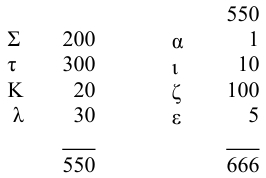
How many more, did space and a sense of propriety permit, might I name, as having kindly and generously [xxv.] aided me in this undertaking. And this, too, in several instances, without having sympathies in common with me on the score of religion. Will the Rev. George Gilfillan, the justly celebrated author of the “Gallery of Literary Portraits,” — a gentleman who is daily reaping fresh laurels in the field of contemporaneous criticism, and who by the productions to which his genius, his acuteness, his amazing powers of generalization, his massive strength of intellect, and his original and vigorous, but subdued imagination, have given birth, has already secured for himself a place in the Temple of Fame, — accept of thanks at my hands for his seasonable and most serviceable reference to the present work, as then forthcoming, in “Hogg’s Weekly Instructor,” for September last? Thomas Mulock, Esq., the friend of the distinguished Canning, himself not undistinguished in the republic of literature;11 Richard Roe, Esq., whose extent and variety of knowledge, accuracy of taste, and refinement of mind, are only surpassed by his singular modesty; and the Rev. George Aspinall, Ph.D., author of “Florence Ray,” “The Idealist,” and various other clever productions, which are fast establishing his reputation as a poet and a man of letters, have, [xxvi.] by numerous and disinterested acts of attention, entitled themselves to my lasting gratitude. I cannot pass over, without special mention, the name of John Fraser, Esq., the upright, manly, talented editor of the “True Scotsman,” at a period when no ordinary firmness and straightforwardness of character were demanded on the part of public men. Thomas Conolly Cowan, once the most popular of preachers in Bristol, now spending his hallowed old age at Reading; William Seabrook, the amiable, able, and Christian minister of Bethesda Chapel, Plymouth; and James Riddall Wood, Esq., author of “Angel Visits,” may rest assured that they and their friendly services are not forgotten. Will Mrs. Sherwood, the authoress of “Henry Milner,” the “Monk of Cimiés,” &c., &c.; and David Waldie, Esq., author of the “Ultimate Manifestation of God,” &c., permit me here to record a passing tribute of gratitude and affection? Let me name also, my friend, Mr. J. C. Mence, of London. What, however, can I say sufficiently strong to mark my sense of the kindness shewn towards me by Philip James Bailey, Esq.? Need I add, the author of “Festus”? One solution of his adorns these pages. This, however, is not all. Letter after letter has that true son of genius — that excellent, no less than distinguished man — addressed to me, having for their object to draw my attention to works from which information, or at all events suggestions, conducive to the perfecting and success of my plan, were likely to be derived. Great [xxvii.] have been the benefits thus conferred on me. Thanks, dear friend. Particularly grateful, as well as seasonable, has been that letter in which you invite my attention to Mr. Alfred Addis’ “Concise View of the Language, Scheme, and Spirit of the Chronological Prophets.” 1830. Besides finding the number 666 in Ludovicus, which he considers to be synonymous with Clovis, and in the Hebrew, of “Prince of the Kings of Javan,” or “Greece,”12 applied to the Roman Emperors, Mr. Addis, it seems, suggests, that “Emperor of the Romans,” in the Hebrew language, קסר רומיים, amounts to the number, 100 + 60 + 200 + 200 + 6 + 40 + 10 + 10 + 40 = 666; and also “His Holiness of Rome,” in the same language, is the number of that name, i.e., makes the same number with it. Thus, קדשו רומי, as follows: 100 + 4 + 300 + 6 + 200 + 6 + 40 + 10 = 666. Mr. Addis having assumed the final ם, nun, in יון, Javan, or Greece, as 50, instead of 700, and the final mem in רומיים, Romiim, as 40, instead of 600, thus, it seems, justifies his procedure. “The Masorites make these finals stand for 700 and 600 respectively; but this is a late invention, according to Gesenius; and the Cabbalists do not use the final for anymore than 40, as may be seen in two instances of their actings in Schoëttgen’s ‘Horæ Hebraicæ et Talmudicæ.‘”13
11 Have my readers seen his interesting pamphlet, recently published, entitled, “The Failure of the Reformation”? Should Mr. Mulock ever happen to see and look over this present work, it may strike him, how singularly my discoveries tend to confirm several of his own leading positions.
12 שר מלכי יון, 300 + 200 + 40 + 30 + 20 + 10 + 10 + 6 + 50 = 666.
13 The following extract from a letter recently addressed to me by my esteemed and learned Christian friend, Mr. Wapshare, may here fitly be introduced: — “As you give all the expositions of the number of the Beast, and that of mine, under figure 26, in Hebrew, I imagine you will give also the χξς, as initial letters, signifying that Satan, or the Spirit of Life, in all flesh, as in all beasts, is, in the cross, transformed into the Spirit of Christ, the Angel giving us the Light of the Truth, in the salvation of MAN. For so was he who was figured by the Old Serpent, and the giver of the Law, (Jehovah) lifted up in the Wilderness, for a sign of the Son of Man, who, coming in the fulness of the power of the Father, should be for the healing of the nations.
“My chief warrants for this doctrine are the two texts, John 1:17, and 2 Cor. 11:14, with its context. For there, the ministers of Satan, or of the Law, are said to transform themselves; putting on the outward appearance of lambs of godliness, but inwardly are as wolves in sheep’s clothing. For the power that transforms the heart, is of Love, and is the gift of the Holy Spirit of God. Such the transformation of Saul.
“God, the Elohim, was six days in creating all things, and having made MAN, he entered into his rest. He is no more seen as a Creator, as Elohim, but as Jehovah, the Lord of the Sabbath, and the Spirit of life in MAN, which Spirit worketh sin in the flesh; for the Spirit of Love, in all flesh, is Lust, or the spirit of a beast. So Rom. 7. And which Spirit is crucified in the flesh. He, then, as Jehovah — as the power of the Law, in and over all flesh, John 8:44 — increases that which he has made as the Elohim, and his power shall last for 6 days, or 6 periods of time, computed at a millennium of years; and at the end of which 6 days, he who is the Spirit of all flesh, shall manifest himself as the Holy Spirit of Almighty Love, and of all Truth; and so shall the Church have her Sabbath of Rest — all contention being at an end.
“This is, as well as I may now express it, my solution of the mystery in Hebrew, and in Greek, and also in Latin, IHS. For he that was lifted up is King of the Jews, and is the Lord of all Life, working in us, both to will and to do; as is manifest in the Jews — they slaying him, that his blood might be good for the healing of the nations, of all people and tongues. As the Father of all natural flesh, he is the Spirit of Lust, as in all beasts; as the Father, or King of the Jews, he is the Devil, as he himself witnesseth in John 8, already referred to. As lifted up, he is transformed into the Spirit of Love, a light to the Gentiles, and the glory of his people Israel.
“As the sign is given in Greek, I cannot but think any solution imperfect, which shall not be in that language. Therefore I say, (χξς’ is,) Σατανας επι Ξυλον Χριστος, i.e., Satan as lifted up on the cross, is transformed into Christ, our Lord and Saviour. For there is but ONE God, ONE Lord, ONE Spirit, ONE body, &c.; and he who was Satan, the Spirit of life in that body, is, in Christ crucified, seen as the Spirit that is in all, and through all, and over all, God blessed for ever. He, therefore, who as King of the Jews, the Lord of Abraham after the flesh, is the Devil, or Satan; is, when lifted up, the Spirit of Love, sanctifying the heart, which is the true circumcision: for love effectually cutteth off every sin, and is king over them who are thus made Jews indeed. The form of the Latin, or modern letters, which answers to
χξς, is
XIS:
which, read after the manner of the Hebrews, is SIX. And I is for a sign of him, the only ONE, who, in the beginning, as under the Tree of Life, is figured as Satan, giving us in natural life, Cant. 8:5, the knowledge of good and evil; but, in the end, is manifest, as by the Cross, to be God, the Giver of all good, the Saviour of the Spirit, made corrupt through the flesh.
“My confidence in this arises from the sublimity of the doctrine. For it is written, If ye do the works, (of Love) ye shall know of the doctrine, whether it be of God. The name of the man, I therefore say, is Satan and Christ, in the power of Jehovah and the Elohim, the giver of life both temporal and spiritual, who hiding himself under the form of a beast, is the power of natural life, and is imaged under the darkness of the law, by its sacrificial offering of beasts; but under the gospel is declared to be God, the maker and the preserver of all things made; and who coming again, or in his second advent, shall come as Satan to destroy all things made; that as Christ, he might purify the Spirit from all the lusts that belong to the flesh, raising it up in the perfect image of its Maker, its Preserver, and its Redeemer. This is the New Jerusalem.
“The figure I., the only numeral letter in modern European languages, is, as I apprehend, formed from the Hebrew vau, ו, and which, as the conjunctive particle, is for a figure, or sign, of the power of Love, made manifest in the cross, as uniting Satan and Christ, the alpha and the omega, in ONE Spirit, and all of us in him, even in God.
“Should you not already have noticed this, you have my permission, nay, you would oblige me by inserting it as an addendum.“
Thus have I complied with my esteemed friend, Mr. Wapshare’s request. What precedes is an exact transcript from his letter.
Upon it, I pronounce no opinion. A sense of respect for the author, and a desire that his views might be fairly brought under public notice, have given birth to this long note. Mr. Wapshare’s “Scripture Revelations,” and other learned productions, must be examined by those who would become further and fully acquainted with his sentiments.
[xxviii.] Desirous am I to embrace this opportunity — perhaps the last which I shall ever have — of expressing my sense of the obligations under which I lie to the dear friends who [xxix.] have now, for a period of more than twenty years, enabled me to submit my lucubrations to the public eye. Poor, otherwise unbefriended, and the object of no common dis-[xxx.]like on account of my religious views, what, but for them, humanly speaking, could I have done? The friendship of others, had their support been withheld, would have [xxxi.] been in vain. I might have written. I might once or twice have launched some small and trifling craft — some frail barque — on the ocean of literature. I might even have contemplated, and in part attempted, some greater things. But the odium attaching to unpopular opinions, and the application to me of the principle implied in the sneering query, Can there any good thing come out of Nazareth? would, but for private, decided, and in many cases most disinterested friendship, soon have taught me, that unless I was content to defraud my printer, to see my publications sent to the pastry-cook or the trunkmaker, and to become the inmate of a gaol, I must discontinue the trade of authorship. Blessed be God, however, He hath seen meet to order matters otherwise. While relations and friends have looked coldly, if not even frowned on my literary undertakings; while open enemies, and the malicious, have indulged in the use of the most spiteful epithets, and have openly exulted in the prospect of my finding no readers; while reviewers have accepted copies of my works, some of them expensive, and have then deliberately and contemptuously Burked them — and while both public and private insinuations have not been awanting, that views so inconsistent with common sense, [xxxii.] with popular notions, and with the all-but unanimous religious sentiments of mankind, must necessarily entail speedy oblivion upon my labours, a few have, through good report, and through evil report, continued to uphold and encourage me. Among these I recognise several, to whom I know that my religious views are obnoxious, but who, with strong, manly, English sense of fair play, having been determined that I should be heard, have exhibited a candour and dispositions so honourable, as to entitle them, as well to my esteem, as to my deepest and most affectionate regards. By this support, not only of fellow-believers, but of real and candid friends, there has been given a currency to my productions, which has brought them into favour with a certain portion of the public, — has secured for them the notice of some able and impartial reviewers, who constitute an honourable exception to their class, — and has carried some of them even into second editions. The names of M’Culloch, Smith, Watson, Macintyre, M’George, Thompson, Dewrance, Meiklejohn, M’Clellan, Walmsley, MacRae, Cameron, Coghill, Wade, Whitby, Goold, Simpson, Nicol, Seward, Tomkinson, Sutton, Procter, Freer, Tilston, Waldie, Sinclair, Miller, Rule, Doran, Day, Seabrook, Campbell, Hynde, Downey, Stewart, Griffiths, M’Gill, Roy, Charteris, Robinson, Fraser, Jeffrey, Leslie, Gordon, Maxwell, M’Kenzie, Blackstock, Ronald, Richardson, Gardener, Lewis, M’Bryde, Fawcett, James, Geddes, Yuill, Wood, [xxxiii.] Bennett, M’Ketterick, Roe, Gilston, Taylor, Davies, Grindlay, Moore, Rogers, Carus, Howard, Drummond, M’Caig, Finlay, Rankin, Callow, White, Young, Thomson, Gardner, Mitchell, Marrow, Lumsden, M’Kerras, Wells, Kewley, Hargraves, Haywood, Dickson, Bell, Charles, and several others — some which I do violence to my own feelings in suppressing the mention of — will always be cherished with respect and affection by myself and family. And when the existing generation, along with myself — when, perhaps, one or two generations more shall have passed away; and when the value of the divine facts of Scripture, as contrasted with existing and mere human systems of theology, shall have come to be better understood and appreciated by the members of the Church of the living God, then will the importance of the course pursued by the individuals named and referred to, (some of them, be it recollected, opposed to me in their sentiments) be brought out more fully and prominently into view. However they may have been actuated — whether by love of truth, or by feelings of personal kindness, or by a sense of manliness and impartiality, or by all these taken together — it will be seen that they, like myself, have been subservient, in God’s hands, to His purpose of drawing attention to the Scriptures themselves, as the sole depositories and fountains of all divine knowledge; and especially of suggesting, in opposition to fixed human creeds, confessions, and formularies, on the one hand, and [xxxiv.] to attempts of the mere human intellect, by its own native energies, to make advances in religion, on the other, that with Himself alone resides the power of communicating spiritual and heavenly discoveries — that through His written word alone can such discoveries ever take place — and that He has a vast deal more of information and instruction to open up out of that Word, than has ever yet fallen to the lot of any of His believing people. These results, I know, will be brought about. To the accomplishment of these results, the procedure of my friends and myself is, in however trifling a degree, and whatever may be our personal and immediate objects, contributing. Happy are we, in proportion as God’s glory, through Jesus Christ, is our sole and conscientious aim. Then do we, and then do all who in their literary and ordinary undertakings are influenced by this heavenly motive, realise in our blessed experience the truth of the Saviour’s declaration, If any man serve me, Him will my Father honour. John 12:26.
To the preparation of the second part of this treatise, it will now be my business, should leisure and the means of support be continued, to devote myself and my energies, such as they are.
In the mean time, it affords me pleasure to announce, on his own authority, that a young and talented friend of mine, Mr. William St. Claire, whom I had the honour at one time to rank among the number of my hearers, and [xxxv.] who, it seems, has had his time and attention lately in no small measure occupied by Apocalyptic topics, conceives himself to have discovered the Beast’s name. He has, it appears further, prosecuted the subject into its details, and contemplates publishing the result of his investigations. Mr. St. Claire’s discovery, I am ignorant of. Most heartily, however, do I wish him success.14
14 Query, Is not this gentleman’s surname, written in Greek characters, capable of bringing out the Apocalyptic number?
————————————
Since writing what precedes, I have, by the kindness of the Rev. Andrew Marshall, D.D., Kirkintilloch, had put into my hands the “Christian Repository and Religious Register,” for 1820. Edinburgh. From an article contained in it, pp. 476-492, I learn that the Rev. Robert Culbertson, of Leith, in his “Lectures on the Prophecies of John,” 2 vols. 8vo., Edinburgh, 1817-1818, represents himself as having had suggested to him by Dr. Duncan, of Midcalder, and as having adopted as his own, the notion that the Apocalyptic number, 666, had a reference to Rome, and to that passion for war which in heathen times was her leading characteristic. This both gentlemen endeavour to make out, by assuming that the Roman Legion, when complete, consisted of 6666 individuals; and [xxxvi.] that the Holy Ghost, in Rev. 13:18, refers to the number of its officers, which was exactly 666, viz. —
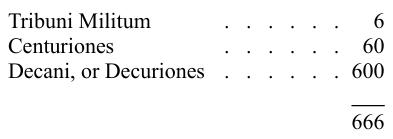
The whole of the assumptions of Messrs. Duncan and Culbertson are briefly and easily, as well as most satisfactorily demolished by the reviewer, who, I presume, is Dr. Marshall himself. Readers of this work will at once perceive that the notion of 666 having alluded to the officers of the Legion, is merely a “variety” of speculations long previously current among our Continental neighbours, and mentioned by Bengel. See p. 270. — Nothing farther need be said about it.
[xxxvii., xxxviii., xxxix.]
[The ERRATA, ADDENDA, ET CORRIGENDA, have been incorporated into the text.]
[xl., blank page]
[1]
INTRODUCTION.
[2, blank page]
[3]
INTRODUCTION.
CHAPTER I.
THE APOCALYPSE IN GENERAL.
SUCH is the nature, and so specific is the design of this present work, that I can only afford a cursory glance at several very important topics, which have attracted the attention, and occupied the minds of the greater part of those, by whom the Book of Revelation has been systematically treated of and expounded.
The first of these respects its authenticity and genuineness.
Long was the right of the Apocalypse to take place among the inspired and canonical records by some called in question. Indeed, during the two or three first centuries of the Christian æra, it was, as is well known, one of those writings, now constituting the New Testament, [4] to which was applied the epithet, αντιλεγομενα.15 This stigma, however, was but temporary.16 The decision of the Council of Laodicea, about A.D. 364, is generally understood to have embodied the sense of what is called the church of Christ, in acknowledging its divine origin. Common consent,17 besides, has now for fourteen or fifteen hundred years recognised the validity of its claims to be enrolled among the productions of prophets and [5] apostles.18 And, what is of infinitely more importance, to every regenerate person to whom its meaning has in any respect and to any degree whatever been opened up, there is carried home an irresistible, heartfelt conviction, that, like the other books of Scripture, it had not its origin in the imaginings or will of man; that, like them, it is not the offspring of mere human sagacity; but that one, specially called and prepared by God himself for the purpose, gave utterance to its glorious and divine intimations, in consequence of having been moved to do so by the Holy Ghost. 2 Peter 1:21: see, also, Psalm 45:1; and 1 Peter 1:10-12.
15 Contradicted. Not one of the νοθα, or spurious.
16 See Jeremiah Jones “On the Canon of the New Testament,” T. Hartwell Horne’s “Introduction,” and other works of a similar description.
17 Not exactly does this remark apply to our German neighbours. Doubts as to the divine origin and inspiration of this book, Lutherans have inherited from their illustrious founder. Sixteen or eighteen years ago, I had my attention drawn particularly to the translation of a work on the Apocalypse, written by either Baumgarten or Semler, in which the authenticity and genuineness of that portion of Holy Writ was, by every species of argument, assailed. The shafts of ridicule were not spared. For the opportunity of perusing this treatise, I was indebted to the kindness of its exceedingly able translator, A. G. Möller, Esq , of Dublin. Well do I remember having been struck by the plausibility of its assertions, its logical structure, the bitterness of its sarcasm, and the aspect of profundity which it was intended to present throughout. A complete embodiment was it of the German mind. Nothing which I have since met with on the subject has interested me more. And yet, instead of that work, or of others since perused by me, which are characterised by the same object, having produced in my mind the slightest tendency to an acquiescence in their professed sentiments, the effect has been in an exactly opposite direction. Their attacks have tended but the more to satisfy me of the divinity of the Apocalypse. My highly respected, talented, and learned friend, the Rev. James Martineau, entertains, I have reason to believe, strong objections to the divine origin of this book. From what I know of his powers of reflection, his extent of reading, and the beauteous felicity of diction with which he is capable of clothing his sentiments, I should like much to peruse a critical exposition of his views regarding this controverted portion of Scripture, however much opposed those views might be to my own.
18 “I do not find any other book of the New Testament so strongly attested, or commented upon, at so early a period,” is the decided language employed by Sir Isaac Newton, in his “Observations on the Apocalypse,” p. 447 of the fifth volume of Horsley’s edition of his works.
Lowman’s preface to his “Paraphrase and Notes on the Revelation of St. John,” G. Penn’s “Revelation of St. John,” contained in his “Annotations to the Book of the New Covenant,” Elliott’s “Horæ Apocalypticæ,” Mr. Roe’s preface to his “Analytical Arrangement of the Apocalypse,” or any other easily accessible commentator, critic, or expositor, (Bishop Newton is very brief, so is T. Scott, of Aston-Sandford,) may be consulted by those [6] who wish to obtain merely a popular view of what has been said respecting the genuineness of this Book, and the codices, or MSS., which have been employed in the printing and criticism of it. Jeremiah Jones, and Hartwell Horne, will supply more detailed information. Those, however, who have higher objects in view, and wish to push their researches further, will repair to such works as the “Prolegomena” of Mill and Wetstein, in their respective editions of the New Testament; to the admirable “Fundamenta Criseos Apocalypticæ,” prefixed by Bengelius to the Book of Revelation, in his critical edition of the New Testament, Tubingen, 1734, pp. 776-789, (alluded to briefly in his “Gnomon N.T.” pp. 1078-1081); the works of Grotius, Hammond, Le Clerc, and Erasmus; and the observations of Griesbach, short but valuable, — especially in reference to the codices of Andreas, and the explanation of Dobrowski, — which occur at the beginning of his second volume. Moses Stuart’s “Commentary” and “Excursûs,” will also, no doubt, be consulted. Nor will the labours and researches of modern German critics be overlooked. By these the student will probably be induced to institute an examination into the works of the Fathers themselves.19
19 The whole subject is admirably, and in a most condensed form, treated of in a work published more than a century ago, by Leonard Twells, D.D., sometime Vicar of St. Mary’s, Marlborough, afterwards Rector of St. Matthew’s, Friday-street, London, entitled, “A Critical Examination of the late New Text and Version of the New Testament, in Greek and English,” 1732, pp. 187. Having failed in all my attempts to procure a copy of this Essay for myself, and having been unable to meet with it in either the Athenæum Library, Liverpool, or Cheetham College, Manchester, I have been obliged to content myself with what professes to be a translation of it into Latin, by the celebrated Wolfius. This is inserted in that volume of his “Curæ Philologicæ et Criticæ,” which treats of the Epistles of Peter, Jude, and John, and of the Book of Revelvation; Hamb. Ed. 2da, 1741, pp. 387-429. The Latin title assigned to it by Wolfius is “Leonardi Twelsii Vindiciæ Apocalypseos.” Dr. Robert Watts’ reading of the English title of Twells’ work, as set down in his Bibliotheca Britannica, differs a little, I observe, from that given by Wolfius — “A Critical Examination of the late New Text and Version of the New Testament, in Greek and Latin,” 1731-2, 3 parts, 8vo.
[7] Another topic which I find myself precluded from entering on at length, has reference to the date of the composition of the Apocalypse.
For many years I have rejected unhesitatingly, and on what seem to myself to be most valid and satisfactory grounds, the notion — might I not even be justified in calling it the fable? — of this Book having been composed towards the close of the first century, A.D. 95 or 96, or thereabouts. Evidence to substantiate this, which is the common opinion, is, it appears to me, totally a-wanting. That conjectures abound — that stories are current — that ecclesiastical traditions may be referred to — that passages from some of the early Fathers may be adduced — and that the Romish church has made declarations, all favouring the idea of the end of the first century having been the date of this work, are facts which are incontrovertible. But this is all. Not only are there counter-conjectures, counter-stories, counter-traditions, counter-passages, and counter-declarations, fixing a much earlier period for its composition, and, so far as they go, tending to neutralize [8] the authority of the others, but internal evidence, I am satisfied, is absolutely irreconcilable with the theory of the later period assigned. Events connected with the destruction of Jerusalem, and the passing away, at that æra, of the Old Testament economy, are in more than one part of it clearly and strikingly spoken of, as matters of future occurrence: and if so, it must have proceeded from the pen of inspiration before A.D. 69 or 70; unless we feel disposed to impute to the Holy Ghost the uttering of prophecies subsequently to their accomplishment. Can it be shewn satisfactorily, indeed, that any of the New Testament records were composed at a later period than the one which has just been indicated?20 I believe not. And if this be the case, then John, the beloved Apostle and the Divine,21 in advanced but still vigorous life — not the same John, overwhelmed with the infirmities of an extreme and fabulous old age, or another John, known in ecclesiastical history as the Presbyter, — was the amanuensis of the Holy Ghost, in writing the Apocalypse. “Domitian, however,” say they, [9] “was emperor at the time when this Book was composed.” Granted; but Domitian was a name not confined to a single individual of the imperial dynasty. It was actually one of the names borne by Nero; and to Nero, as the Domitian in question, does the title of the Syriac Version22 of the Apocalypse expressly refer. Not under the government of the brother of Titus, therefore, or during the continuance of the imperial authority in the hands of the Flavian family — not in 95 or 96 — not when the Apostle was feeble, imbecile and decrepid — are we constrained to suppose that his banishment to Patmos took place. Exceedingly probable is it, that between A.D. 66 and 68, was the period of his exile; that it terminated with the death of Nero, which happened in the year last named; and that it was some time during the interval specified, he was the favoured recipient of these divine visions and discoveries, of a detail of which the Apocalypse consists.23 Understanding all this, every thing is intelligible and consistent. On the contrary, into an anachronism of not less than thirty years, and into a vast number of other absurdities, should we plunge, were we to adopt the notion — the mere figment — which the Church of Rome, in concert with certain traditions which she would fain invest with infallibility, has handed over to us in reference to this subject.
20 The opinion of the celebrated author of the “Horæ Hebraicæ,” Lightfoot, is, on this point, expressly with me. Rather, I happen to have the honour to agree with him. See his able statement of the dates of the composition of the various portions of the New Testament, in his “Harmony, Chronicle, and Order” of that Book, contained in the first volume of the folio edition of his works, 1682. Perhaps, as to some of the dates, he may be mistaken. The ingenious remarks of Paley, in his “Horæ Paulinæ,” respecting the dates of the Epistles, are not to be overlooked. But in maintaining that none of the Books of the New Testament were written after or about A.D. 68, I believe Lightfoot to be literally correct.
21 The Divine, ὁ Θεολογος.
22 Probably the Old, certainly the Philoxenian Version.
23 This is clearly the opinion of Lightfoot. See his “Revelation of John,” “A. c. lxvi., Nero 12,” pp. 340-358 of Vol. I. of his works. It forms a part of his “Harmony of the New Testament.” Grotius ascribes the date to either Claudius or Nero.
Avoiding Charybdis, however, let it not be supposed [10] that I have run upon Scylla. Because I reject the late date which has been assigned to the Apocalypse, I certainly am not prepared to follow in the wake of some eminent men, who have chosen to go to the opposite extreme.
Sir Isaac Newton’s “Observations upon the Apocalypse of St. John,”24 may be advantageously consulted, by all those who are desirous to obtain full information respecting the date of the composition of this portion of Holy Writ.25 To the ordinary reader,who may not have an opportunity of procuring and perusing the theological works of England’s great astronomer, Dr. Tilloch’s treatise, entitled, “Dissertations introductory to the study and right understanding of the language, structure, and contents of the Apocalypse,” London, 1823, may be recommended. Against one thing, however, I must enter my caveat; and this with regard to both writers. Indulging an unwarranted license of imagination at the expense of sober judgment, and with the risk of damaging even their own cause, both Sir Isaac and his follower, the Doctor, not satisfied with having demolished the anachronism involved in carrying down the date of the Book of Revelation to the close of the first century, have endeavoured, by a series of ingenious and somewhat plausible, but most sophisticated reasonings, [11] to represent that book as having been written previously to any other portion of the New Testament Scriptures: perhaps A.D. 54, perhaps even earlier.26 Upon what grounds is an assertion so novel, and so startling, made to rest? Why, upon such as the following: — The word αποκαλυψις, revelation, occurs in the First Epistle of Peter. Wherefore, gird up the loins of your mind, be sober, and hope to the end, for the grace that is to be brought unto you, at the revelation, the grace brought unto you through the Revelation, say they, εν αποκαλυψει, of Jesus Christ. 1 Peter 1:13. Ergo, this passage refers to the Book so denominated, as already existing! Again, in the Epistles of Paul and Peter, our Lord is represented as coming like a thief in the night, 1 Thess. 5:2,4, 2 Peter 3:10; and other phrases are employed, exactly parallel to phraseology which is to be met with in the Apocalypse. Rev. 3:3; 17:15. Ergo, such expressions, as having been, in all probability, borrowed from this very Book of Revelation — an inference to which, say they, we are led by their peculiarity — prove it to have been written before the composition of the Epistles in which they occur! Such is a specimen of the reasonings adopted and made use of by Sir Isaac Newton and Dr. Tilloch, with a view to establish their favourite crotchet. Persons unprepossessed and unbiassed by a theory, and endowed with plain common sense, will, upon reading such arguments, be apt to enquire — Is it [12] not possible — nay, is it not just as probable — that, in the Book of Revelation, reference is made to the Epistles of Paul and Peter, as already existing, as that in them reference should be made to it?27 And if so, what is the worth of the reasoning had recourse to? — Strange, that a line of argument such as that upon which I have now been animadverting, should have received any countenance whatever from that great philosopher, whose constant and whose proud boast in physics it was, hypotheses non fingo.28
24 A work which, with his “Observations upon the Prophecies of Daniel,” gave occasion to the well-known sneer of Voltaire.
25 The title of the whole of this part of Sir I. Newton’s works is, “Observations upon the Prophecies of Holy Writ, particularly the Prophecies of Daniel, and the Apocalypse of St. John.” These prophetical expositions occur in the fifth volume of the 4to. edition of the “Opera quæ extant omnia,” published by Dr., afterwards Bishop, Horsley, in MDCCLXXXV., pp. 293-491.
26 Grotius, I suspect, as to this matter, had the chief hand in leading both, especially the philosopher, astray; and Sir Isaac and Grotius, it may be fairly surmised, mystified Bishop Newton.
27 Even Bishop Newton, who agrees with his name-sake, not only in holding the early date of the Apocalypse, but also in swallowing his notion of the Epistle to the Hebrews and the Epistles of Peter having alluded to it, is obliged to admit the possibility of the objection “that St. John might borrow from St. Peter and St. Paul, as well as St. Peter and St. Paul from St. John.”
28 To do Sir Isaac justice, he is, as might have been anticipated from his habits of profound and accurate thinking, not quite so decided in his Apocalyptic theory as his follower. His somewhat qualified language is: “These reasons may suffice for determining the time; and yet there is one more, which, to considering men, may seem a good reason; to others, not. I will propound it, and leave it to every man’s judgment. The Apocalypse seems to be alluded to in the Epistles of Peter, and that to the Hebrews, and therefore to have been written before them.” And so on. Still, even to the concession which I have made in his favour, I am not altogether sure that the great astronomer is entitled; as I find him, in sections fifth and sixth, arguing, unhesitatingly, as if the hypothesis in question were true.
The fact is, that, while the composition of the Apocalypse preceded the period of Jerusalem’s destruction, A.D. 69, and while it had for one object, among other and far more important ones, to prepare the minds of the disciples [13] for that rapidly approaching event,29 and the consequences which were therein involved, it was intended not to be subservient to other inspired writings, but to be the consummation of them all. As respects the passing away of the Mosaic economy, it was to be the final warning.30 Hence the Apocalypse is, as on the face of our Bibles it appears to be, the last specimen of prophetic inspiration; and its grand object, as may afterwards be shewn, is to serve as a summary and exponent of all that had gone before.31
29 Arethas “affirms that the Apocalypse was writ before the destruction of Jerusalem, and that former commentators had expounded the sixth seal of that destruction.” — Sir I. Newton’s “Observations,” ut supra.
30 “As Ezekiel wrote concerning the ruin of Jerusalem, when the ruin of it was now begun, so I suppose doth John of the final destruction of it, when the wars and miseries were now begun which bred its destruction.” — Lightfoot’s works, vol. i., p. 340.
31 Let me here observe, in order to do justice to myself, as well as to that eminent man, that I conceive the reasons adduced by Sir Isaac Newton for rejecting the ordinary notion of a late composition of the Apocalypse to be, although briefly, most pointedly and convincingly stated.
I now proceed to the third and last general circumstance, with regard to which I am compelled to be brief, viz., the period of the fulfilment of the prophecies contained in this wonderful Book.
Great diversity of opinion, as is well known, prevails respecting this point.
By some, the whole Book is considered to have received its accomplishment in the fact, and at the period of Jerusalem’s destruction. Among the American Universalists, [14] of the Ballou school, this view is just now very prevalent.32 Similar, also, judging from Wilkinson’s “Last Days,” and Mr. Stark’s writings, I take to be the opinion of the Salemites, a recent sect, having its locality chiefly in Devonshire. Pushed to an extreme is this theory, in “The Second Coming of Jesus Christ a Past Event,” by Robert Townley, A.B., 1845. These notions may have sprung up in the minds of modern enquirers, from a perusal of the Scriptures themselves. For my own part, however, I am inclined to think, that, although perhaps unconsciously, they have had their origin in theories propounded, and in views entertained and promulgated, by Grotius, Hammond, and others, two centuries ago. Maintained, afterwards, by Le Clerc; and revived, in our own days, in a modified form, by Michaelis and some of the other divines of Germany, from whom Professor Moses Stuart, of Andover, U.S., appears to have borrowed them.33
32 See the works of H. Ballou, T. Whittemore, Balfour, and others. Also, the pages of the “American Universalist Quarterly Review.”
33 This will be clearly seen, by a reference especially to Mr. Stuart’s Excursûs, at the end of his “Commentary on the Apocalypse.”
Dr. Lee, the learned Professor of Arabic in the University of Cambridge, I may fairly rank among this class of theologians. To him, evidently, do the Salemites owe much of what is valuable — almost all, indeed, that appears to carry with it any weight — in their views and writings. Only let this, with regard to the Doctor, be observed, that in his admirable “Dissertation on Prophecy,” contained in the volume entitled “Six Sermons,” &c., published by him, at London, in 1830, he makes admissions respecting [15] instances of the fulfilment of prophecy, subsequently to the destruction of Jerusalem, which, notwithstanding the ingenuity of his attempts to account for them, seem to be inconsistent with, and destructive of his general theory.
The celebrated Bossuet, Bishop of Meaux, in his “L’ Apocalypse avec une Explication,”34 has asserted and pretended to prove, that the Book of Revelation was fulfilled at the period of the establishment of Christianity by Constantine the Great. He has had followers.
34 The copy now lying before me, is one printed at the Hague, from a Paris edition, in 1690.
Some would have it believed, that no part of the Book is yet fulfilled; and that, therefore, we must refer its accomplishment to an æra still future.
But by far the majority of commentators and critics conceive it to have been in the course of fulfilment, from the time when the preaching of the Apostles commenced, until the present day. They profess to see it fulfilled, almost exclusively, in those revolutions of states and empires with which history makes us acquainted — in the disputes, heresies, and heart-burnings which characterise what is commonly considered and denominated the Church of Christ — and especially in the rise and progress of the Pope, or man of sin, in the devastations of Mohammedanism, in the events and consequences of the Reformation, and in a millennium of peace and blessedness, to be enjoyed by the people of God upon earth. To specify names is here unnecessary. The supporters of such theories are “legion.”
From every one of these opinions, and classes of opi-[16]nions, I dissent. And yet, to all of them, I am indebted for valuable suggestions. Upon the principles of my own interpretation of the Apocalypse, or, rather, upon the way in which, to the heaven-taught mind, it appears to me that it interprets itself, I have no intention at present to enter. Suffice it to say, that if any man shall understand this Book to be the opening up of the mind and kingdom of the glorified Jesus, as contrasted with the minds and views of earthly men, and with the nature and constitution of earthly kingdoms; to be the manifestation of the Church of Christ, as contrasted with bodies of men and earthly associations, which have arrogantly and presumptuously usurped the name; to be the explanation of the New Testament economy, as shadowed forth by the Old; and to be a view of the progress of matters during New Testament times, from the period of the apostolic ministry, till the second advent of our Lord, at the close of this present world, in the fulness of his mediatorial glory; the person entertaining such views cannot, in my apprehension, be far mistaken. Instead of assuming the facts, or supposed facts, of secular and ecclesiastical history, as the basis of his interpretation, such a one will not fail to observe that the divine facts of the Old Testament Scriptures, and “the life and immortality brought to light by the gospel,” constitute the basis upon which the whole superstructure of the Apocalypse rests; and that man, man’s character, and man’s doings are never introduced, except as contrasted with, and as foils to the illustration of the principles, nature, character, and tendencies of the kingdom of God.
[17]
CHAPTER II.
TOUCHING THE DESIGN OF THIS WORK.
THIS is so limited, that to two topics only of the numerous, instructive, and profound ones treated of in the Book of Revelation, have I restricted myself. The Number of the Beast — θηριον, wild beast35 — propounded enigmatically towards the close of the thirteenth chapter; and his Name, as destined to be found out thereby, are what alone I purpose to elucidate.
35 Θηρια, rather, for there are two of them. The two beasts are in reality one, for the second Beast is in many respects, not only an emanation from, but even identical with the first. Hence its feeling of affection towards, subjection to, and worship of the first.
“Innumerable attempts have been made to discover this name, but hitherto without success.” True; painfully true, indeed. Hence, in a matter of this kind, the propriety of caution, and of repressing the workings of mere imagination. But the name is not necessarily hidden; for to have discovered it by computation, is set down as one distinguishing mark of him who hath wisdom: [18] the wisdom which cometh down from above, I mean. And the test of our investigations having been crowned with success, proposed by divine inspiration, is, their result agreeing with 666, the number proposed.
Not as if this was to be considered the sole test of success. For various conjectures, some of them accurately enough, and very ingeniously too, involving the number, will afterwards be given, none of which are entitled to the slightest regard. And why? Because they agree not with the context. They explain nothing; or their explanation, although partially true, is defective. The numeral agreement is indispensable. It is a sine quâ non. Having obtained it, however, then comes the grand and puzzling enquiry, Is it worth any thing? Does it take its place as the only possible meaning of the symbol? Will it solve all the difficulties of the passage? Unhesitatingly do I refer to my solution, as what for ages the Church of God has been waiting for; and as what the greatest talents, and the highest literary attainments have hitherto attempted in vain. To one without pretensions to either, it has been made known.
And the discovery hath value. Not as a gratification of mere curiosity; for had that been all, the public would never have been troubled with this volume. But as throwing light on the structure, contents, and objects of the Apocalypse, viewed as a whole, in the first place; and, through it, on the rest of the sacred volume, of which, as has been already remarked, the Apocalypse is at once the closing portion and the summary. The grand value of the discovery is, that it opens up an entirely new principle of Biblical interpretation.
[19] When advanced beyond this Introduction, to nothing except to the Number and Name of the Beast, will the reader find his attention directed. Digressions, to be sure, may occur. Little episodes may be indulged in. To discussions, having perhaps but a collateral relation to the subject, notice may be solicited. This, however, but seldom; and never, except when it is conceived by the writer that such bye-play has some sort of bearing upon his main object, or when it is his wish to concede a little relief to the mind, otherwise apt to be overstrained and fatigued by a long detail of matters of fact.
The application of the discovery, so important in its nature and consequences, must not be looked for here. It is reserved for the Second Part. That is, for a part of the author’s work which may never be written; or, if written, which may never be published. Pecuniary means, health, life, and other desiderata, all dependent on the good providence of God, must be conceded, otherwise the completion of his plan is impossible. Towards the close of this volume, the true Name is given; and upon that, in the mean time, the reader is left to indulge his speculations.
[20]
CHAPTER III.
IS IT THE NAME OF ONE OF THE TWO BEASTS ONLY THAT IS TO BE SOUGHT FOR? OR, IS THE ENIGMA COMMON TO BOTH?
TO the former of these questions, my reply is in the negative; to the latter, in the affirmative: consequently, the discussion of the former I am enabled to decline altogether.
At the same time, in order to a correct understanding of my own view with reference to this subject, a brief statement of the facts of the case, of the controversy which has arisen, and of the grounds upon which it rests, may not be altogether inappropriate, or unacceptable. What, however, I have to state, with regard to my own view, shall be extremely condensed. The full satisfaction of enquiry belongs properly to the second part of my work.
All the direct information which, on inspired authority, we possess respecting the subject now under consideration, is contained in the thirteenth chapter of the Apocalypse. [21] There mention is made of two Beasts: the one, having seven heads and ten horns, 1-10; and the other, characterised by two horns like a lamb, while it spoke like a dragon, 11-18. The language of Daniel’s prophecies, especially of chapter seventh, assists us in understanding the composition and character of the first Beast; and to both monsters there are evidently allusions in other parts of the Book of Revelation. See chapters 11:7, [and chapters] 16, 17, 19, and 20.
So ambiguous is the phraseology of chapter 13:18, in which the enigma is proposed, that by some learned men, the former, and by others, the latter of the two Beasts, has been conceived to be the party spoken of. Certainly, we must admit, that concerning one of them only are we called on apparently to solve the problem. The injunction is in the singular number. Let him count — the number of THE BEAST. Hence the common understanding of the words in an exclusive sense; and hence the opposite theories which have been adopted and maintained, with no small degree of pertinacity, on the subject. One of the two Beasts only, say they, can be intended. Which of the two is determined by each critic’s judgment or fancy. Arguments in favour of the one and the other have, as a matter of course, been found or invented. The greater importance of the first Beast has, by the one class, and the place occupied by the second Beast, as the immediate antecedent to the enunciation of the enigma, has, by the other class, been the main weapons employed and relied on, to settle this singular controversy.
Imagining that some of my readers, without caring to trouble themselves with long and tedious disquisitions on a [22] matter of so little importance, might like to know something of what has been said by the partisans on both sides, I would suggest to them, that they may have their curiosity gratified, at a very small expenditure of time and patience, by procuring and perusing a small 12mo. volume, published by Bagster and Sons, in 1844, entitled “Wealth, the name and number of the beast, 666.” See especially pp. 66-72. The author inclines to consider the second Beast to be that spoken of, this latter monster being, he thinks, as many had done before him, the only proper antecedent to verse 18th. He refers, besides, to the famous Vatican MS., as establishing his position. However, in this opinion of his, regarding the claims of the second Beast, he stands opposed to very high theological and critical authority. Persons who cannot be satisfied with a cursory and superficial glance at this, or at any other Apocalyptic matter, and who may chance to deem a prosecution of their researches as to which of the Beasts is signified worth while, may consult larger and profounder works, some of which are mentioned by the author in question, and the titles of several of which occur, and references to several of which are made, in the course of this essay.
Relieved am I from all controversy as to which of the two Beasts constitutes the subject of the Apocalyptic enigma. And this, for the simplest and most substantial of all reasons, that the number 666 I have found to be involved in the names of both. To the claims of the second Beast, I confess that I originally inclined; although not without great hesitation. Besides, my discovery of a name corresponding to the number, began with [23] reference to the second Beast; and it was not till many years afterwards that the name of the first, as containing the same number, was disclosed to me. This, of course, ended all controversy on the subject. And yet, I am satisfied that a mere examination of the words of the text could never have led me to my present conclusion; for in the singular number is the enigma proposed, and decidedly ambiguous, as to which of the two Beasts was meant, is its phraseology. But having discovered the number to exist in both names, and having ascertained thereby that both were intended, how easily and satisfactorily is the very ambiguity itself explained. Like other prophecies, the obscurity in which, from its mode of statement, the subject is involved, was contemplated by its Divine Author; and, like other prophecies, by nothing but the true solution can this obscurity be cleared away.
Dr. Adam Clarke’s “Commentary,” and the opinions of some previous critics quoted by him, shew, that I am far from having been the first to suppose, that the number given was meant to apply to both the Apocalyptic monsters. Nay, perhaps I am not even the first to suppose, that two distinct names, each equivalent to 666, were discoverable. However this may be, the actual discovery of two such names, each involving the mystic number, — of each satisfying the requirements of the text, in so far as itself is concerned, — and of both being necessary to the entire solution of the enigma, — is what I may fairly lay claim to, as the grand, and what is more, as the truthful novelty, in which my investigations have resulted.
We have thus, by our knowledge of the fact, that both Beasts are indicated by the number 666 — a knowledge [24] derived from our discovery of who the two Beasts are — got rid of what has hitherto been felt to be an opprobrium to theology, a stumbling-block in the way of prophetic solution, and a source of feebleness and inconclusiveness in all attempts at Apocalyptic demonstration. “Which of the two Beasts is here meant?” or, supposing the claims of the one or the other to be advocated, “How can you satisfactorily establish your position?” or, supposing it to be alleged that both are intended, “Why cannot you furnish us with distinct and appropriate names for each?” are taunting, annoying, and unanswerable queries, which, independently of other objections, might, until now, have been cast in the teeth of those by whom the ordinary explanations of the enigma have been propounded. None of these taunts apply to us. We shew that both names are here meant. We furnish their names. And we establish our position, not merely by shewing that the names given agree with the number proposed, — the grand preliminary step, — but that what these names indicate as existing in fact, coincide in every, even the minutest particular, with the characters of the two Beasts as delineated in the text and context. The very ambiguity, which has hitherto been so puzzling, is itself explained, and thereby made to contribute its testimony to the truth of the solution. Truly, hypotheses non fingimus. The concoction of these we leave to others. We state facts: — facts heavenly and divine, as regards their origin — facts realised on earth in man’s nature, and man’s associations, as regards their accomplishment.
[25]
CHAPTER IV.
ROMAN, GREEK, AND HEBREW METHODS OF ARITHMETICAL NOTATION.
OWING to the nature of the present work, it becomes indispensable that a clear and distinct understanding of the way in which the Romans, Greeks, and Hebrews respectively conducted their arithmetical processes, should be possessed by my readers.
To the man of letters, what immediately follows is of course unnecessary. To some of those, however, who do me the honour to peruse these pages, and who take an interest in my subject, the contents of this chapter may be, in a great measure, a novelty; and they may find it advantageous to have it in their power, when at a loss, or whenever so inclined, to refer to them.
Popular information, therefore, being my object, I omit altogether the discussions in which learned men have indulged, respecting the origin, and the claims to authority, of the different modes of notation mentioned, especially that of the Hebrews.
[26] Taking up the three systems of numeration, in the order in which they have been proposed, we begin with,
1. — That of the Romans.
This celebrated nation, as is well known, conducted their arithmetical processes and operations, by means of a very few of the capital letters.
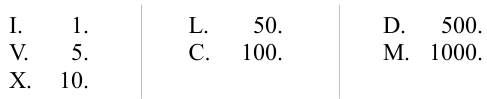
Upon this I need not dwell.
A different way of employing the Roman letters in calculations will afterwards engage our attention.36
36 Is it needful for me to inform any of my readers, that we are indebted for our cyphers, 1, 2, 3, &c., to the Arabians?
2. — That of the Greeks.
Anxious to give my readers a full and fair, and yet condensed view of this subject, I set down, first of all, the following extract from a translation of the Port-Royal Greek Grammar, by Nugent, published in London, 1797, pp. 14-16.
“Letters are taken arithmetically, when they are used to express numbers; which may be considered in two different manners, one natural, the other artificial.
“The natural manner is, when the letters mark the numbers, according to the alphabetical order; so that A signifies 1, B, 2, and Ω, 24; as we see in the order of books in the Iliad, and elsewhere.
“The artificial manner is two-fold: one, by all the [27] letters divided according to their classes; the other, by some particular letters.
“The division of letters by classes is three-fold: the first is of the digit number, or of units: this is done by the eight first letters, with this other character, ς, which is put in the sixth place, to signify 6,which is called επίσημον Fàu, or επίσημον only.
“The second is, of tens, which is done by the eight following letters, with this character, Ϟ or ϟ, which is put in the ninth place, to signify 90, and is called κόππα.
“The third class is that of hundreds, containing the eight last letters, with this other figure, ϡ, which they put also in the ninth place, to signify 900; and they called it σανπι, because it is made of a σιγμα inverted, with a π in the middle.”
And so on.
“The manner of computing by particular letters, is done by these six capitals, Ι, Π, Δ, Η, X, M, each denoting the number of which it forms the initial letter.
“Thus I signifies one, because it is taken from ‘ία, which was used for μία, una.
“Π signifies five, because it comes from πέντε, quinque.
“Δ stands for ten, as coming from δέκα, decem.
“H denotes a hundred, because, as it stood formerly for an aspiration, it was the initial letter of word HEKATON, centum.
“X denotes a thousand, by reason of χίλια, mille.
“M signifies ten thousand, because of μύρια, decies mille.
“And all these letters may be four times doubled [28] (excepting Π, which is never doubled,) or multiplied with the rest, to form all numbers whatever; as II, 2, III, 3, ΙΙΙΙ, 4, ΔΔ, 20, ΔΔΔ, 30, ΔΔΔΔ, 40. Thus ΔΙ, 11, ΔΔΙ, 21, ΠΙ, 6, ΔΠ, 15, &c.
“But if these very letters are inclosed in a great Π, (excepting I, which is never inclosed, because an unit cannot be multiplied,) this denotes that the number of the letter inclosed is to be repeated five times. Thus [see note]is five times ten, that is 50. [see note], five times a hundred, viz., 500. [see note], five times a thousand, viz., 5000, &c. And in the same manner, to combine [see note]I, 51, [see note] Π, 55, [see note] Δ, 60.”*
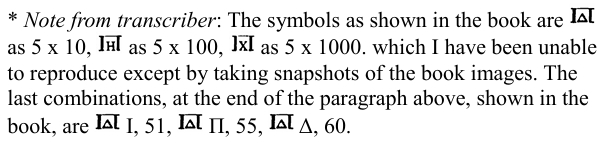
Those who desire to possess further information with respect to the mode of notation last mentioned, will find enough to answer their purpose in two short notices generally appended to Scapula’s Lexicon Græco-Latinum. They are entitled respectively, “De Græcorum notis arithmeticis Compendium, ex Hadriani Amerotii Scriptis;” et “Herodiani de iisdem tractatus.” In the Amsterdam edition of Scapula, 1652, these notices will be found occupying columns 231-235 of the Appendix; and in the London edition of 1820, edited by Bailey and Major, at pp. 878, 879.37
37 Besides, if any of my readers can command a perusal of the works of the celebrated John Selden, they may be interested by what he says respecting the use in notation of the I, Π, Δ, H, X, and M, on the part of the Greeks; a subject alluded to by him in his “Marmora Arundelliana, sive saxa Græcé incisa.” This method of numbering by the six initial letters just given, is styled by him the antient, or rather Attic Greek one. — See the Editionis ansa, causa, consilium, vol. ii., tom. ii., coll. 1440 et sequen.
[29] The former of what the Port-Royal Grammar denominates the artificial processes of numeration, is that which we encounter in the Greek Scriptures, and that to which I now particularly invite attention. It was the method commonly adopted, and it is that by which the apocalyptic mystery is solved.
Greek calculation, according to this system, was performed, as we have just been told, by the twenty-four letters of the alphabet, with the assistance of three επισημα, characters, marks, or signs.
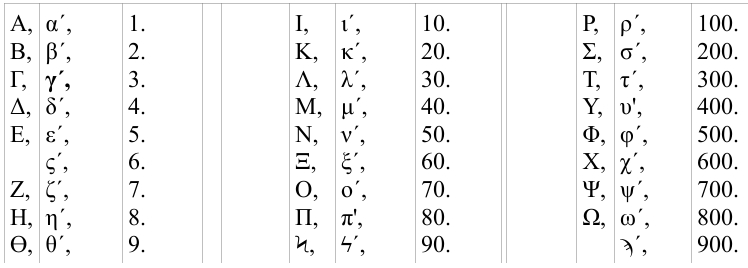
The mark denoting six is denominated επισημον, or, more correctly, επισημον Fáu, or βαυ; ninety, κοππα; and nine hundred is σανπι.
Units, tens, and hundreds are distinguished by a mark, or short stroke, placed above the letters. The placing of the mark below, shews that they are intended to stand for thousands. Thus, α΄ is 1, β΄ is 2, γ΄ is 3, &c.; but α, is 1000, β, is 2000, γ, 3000, &c. Two strokes below denote millions. And so of higher numbers.
It will be understood that ι΄, with the letters signifying [30] units annexed, expresses the numbers from 10 to 20: ια΄ 11, ιβ΄ 12, ιγ΄, 13, &c. κ΄, with the same letters, expresses those from 20 to 30: κα΄ 21, κβ΄ 22, κγ΄ 23, and so on. In the same manner the letters expressive of the tens, added to those of the hundreds, denote any intermediate number from a hundred to a thousand. Thus, ρι΄ 110, τξε΄ 365, and αωμη΄ 1848.
The number of the Beast, thus expressed, is of course, χξς΄, 666.
I have taken the few immediately preceding remarks chiefly from the very common Greek Grammar of Professor Moor, of Glasgow, and that of John Jones (2d Ed., London, 1808): not overlooking the Eton one, or the Port-Royal one already quoted from. The repetitions have had for their object to render the whole as distinct and explicit as possible.38
38 Several other Greek Grammars, such as Matthiæ’s, translated by Blomfield, London, Murray, 1829; Stuart’s, of the New Testament Dialect, London, 1838; G. Thompson’s Apparatus ad linguam Græcam, &c., London, 1732, &c.: also Greek Lexicons, such as Damm’s, Berlin, 1774; Parkhurst’s, London, 1794, &c., &c.; I have made a point of consulting, with a view to ascertain if there was any thing in them on the subject of Greek numeration and computation, which might be more interesting to the general reader, as well as more instructive and satisfactory, than what in the common Grammars is to be met with. To my great disappointment, except in Scapula, I found nothing. Almost all of them have remarks upon the subject, perhaps devoting a page or two to it. But they say nothing more than what I have set down in the text. Accordingly, on the common Grammars I was induced to fall back.
3. That of the Hebrews.
The following quotation from Professor Charles Wilson, [31] of St. Andrew’s, excellent Hebrew Grammar, pp. 200-202, Edinburgh, 1782, will communicate all that is necessary to be known on the subject.
“The Jews employ the letters of the alphabet to express numbers, in the same manner as the Greeks and Romans. But this practice is chiefly confined to the writings of the Rabbies and of the Masorites. To the twenty-two common letters of the alphabet, the five finals are added, making in all twenty-seven, which are divided into three classes, consisting of nine each. The first class represent units, the second tens, the third hundreds, in this manner: —

“In joining Hebrew letters, to denote numbers, it must be remembered, that the letter of the highest numerical value is placed first, on the right hand, before the letter of less value, contrary to our method of calculation by figures, according to which the value of a figure increases towards the left, and diminishes towards the right.
“י stands for ten, and ב for two. Placed thus, יב they signify 12; so קה ,93 ,צג ,31 ,לא, 105, רסו, 266.
[32] “The number 15 should be represented by יה; but because these letters constitute part of the word יהוה ,the letters טו or 9 and 6, represent 15, to prevent, as the Jews allege, the profanation of the peculiar name of God. For the same reason, טז, 9 and 7, is used instead of וי, 10 and 6, to express 16.
“An acute accent above any one of the first nine letters, multiplies its value by a thousand; א΄, 1000, נ΄, 3000; though sometimes the number of thousands is represented by a common letter prefixed to a doubly accented א΄΄.
“א΄΄ב, 2000; א΄΄ח 8000.*

“If hundreds are added, the accented Aleph is omitted.
“בק, 2100; דש, 4300; אופב, 1782.
“As the pages and chapters of printed Hebrew Bibles are generally marked with letters for numerical signs, it is proper that the learner be acquainted with this method.”39
39 Professor Wilson has, in the few sentences quoted in the text, expressed himself so fully and clearly, that the ordinary reader, it seems to me, has nothing left to desire. From Parkhurst, in his Hebrew Lexicon; from Keyworth and Jones, in the Hebrew Grammar prefixed to their Principia Hebraica, London, 1817; and from Lee, in his Hebrew Grammar, London, 1827, they will not learn so much. Some eminent Hebrew scholars seem, in their works, scarcely to touch on the subject of notation and computation at all. — In S. Glassius’ Philologia Sacra, under the head De Allegoriis, pp. 428-439, Jena, 1651, the curious reader may find some important information about the Cabalistic treatment of Hebrew numbers and names.
[33]
CHAPTER V.
A SUSPICION OBVIATED.
MANY will be apt to suppose that, in the work now before them, I am presenting them with something like a foregone conclusion. That, for instance, instead of my discovery of the Names of the Beasts having been at variance with notions originally entertained by me, I had adopted some particular theory, respecting the meaning and intent of the Book of Revelation; that, in consequence of this, I had bent myself with might and main to find, in its mystic phraseology, views and circumstances corroborative of my hypothesis; and that what I consider and denominate the Names of the Beasts are a mere fetch, or, at the best, conjectures pressed by me into the service, not on account of their truth, but because they seem to me calculated to answer my purpose, and promote a favourite object.
Whatever justification such suspicions may find in the character and procedure of others, to me, in the present case, they are totally inapplicable.
[34] A remark or two, submitted to my readers in the simplicity of my heart, will, I think, evince to all of them who are endowed with candour and reflection, how impossible it was that any previous and positive theory of mine, respecting the Apocalypse itself, could have influenced my discovery.
First. So far from my mind, in the spring of 1837, when the discovery took place, having been pre-occupied by any particular hypothesis as to the import of the Book of Revelation, it was then, in regard to it, very much in the condition of a blank. In the early part of my theological career, I had read, as well as thought a good deal on the subject of that wondrous production. I even fancied, at one time, that I had attained to some acquaintance with its contents. Its seals, its trumpets, and its vials, — its machinery in general, — I had interpreted as many had done before me. European convulsions — the overturn of the Roman empire — the rise and progress of the papacy — the astonishing success of the Mahommedan imposture — and many other things of a similar kind, familiar to protestants whose attention has been directed towards such topics, were believed by me, — with such faith as man’s mind is able and accustomed to yield, — to constitute the staple of what the Holy Ghost had in the Apocalypse seen meet to reveal.40 But a change had come “o’er the spirit of my dream.” Circumstances to which it is unnecessary in this place more fully to allude, [35] and investigations and discoveries connected with these, had, as early as 1827, begun to abate my confidence in what Apocalyptic commentators had said. The more I examined, and the more I compared one hypothesis on the subject with another, the more was this confidence lessened. Truths opened up to me from other portions of Scripture at last succeeded in subverting and destroying it altogether. I saw through the whole host of interpreters. The Medes, the Mores, the Potters, the Durhams, the Flemings, the Newtons (astronomer and bishop), the Lowmans, and the Fabers, might still continue to impress my mind with feelings of respect for the prodigious extent and depth of their research and learning, for their ingenuity, and for their industry; but their power over me, as expositors of God’s word, was gone. Their various systems were obviously hollow and self-contradictory — they bore upon them, but too evidently, the impress of a mere fleshly origin — they were guesses: nothing more. From their influence, therefore, I was delivered. Not, however, by the adoption of any other system, but by something like a negation of all systems. For many years previously to 1837, I had in a great measure thrown the Apocalypse aside. Not as unworthy of God; but as, in the present state of the church, and in the then state of my own mind, unintelligible. For years, too, as a sort of corollary to this, conjectures respecting the name of the Beast I had given up. Not any preconceived theory, therefore, as to the meaning of the Book of Revelation, but a total abandonment of all theories on the subject, was my preparation for the discovery to which it is the grand object of this work to draw attention.
40 The prophetic reveries of Jurieu, Cooper of Dublin, Bicheno, Faber, &c., &c., constituted, in early life, a favourite portion of my reading.
[36] And, secondly, what was my case in 1837 is very much my case still. I do not now understand the full scope and meaning of the Apocalypse. I have not formed, and I find myself incapable of forming any hypothesis concerning it, which shall reach the height of its sublime mysteries, or penetrate to the bottom of its deep-laid principles — which shall be able to explain all its details, and to point out the wondrous extent of its ramifications and relations. Doubtlessly my discovery of the names of the Beasts has not been altogether in vain. Some light respecting the Revelation as a whole, has, through its instrumentality as well as otherwise, been introduced into my mind. Glimpses of the meaning of the book, here and there, I have had; connexions, in some instances, with other parts of Scripture, I have been given to see with pretty considerable clearness; and the views thus communicated are as delightful and instructive as they are extraordinary. In every instance they are quite the reverse of what the literal meaning of passages had suggested to the minds of learned and able Commentators. See Matt. 11:25,26; 13:11-17; John 8:33-47; Acts 28:25-28; Rom. 8:7; 1 Cor. 1:25-31; 2, throughout; 3:18-20; Gal. 5:17. Part and parcel, when discovered, I find them to be, not of earth or of earthly systems, but of that heavenly and divine system, which, through the resurrection and ascension of Christ Jesus, God is carrying into effect. They are essentially connected with, as they are the expression of the new-creation of God. Hence the impossibility of man’s mind, however learned, however acute, and however vigorous — apart from light communicated from above, — grasping or comprehending them. [37] Man’s mind belongs to the old-creation; while what is divine, as belonging to the new, can only be apprehended by the mind as being itself renewed, through its conformity to the glorified state and nature of Christ. Instead, therefore, of our taking hold of things divine, it is they which, in consequence of their being revealed to our minds, take hold of us. 1 Cor. 2:14-16.
Portions of divine discovery respecting the meaning of this book are, be it observed, all that I can rightfully claim, as being all that have hitherto fallen to my lot. The views opened up to me belong to the divine system — but they do not constitute the entire of the divine system. Accordingly, as having had imparted to me only glimpses of divine truth, it is impossible for me to speak and act as if there had been presented to me a complete discovery of it. The Apocalypse as a whole I cannot arrange or explain. Who, indeed, can? Have not pretended expositions of this wondrous book hitherto been the opprobrium of theology, the laughing-stock of infidels, and stumbling-blocks to the Church? And if this single divine production have succeeded in baffling and pouring contempt on human ingenuity, what shall we say of the presumption — the blasphemy — the madness of him, who undertakes, and still more, who professes to have executed, a full, continuous, and satisfactory explanation of the whole of the inspired volume?
[38]
CHAPTER VI.
WHAT I ACTUALLY KNOW RESPECTING THE MEANING OF THE APOCALYPSE.
NOTWITHSTANDING my decided disclaimer of being able to comprehend the entire design, the whole of the figurative language, and all the complicated details of the Apocalypse, there are two general principles involved in it, about which, for some years, my mind has been completely satisfied. The extent to which I have been aided in the discovery of these, by my knowledge of the names of the Beasts, I do not consider it at present necessary to mention.
The principles in question are: —
1. — That in reality the Book of Revelation is the simplest, the clearest, and the most resplendently luminous of all the divine records. In other words, that it is, what its name, Apocalypse, αποκαλυψις, imports, unveiling or revelation: the lifting up of the veil from that over which it had formerly been thrown; and which, from this circumstance, had been formerly mystical and unintelligible.
[39] The obscurity of this book arises, not from its inherent darkness, but from the intensity of its light. It is, to use Milton’s phrase, “dark with excess of bright.” Man’s mind, as I have elsewhere at some length endeavoured to shew,41 stands opposed in all respects to God’s mind. Rom. 8:7; Gal. 5:17. Among others, man’s light, consisting in his wisdom, experience, fleshly conscience, literature, and scientific attainments, is, in reference to spiritual things, in reality darkness; Matt. 6:23; Ephes. 5:8; and therefore, as such, stands opposed to God’s wisdom, and the knowledge thereby conveyed, which alone are entitled to the epithet of light. 2 Cor. 4:6; Gal. 5:17; Ephes. 5:13. Compare James 3:15, with 17 and 18. Hence, all attempts, on the principles of human wisdom, to explain the Apocalypse, are actually attempts to explain it on principles the very opposite of those on which it is constructed; and of those which, through the Book itself, are, by divine teaching, to the spiritually enlightened mind disclosed. Such attempts are darkness usurping the place of light: — darkness undertaking by means of negations, such as its own ignorance, its own mistakes, its own confused notions and fleshly surmisings, to comprehend that which is positive, as light unquestionably is; and that which is never manifested, except at the expense of its antagonist’s destruction. John 1:5; Eph. 5:8–14; 1 John 1:5. And the result? Why, that as he who walketh in darkness stumbleth, because there is no light in him, John 11:10; so he who, walking amidst destitution of spiritual light, tries to unfold the [40] meaning of the Apocalypse, stumbles at every step, from the ignorance that is in him: and yet would fain ascribe to the contents of a book which is light itself, that obscurity which is the inmate only of his own mind. Light — intense light — heavenly light — the Book of Revelation is. And light arising from the gradual opening up of the scope and intent of its prophecies by their divine Author, — a necessary consequence of the growing influence of the Spirit of the glorified Jesus, by whom its language was originally dictated, Rev. 1:10, 14:13, 22:16,17, — will ultimately be the means of removing what at present is obscure; and of shewing, that however inconsistent its views may be with human ideas and human anticipations, there is nevertheless a divine beauty, a divine harmony, and a divine glory actually pervading it from first to last, which are capable of satisfying every want, every conception, and every principle of the divinely-taught mind.
41 See my “Divine Inversion.”
2. — The Book of Revelation, when opened up, will, I am satisfied, be found to be a focus or condensation of all preceding Scripture, and the grand source of its spiritual and heavenly, that is, of its true interpretation. As the New Testament Scriptures constitute the key to the understanding of the Old, so does the Book of Revelation constitute the key to the understanding of the whole, both Old and New. Hence, most properly, its position at the close of the volume of inspiration. Still, not to all does it speak, or will it ever speak. He that hath ears given him to hear, and he alone, will hear. Rev. 13:9; Prov. 22:19. And this, even in his case, only to the degree in which the spiritual understanding shall have been con-[41]ferred upon him. To the common run of mankind, according to their respective capacities and fancies, the Apocalypse will appear to treat of human affairs, ordinary or extraordinary. Possessed, however, in some measure of the mind of the glorified Jesus, the few elected ones find that this book has indeed emanated, as it professes to do, from their Divine Head risen and glorified, Rev. 1:17,18; — that it treats of subjects connected with his glorified state, and only of human beings, human dispositions, and human topics, as contrasted with and in subserviency to these; — and that it can only be understood in proportion to the degree in which the mind and principles peculiar to that glorified state have entered into them, have taken hold of them, and have been conforming them to itself. The same light of spirituality, not confined to the illustration of the Apocalypse, is shed also on the rest of the sacred volume. In this light, the true meaning of all Scripture, and thereby the beautiful consistency of one part of it with another, begin to make their appearance. From one Spirit all the records constituting our Bible are seen to have proceeded; to one class of topics, topics heavenly and divine, they are seen to have reference; and upon one set of principles only, principles connected with the death and resurrection of Christ, are they seen to be susceptible of explanation. David’s experience now yields to the experience of David’s Lord; the peaceful triumphs of Solomon are now discovered to derive all their value from having been types of the still more glorious triumphs of him who is the Prince of Peace; and the revolutions of states and empires — once all-important and all-absorbing in our estimation, once deemed by us [42] fitting subjects for the pen of inspiration in the New Testament records, — are now perceived by us to be too trifling to have been the direct topics of manifestation, by him whose object was to make his church acquainted with the rise and progress of a revolution which Divine Sovereignty is engaged in effecting, and of which eternity itself is to witness the full development. The testimony of Jesus is now seen by us to be, what it actually is, the spirit of prophecy. Rev. 19:10.
Thus, then, the Book of Revelation beginning to be understood in its true sense and import, the mysteries of the kingdom of heaven, Matt. 13:11, — always kept back from the worldly wise and prudent, and revealed only to babes, Ibid. 11:25, — begin more and more to disclose themselves. From human notions respecting the Scriptures, the members of the church, as in possession of their true and heavenly meaning, are more and more set free. Imputed obscurities, contradictions, and self-inconsistencies more and more disappear. One whole, Scripture more and more shews itself to be; until, at last, the Spirit of the glorified Jesus, operating in all the fulness of its manifestation upon the minds of his chosen people, one flood of divine light, taking its rise in the Apocalypse, and shewing it to be what its name imports, Revelation, and ultimately flowing over and flowing from all the inspired records, shall be the means of communicating to those favoured ones the highest knowledge and the highest enjoyment of a heavenly nature, of which, while in their time state, they are susceptible.
[43]
CHAPTER VII.
AVOWALS.
HAVING stated, as I have done, that I had rejected former theories of the signification of the Apocalypse, and that I was unprepossessed with any theory of my own, at the period of my discovery of the name of the second Beast, I may be supposed by some to have said enough on the subject.
But a regard to the dictates of common honesty, and a desire to put my readers in full possession of the leading facts of the case, have induced me so far to enlarge my plan, as to set before them a statement of certain peculiar views regarding divine truth, which, previously to 1837, had been gradually forming themselves in my mind. That they had no direct and immediate connexion with the discovery I am certain. Their indirect influence in leading to it I confess myself unconscious of. And yet, that they may to some extent have contributed towards the result, or, at all events, that they may have served to pave the way for it, as being a matter within the bounds of possi-[44]bility, I should be very sorry absolutely and explicitly to deny. The case shall be fairly stated: each of my readers then must decide for himself.
The following are the facts, in so far as they seem to have a bearing upon this particular case.
1. — Early in 1826 occurred my discovery of the opposition represented in scripture as subsisting between soul and Spirit. Soul, the earthy mind of Adam, the creature, assumed for a time, and, after having shewn it perfect in himself, sacrificed or destroyed by the Lord Jesus, the Creator, Isaiah 53:10,11; and Spirit, the heavenly and glorified mind, possessed of which Jesus rose from the dead, and appears seated at God’s right hand. 1 Cor. 15:45. Along with this, the use and application of certain New Testament terms, not in conformity to heathen usage, or to the anticipations and decisions of human reason and human science, but upon principles peculiar to the scriptures themselves, forcibly arrested my attention. Ψυχη and φρονημα της σαρκος, I soon observed, were terms both predicated of the mere mind of man: but with this difference, that ψυχη, or soul, pointed upwards as it were, indicating man’s natural mind as at once shadowy of Spirit, and yet opposed to it; whereas, φρονημα της σαρκος pointed downwards, indicating the close and inseparable connexion subsisting between man’s physical structure and man’s mind — the essential earthliness and fleshliness of the former, finding their exact counterpart in the essentially earthly and fleshly dispositions, tendencies, and aims of the latter. The two adjectives, ψυχικος and σαρκικος, soulical and fleshly, as they are employed in the New Testament Scriptures, had, as a [45] matter of course almost, particularly attracted my notice, in connexion with the substantives from which they are respectively derived. Both evidently applied to man’s present state, circumstances, and character. The former, ψυχικος, even while indicating man’s natural opposition to πνευμα, Spirit, indicating also his connexion with it — ψυχη having been projected by it, being emblematic of it, and instinctively tending towards it; the latter, σαρκικος, indicating the utter impossibility of man’s mind, while it continues the mind of the first and old Adam, rising above feelings, views, and objects connected with his earthly and fleshly nature, and the earthly and fleshly condition in which he is placed.42
42 I was not in any respect whatever indebted for these views and conclusions to Schleusner, or any other Biblical Lexicographer. The study of my Greek New Testament had led me to them, before I consulted the pages of Schleusner.
2. — Discussions connected with the views of the late Mr. Edward Irving, and investigations to which these gave birth, resulted, between 1829 and 1830, in effecting a complete revolution in my mind on the subject of miracles. Having first satisfied myself that the Apostles alone possessed the power of conferring miraculous gifts, John 20:22,23, Acts 8:14-20, 10:44, 11:15, 19:6, 2 Cor. 12:12, Heb. 2:4, I saw clearly, by a species of à priori reasoning, that not a single miracle could by any possibility have been wrought, after the death of the last individual upon whom, by the Apostles, the gift of performing miracles had been bestowed. This, it was apparent, taking as the basis of my conclusion the ordinary average duration of human life, must have happened, at [46] the utmost, towards the close of the first, or about the beginning of the second century of the Christian æra. Meeting soon afterwards with the work of the celebrated Conyers Middleton, D.D., entitled, “A free Inquiry into the miraculous powers which are supposed to have subsisted in the Christian Church from the earliest ages, through several successive centuries,”43 I found that that able, deeply learned, and most ingenious man44 had, a century since, established my position, à posteriori, by a course of inductive reasonings, the most masterly and conclusive. According to his statements, and as the result of his investigations, we have no satisfactory evidence of a single miracle having been performed after the beginning of the second century; and, consequently, all the alleged miracles of subsequent periods are false and delusive, having had their origin either in intention to deceive, or in mistake and credulity. The reasonings of Dr. Middleton and myself, setting out from opposite directions, thus converged towards the same point, and issued in the same conclusion. After the commencement of the second century, no miracles existed. — Since 1830, this subject has been still farther opened up to me. Miracles, I perceive, although while performed the result of divine interposition, and intended to point to immediate divine agency, were not in themselves spiritual, or indicative of [47] the existence of a spiritual system; but were of the nature of appeals to man’s fleshly mind and principles, and were connected with the fleshly and external system of things, which at the period of Jerusalem’s destruction passed away. Into a spiritual system of things, such as that which now exists, and which is now being developed, miracles cannot enter.45 All pretences to them now, therefore, are of necessity characterised by falsehood and imposture. Rev. 13:14; 16:14; 19:20. It is the divine nature — the nature of the risen and glorified Jesus — which God is now seen to be engaged in propagating. 2 Tim. 1:10; 2 Peter 1:4. And it is one of the grand characteristics of the divine nature, that its communication and peculiar effects cannot be rendered the subject-matter of observation by mere fleshly mind, as miracles were.46 Man’s eye cannot see it; man’s mind cannot comprehend it. 1 Cor. 2:14. It is a way which the vulture’s eye (man’s fleshly mind, figuratively [48] so called) hath not seen. Job 28:7. The divine nature is, be it observed, real and substantial. It is not, like man’s nature, shadowy, and capable of passing away. Once possessed, it is possessed for ever. But its very reality is what renders it capable of being understood only by those, by whom it is possessed and enjoyed; and what renders it impossible to be subjected to the observation of man’s shadowy mind and nature, as miracles, in themselves shadowy, and thereby accordant to man’s nature, might be. Therefore it is, that it doth not yet appear to our own fleshly senses, or to those of others, what we shall be: which, however, were the possession of the divine nature miraculous, would not only have been possible, but would actually have happened.47 See 1 John 3:1,2.
43 The copy of this which came under my notice, is contained in the edition of Dr. Middleton’s “Miscellaneous Works,” which was published in London, in 1755.
44 Sceptical, on the subject of revealed religion, Middleton, I fear, must be admitted to have been. It was with his facts, however, not with his speculations, that I had to do.
45 They enter now as a portion of the Sacred Record itself, and as clothed with internal evidence of truth and divine origin. External evidences now, they clearly are not.
46 Its negative effects, or in so far as it is a means of evil being abstained from, may be observed; its positive effects, or as productive of heavenly and divine consequences, elude human observation altogether. And yet, these negative effects may be produced by the mere principles of human nature themselves. 1 Kings 21:27; Matt. 14:9; Ibid. 27:11-24; Acts 18:12-16; 24:25. Seeing, then, that the people of God have no way of making their heavenly principles directly manifest, how important that they should avoid all evil, and thereby shew forth the praises of him who hath called them out of darkness, into his marvellous light, in the only way that the world can understand. Philip. 4:8,9.
47 See my “Three Grand Exhibitions of Man’s enmity to God,” Part third, chapter iv., section 1-3. My “Irving Miracles,” although in some respects erroneous, especially as regards the miraculous nature of faith, contains a few valuable hints on the subject of which, in the text, I have been treating.
3. — There were suspicions introduced into my mind, as far back as 1826, respecting the identity of what are called churches of Christ, with the churches of which mention is made in the New Testament. These suspicions, on a further acquaintance with the subject, became gradually matured into convictions. Early in 1835, my mind became thoroughly and permanently satisfied, as to the present non-existence of any church of Christ upon earth; and, some time afterwards, as to the impossibility that any such church should ever exist again. The church of Rome, the Greek church, and ordinary Protestant churches, [49] whether connected with an establishment or dissenting from it, had, I observed, adopted and were acting on one principle, namely, that of the perpetual existence of persons endowed more or less, and in one way or another, with the apostolic powers; whom they denominated priests, clergy, or ministers, and whom they regarded48 as the [50] apostle’s successors. And John Glas and Robert Sandeman, with their followers and the numerous small bodies which have branched out from them, — such as the Separatists, or adherents of John Walker, the Scotch Baptists, the old Scotch Independents or Inghamites, &c. — had, I perceived, adopted, and were acting on another principle, namely, that of the existence now of churches, or bodies of individuals, constructed on the apostolic model, possessed of the powers which the apostolic churches had, and exercising over their members the same jurisdiction and authority. During the forty years which succeeded our Lord’s resurrection, and preceded the destruction of Jerusalem, there existed apostles, and there existed apostolic churches. Roman Catholics, and their numerous spawn, contend for the existence of successors to the former; Sandemanians, and their off-shoots, contend for the existence of successors to the latter. The principles of both equally imply, if they imply anything at all, the existence still of apostolic, that is, of miraculous authority: residing, according to the one, in priests; and according to the other, in voluntary associations, which they are pleased to denominate churches of Christ. Both applications of this common principle, however, I found, on examination and comparison with scripture, to be equally hollow and deceptive.49
48 Or, professed to regard. See the form of the “Consecration of Bishops, and the ordering of Priests and Deacons,” in the Church of England. Especially, the singing of the hymn, Veni Creator Spiritus, connected with the — sham? blasphemous? — no; I will say, human appointment of the former. The forms of the Church of Rome are, as a matter of course, worse. Hence, need we wonder at the secret, if not avowed infidelity of its leading supporters? How profitable to us has been this fable concerning Jesus Christ, is language which, after perusing Blanco White’s “Letters of Don Leucadio Doblado,” Dr. Shepherd’s “Poggio Bracciolini,” and other works of a similar kind, I can easily conceive to have been frequently in the thoughts, and more than once even, where they durst employ it, to have issued from the lips of Roman Catholic churchmen. — But the church of England? Surely, you would not insinuate anything as to the unbelief of its godly prelates and dignified clergy in the truth and efficacy of its forms? I would insinuate nothing. Only, after reading carefully Bishop Hoadley’s Sermon on the nature of Christ’s kingdom, Archdeacon Blackburne’s “Confessional,” and the works of certain other ecclesiastics, who have lived and figured somewhat nearer to our day, it would require rather more than the bare assertions of such men, to satisfy me that ambition, filthy lucre, rank and dignity, and other motives of a similar kind, were not what mainly influenced them in accepting of and retaining archidiaconal, episcopal, and archiepiscopal dignities. Men can sneer at the pretensions to apostolic powers, implied in the very offices which they hold, without saying in so many words that they do so. Poor Edward Irving’s vagaries respecting miracles, and the notions of the Puseyistic leaders, are properly attempts made by those who, with less worldly wisdom, (?) are somewhat honester (?) than their brethren, to reconcile dead forms with living realities — human inventions with divine truths.
49 Doubts with regard to the notions commonly received, on the subject of the ministerial character, appear to have occurred to John Foster. See his recently published Memoirs.
[51] Gradually, as the views alluded to were taking possession of my mind, there opened up to me a discovery of the earthly and visible church of the Jews, as having been destined, not to be succeeded by an earthly and visible church like itself, or by a number of such churches, but to be succeeded and superseded by that heavenly and invisible church of the true Israel of God, of which it was emblematic.50
50 Taylor, of Norwich, has ably and honestly endeavoured to shew, that the New Testament church was a continuation of the Old. Upon his principle alone does it appear to me that external churches of Christ, and their practices, are at all defensible. But where in scripture is there mention made of a continuation, in an amended and improved form, of the former church? Is not the church of Christ, the bride of the Lamb, now, like himself, heavenly? And if heavenly, as the antitype of the earthly one, what becomes of the principle of continuation, with all its consequences? Behold I make all things new, saith our Lord, seated on his throne. Rev. 21:5. See also 2 Cor. 5:17. If so, what place, in a heavenly system, is there for old things, improved and tinkered, whether churches or individuals? — By the way, Bunsen’s “Church of the Future” affords no unmistakeable evidence of the dissatisfaction cherished by the thinking minds of Germany, with reference to the present posture of ecclesiastical affairs.
Combined with the preceding discoveries, this last discovery was destructive of the last remnant — dare I even say so much? — of that human and earthly influence, in matters of religion, by which I had so long been held in bondage. And supposing my previous progress to have had anything to do with my having stumbled on the name of the Beast, — a circumstance of which, I again repeat, I am unconscious — this last apprehended fact, of the entirely spiritual, heavenly, and divine character of the [52] church of Christ, may have been that which, in the hands of my Heavenly Father, was most closely connected with, if not even productive of the result.
What has been hinted at, respecting the contrast between the so-called churches of the Lamb, and his one true and celestial church, together with views of the origin, constitution, and nature of the former, is intended to constitute the staple of the second part of this work, as being the application of the discovery which in the present part I content myself with setting down.
[53]
CHAPTER VIII.
EVIDENCE OF THE ACCURACY OF THE SOLUTIONS.
THIS present part of my work will, as has been already stated, supply my readers with the names of the Beasts; and no more. The discovery will thus be presented to them, stripped of all that evidence of its truth, which arises, not only from its consistency with the Apocalypse, and the rest of the Sacred Volume, but also from its thorough and wonderful agreement with matter of fact.
At the same time, its correctness may to a certain extent be tested even now, without waiting for that which it may never be in my power to publish.
Persons who are but moderately enlightened by the mind of God, if disposed to institute a comparison of the latter part of Revelation 13 with the commencement of the following chapter, taking my discovery for their guide, will be astonished and delighted at the evidence of its truth and divine origin, which is afforded by its linking together, in one consistent and continuous statement, the two passages just referred to. They are, by [54] means of it, seen, in a moment, to treat of a contrast between two distinct bodies of individuals, one earthly, and the other heavenly.
A greater measure of light may enable enquirers to perceive the connexion subsisting between the second Beast, the name of which was first discovered by me, and the first; and still more, to see the relation in which the thirteenth chapter stands to the twelfth, as well as to the seventeenth.
2 Thessalonians, second chapter throughout, will be found to be perfectly clear and unambiguous, viewed in the light of this discovery. Some hints thrown out by me, in my “Three Grand Exhibitions of Man’s enmity to God,” pp. 247-262, may, in connexion with this chapter, be advantageously consulted,
The long enumeration of the conjectures of others respecting the Name of the Beast, by which the statement of my own discovery is preceded, has something far higher in view than the mere gratification of curiosity. It has for its object to be of the nature of evidence. Evidence, negative, it is true; but still evidence. Having placed before my readers the solutions of the divine problem which others have proposed, let them, if they please, try each one of these in succession by the true and only appropriate standard. That is, supposing them possessed of the patience, industry, information, and intelligence requisite for the task. Does any one of the explanations given by others possess more internal evidence, and tally better with the inspired volume as a whole, than mine? Then, unquestionably, it has better claims to be regarded as the true one. The key of an [55] extremely intricate lock, is what, in all its wards, is found to adjust itself exactly, and without forcing, to the various turnings and windings — the minute, peculiar, and delicate subdivisions of that, to which as a counterpart it is applied. That it fits exactly, is the proof of its being what it professes to be. Can this, however, be said with truth concerning any of the thousand-and-one hypotheses which have hitherto been hazarded on this subject? Undoubtedly, we have, in the various solutions, instances innumerable of the truth of the adage: —
“As the fool thinks,
So the bell clinks.”
But does any one of these remove every difficulty, and satisfy every condition? Will any of them bear to be subjected to the minutest examination, and the most rigorous scrutiny? Which of them can boast of an entire agreement with Scripture and fact? To these queries, well do I know that an answer in the affirmative cannot be returned. Thus, then, if the exhaustive process be worth anything as a species of negative evidence, to state and get rid of the guesses of others, is, negatively, to say the least of it, to have made some progress towards the establishment of my own discovery.
Replies of every description to the query, What is the name of the Beast? follow. Let the man who questions the truth of mine, and yet feels indisposed or unable to refute it, take his choice out of those which I here set before him, or invent one of his own. Then comes the rub. — Will his abide the strict and inexorable scrutiny of the Word of God? Will his be found to comply with [56] every requirement, and to satisfy every condition, of the Holy Spirit? — Let him try.
The solution given at the end of this volume, shuns no investigation. So far from deprecating, it courts enquiry. Its language is not with mock modesty,
” Si quid novisti rectiùs istis,
Candidus imperti; si non, his utere mecum.”
On the contrary, it quietly and calmly, but firmly, unhesitatingly, and certainly proposes itself as excluding the possibility of finding a better. It challenges acceptance. Instead of coming in the attitude of a probable conjecture — instead of supplicating, on bended knees, and in the guise of an humble suitor, that the shafts of criticism may be spared — it sets all opposition, from whatever quarter, at defiance. It is true; and it claims to be acquiesced in as what it is.
[57]
THE NUMBER AND NAMES OF THE BEASTS.
[58, blank page]
[59]
THE NUMBER AND NAMES OF THE BEASTS.
REV. 13:18.
“Ωδε ἡ σοφία εστιν΄ ὁ ἔχων νὄυν, ψηφισάτο τὸν ἀριθμὸν τõυ θηρίου΄ ἀριθμὸς γὰρ ανθρώπου ἐστὶ, καὶ ὁ ἀριθμὸς ἀυτõυ χξς΄.
HERE IS WISDOM. LET HIM THAT HATH UNDERSTANDING COUNT THE NUMBER OF THE BEAST; FOR IT IS THE NUMBER OF A MAN: AND HIS NUMBER IS SIX HUNDRED THREESCORE AND SIX.
WHEN I first set about the composition of this work, it appeared to me that one topic alone demanded my attention. That was, to ascertain the Beast’s name. A more enlarged acquaintance with the subject, however, soon satisfied me of my error.
I found, that I had to encounter various interpretations of the phrase the number of a man; and that a diversity of reading, of very remote antiquity, had to be attended to, and disposed of. To settle these two points was indispensable, before proceeding further.
Under two distinct heads, I was thus compelled to treat of my subject. The first, respecting the number, the [60] second, the names of the Beasts. This is the principle upon which what follows is constructed.
Undoubtedly, all that concerns the number is despatched with comparative ease and brevity. The first book, therefore, in point of length, and minuteness of detail, will be found to bear no proportion to the second.
[61]
BOOK FIRST.
THE NUMBER OF THE BEASTS.
[62, blank page]
[63]
CHAPTER I.
MEANING OF THE LANGUAGE, “LET HIM COUNT..THE NUMBER OF THE BEAST; FOR IT IS THE NUMBER OF A MAN.“
NOTHING, it appears to me, can be simpler, clearer, or more intelligible than the meaning of this passage. And, even supposing a little ambiguity in the language quoted in the title of this chapter, which I do not admit, it is completely removed by the exegesis or explanation contained in Rev. chap. 15, verse second. The number of the Beast is the number of his name. Taking both passages together, the import manifestly is: the name of the Beast consists, like every word expressed by alphabetical characters, according to the usage of the nations of the West, of a certain number of letters. These letters, in the Greek language — the one employed in the composition of the Apocalypse, and, therefore, the one in which the solution of the enigma ought to be sought for and found — also express numbers. Consequently, they are capable of being employed in calculations, or arithmetical processes. Now, it is to a calculation or [64] process of this kind that attention is here directed. And about the calculation itself there is nothing remarkable or peculiar. The wisdom that suggests it, is, it is true, divine. The wisdom that discovers it, is divine also: the latter corresponding, in certain respects, to the former, as wax does to the device of the seal which is impressed upon it. But human understanding, likewise, is concerned in the matter. For the language and the process employed are both human. It is the number of a man, or a human method of numbering, calculating, or computing, that we are here concerned with. — Let the numbers denoted by the letters of the Beast’s name, then, be set down; and let these numbers be added, or computed. The amount will be 666.
Such is the plain, common-sense view of the matter, without reference to Gematria, or any other theory or system indicative of learning or research, — a view which I claim no merit whatever in taking. It has occurred to hundreds and thousands before me. Piscator, I see, adopts it.51 And other learned men have, in this respect, preceded him, as well as followed in his wake.52 But it [65] requires no reference to human authority in order to our being impressed with its truth. The very statement of it commends it to our understandings.
51 Numerus Bestiæ, sive nomen quo continetur numerus Bestiæ.— ψηφισατο numerum nominis Bestiæ — numerum hominis — qui ab homine posset reperiri et computari. — Johannis Piscatoris Commentarii in omnes libros, N.T. — Herbornæ Nassoviarum, 1638, p. 811.
52 Such, for instance, as Cluverus, who says that the Apostle, or rather the Holy Spirit, adjicit humanum esse numerum, quem perscrutari humanus intellectus queat: the number is a human one, which it is perfectly competent to the human intellect to discover. Need I do more than refer, besides, to the names of Daubuz, Turretin, Bishop Newton, Faber, Elliott, Rabett, (names which occur to me almost at random,) and the great majority of those who have written on the subject?
Expressed mathematically, the problem to be solved is: Given the sum, which the Greek letters of the Beast’s name, as signifying numbers, will, when computed, be found to amount to. Query: What is the name itself?
All this, however, is vastly too simple for men of talents and men of learning to acquiesce in. And they may be pardoned for the exercise of a little unnecessary and misplaced ingenuity here. They have all of them been baffled in their attempts to master the difficulty. They are conscious that they have been so. Still, they have tried to succeed. And pity it were that efforts and researches so great as theirs, should be entirely thrown away. The public, therefore, must know the various processes which they have adopted, even although, in the application of them, they have failed. — Well, we are so far obliged to them. If they have not assisted in conducting us to truth, they have at all events made us better acquainted with error. They have opened up to us a few more of its bye-ways. Their respective modes of failure are so many beacons, warning us of previously unknown dangers to be avoided. We thank them accordingly. When the truth is known, ingenious forms of sophistry and error tend but the more to commend to us the simplicity, as well as majesty of their eternal rival and conqueror.
Instead of teasing my readers with an enumeration of [66] all those conjectures as to the signification of the phrase, number of a man, which may be found in Poole’s Synopsis, or by wading through the pages of authors who have treated professedly of the subject,53 the few following, as the most remarkable, may be noted.
53 Durham, Drusius, Gagnæus, &c., &c.
1. — That of Hugo Grotius.
After having given,54 as the interpretation of the commencement of the verse, “Let him who hath wisdom, or understanding, note, mark, or count the time when idolatry shall resume its spirit and vigour,”55 he adds, in explanation of the following part of it, “that is, the time in question is pointed out, or established, by means of the name of a particular prince; and this, upon a principle adopted by the Romans, who, instead of denoting a particular year by a number, were accustomed to express it by the names of the persons who then officiated as Consuls, substituting for this practice, afterwards, that of denominating particular times, periods, or æras, by the names of the then reigning Emperors.”56
54 In his Treatise on the Apocalypse, which is inserted in tom. ii., vol. ii., Operum suorum. The passage quoted will be found pp. 1205, 1206.
55 Qui sapit, notet tempus Idololatriæ, animos et vires resumentis.
56 Id est, tempus illud designatur per nomen principis; sic ut nunc, apud Romanos, tempora denominari solent, quæ olim a consulibus denotabantur.
This is introductory to his proposing the word ὌΥΛΠΙΟΣ, — a name of the Emperor Trajan, — as a solution of the enigma.
[67] Grotius’ mode of explaining the number of the Beast, and the number of his name, is thus, not to assume the name of any single human being as the name of the Beast; for the Beast, in his estimation, is Heathen Idolatry, raging against the Christian religion with brutal and savage ferocity: but to suppose that the name of an individual points, through the amount of the number indicated by the letters of his name, to the time or period in which the Beast was to make his appearance. It is in this sense that, according to him, the number of a man, is the number of the name of one man.
Still more explicitly: according to Grotius, number of a man, and number of the Beast, are not identical modes of expression. The latter is the all-important point, to which the former is merely subservient. The former is the number obtained, by calculating the letters of the name of a single individual; the latter is a particular æra, or period of time, to which by the former, as by a guide, we are conducted.
2. — We have the theory of Lowman, and a great number of others.
According to them, although the number of a man signifies a human number, yet the number 666 given, does not indicate the name of a particular individual, but is to be understood in a chronological sense, or as expressing the length of the period of the duration of the Beast’s, or Anti-Christ’s reign.
Afterwards, we shall have occasion to speak of the period from A.D. 89 till A.D. 755, and some other periods, proposed on this chronological principle.
3. — The number of a man is supposed to be emphatic, [68] and to point to some peculiar method of arithmetical calculation: such as, the extracting of the square root.
Upon this fundamental idea rests the ingenious and celebrated theory of Potter.
4. — There is the exceedingly common explanation of the number of a man, that it points to some specific human being as the Beast.
In all theories of this description, the number of a man, the number of the Beast, and the number of the name of the Beast, are assumed to be equivalent modes of expression; and the Beast, and Anti-Christ, are assumed to be one and the same individual.
So well known, and so extensively adopted, has been this principle of interpretation, that it is unnecessary to designate any particular writer, or writers, as having advocated it.
With Protestant, no less than with Roman Catholic expositors, it has been an especial favourite. Almost all the eminent men among the latter, in whatever other respects they may differ, have concurred in adopting it. Obvious reasons suggest this policy. No matter whether, with Feuardentius, they propose Martin Lauter;57 or, with Bossuet, Diocles Augustus;58 or, with Bishop Walmsley, (Pastorini) Μαομετις,59 as the Beast’s name. It is all one. In every such case, the aim is to withdraw attention from the Papacy. They are “flinging the tub to the whale.” The annoying suggestion of Λατεινος, so [69] ancient, so plausible, and so constantly cast in the teeth of Romanists by Protestant commentators and controversialists, must be got rid of. And, besides, that the Romish Clergy, as a body, should be even suspected of a connexion with the unhallowed monster of the Apocalypse, is an idea never for a moment to be tolerated. Hence some individual — no matter who — must be found, upon whom to fasten the condemnation involved in the prophecy. All this is well enough on their part, and perfectly intelligible. But why have so many Protestants, by adopting the same principle of interpretation, assisted in confirming Papists in their error, and in thus darkening the truth? Ignorance of the true meaning, it may be answered, is the cause. Granted. But along with ignorance, has there never, on the part of Protestant writers, been mixed up the suspicion, that, except on the assumption of the Beast being an individual, the weapons directed by them against Roman Catholics might recoil upon themselves? In the case of living Protestants, who support the notion, let conscience speak. Perhaps, my discovery may be helpful to them in their personal investigations. De te fabula narratur,60 is certainly awkward.
57 Annotationes in Iræneum, p. 486.
58 L’Apocalypse avec une explication, par Messire Jacques Benigne Bossuet, Evesque de Meaux. A la Haye, Moetjens, 1690, p. 163.
59 Walmsley’s General History of the Christian Church, p. 320.
60 Suggested, perhaps, by having read, or having heard of, the language addressed by Nathan to David; Thou art the man! That Horace was not altogether ignorant of Jews and Judaism, is manifest from his well-known
Credat Judæus Apella,
Non ego;
also his
Ac veluti te
Judæi cogemus in hanc concedere turbam ;
and one or two other allusions to them and their practices.
[70] 5. — The phrase number of a man, may be supposed to have a different signification from the number of the name of the Beast. While the former may be allowed to signify a mode of numbering, or calculation, employed by men; the latter, it may be insisted on, does unquestionably represent the number given as involved in the name of, and as fastening the character of the Beast upon some particular individual. A theory, it will be observed, in some respects the converse of that of Grotius.
Without intending to enter on any discussion of this point, I would only remark, that while the expression number of a man appears to me, as it has appeared to multitudes of others, clearly to signify a human number, or a mode of numbering in use among men; equally clearly does the number of the Beast’s name appear to me to signify no more than the amount of the numbers denoted by the letters of which his name consists. At the same time, if it will afford any satisfaction to persons holding the view supposed, I may draw their attention to the fact, that my discovery involves not merely a calculation made on human principles, but a calculation also respecting human beings. It is both man’s mode of numbering, and it concerns man.
Had I leisure, and were this the proper place for doing so, perhaps I might shew, that number of a man, no more than man of sin, and son of perdition, (2 Thess. 2:3,) has respect to a single individual. Ignorance of the meaning of Scripture, and consequently ignorance of Scripture phraseology, (will those professors, scholars, and critics who are so fond of parading continually the supreme advantage of the science (?) of Biblical hermeneutics, in [71] order to the understanding of God’s Word, excuse the way in which I advisedly, and with divinely logical accuracy express myself?) have hitherto blinded the eyes of most of those who are the gods of the idolatry of the religious world, to the fact, that, owing to the principle of prosopopœia, or personification, so constantly acted on by the Holy Ghost, man, and a man, and some particular man, are sometimes employed to signify a principle common to all men, or to many men, and sometimes to denote masses of human beings. The 109th Psalm, viewed not only in the light of the 1st of the Acts, but also as in the character of one individual presenting us with the character of a nation, is a striking example of this. How singular, and, except on this principle, how inexplicable, the interchange of the singular and plural numbers, with which, from the beginning to verse 20th, the Psalm alluded to abounds. Our blessed Lord is evidently the speaker. And is he not holding up to view Judas Iscariot, as in his character, conduct, and fate a sample or specimen of the nation to which he belonged?
To return from this digression. Why should I go over other human theories respecting the sense of the phrase, number of a man?61 When so clearly, as has been [72] proved again and again, the words meet with a divine, and therefore appropriate and conclusive explanation, in another passage of this very book. In chapter 21, verse 17th, we read, And he measured the wall — that is, the angel spoken of in the 9th and following verses, as well as in the present one, did so — an hundred and forty and four cubits, according to the measure of a man; that is, evidently, not according to the height of the angel [73] who measured, but according to a human method of mensuration. This, I conceive, settles beyond controversy the meaning of the expression number of a man, in chapter 13, verse 18.
61 I intended, at one time, to have said something respecting the views of Baron Swedenborg on this subject. Really, however, after perusing with great care what his translators have made him to express, in his “Apocalypse Revealed,” vol. ii., pp. 88-90, London, 1832, I cannot satisfy myself that, in reference to this point, I thoroughly understand him; and, even if I did, I am not sure that, within the compass of a note, I should be able to convey a very intelligible notion of his sentiments to my readers. It is not that in general I have found much difficulty in comprehending Swedenborg’s writings. Having gone through his “De Cœlo et de Inferno,” and his “Christian Theology,” besides reading many portions of his Arcana Celestia, (as well as several treatises of his followers,) I have risen from their perusal with a conviction that, however hard, dry, repulsive, and (notwithstanding their ingenuity,) unsatisfactory they may be, still they might, by dint of labour and attention, be understood. Even the perusal of his Comment on Rev. 12 and 13 has not particularly puzzled me in other respects. What does he mean exactly, however, by such remarks as, “By number is signified the quality of a thing; and because it is said, or the number of his name, that which is not at variance with it, and its quality is signified,” vol. ii., p. 88? Again, p. 90, “‘Let him that hath understanding, count the number of the Beast,’ signifies, that he who is in illustration from the Lord, may know the nature and quality of their confirmations of that doctrine from the Word.” — “To compute the number, signifies to know the quality, number signifying quality,” — “and to compute, signifies to know; and because the quality which is signified by number, is its quality as to truth, and all doctrine of truth and faith in the Church being from the Word, therefore it means the quality of their confirmations from the Word; this also is the quality which is signified by the number six hundred sixty and six, as we shall see presently.” — ” “‘For it is the number of a man,’ signifies, the quality of the Word, and thence of the Church.” And so on. My readers must excuse me, if I refer them to the exceedingly able and learned, but eccentric author himself, for further information regarding the subject.
Other passages of Scripture have been referred to, in proof of what I have just stated. For instance, Isaiah 8:1, where we find, a man’s pen; and Ezek. 24:17, which speaks of the bread of men: respectively signifying, a pen used by men, and bread eaten by men; or a human pen, and human bread.
Can we, looking at these, fail to see the Hebrew origin of the expression used in the Apocalypse? And perceiving this, can we fail to perceive also, and if honest to acknowledge, that number of a man signifies, and can only signify, a number used by men, or a human manner of numbering? A human number, calculated by human means, or after a human fashion?62
62 Were I inclined to fortify still farther the opinion expressed by me in the text, it would be by a reference to the language of that prince of Biblical critics, John Albert Bengelius. He seems never to have conceived it possible that the shadow of a doubt could enter into the mind of any man, as to what άριθμὸς ανθρωπου, number of a man, meant. “Αριθμος sine articulo prædicatum est; et ανθρωπου dicit, numerum humanum. Sic μετρον, non το μετρον, c. 21:17.” “Αριθμος, number, is set down without the article; and being followed by ανθρωϖου, of a man, also without the article, the indefinite sense, human number, is clearly intimated to us. So μετρον, measure, in the phrase measure of a man, c. 21:17, being without the article, is human measure.” To which, with his characteristic acumen, he adds, that in this verse, Apoc. 13:18, there are placed before us in succession, both the quality and the quantity of the number in question; its quality, αριθμος ανθροπου, a human number; and its quantity, χξς΄, 666. See Bengel.’s Gnomon N.T. in loc. Tubing. 1742, p. 1160.
[74] Thus divine usage and analogy confirm what, as I set out with saying, a plain, common sense view of the subject obviously dictates.
So inexpressibly simple and obvious, indeed, is the meaning of the phrase, the number of a man, that I have sometimes been inclined to ascribe to its very simplicity, the difficulty which even able men have experienced in understanding it. “No meaning,” it has been well said, by one of the first of English poets, “puzzles more than wit.” And so, very often, does a signification which lies upon the surface. The following cleverly got up and well-told story, which came under my notice recently in the columns of a newspaper, may serve to illustrate my meaning, as well as form a suitable conclusion to the present chapter: —
Dr. M—, an army surgeon during the American war, was very fond of a joke, (if not perpetrated at his own expense,) and had, moreover, a great contempt for citizen-soldiers, who were more renowned for their courage than their scholarship. One day, at mess, after the decanter had performed sundry perambulations of the table, Captain S—, a brave and accomplished officer, and a great wag, remarked to the doctor, who had been somewhat severe in his remarks on the literary deficiencies of some of the new officers, “Dr. M—, acquainted with Capt. G—, are you?” “Yes, I know him well,” replied the doctor; “he’s one of the new set. But what of him?” “Nothing in particular,” replied Captain S—. “I have just received a letter from him, and I will wager you a dozen of old Port, that you cannot guess, in five guesses, how he spells. cat.” [75] “Done,” said the doctor, “it’s a wager.” “Well, commence guessing,” said S—. “K, a, double t.” “No.” “K, a, t, e.” “No! try again.” “C, a, t, e.” “No! you have missed it again.” “Well, then “returned the doctor, “c, a, double t.” “No, that’s not the way. Try again; it’s your last guess.” “C, a, g, h, t.” “No,” said S—, “that’s not the way. You have lost the wager.” “Well,” said the doctor, with much petulance of manner, “how in the name of wonder, does he spell it?” “Why, he spells it, c, a, t,” replied S—, with the utmost gravity.
[76]
CHAPTER II.
A DIFFERENCE OF READING.
SECTION FIRST.
IN the textus receptus, as well as in almost all critically printed editions of the New Testament, the number 666, mentioned in Apoc. 13:18, is not, as is well known, written in words at length, but in three Greek letters having that value. These are χξς΄. The only exception to this which has ever fallen under my notice, occurs in the edition of the New Testament of J. A. Bengelius, published at Tubingen, in 1734. “Εξακόσια ἕξηκοντα ἕξ” is his reading. His very able and learned note on the passage may be recommended to the perusal of all critical students of the sacred volume.
Six hundred three score and six, whether expressed in words, or in letters having that value, is not, however, the sum which has always and exclusively obtained a place in the passage now before us.
Griesbach, in a short note, in loc., occurring in his most valuable critical edition of the New Testament, (London, [77] 1806,) shews us that, however unanimous on the whole manuscripts and commentators may have been, some slight discrepancies as to the text, one of these affecting the number itself, have existed. His words are “Εξακοσιαι δεκα έξ, (id est, χις΄) C. 11, ap. Mill. Quidam ap. Iren. quos ipse vituperat. Tychon. ed. qu. — // έξακοσιοι Α. Alii. — έξακοσιαι63 C. 39. — έξακοσια 7. 16. Andr.”
63 Supposing the number to have proceeded directly from the Apostle in words at length, the use of the feminine gender plural here is, considering the nature of my discovery, not a little remarkable.
That is, six hundred and sixteen, 616, is the number given in one of the codices used by Mill.64 And it is a number mentioned by Irenæus as having existed in his day — as early as the second century — although condemned by him. It appears, besides, in the Commentary of Tychonius. — The rest of the note just quoted, respects a different, although kindred topic. Certain manuscripts, instead of setting down the number, as is commonly done both in them and in the printed text, in the form of three letters, having a numeral value, xξς΄, give it in words at length. Among these is the celebrated Alexandrian Manuscript, of indisputable antiquity, and possessing the highest authority, which expresses in full, ἕξακοσιοι έξηκοντα έξ,65 [78] six hundred and sixty-six.66 Some slight varieties of reading, to be found in the codex Ephrem, and in the codices Augustanus et Palatinus, close the note.
64 This is the Codex Ephrem rescriptus of Wetstein and Griesbach. It is the Codex Petavianus of Mill. Wetstein’s remark about his having collated it, along with David Lavater, with express reference to Rev. 13:18, may be seen inhis Prolegomena, p. 742.
65 Persons who can command a sight of C. G. Woide’s beautifully executed fac-simile of the Codex Alexandrinus, (the original is in the British Museum,) published by Nicholls, London, 1786, may satisfy themselves in regard to this fact.
66 Probably suggesting to Bengelius his manner of printing the text: although, for reasons assigned by himself, he has chosen to give the words in the neuter gender. Some of these reasons may be stated. According to him, “in writing this number in the masculine gender, the early transcribers acted under a mistaken notion of their being obliged to copy the manner in which numbers are set down in the LXX.” They farther, in his opinion, overlooked the fact that whereas, in the Latin, DCLXVI. was to have the sexcenti masculine, as construed with anni; on the contrary, in the Greek the cardinal required to be neuter, ἑξακοσια, as agreeing with ετεα. By the way, in his note, Bengelius mentions two other various readings of the text, the one occurring in a Greek, and the other in a Latin manuscript. The former, ψξς΄, 766; and the latter, DCLXIΠ. They are obviously mere sphalmata — clerical blunders, committed by transcribers.
Not satisfied with the information got from Griesbach, I have consulted also the magnificent editions of Mill and Wetstein. The observations of both these eminent critics I here set down.
1. — With regard to Mill.
His note on the passage is: — ‘Εξακοσιοι (έξακοσια Cov. 2) έξηκοντα έξ, Alex. Cov. 2. Comp. — χις΄ Pet. 2. et codd. al. etiam tempore Irenæi; vitio, quod existimat ille, librariorum. Vid. Lib. v. cap. 30, p. 484. Vide etiam Prol. 834.
Turning to the Prolegomena, we read as follows: — “In Commentario Tychonii, (qualis Primasii, Victorini, Bedæ notulis interpolatus exstat,) nonnulla sunt ab editis Vulgatæ diversa. — Numerus ejus est sexcenti sedecim, Rev. [79] 13:18; sic codex unus è nostris, et exemplaria aliq. tempore Irenæi, quæ perperam descripta fuisse ait, posito pro ξ, τὸ I, seu iota, quod vocat expansum. Sic certè Iota majusculum jam olim exaratum fuisse notat, ex nummis et marmoribus, Cl. Bernardus noster, ὁ μακαριτης.” Proleg. Mill. p. 834. — Ludolph. Kuster. Rotterdam, 1710.
2. — Wetstein thus expresses himself, in his note on the numeral letters, χξς΄ of Rev. 13:18 — “Εξακοσιοι έξηκοντα έξ Α. Editio Complut. Plant. Genev. Versio Vulg. — Εξακοσια, 7. 16. Audreas. Editio Bengelii.67 — ‘Εξακοσιαι δεκα έξ C. Tychonius, Irenæus, v. 30.” Then follows an extract from Irenæus, a considerable portion of which is afterwards given. The conclusion of the note is too extraordinary not to be quoted. “Cum verò utraque lectio” 666 et 616, “Titum Imp. non obscurè significet, neutram aberranti Librario deberi existimo; quin potius utrumque numerum profectum esse amanu Joannis, minorem,” 616, “in primâ Libri editione, majorem,” 666, “in secundâ.”! Wetstein’s application of this, in one of his foot-notes, will be afterwards adverted to.
67 Already referred to.
Enough, I presume, has been said and quoted, to shew, that as far back as the time of Irenæus, A.D. 178 or 180, a diverse reading, 616, existed; and that in one manuscript68 it has come down to our own time.
68 This codex, according to Bengelius, confessedly Latinizes. See his New Testament, p. 826.
Had it not been for the perversity of Wetstein, treading apparently in the footsteps of Archbishop Laud, and fol-[80]lowed by Professor Lee, as well as by certain German expositors mentioned by M. Stuart, of Andover, and not condemned exactly by Stuart himself, the various reading in question might at once have been dismissed, as totally destitute of even a shadow of evidence, whether external or internal. A few remarks, however, having for their object to point out its utter groundlessness, seem demanded by the rank and the unquestionable talents of some of those who have chosen to impugn, or, at all events, to throw suspicion on the received reading.
First of all, let us see what the statements made in favour of the diverse reading are. J. J. Wetstein we have actually found imputing to the apostle John the origin of both the numbers, 616 and 666. The former he imagines was written by him in an early, the latter in a subsequent edition of the Apocalypse.69
69 This occurs in the marginal annotations which he has appended to his critical edition of the New Testament, Amsterdam, 1752, p. 805. Some justification of a theory so strange and fanciful appeared to be necessary. To this, two foot-notes, pp. 805-807, are devoted. After having, in the former of these, quoted Irenæus, Andreas, Hesychius, Bede, and Arethas, respecting Λατεινος and Τειταν, and given a preference to the latter word, he assigns to it a meaning which never seems to have entered into the brain of any preceding critic or commentator. Τειταν he endeavours to fasten on Titus Flavius Vespasian, on account of his addictedness to mathematical, or rather, magical pursuits; of the resemblance of Τειταν to Titus; and of the Vespasian family, like the Titans of old, having been Θεομαχοι, or fighters against God. Rabbinical and classical authorities are then quoted, in support of his interpretation. In the latter of the two notes, p. 807, the following words occur: — “Sin autem ex aliorum codicum lectione præferas 616, invenies hunc numerum, demptâ literâ postremâ N, invoce Τειτα, quæ Titum clariùs designat.” If, however, influenced by the reading of other manuscripts, you should prefer 616, you will find this number, after having removed the letter N, in Τειτα, which even more obviously than Τειταν designates the emperor Titus. This, as is usual with Wetstein, is followed up by classical allusions and quotations. The learning of Wetstein in all this is abundantly manifest. His critical acumen, combined with some regard to his literary reputation, prevented him from expressly adopting 616 as the true reading. But having thrown out an insinuation that it might be correct, and charged the apostle with something very like double-dealing in the matter, he has left the whole to work its way.
[81] Judging from the language of Professor Lee, in his “Exposition of the Book of the Revelation,” pp. 328, 329,70 the number 666 seems to have occasioned him no small degree of perplexity; and, after all his attempts to explain it, and even to do away with the number altogether, to have left his mind in an extremely unsatisfied state. Under these circumstances, the diverse reading is eagerly seized upon by him, as affording some sort of explanation of, as well as apology for his inability to come to any fixed and definite conclusion. “In the times of Irenæus, another number, viz., χις΄, 616, was also found, which is sufficient to shew that liberties had been taken with this passage; and I cannot help adding the words of Archbishop Laud: ‘Numeralis illa theologia — non mihi placet — non sapit spiritum Apostolicum.'” The whole apparently merely signifying that Dr. Lee, like the Archbishop before him, had been baffled in his attempts to ascertain the meaning of the passage.71
70 Inserted in a volume of Miscellanies, entitled, “Six Sermons,” &c., London, James Duncan, 1830.
71 So curious, indeed ingenious, is Dr. Lee’s attempt to get rid entirely of this refractory number, 666, that I shall probably not merely be excused, but have the thanks of my readers, for here placing it before them. “I am not without my doubts, however, whether this is not a false reading, and whether it has not been introduced by some early copyist, for the purpose of filling up what he may have supposed to be elliptical. The passage now is: αριθμος γαρ ανθρωπου εστι, και ὁ άριθμος αυτου χξς΄: and, taking away the numerals, we shall have, και ὁ αριθμος αυτου, parallel to the same Evangelist, in [his Gospel] chap. 8:44, και ὁ πατηρ αυτου, which has given abundance of trouble to the commentators. I am disposed to believe, that in each of these cases the particle και is the word on which the sense principally turns; and that if we translate it by even, nay, moreover, or some such expression, which every one knows it will bear, we shall at once see what the Evangelist meant. In the one case, ‘For he is a liar, nay, moreover, its father;’ ότι ψευςης εστι, και ὁ πατηρ αυτου, (ⅰ.e., του ψευδους, mentioned just before.) So in the other passage: άριθμος γαρ ανθρωπου εστι, και ὁ αριθμος αυτού, ‘For it is the number of a man,’ even, or nay certainly, his number,(ⅰ.e., του θηριου, of the Beast,) character or mark. It is not necessary, however, to my purpose, to insist on this; and I only suggest it as a probability.” Concerning this probable suggestion of the eminently learned Professor, my only remark is, valeat quantum!
[82] The most decided supporter, in modern times, of 616, not as the sole, but as the alternative and equally valuable reading, is Professor Moses Stuart, of Andover. To this he seems to have been led by his deference for the authority of two continental divines, Ewald and Benary. The former had suggested קיסר רום, Cæsar of Rome, the letters of which amount, according to him,72 to 616, as an alternative to Λατεινος, 666. The theory of the latter appearing to be a favourite one with Professor Stuart, I quote his language concerning it at length. “Quite recently, however, Professor Benary, of Berlin, has proposed a more [83] ingenious, and to my mind more satisfactory solution of the nodus in question, than any with which I have before met. He regards it as nearly certain, that the letters indicative of the number in question must be Hebrew letters; although he does not seem to have given a satisfactory reason. The very design, however, of partial concealment seems to be, as I have already hinted, a good reason for the adoption of this method by John. A Heathen Greek or Roman would not be likely to divine the writer’s meaning, in case the latter designed to make the appeal to the Hebrew letters, or words; while there were everywhere Jewish Christians in the church, who could easily unravel it. Benary remarks, that in the Talmud, and other Rabbinical writings, the name of Nero, in the form of נרון קסר, often occurs. This amounts numerically to the number of the Beast; q. d., 50 + 200 + 6 + 50, and 100 + 60 +200, added together, make 666. Nor is this all. There is another method of writing and pronouncing the name of Nero, approaching nearer to the Roman method. This was נרו קסר, Nero Cæsar, which amounts numerically to just 616, and thus gives us a good ground of the diverse reading which Irenæus found in some codices. This is surely a remarkable coincidence. The same name, pronounced after the Greek and Hebrew analogy, equals numerically the sum of 666; but spoken in the Latin way, (which is also consonant with the Hebrew apocopate form of ון — viz., ו,) it amounts to 616, which is the rival reading.”73 Influ-[84] enced by these considerations, as well as by his theory of the Beast having appeared in an early period of the Christian church, Mr. Stuart is induced to lend the weight of his critical authority, to the idea of 616 being one of two equally genuine readings of this passage of the Apocalypse. And this, too, after allowing, that against Ewald’s solution, which makes the number 616 to be necessary, there lies the testimony of Irenæus, viz., that all the older and better codices read 666. See his Excursus iv., appended to his “Commentary on the Apocalypse.” The Excursus iii. should be perused carefully along with it.74
72 Erroneously, for finalם is not 40, but 600.
73 Did not Benary borrow his idea of dropping the ן in Nero, from Wetstein’s previous elision of the ν from Τειταν? — Each had a favourite theory to support. Τειτα and נרו, approach nearer respectively to Titus and Nero, than when the n in either case is added. The removal of the n reduces the amount to 616. Therefore 616 should be the number. — Is not this the key to the procedure of both parties?
74 That there is on my part no straining or perversion of the learned Professor’s meaning, his own words incontrovertibly demonstrate. “The number 616 would seem to be in itself a good and apposite reading;” it is “a rival reading;” and “a solution of the various readings,” which is founded on the supposition of 666 having been the Greek and Hebrew, and 616 the Latin way of “sounding Nero’s name,” “must have its foundation in truth and reality,” are expressions actually used by Mr. Stuart; and tempt one to suspect, if not a leaning to 616, on his part, at all events a disposition to put the two readings, 666 and 616, on something like a footing of equality. Indeed, why say that one is tempted to suspect? The Professor actually does, by adopting Benary’s view, assign to both numbers a divine origin. For, in the paragraph immediately following that concerning Benary, which I have quoted in the text, he expresses his conviction that “the solution of Benary removes” certain strong objections which he himself adduces, and, “at the same time accounts for the variety in the ancient readings. Is it not, therefore, a highly probable one?” Thus, what Wetstein, in reference to another word, first suggested, and what, from Wetstein, Benary seems to have adopted, Professor Stuart has chosen to stamp with his critical authority. Or, to use the commercial phraseology of his own country, he has chosen to indorse the notion of the original existence of two readings of the text, both claiming an inspired, that is, a divine origin! Such a groundless, reckless, and truly German mode of experimentalizing on a passage of Holy Writ, I am unfond of characterising as it deserves. — And all this, because in the estimation of two men unquestionably learned, two Hebrew expressions may be invented, which count 666, or 616 — one of which may, the other of which does refer to the Emperor Nero, who may have been the Beast in question!!! Human probabilities — rather, mere jeux de mots — justifying us, on the principles of these men, in setting aside the most approved canons of sacred criticism, and introducing the most baseless conjectures into the text of the inspired volume!
[85] To these modern authorities let there be added the ancient commentator Tychonius, if even he can be proved to have borne testimony in favour of 616, — a matter which is extremely doubtful. No scholar should come to a conclusion in reference to this fact, or, indeed, in reference to the whole subject-matter in question, until after having carefully perused the note of Bengelius, in his edition of the New Testament, page 826, formerly alluded to: in which he appears to me to have all but demonstrated the impossibility of the genuineness of any other reading, but 666.
Having thus stated the case as fairly and strongly as I can, against the received reading, what do the testimonies, or rather the hypotheses adduced, amount to?
Why, that Professor Lee, like a Prelate before him, found the diverse reading of service in covering his retreat [86] from an attempt to take the passage by storm; and that certain other parties, — exceedingly eminent, no doubt, but with certain crotchets of their own to maintain, in favour of one or other of two Roman Emperors having been the Apocalyptic Beast, — found 616 a valuable assistant to them in the accomplishment of their design, as enabling them to drop a troublesome letter, which somehow or other embarrassed their conclusion. None of the parties, besides, having been daring enough, on the strength even of their predilections, to cast the number 666 overboard, or altogether to deny its authenticity. Unless Ewald and Dr. Lee are to be regarded as exceptions.
Perfectly overwhelming is the weight of testimony, both external and internal, in favour of the received reading. As to external evidence. The existence of the diversity in question, even in early MSS. may be easily and satisfactorily accounted for,
1. On the ground assigned by Irenæus, and after him by Mill, of some early transcriber having mistaken an ξ for an I.
2. On the supposition of this clerical mistake, from whatever cause committed, having been propagated by means of transcription from the MS. in which the blunder originally occurred. See the quotation from Irenæus, afterwards given in a note.
Passing from this, however, we find that by Irenæus, the Father by whom the existence of the various reading, 616, in his time is taken notice of, it is unhesitatingly, and most decidedly rejected. No terms can be conceived more explicit than those in which he asserts the genuineness of 666, and ascribes to carelessness or wilful perver-[87]sion the other reading of the passage. In a portion of the Greek text of his work, Adversus Hæreses, in which the subject is treated of, — a portion which has come down to us, — he says: ὄυκ ὀιδα πῶς ἀσφαλησὰν τίνες, ἐπακολεθήσαντες ἰδιωτισμῷ, και τὸν μέσον ἠθετησαν ἀριθμὸν τõυ ὀνòματος, ν΄ ψήφισμα ὑφέλοντες, καὶ ἀντὶ τῷν ἐξ δεκάδων μίαν δεκάδα βουλομενοι ἔιναι. “I cannot conceive what can have been the cause of the mistake of some, who have so far deviated from the common reading, as to vitiate the middle number of his,” the Beast’s, “name; the sum of 50 having by them been subtracted from it, and, instead of six tens, corresponding to six hundreds and six units, they having chosen to palm upon us one ten only.” This express condemnation of the rival number, 616, he proceeds to fortify by several reasons. That some of these are fanciful, and even childish, I admit. The flood destroyed the earth in Noah’s 600th year — Nebuchadnezzar’s golden image was 60 cubits high, and the same image was 6 cubits broad: taken together, 600 + 60 + 6, these different numbers amount to 666. Ergo, 666 must have been written by the apostle! Truly do I agree with Professor Stuart, in his remark, that reasons like these cannot “influence our minds in settling the question about the true reading.”75 But all the reasonings of Irenæus are not like the one quoted. And besides, it is not with Irenæus as a reasoner, but as bearing testimony to a matter of fact, that we have here to do. Now, looked at in this light, we have his express authority that 666 was in his time “the common read-[88]ing.” We have his express authority, and this by the admission of Professor Stuart himself, that in the second century, “the older and more accurate codices read 666.”76 We have his express authority, that those who had seen and conversed with the apostle John, gave evidence that this was the genuine number. We have thus one of the most ancient and celebrated of the Fathers bearing testimony to facts, to the understanding of which he was undeniably competent, and with which he had every means of making himself acquainted. Can stronger evidence than his, in favour of the common reading, be conceived of or adduced? Satisfied am I, with Mr. J. E. Clarke, — a gentleman afterwards to be more particularly mentioned, and to whose labours and kindness I lie under no ordinary obligations, — that “it is impossible that a greater evidence for the number 666 could be produced than that of Irenæus, as this Father flourished only about a century after the writing of the Apocalypse, and consequently was best qualified to correct a vicious reading, that might creep into the text.” Clarke’s Dissertation, p. 79.
75 See M. Stuart’s Commentary, vol. ii. p. 457.
76 “In omnibus antiquis, et probatissimis et veteribus scripturis, numero hoc [666] posito,” is Irenæus’ own language, in the Latin version.
For the benefit of the learned and curious reader, who may not have an opportunity of consulting the original of Irenæus, I have extracted and set down in a note, from Grabe’s edition of the Father’s works, a considerable portion of what occurs respecting this subject. It is the Latin version, the Greek text having come down to us only in fragments. Much corrupted, the Latin version is gene-[89]rally, and I think justly supposed to be. I do not translate the words, because, in this particular subject, it is scarcely probable that any besides those who are able to translate for themselves will take any interest.77
77 His autem sic se habentibus, et in omnibus antiquis, et probatissimis, et veteribus scripturis, numero hoc posito, et testimonium perhibentibus his qui facie ad faciem Joannem viderunt, et ratione docente nos, quoniam numerus nominis Bestiæ, secundum Græcorum computationem, per literas quæ in eo sunt, sexcentos habebit, et sexaginta, et sex; hoc est, decadas equales hecatontasin, et hecatontadas equales monasin;A ignoro quomodo erraverunt quidam [non?] sequentes idiotismum et medium frustrantes numerum nominis, quinquaginta numeros [numerum, qu.?] deducentes, pro sex decadis unam decadem volentes esse.” [See the Greek of this last passage in the text.] “Hoc autem arbitror scriptorum peccatum fuisse, ut solet fieri, quoniam et per literas numeri ponuntur, facile literam Græcam, quæ sexaginta enuntiat numerum, in iota Græcorum literam expansum; post deinde quidam sine exquisitione hoc acсереrunt; alii quidem simpliciter et idiotici usurpaverunt denarium numerum; quidam autem per ignorantiam, ausi sunt et nomina exquirere, habentia falsum erroris numerum. Sed his quidem qui simpliciter, et sine malitiâ, hoc fecerunt, arbitramur veniam dari à Deo. Quotquot autem secundum inanem gloriam statuunt nomina continentia falsum numerum, et quod à se fuerit adinventum nomen definierunt esse illius qui venturus est; non sine damno tales exient, quippe qui et semetipsos, et credentes sibi seduxerunt. Et primùm quidem damnum est excidere à veritate, et quod non sit, quasi [sit?] arbitrari; post deinde apponenti, auferenti de scriptura, pœnam non modicam fore; in quam incidere necesse est eum qui sit talis.” And so on. Iren. adv. Hær., lib. v. c. 30, pp. 447, 448. London, 1702.
A Numerus enim qui digitos sex similiter custoditus, recapitulationes ostendit Universæ Apostasiæ ejus, quæ in initio, et quæ in mediis temporibus, et quæ in fine erit.
Were confirmation of 666 having been the ancient and [90] genuine reading of the passage required, it is furnished by Hippolytus, bishop and martyr, who flourished not later than about thirty years after the time of Irenæus, or about the beginning of the third century. His language is: — “Ἥ δε σφραγις ἄυτοῦ ἐπι τοῦ μετὼπου, καὶ ἐπι της δεξιᾶς χειρὸς, ἐστὶ ψῆφος χξς.” “Anti-Christ’s seal, upon his forehead, and upon his right hand, is the number six hundred and sixty-six.”78
78 B. Hippolyti, de consummatione mundi, et de Anti-Christo, p. 355, T. ix., Biblioth. Patrum.
To prosecute further the argument, on the footing of the external evidence, is I am satisfied unnecessary. Positively one has no antagonist to contend with. The common reading, 666, is established as it were on a rock. When we consider that in favour of it there is unanimity on the part of the Fathers; there are all existing MSS., except one,79 and that, as Latinizing, of little or no authority; there are all ancient Commentators, with the exception of Tychonius, and even his opposition to it doubtful; there are all eminent Roman Catholic and Greek authorities, ancient and modern, including Andreas, archbishop of Cæsarea, Arethas, Primasius, Nicolaus Lyrinensis, Bede, Pope Innocent III., Cardinal Bellarmine, Bossuet, and Walmsley; there are all eminent Protestants, including Foxe, Selden, Piscator, Cluverus, Mede, More, Durham, Napier, Sir Isaac Newton, Bishop Newton, Daubuz, Wolfius, Bengelius, Adam Clarke, J. [91] E. Clarke, continental and other foreign divines innumerable, and all this with such unanimity, that even those who would introduce 616 confess 666 to be a genuine reading;80 there are all the ordinary editions of the New Testament, including those of Erasmus, Stephanus, and the Elzevirs; there are all the critical editions, including the Complutensian, and those of Mill, Bengelius, and Griesbach — Wetstein as to his text forming no exception; there is almost every reference to the passage, in writers of every description; and there is every attempt at calculating the number of the name,81 excepting perhaps two or three; I say, when we take all these facts into consideration, to bring external evidence to bear further on an opposition which has sprung up principally in modern times, and been confined to a very few individuals, would be really “thrice to slay the slain;” would be to stir up ocean from its lowest depths, and set its stupendous energies a-working, with no higher object than
“To waft a feather, or to drown a fly.”
79 The other two readings mentioned by Bengelius, Ψξς΄, and DCLXIII., neither of which countenances 616, and both of which are obviously clerical errors, will not surely be pleaded in exception to this.
80 Laud, Ewald, and Lee, with perhaps a few more of inferior name, alone appearing in the ranks of opposers.
81 Beginning with Irenæus’ three, Ευανθας, Λατεινος, and Τειταν.
SECTION SECOND.
As to the internal evidence in support of 666, as the only genuine reading of the passage before us, no small degree of ingenuity, not always accompanied by corresponding soundness of judgment, has on the part of various writers been displayed.
More to gratify the reader’s curiosity, and to render [92] this treatise complete, than from any weight which I attach to them, I proceed to a statement of several arguments, founded on internal evidence, which, by different individuals, and at different times, have been maintained.
1. — We have Irenæus’ argument. Congruity, analogy, or harmony, seems to require that the units, the tens, and the hundreds should all agree in being represented by the same number. Hoc est, decadas æquales hecatontasin; et hecatontadas æquales monasin. Interposing a single ten, between the six hundreds, and the six units, you mar the harmony of the whole.
2. — Grotius’ mode of reasoning next arrests our attention. Having glanced at what Irenæus had said, in these words, “There is something striking in the fact of the same number occurring in the units, the tens, and the hundreds,”82 he adds, “Tum, vero, senarius numerus res hujus mundi significat, ut septenarius res sæculi melioris. “The number six denotes the things of this present world, just as seven is significant of those of another and a better state of existence.83 That is, as, according to Grotius, the inspired writer is here speaking of time, and of events which are to be realized in time, he employs to express his meaning six three times set down: six being the emblem of things pertaining to time, and thrice six the most emphatic way of declaring that this is the case.
82 Habet, autem, aliquid insigne, numerus idem in singulis, denis, et centenis.
83 H. Grot. Op., tom. ii., vol. ii., p. 1206.
3. — By Bellarmine we are treated to the following curious piece of argumentation in favour of three sixes. “The fourth opinion is that of Rupertus himself, who fancies, [93] that by the number 666 is not to be understood the name of Anti-Christ, but that triple prevarication, or false and treacherous procedure on the part of the devil, which, in the person of Anti-Christ, is to receive its full accomplishment. The reason according to him being, that as the number six does not reach to, but comes short of the number seven, — in which last number alone rest and blessedness are to be found, — therefore six is emphatically the number of a creature, by means of its prevarication or deviation from truth, coming short of rest. Now the devil has been chargeable with a threefold prevarication; or, rather, one and the same prevarication he has on three different occasions exhibited. For, the first time he played false was, when he sinned against himself. His second act of this kind was, when, in the garden of Eden, he induced man first to commit transgression; the former six having thereby been carried up from the place of units, to the place of tens. His third and last act of prevarication is still future, and will take place when, through the instrumentality of Anti-Christ, he will succeed in seducing the whole world. Then to the 6 units, and the 6 tens, shall the 6 hundreds be added: the figure 6 then taking its last and highest place.”84 Comment upon this, surely, is unnecessary.
84 Quarta sententia est ipsius Ruperti: qui existimat, hoc numero non significari nomen Anti-Christi; sed significari triplicem prævaricationem Diaboli in Anti-Christo complendam. Nam senarius numerus, quæ non pertingit ad septenarium, in quo est requies et beatitudo, est numerus creaturæ per prævaricationem excidentis à requie. Diabolus, auten, triplicem prævaricationem incurrit, seu potiùs unam triplicavit. Primùm, enim, prævaricatus est, cùm in se peccavit. Deinde, rursum, cùm primùm hominem peccare fecit; et tum, ad simplicem senarium, addidit sexagenarium. Denique, tertio, prævaricabitur, cùm per Anti-Christum totum mundum seducet; et tune ad sexagesimum, addet sexcentesimum. Disput. Rob. Bellarm. Polit. de controv. Chris. fid. adv. h. t. heret. iv. Tom. Compreh. — Lutet. Par. sump. P. Billaine. 1620. — Tom. i. — Tert. Controv. Gen. de Sum. Pont. libri iii. — De Anti-Christo, c. x. col. 730.
[94] 4. — The learned Cardinal, from whose pages I have been quoting, next supplies us with the view of the venerable Bede. — “The fifth opinion is Bede’s, who, proceeding on principles the very opposite of those which we have just been considering, represents six as a perfect number, because in six days God made the heavens and earth; sixty, as more perfect; and six hundred as perfection carried out to the superlative degree. Having laid down these premises, he endeavours to shew from them, that Anti-Christ is marked or designated by 666, because he will arrogate to himself that tribute [of obedience and praise] in its most perfect form, which belongs to God alone.” (Query: Will arrogate to himself, or usurp, the attributes and perfections of Deity?) “A figure of this, according to him, we have in the 3d book of Kings, chap. 10,” (1 Kings 10:14,) “where we read, ‘that the weight of gold which came to Solomon, in one year, was six hundred three-score and six talents of gold.'”85
85 Quinta sententia Bedæ est, qui contrariâ viâ incedit, ac docet, numerum senarium esse perfectum, quia sex diebus fecit Deus cœlum et terram; sexagesimum verò perfectiorem; et sexcentesimum, perfectissimum. Ex quo colligit Anti-Christum designari per numerum 666, quia usurpabit sibi perfectissimum tributum, quod soli debetur Deo. In cujus rei figuram legimus, Lib. iii. Reg. cap. 10. Pondus auri quod adferebatur Salomoni, &c. — Bellarm. ut supra.
[95] 5. — Bellarmine furnishes us with, or rather suggests to us another reason for the adoption of 666 as the correct reading, in which he seems to have been followed by A. Kircher. It is this. That as there is a resemblance between Christ and Anti-Christ in other respects, so also in the fact of two distinct numbers, each thrice told, having constituted the indices or marks of their respective names. The one, 888,86 and the other, 666. He employs the supposed circumstances of the enunciation of the former, however, as an argument against the latter being known, until Anti-Christ himself shall be revealed. The name of the future Christ was, according to him, set down in the Sibylline books in the number 888, long before he made his appearance; but not until Jesus of Nazareth became incarnate, was the mystery solved, or could it have been solved. Just so, we have the name of the future Anti-Christ, placed before us in prophecy, in the form of the number 666; but we are not able to know who he is, until he shall have come, and assumed the exercise of his baleful dominion.87

87 Est autem hoc loco notandum, Anti-Christi nomen fore notissimum, cum ille venerit. Nam etiam antequàm Christus veniret, indicio non certo noverunt quo nomine appellandum esset, etiamsi multade ejus nomine Prophetæ prædixerunt. Quin etiam Sibylla quædam, ut est in primo libro Carminum Sibyllorum, notaverat numerum nominis Christi futuri, ac dixerat esse 888: ut Irenæus, de Anti-Christo scripsit, numerum hominis ejus esse 666. Et tamen nondum potuerunt homines, ante Christi adventum, dicere, vocandum esse Jesum. At postea Christus venit, omnis controversia sublata est; et omnes omninò sciunt, se eum Jesum appellari, &c. — Bellarm., ut supra, col. 731.
[96] 6. — There is one celebrated individual entitled to a hearing in reference to this point. — I mean, Emanuel Swedenborg. His interpretation (?) of the mystic number, in his “Apocalypse Revealed,” translation, London, 1832, may most advantageously be brought in, as of the nature of internal evidence in favour of the common reading. The following is his language: — “‘And his number is six hundred sixty and six,’ signifies this quality, that all the truth of the Word is falsified by them.” (The Reformed Clergy, whom he considers to be the second Beast.) “By the number of the Beast, is signified the confirmations of doctrine and faith from the Word among them, —; by six hundred sixty and six, is signified every truth of good, and as this is said of the Word, it signifies every truth of good in the Word, here the same falsified, because it is the number of the Beast. The reason of this signification is, because six signifies the same as three multiplied by two, and three signifies what is full and all, and is predicated of truths, n. 505; and two signifies the marriage of truth and good; and as six is composed of these two numbers multiplied by each other, it therefore signifies every truth of good in the Word, but here the same falsified: that it is also falsified by them,” (Reformed Clergy,) “may be seen above, n. 566. The number six hundred sixty and six is used, because in that number six [97] is tripled, and triplication completes; the multiplying by one hundred, whence comes six hundred, and by ten, whence comes sixty, — makes no difference, as may be seen above, n. 348. That six signifies what is full and all, and is used where the truths of good are treated of, may appear from those passages in the Word where that number occurs; but this signification of this number does not clearly appear, except to those who see the things concerning which it treats in the spiritual sense.” Then follow quotations from Scripture, of which it is probably enough to give the words considered by the Baron to be emphatic. Matt. 13:8,23; Mark 4:8,20. Thirty-fold, sixty-fold, an hundred-fold. Matt. 20:3,5. Third hour — Sixth hour. Levit. 24:6. Cakes of bread — six on a row. John 2:6. Six water pots. Numb. 35:6,7. Deut. 19:1,9. Six cities of refuge. Ezek. 40:5. Measuring-rod — six cubits long. 4:11. Water — the sixth part of an hin. 45:13. An offering — the sixth part of an ephah. He then goes on. “Because six signifies what is full, the word to sextate, or give a sixth part, came into use, by which, in a spiritual sense, is signified what is complete and entire; as, that they should offer the sixth part of an ephah out of an homer of wheat, Ezek. 45:13; and it is said of Gog, ‘I will turn thee back, and leave but the sixth part of thee,’ or will sextate thee, 39:2; by which is signified, that with him every truth of good in the Word should be utterly destroyed. Who are meant by Gog, may be seen at n. 859.” — Apoc. Rev., vol. ii., pp. 91, 92.
7. — Two remarkable texts of the Old Testament Scriptures, to which it has been supposed that the Apocalyptic [98] number bears some analogy, are made to be the foundation of another argument in its favour. One of them, already quoted, is 1 Kings 10:14; Now the weight of gold that came to Solomon in one year, was six hundred, three-score, and six talents of gold. And the other, Ezra 2:13; The children of Adonikam, six hundred sixty and six. These are certainly curious coincidences; and, as we shall afterwards find, writers on this subject have not failed to avail themselves of them. “But, alas!” as Archdeacon Wrangham observes, “this number,” in the text last quoted, “in Nehemiah 8:18, is said to be six hundred three-score and seven. “
8. — We set before our readers a very singular argument of Bengelius, which occurs in his Gnomon N.T. Owing to the great length at which, in a subsequent part of this work, his theory is developed, I content myself with a mere passing reference to it here. The number 1000 is an Apocalyptic one. See Rev. 20. To this, 666 stands in the proportion of two-thirds: 666 being the nearest approach, which, in the form of an integer, we can make to that ratio. 666 = 1000 — 1 — 333: i.e., = 999 — 333. So singular is the proportion thus borne by 666 to the 1000 years of Christ’s reign, that Bengelius is satisfied it cannot have been accidental.88
88 The exact proportion is 666 2/3, or, decimally expressed, 666.666, &c., (the decimal being a repeater.) Bengelius’ own words are, “666, сит аppendiculà.“
9. — Geometry has been laid under contribution, to furnish its contingent in support of the common reading. The splendid and ingenious, but decided failure of the learned Potter, with respect to the square root of 666, [99] will afterwards be noticed. To calculations of this sort, however, his “Interpretation of the number 666,” is not confined. Other topics are treated of in it. The twenty-eighth chapter of his work very particularly deserves attention. It bears as title: “A further and a full answer to all objections about the root of 666, drawn from the consideration of the figure of that number, by which the figure of the city of Rome is exactly expressed.” Oxford, 1642, pp. 190-202. After some curious and interesting remarks on figurated numbers, especially on the number 144, which may be expressed either by a square of 12 by 12, or a parallelogram of 16 by 9, and giving a preference to the former, on the ground of “the equilateral square” being “the most perfect,” and “the most capacious of all isoperimetral figures;” and after stating that the figurated number 144, as the square of 12, “sheweth the true figure of the city of Hierusalem;” that is, according to him, of the true and heavenly church; he thus proceeds to speak of the number and figure of its Romish counter-part. “Now, then, that the figures of Anti-Christ’s city may be found out, let us seek after the figure of the number 666; for the most perfect figure that this number is capable of is as exactly applicable to Rome, as the most perfect figure of the opposite number is to Hierusalem. The nearest way that I know to find whether any number given be a figurated number or not, and to find what is the most perfect figure of it, is to divide the number given by its own root, and severally by all such numbers as are less than it. If, after the performance of every several division, there do some fractions remain, then is [100] the number given no figurated number. But so many times as there do no fractions remain, of so many several figures is the number capable. Of all which figures, that which either is the equilateral square, or else that which is nearest unto it, is the most perfect figure which is sought after. I divide, therefore, the number 666 by 25, the quotient is 26, and the fractions are 1/2 6/5; so that it doth not yet appear to be a figurated number. But by this first computation it appeareth to be no perfect square number of equal sides, as 144 is; and, therefore, by this first division it may be concluded negatively, that the city of Anti-Christ is not of an equilateral square figure, as Hierusalem was. In the next place, I take away one unity from the number 25, and I do again divide the number 666, by the number 24. The quotient is 27, and the fractions remaining, 1/2 8/4. And because there be fractions remaining, it doth not yet appear to be a figurated number. In the next place, I divide the number 666 by 23. The quotient is 28; the fractions remaining are 22/23. In like manner, if the number 666 be divided by 22, the fractions remaining are 6/22. If by 21, the fractions are 1/2 5/1. If by 20, the fractions are 6/20. If by 19, the fraction is one unity. But if it be divided by 18, the quotient is 37, and no fraction remaineth. By this, therefore, it may be concluded, that 18 being multiplied by 37, the product must be 666; and, therefore, the number is a figurated number; and that the most perfect figure of it is, quadratum oblongum proportione quasi duplâ. That is, an oblong square figure, in which the length exceeds the breadth by a double proportion, and somewhat more; as by this figure may appear.”
[101]

“Now, how fitly this figure agreeth with the figure of the city of Rome let all men judge, and shew, if they can, any one regular figure that comes nearer to it.” But enough. To Potter’s own work I must refer the inquisitive [102] reader for the prosecution of the argument. Surely, the ingenuity of the author is very remarkable.89
89 The following curious note is set down by Potter, in his margin: — “If furlongs be added to these numbers,” 37 and 18, “it cometh near to shew also the quantity of the city. For Rome is, or not long since hath been, about 37 furlongs in length, and about 18 in breadth; and doth or hath contained about 666 furlongs of square measure. But as this manner of measuring the city of Anti-Christ is not drawn from the like example of the opposite numbers of Hierusalem, so neither is it so exact as the manner of measuring which is thence derived.”
10. — For the following addition to my stock of internal evidences, in favour of 666, I am indebted to Mr. J. E. Clarke, who, in a letter which he has done me the honour to address to me, thus expresses himself: — “The following remark in the ‘Translation of the New Testament,’ by the author of the ‘Christian Code’ and ‘Primitive History,’ though it may be thought by many to contribute little or nothing towards the right understanding of Rev. 13:18, will nevertheless to the mathematician be interesting. The sum of the first thirty-six natural numbers amounts precisely to 666. They form a regular pyramid, when disposed in the following order: — [102]
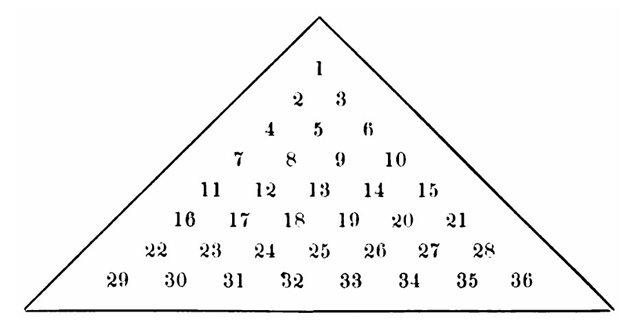
[103] Added together, 666.”
Such is the internal evidence, good, bad, and indifferent, so far as known to me, which has been adduced to substantiate the claim of 666 to be the genuine text of the sacred record. Observe, I hold it in very light estimation myself. In submitting it to my readers, I have aimed chiefly at gratifying their curiosity; and have no higher merit, — indeed, throughout almost the whole of this present work, I lay claim to no other merit, — than that of having acted the part of an industrious and faithful compiler.
Could I persuade myself that internal evidence, of the nature of the above, was requisite, and that without it the statement of the case would be in some measure defective, I also might be induced to propound theories of my own. I might, for instance, suggest that for anything peculiar in an Apocalyptic number, an Apocalyptic reason alone should be sought for and obtained. Now, in the Book of Revelation itself, is not such a reason presented to us? One of its most remarkable pieces of machinery is, the seven seals, seven trumpets, and seven vials or bowls.90 That is, the number seven thrice told. (I may be reminded of seven spirits, and seven candlesticks also. True: but they are not introduced exactly as the other three sevens are.) Now, by the generality of commentators, in the seven seals, [seventh seal,] are the seven trumpets understood to be involved; and in the seven trumpets, [seventh trumpet,] [104] the seven vials. The application of this clearly is — may not the use of three sixes by the inspired writer have had some sort of reference to the three sevens just mentioned? These three sevens imply perfection. It is done. May not the corresponding three sixes, as coming short of seven, imply imperfection? The second set of sevens is said to be involved in the first, and the third set in the second: the trumpets in the seals, and the vials in the trumpets. So are the six decads involved in the hundreds, and the six monads, or units, in the decads. Judging from these, and some other coincidences between the two sets of sixes and sevens which may suggest themselves to the studious reader, am I indulging fancy very outrageously, when I think that there may have been some allusion in the one to the other; and that the three sevens tend to establish the three sixes? However, to an argument like this I beg to be understood as attaching not the slightest importance.
90 So translated, I perceive, by my dear and venerated friend, Richard Roe, in his “Analytical Arrangement of the Apocalypse, or Revelation recorded by St. John.” Dublin, 1834.
The grand, I should rather say, the sole and conclusive argument of an internal kind, which to me establishes the genuineness of the received reading, is the fact, that in the number 666 alone is the solution of the mystery found. No other number can be brought out of the letters of the words which compose the names of the Apocalyptic Beasts. Six hundred and sixteen, certainly, is what neither of them can be reduced to. There is in one of them no N, or the letter which corresponds to 50; and to the other, the retention of the N is indispensable. Subtraction from their names of either letters or numbers, or substitution of other words for those which I have given, — if the meaning of the Holy Spirit, in the text and context, is to be [105] attended to, — are alternatives alike and altogether out of the question.91
91 It will be seen afterwards, that besides the true and generic solution, there are specific solutions also, legitimately involving the Apocalyptic numbers, which it is not improbable were contemplated in the inditing of the passage by the Holy Ghost.
Nothing but six hundred and sixty-six will meet and satisfy all the requirements of the Apocalyptic problem; and therefore, six hundred and sixty-six must be the genuine, as it is the received reading.
[106, blank page]
[107]
BOOK SECOND.
THE NAMES OF THE BEASTS.
[108, blank page]
[109]
CHAPTER I.
NUMBER OF CONJECTURES.
SCARCELY ever has human ingenuity set itself so actively to work, as in endeavouring to find out the name of that prophetical monster, the character and procedure of which are depicted in colours so vivid and repulsive, and with the Number of which we are supplied, by the Holy Spirit, in this thirteenth chapter of the Apocalypse.
The high attribute of wisdom ascribed to him by whom the discovery should be achieved, has no doubt stimulated many to the attempt. But perhaps the busy and prying nature of the human mind itself, combined with the idea so prevalent among mankind, that what others have failed in is still open to the enterprise of some more fortunate individual, may of itself, and independently of direct divine encouragement altogether, serve to account for the number and variety of the essays of the inventive faculty, in this particular department of knowledge. (Query, ignorance?)
So numerous have the conjectures as to the name of [110] the Beast been, that, with their explanations, they suffice to fill a goodly-sized volume.
Nor have we yet done with them. Whatever may be our estimate of the quality of the guesses with regard to this subject which still issue from the press, our own age, in point of quantity at least, does not appear to be behind-hand with its predecessors.
Some learned, and, in the estimation of many, sensible men, have discouraged enquiry into this point.92 They, however, have always been in a very small minority.93
92 See Poole’s Synopsis Critic. in loc. Col., 1887, misprinted 1897.
93 The confessions — testy-monies (?), if the reader will pardon the wretched pun — of a few of them may be quoted.
Ego sanè quis sithic numerus, planè me ignorare fateor. — Gagnæus, cited by Poole.
Archbishop Laud says; “Numeralis illa theologia non mihi placet, non sapit spiritum apostolicum:” being a free translation of the speech of the fox in a well-known fable, “Hang ’em — the grapes are sour — they are not worth eating.”
The learned Dr. Hammond, after several remarks on the subject which betray the confusion of his mind, and his inability to satisfy himself, adds, somewhat pettishly, that he “considers it unreasonable to take any pains in finding out the precise name whereof this of 666 is the numeral expression.” — Paraphrase and Commentaries on the New Testament, 1689, p. 917.
Cardinal Bellarmine says, in his Disput. de controv. Chr. fid. adv. h. tem. her. Lut. Par. 1620, T. i. P. iii. L. iii. c. 10, de nomine Anti-Christi, col. 730, “Verissima igitur sententia est eorum, qui ignorantiam suam confitentur, ac dicunt adhuc ignorari nomen Anti-Christi.”
When I consult the Theologia Christiana of Philip Limborch, I meet with a similar confession. “Quod si quis ulteriùs quærat de tempore, charactere, et numero bestiæ, ingenue fatebor, ignorantiam meam — nihil certi definire præsumimus — multo minus de numero bestiæ, 666, qui dicitur esse numerus hominis: cum incertum admodum sit, ex numero literarum alicujus nominis in unam summam collecto, certum quendam hominem, cui nomen illud applicari potest, definire velle. Cum videamus, unumquemque pro studio partium, nomen effingere, in quo numerum hunc inveniat, et eo adversarios suos premere, aut saltem ipsorum argumentum, ex numero nominis depromptum, retorquere.” Book 7th, chapter 11th, p. 836. Amsterdam, 1686.
Calmet, in his “Dictionary,” after giving various solutions, thus expresses himself: “Almost all commentators have tried their skill, without being able to say positively that any one has succeeded, in ascertaining the true mark or number of his name.” Not very dissimilar is the language of Mr. Burgh, as quoted by Elliott: “The number 666 has by some been applied to Pagan, and by some to Papal Rome. By the Protestant to the Pope, by the Papist to Luther, and by others to Mahomet; and with just as good warrant in all cases.”
Rev. 13:18: Τον αριθμον του ονοματος. “This is to be explained from the Cabbala of the Jews, and that part of it called Gematria. It means the number which is made up by applying the numeral power to each of the letters of which the name is composed, and bringing out a sum total. That art, now held in merited contempt, was in the time of the Apostle held in great honour, not only among the Jews, but also the Greeks, as we may collect from Artemid. Oneir. i. 12.” Heinrich’s Excursus iv. on the above text, quoted by Rabett.
Speaking of Irenæus’ giving, among other interpretations of the number of the Beast, the word Λατεινος, Dr. Lee remarks, “Various other attempts have been made to ascertain these numbers, and to fix the person here meant, which I pass over, because I doubt whether any reliance whatever can be placed on such a method of deduction; and when I believe that the passage can be made out without it, my opinion is, that we need not trouble ourselves about it.” This is introductory to the learned and able doctor’s ingenious attempt, à l’ Allemande, already noticed, to get rid of the number altogether.
[Τον αριθμον.] “Irenæus mentions the word Λατεινος, the letters of which make up the number 666; but the same number has been extracted from so many other words, that it is useless to attempt the solution.” — Burton’s Notes on the Greek Testament, Rev. 13:18.
Dean Woodhouse shall finish my list. In his “Annotations on the Apocalypse,” published 1828, treating of the “Number of the Beast,” he writes as follows: “The Number of the Beast. The consideration of this article has been kept back, and assigned to this its present place, because I felt it out of my power to pursue it with the same hope of success as those which have gone before. For I must still confess, as I did in my former work, my inability to solve this enigma.” After speaking of the speculations of Irenæus and Bishop Newton, he adds: “But this mode of calculation has fallen into discredit, by the fact, resulting from experience, that there is no end to the multitude of names which may be composed by such fabrications; and that not only the antichristian chiefs, but the most eminent of our reformers may be, and have been thus designated by their adversaries.” Archdeacon Wrangham had observed, that “scarcely has a single controversy started up, in which this accommodating number (666) may not be ranged on either side.” “And we may add,” says Woodhouse, “that none of them afford that satisfactory conviction, which attends the perfect discovery of a hidden mystery. There is wanting that flash of illumination, that lively sense of having passed from darkness to light, which so delightfully affects us, upon the solution of a well-formed enigma.”
[111] Considering the vast number of solutions of the Beast’s name which have been proposed, it never entered into my head to imagine that it was possible for me to exhaust [112] them. I certainly have not read all, or nearly all, that has been written on the subject. Notwithstanding, I have spared no pains, in so far as my circumstances would [113] permit, to make myself acquainted with it. What follows will probably be found to constitute the fullest list of conjectures respecting the Beast’s name that has yet appeared. Should any view of the subject deserving attention have escaped my researches, it will be to me matter of sincere regret.
[114]
CHAPTER II.
SEVERAL WORKS WHICH TREAT OF THE SUBJECT, REFERRED TO.
THOSE whose attention is turned for the first time towards this subject, and who possess neither leisure nor inclination to consult works in which it is treated of at length,94 are apt generally to look for information to some of our standard and popular commentators. To such, for instance, as the following: —
94 Who are ignorant, perhaps, that such works exist.
Doddridge, in his Family Expositor. He has a note on Rev. 13:18, curiously indicative of his own utter uncertainty about the whole matter.
A note, by Thomas Scott, A.M., Rector of Aston-Sandford, contained in his useful and laborious work on the Bible, may to some suffice. By the majority of readers, however, it will, I suspect, be found to be very unsatisfactory.
The observations of the learned and celebrated Dr. [115] Adam Clarke, on Rev. 13:18, are far more detailed and critical than those of either of the two just named; but they are limited to the consideration of a very few solutions.
Daubuz’s “Perpetual Commentary on the Revelation of St. John,” new-modelled and abridged by Lancaster, may suggest somewhat more food for reflection to the inquiring mind. His preference of the Hebrew רומיית, to the Greek Λατεινος, may strike. And yet, is not the mind conscious of wanting still more?
Taking up polemical treatises on the Book of Revelation, one encounters the same meagreness of statement. I care not whether Jurieu, Bossuet, Fleming, Bishop Newton, Markwick, Burton, Faber, Bicheno, Snodgrass, Johnstone, or any other, be instanced. It is all the same. They excite, rather than satisfy curiosity.
I remember opening Ashe’s “Book of the Revelation, with compendious notes,” with highly raised expectations, in consequence of the quarter from which it had come recommended to me. But I was doomed to disappointment.95 Only four solutions are there given.
95 The Book of Revelation, with compendious notes, by the Rev. Isaac Ashe, A.B. Dublin, Wm. Curry and Company; London, Simpkin and Marshall, 1835.
When from works of the kind alluded to — such, I mean, as are popular and easily accessible — we turn to productions of a higher class, or, at all events, with higher pretensions, we find that we succeed no better.
Irenæus, (who gives us three guesses,) Hippolytus, &c., among the ancients, have their use; but not in supplying us with the information which we want. And equal will [116] be our disappointment, if, expecting satisfaction there, we have recourse to the pages of Erasmus, Bellarmine, Durham, Grotius, Hammond, Le Clerc, Limborch, Turretine, and Pictat, among the moderns. They set before us a few conjectures, and, perhaps, set us a thinking: but that is all.
Where, then, shall we look for and expect to find satisfaction?
The Synopsis Criticorum, of Poole, on Rev. 13:18 — as usual, an indigesta moles — will scarcely be found to reward the labour expended in perusing it.
Calmet’s Dictionary of the Holy Bible has, I believe, been recommended for consultation to those who are desirous to prosecute their researches into this matter. And, certainly, under the head Anti-Christ, he does furnish us with a larger number of solutions than are ordinarily to be met with.96
96 A very good edition of the English translation of this work was published at London, 1823.
A work entitled, “Critical Remarks on detached passages of the New Testament,” by the late French Laurence, LL.D., M.P., Oxford, 1810; and the “Commentary on the Revelation,” of David Paræus, — neither of which I have been able to procure, — contain, it seems, much to interest and gratify the enquirer.
No small degree of information on the subject I have got, from a perusal of the learned and able “Commentary on the Apocalypse” of Professor Moses Stuart, of the Theological Seminary at Andover, Massachusetts, United States.97 I have been assisted, also, in the preparation of [117] this treatise, by the very laborious, and still more recent production of the Rev. E. B. Elliott, entitled, “Horæ Apocalypticæ.”98 More, perhaps, as regards arrangement, than from any great addition made by it to my previous stock of solutions. To the works mentioned, I may add Mr. Rabett’s “ΛΑΤΕΙΝΟΣ, LATEINUS.”99 Not but that its sadly diffuse style, and superficial mode of treating the subject, have annoyed me; and not that its range of information is very extensive, — for the conjectures started are far from being numerous, and a great part of the book is confined to an attempt at refuting the theories of Faber, J. E. Clarke,100 and Lee. Still, the “ΛΑΤΕΙΝΟΣ” is not without value. Independently of its facts altogether, the simple, easy elegance of its style, and the almost transparent luminousness of its statements, have quite charmed me. To those who cannot be con-[118]tented with Stuart or Elliott, and who find themselves unable to procure any of the larger and more elaborate works which have been written on the subject, Mr. Rabett’s book may be safely recommended, as abounding with information lying scattered throughout the pages of other writers, and as containing a rather successful confutation of one ingenious, and ably-supported, although fanciful conjecture.101
97 A Commentary on the Apocalypse, by Moses Stuart, Professor of Sacred Literature in the Theological Seminary at Andover, Mass. 2 vols. large 8vo. London, Wiley and Putnam, 1845. See his EXCURSUS IV. Also the immediately preceding one.
98 “Horæ Apocalypticæ; or a Commentary on the Apocalypse, Critical and Historical.” By the Rev. E. B. Elliott, A.M., late Vicar of Tuxford, and Fellow of Trinity College, Cambridge. 3d Ed., 4 vols. 8vo. London, Seeley, Burnside, and Seeley, 1847.
99 “ΛΑΤΕΙΝΟΣ, LATEINOS; or the only proper and appellative name of the man whose prophetical number in Greek numerals is χξς, or 666; Rev. 13:18; demonstrated to be the ecclesiastical mark or name of the Beast, who had two horns as a lamb, and he spake as a dragon.” By the Rev. Reginald Rabett, A.M., of Queen’s College, Cambridge, and Vicar of Thornton, Leicestershire. 8vo. London, R. B. Seely and Burnside, 1835.
100 Did Rabett, who professes to quote from, ever look into Dr. Adam Clarke’s “Commentary”? Surely not. Had he done so, he must have seen at a glance, that to the solution, ἡ λατίνη βασιλεία, the name of John Edward Clarke, and not that of his uncle, the learned and accomplished luminary of Methodism, is subscribed. Throughout, the language of Mr. Rabett’s strictures satisfactorily evinces, that of the name of the discoverer of the solution he had never even heard. His reference to A. Clarke must have been taken up at second hand.
101 For the opportunity of perusing Mr. Rabett’s work, as well as for much assistance otherwise in the composition of this work, I hereby confess myself indebted to Thomas Jones, Esq., A.B., the learned, amiable, and accomplished Librarian of the Cheetham College, Manchester. The works of Stuart and Elliott I procured through the kindness of a much attached and highly valued medical friend, Dr. Macintyre.
All preceding as well as subsequent works, however, must, in respect of the minuteness, and fulness, and accuracy of the information respecting the subject in question which they afford, yield to a book published at London, in 1814, by Ogle, Duncan, and Cochran, Hatchard, and Blanshard, entitled, “Dissertation on the Dragon, Beast, and False Prophet of the Apocalypse, in which the number 666 is satisfactorily explained,” &c., by J. E. Clarke.
So extensive have been Mr. Clarke’s researches, and so successful has he been in these, that but little has been left to be gleaned in this particular field of knowledge, by [119] those who come after him. Among the numerous volumes on the Book of the Revelation which I possess, or which at different times I have consulted, I find but few which he does not appear to have seen, and the statements of the authors of which respecting the name of the Beast he has overlooked. There are some solutions which may have escaped his notice, or which he may have deemed of too little importance to be adverted to.102 And a stray guess or two may have been started since his time.103 But so full and satisfactory, on the whole, is his enumeration of particulars, that I shall unhesitatingly make use of his work as a kind of text-book in what follows: only taking the precaution, in so far as I have had it in my power, to verify, by actual examination, his quotations; as well as, where it appears necessary, altering his arrangement, and, to the best of my knowledge and ability, completing the list with which he has furnished us.
102 Such, for instance, as that of Mr. Burton, respecting Αντιχριστος, and that of John Glas, about the meaning of the initials χξς΄.
103 As ευπορια, wealth. One or two, derived from Stuart and Elliott, will be mentioned in their proper places.
A few solutions of the Beast’s name, which have been suggested and published, will, after all, be omitted. Let me hope, however, that none really deserving notice will be found to be so. It has not been my purpose to pass by a single conjecture.
Were it not that so to do would be to swell to too large dimensions this present volume, such is the importance which I attach to Mr. Clarke’s second chapter, pp. 6-36, and so valuable do I consider the condensed information respecting the different modes of numeration [120] and calculation employed by the Greeks and Romans which it contains to be, that I would (but for the consideration stated,) copy entire the whole of the chapter. My readers will do well to refer to, and make themselves acquainted with it, in the work itself.104
104 At the place mentioned. Should Mr. Clarke’s work not be at hand, or should the reader be disinclined to the task of going through the passage indicated on account of its length, he may perhaps be satisfied by a perusal of the earlier portion of Dr. Adam Clarke’s note, in his Commentary, or of Elliott’s Horæ Apocalypticæ, vol. iii., pp. 202-207. Scholars will of course not be satisfied with any popular works on the subject. The portion of Glassius already referred to, Wolfius’ Curæ Philologicæ et Criticæ, and productions of still profounder character, there and elsewhere referred to, will of course be consulted by them. May I mention the Musurgia Universalis, and the Œdipus Ægyptiacus, of the learned Athanasius Kircher? The subject of Gematria, and ισοψηφία, numeral equality, is a very curious one.
Mr. Clarke’s book I did not see, until several years after my own discovery of the name in question.
It may be proper to state farther, in order to guard against all misconstruction of my meaning, that while I admire, on many accounts, the work just alluded to, especially the system of exhaustion in regard to the words βασιλεία and πολιτεία,105 which its author has so strikingly and beautifully prosecuted; and while I confess myself largely his debtor, for the mass of information respecting the subject-matter of this present volume, which he has afforded me; I am nevertheless obliged to dissent from him almost in toto, in his interpretations of the Apocalypse, the import and bearings of which, in so far as he [121] has gone, he seems to me, in common with other commentators, to have entirely mistaken.106
105 See pp. 97-117 of Mr. Clarke’s work.
106 Since writing the above, I have been put in possession of Archdeacon Wrangham’s “Six hundred threescore and six,” a treatise contained in the second volume of his works. London, 1816. Numerous additions to my previous collection of conjectures on the subject of this volume have been the result. Recent letters of Mr. Clarke, kindly communicating farther discoveries, have also materially assisted me.
[122]
CHAPTER III.
THE HEADS UNDER WHICH I ARRANGE THE VARIOUS SOLUTIONS.
HOW to bring under notice the various solutions of the Name of the Beast with which I am acquainted, in a manner the most simple, and at the same time the best calculated to be useful, has cost me some little reflection.
Mr. Clarke’s method, I at one time thought of adopting. Indebted to him for several conjectures of which I might never otherwise have heard, and for having presented to me a beautiful coup d’œil of the whole, I almost, as it were, felt constrained to testify my sense of obligation, by as nearly as possible making his arrangement my own. But finding myself pressed with difficulties, with which I need not trouble the reader, it became necessary for me, without entirely losing sight of his method, to invent one for myself.
Assistance in doing so, as a matter of course, I sought for.
From Poole’s Synopsis, I derived none. A mere [123] cumulus or heaped-up collection it is, as every one knows, of the opinions of others.
Bengelius’ Gnomon,107 which, in relation to the subject of this work, I had perused with avidity, suggested nothing as to arrangement.
107 J. A. Bengel’s Gnomon Novi Testamenti. Tubingen, 1742, pp. 1170-1172.
The same, excepting perhaps Elliott, maybe said respecting many other celebrated writers on the Apocalypse, some of whose works have already been spoken of.
At last, in Wolfius’ Curæ Philologicæ et Criticæ,108 I met with an arrangement of the subject equally learned and valuable.
108 The edition consulted by me was the second, published at Hamburgh, in 1741.
Wolfius divides the interpretations which have been given of the number and name of the Beast into three classes: —
1. Explanations upon Cabalistic principles. — Two are set down.
1st. By Gematria.109
2d. By Notarikon.110
109 Per Gematriam, vox aliqua cum alterâ comparatur, atque illam denotare censetur, quæ per literas eundem, quem prior illa habet, sensum producit.” — Wolfius.
110 “Notarikon. Per illud, verò, singulæ literæ singulas voces, earumque sensum, exprimere existimantur.” — Idem.
The difference between Gematria and Notarikon, may, to the ordinary reader, be thus expressed: — Gematria respects all the letters in a word; Notarikon, only the initial, or single letters.
Le Clerc conceives that the Jewish Rabbies derived their Gematria from the Greeks — “Certè,” says he, “Gematria mera est corruptio vocis Græci Geomatria.” — Unquestionably Gematria is neither more nor less than a corruption of the Greek word Geometria. — Le Clerc’s Adn. in vulg., vol. ii., p. 687.
[124] 2. Explanations upon Arithmetical principles. — With three of these we are presented.
1st. By simple division.
2d. By extracting the square root.
3d. By dividing the number of the Beast, and the number opposed to it, the one by the other, or by its root.111
111 “A second class adopt a different system. Henr. Horschius contends, that the number in question must be resolved arithmetically into its principles, either,
“By dividing it, solitariè spectutum — his own theory; or,
“By extracting its square root, which is Potter’s plan; or,
“By dividing it and its opposite, 144,000, (the number of the company of the Lamb, Rev. 14:1,) unus per alterum, vel illius radicem. This last process was adopted by Cocceius, Herm. Deusingius, and J. C. Laersius.” Archdeacon Wrangham’s works, vol. ii., pp. 415, 416.
3. Explanations on the principle of the number 666 having reference to the period of the origin and existence of Anti-Christ, or chronological explanations.
Many examples of this are given. To the work of Wolfius itself, I would refer all who wish to obtain further information on this subject. They will, by a careful perusal of his statements, and by attending to his references, become acquainted with the names of various Continental Divines who, previous to his time, had published respecting the Beast’s name and number; as well as learn the titles, and occasionally even the contents of their writings.
[125] The above arrangement, however, although in some respects most admirable, and suggestive of many valuable ideas, did not exactly suit me. Something more popular appeared to me to be necessary.
For some time, my endeavours to devise a plan which should be at once simple and satisfactory, were far from being crowned with success. Indeed, I almost despaired of accomplishing my object.
What follows, at last suggested itself to my mind, and was adopted by me.
I arrange and treat of the various solutions of the Name of the Beast under the four following heads.
1. — Solutions which are obviously and glaringly without any foundation of truth whatever.
2. — Solutions which, although mistaken, are distinguished by something novel and ingenious.
3. — Solutions which, if not the truth, at all events may have some connexion with it. And,
4. — The true solutions.
Without saying, or even thinking, that this arrangement is superior to that of Wolfius, — nay, admitting that his is preferable, on the score both of comprehensiveness and logical accuracy, — I fancy that mine will be equally well understood; and that it is perhaps more popular, as conducting by a series of obviously connected steps to the desired result.112
112 The learned Wrangham, in the treatise already alluded to, and from which I purpose making numerous quotations, upon the whole adopts and proceeds on the arrangement of Wolfius.
[126]
LIST OR CATALOGUE OF SOLUTIONS
OF
THE BEAST’S NAME
WHICH HAVE COME UNDER MY NOTICE:
WITH OBSERVATIONS AND EXPLANATIONS.
DIVISION I.
SOLUTIONS OF THE NAME OF THE BEAST WHICH ARE OBVIOUSLY AND GLARINGLY DESTITUTE OF ANY FOUNDATION WHATEVER.
WITH the assistance of Mr. Clarke’s work, — not, of course, excluding the hints derived from Bengelius, Wolfius, Calmet, Rabett, M. Stuart, Elliott, and others, — we arrange these in four classes.
[127]
SUBDIVISION FIRST.
SUCH AS ARE CONNECTED WITH THE ROMAN METHOD OF NUMERATION.
To all conjectures which pretend to solve the difficulty in question by words in Latin, two grand preliminary objections present themselves. The first is thus stated by Mr. Clarke: “All such” [interpretations given in the Latin language] “can be of but very little authority, as no evidence can be produced that the Romans numbered in this way so early as the days of the apostles.” And the second, that as the enigma is proposed in the Greek language, so is it a fair primâ facie conclusion, that its solution is to be sought for in the same. Upon this, Mr. Elliott and Mr. Rabett both very ably and cogently insist.113 The great majority of those whose opinions in a matter of this kind are worth a moment’s consideration had done so before them.
113 Let the reader consult the Horæ Apocalypticæ of the former, vol. iii. p., 208, 3d ed., where he will find the argument for a Greek solution of the enigma briefly, but powerfully and conclusively stated.
Monarchs’ names have been discovered to contain the number in question; and to them, therefore, the character of the Beast has been applied.
ROMAN EMPERORS.
M. de la Chatardie, as we learn from Calmet,114 finds [128] the number in D. F. JULIANUS CAESAR ATHEVS; upon which Calmet has improved, by writing it D. F. JULIANUS CAESAR AUG. That is, the name of Julian, the Apostate, one of the well-known descendants and successors of Constantine the Great, is supposed to involve the mystery. Here, it will be observed, a selection of letters requires to be made, as only some of them count, according to the Roman method of computation: —
114 Also from Clarke. Not having seen M. de la Chatardie’s work, I am obliged to be contented with the references to it which I find in both these writers.

The same result follows if AUG. (for Augustus,) be written instead of ATHEUS, as, in both cases, the U only counts.115
115 The absurdity of this solution is, that you must contract the word, in order to bring it out. AUGUSTUS, written at full length, will not answer.
After having finished the perusal of a once celebrated work, Peter Jurieu’s “Accomplishment of the Scripture Prophecies,” and having been struck by the baseless and merely fanciful nature of almost all his explanations and applications of the Apocryphal language and imagery, there was put into my hand, by Mr. Wm. Roscoe Jones, [129] of the Athenæum Library, Liverpool, the once equally celebrated work of his redoubtable antagonist, Bossuet, Bishop of Meaux.116 The Bishop certainly makes mincemeat of poor Jurieu and his theories. When, however, from the work of destruction, Bossuet proceeds to construct and establish a scheme of interpretation of his own, and when, after having read it, one has had time to recover from the astonishment which it has occasioned, two questions irresistibly force themselves upon the mind: first, Is not his own theory as baseless, fanciful, and absurd as that which he has overthrown? and, secondly, could a man of his singular acumen, and prodigious range and variety of learning, by any possibility believe what he says? Has not the whole the appearance of having been got up merely to serve a turn? Is it not — was it not intended to be — a piece of ingenious persiflage? The Book of Revelation, according to him, respects the period of time which elapsed between the writing of it, and the accession of Constantine to the throne. And every passage is forced, and squeezed, and strained to bear this meaning. That the Apocalypse was confined in its allusions to less than three hundred years after the ascension of our blessed Lord, is the Procrustes’ bed, upon which the learned Jesuit racks and tortures the language of the Holy Ghost. Throughout the whole of his clever and ingenious, but most disingenuous production, nothing bears more the impress of a fetch, or of having been got up with a view “to help a lame dog over a style,” than the name which he assigns to the Beast. It is that of the Emperor Diocletian. This monarch is [130] represented in history as having been the author of the tenth and last persecution to which, before the Christianization (?) of the Roman Empire, the followers of the crucified Nazarene were subjected. In Diocletian, therefore, Bossuet professes to have discovered the Apocalyptic monster. To bring the number 666 out of his name, was, to be sure, a matter of some difficulty. And yet, it behoved to be surmounted. This the Bishop has accomplished after the following fashion: — Diocles, according to him, was Diocletian’s private name, while Augustus, of course, designated the imperial dignity. Ergo: read as Diocles Augustus, we have the grand desideratum!
116 L’ Apocalypse, avec une Explication.
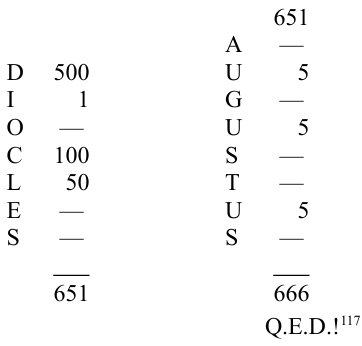
117 This is one of the solutions quoted by Calmet, under the head “Anti-Christ.”
Well may Mr. Clarke observe, “It is evident, if this persecutor of the Christian church were intended, that the whole of his imperial name would have been computed; [131] thus Diocletianus Augustus, and not Diocles Augustus.”118 That is, that the term indicative of imperial office would have been conjoined with the imperial, not the private name. The fact is, no man in his sober senses can believe Bossuet to have been in earnest. The coolness, the nonchalance, the easy impudence with which he broaches and dismisses his conjecture on the subject, are so remarkable and amusing, that for the gratification of my readers, I have given his ipsissima verba in a note.119
118 Clarke, ut supra, p. 61. Archdeacon Wrangham’s suggestion of the Greek name of this Emperor will be noticed afterwards.
119 Et son nombre est six cens soixante-six. Le nom de Dioclésien avant qu’ il fut Empereur estoit Diocles. Il s’ appelloit Diocles devant son Empire. Lact. de mort. 9. Et ensuite, il quitta la pourpre, et redivint Diocles. Ibid. 19. Pour en faire un Empereur, qui est icy ce que Saint Jean a designé par la Beste, il ne faut qu’ ajoûter a son nom particulier Diocles, sa qualité Augustus, que les Empereurs avoient en effet accoutumé de joindre à leur nom: aussitôt on verra paroistre d’ un coup d’œil dans les lettres numérales des Latins ainsi qu’ il est convenable, s’ agissant d’ un Empereur Romain, le nombre 666. DIOCLES AVGVSTVS: DCLXVI. Voilà ce grand persecuteur que Saint Jean a representé en tant de manières; voilà celui que Julien a fait revivre; c’ est pourquoy on marque son nom plutost que celuy de Julien. Bossuet, pp. 163, 164.
MODERN KING.
A very favourite interpretation of the name in question, towards the end of the seventeenth, and the beginning of the eighteenth centuries,120 was Ludovicus, the Latin of [132] Lewis, or Louis, the name, as is well known, of many French monarchs.
120 Nay, even down almost to our own days: as witness the strenuous support which it has met with from David Simpson, Bicheno, and others.
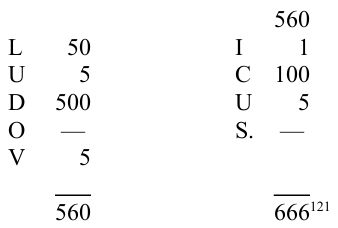
121 Having pronounced the more modern solutions of the Beast’s name to be fables or nonsense, (recentiora autem commenta vel nugamenta,) and observed, “itaque,” that is, because Wolfius has already either enumerated or referred to them, “supersedere licet nobis,” Bengelius, in his Gnomon, pp. 1171, 1172, thus goes on: “Adjici tamen possit, quod Christophorus Seebachius in Clavi Germ. Ap. p. 309, ἐπαῤῥησιασατο˙ sed minus certè coactum est nomen LVDOVICVS quod tractatus Belgice et Germanice editus, cum titulo, Fides et patientia sanctorum, cap. xxiii., huc accommodavit, quanquam ne gravis quidem illa Reformatorum in regno Galliarum persecutio tantam numeri vim est assecuta, planeque aut nusquam, aut in Papali serie, nomen hoc numero præditum, deprehendi debet.” That is, the number of the Beast must be found in the name of a Pope, and nowhere else, if the solution is to be sought for in this way; which Bengel expressly denies that it is.
Still, as will be observed, just as in (with but two exceptions) every instance of Latin numeration which has been had recourse to, some of the letters not entering into the calculation. — The Louis particularly alluded to, by those who have embraced this mode of interpretation, is Louis XIV., whose revocation of the Edict of Nantes, in 1685, followed up by his dragonnades, banishments, and other species of persecutions of the poor industrious [133] Huguenots, rendered him particularly and deservedly obnoxious to his Protestant contemporaries, as it has covered his name since with infamy.122 I am somewhat surprised to observe, that, considering his personal sufferings and sympathies, Jurieu has preferred Λατεινος, and רומיית, to the name of his Gallic persecutor.123
122 Kleschius is quoted by Wolfius as having maintained this conjecture; and as having endeavoured to confirm it by a reference to the three lilies, (Archdeacon Wrangham observes, “Hexandrian,”) which constituted the arms of the ancient French monarchs: lilies in Hebrew being שוש and שש (pronounced shish) signifying 6: three lilies, therefore, being three sixes. Revelationes Theologicæ Novantiquæ. An. Dom. 1705, p. 519.
123 See part I., chap. xv., of his “Accomplishment of the Scripture Prophecies.” London, 1687, p. 149.
May I hazard a conjecture, that the calculation of Ludovicus as the name of the Beast, was first suggested by a passage which I find in Foxe’s “Acts and Monuments,” vol. iv. p. 106, ed. Cattley, London, 1837? “Some feign other names, as αντεμος, or τειταν; made words, which signify nothing, DICLUX, or LUDUUIC, by Roman letters,” &c. This hint was thrown out in Queen Elizabeth’s reign, a century before the party to whom it was applied came to occupy the French throne.124
124 “Another writer,” it seems, brings down the reference to Louis the Fourteenth’s successor. ‘The Beast,’ says he, ‘is the Constitution; the War is the present persecution of the Reformed, which began March, 1730, and will end September, 1733. This is included in the name Ludovicus, the numeral letters of which amount to 666: the rest of the King’s title, DeCIMVs qVIntVs FranCIæ, (or GaLLIæ,) et NaVarræ reX, makes exactly 1733! &c.’ (500 + 100 + 1 + 1000 + 5 + 5 + 1, + 5 + 100 + 1, (or 50 + 50 + 1,) + 5 + 10 = 1733.) Calend. Myst. fondée sur l’ Apocalypse et sur Esaie. Here, by substituting for QVIntVs, SeXtVs, and subjoining gVIL. as the abridged name of the murtherous implement by which (to descend lower still) the Sixteenth Louis was sacrificed, we get not only the date, 1793, but also the very mode of his execution. (1733 + 10 + 5 − (5 + 1 + 5) 11 + 5 + 1 + 50 = 1793.)” Wrangham’s works, vol. ii. pp. 411, 412.
POPES AND PAPAL TITLES.
The number is found in the names of Popes: such as Silvester Secundus, and Linus Secundus.
[134]
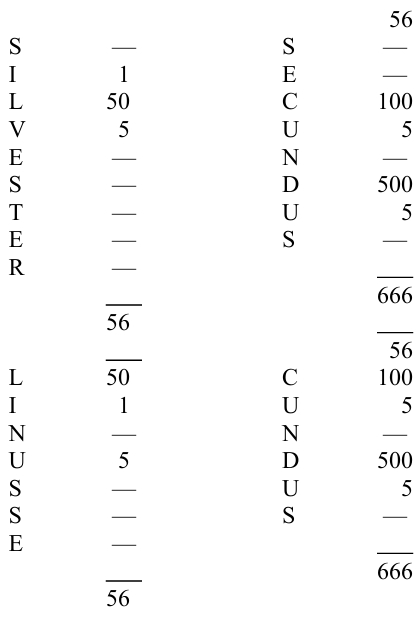
[135] Shewing, that whenever you can find a Pope, the letters of whose name or characteristic appellation amount in Latin numeration to 56, by adding the word secundus, you can always ensure the number required.*
* [Note from the ERRATA.] Perhaps the following account, given by Bengelius, of what he conceives may have been the cause of seeking for the number 666, in the names of individuals, should have been set down by me, in the form of a note, at the end of the first paragraph of p. 135. It is rather curious, and may, to some of my readers, prove interesting. To save room, I omit the Latin. Those, however, who are desirous to consult it, will find it at p. 1170 of the “Gnomon Novi Testamenti.”
“Easy and simple are the principles upon which the explanation of the Beast’s name is given. Some, however, there are who imagine, that after a very different fashion is the enigma to be solved. For instance, it is thought that as the name ΙΗΣΟΥΣ, Jesus, when its letters are calculated, amount to 888, (see Estius, when treating of this passage,) so the name of his great adversary must, when computed in the same way, make 666. Nor, as illustrative of the great importance which is to be attached to names, can we pass over, says Edo Neuhusius, a fact to which historians have adverted, that the number of the name assumed by each Pope, on his accession to the chair of St. Peter, has in most cases been an omen or prognostic of the number of years during which his life and dignity were destined to last. For, of a truth, Alexander II., in the second, Clement III., in the third, Victor IV., in the fourth, Pius V., in the fifth, Leo X., in the tenth, Gregory XIII., in the thirteenth, and Sixtus V. in the fifth years of their respective Pontificates,have departed this life. By a similar fate, Benedict II., Sextus II., Anastasius II., Ioannes II., Martinus II., Nicolaus II., each died in the second year of the imperial dignity of the individual who at the time occupied the throne of the Cæsars. Stephen III., Martinus III., Clemens III., Nicolaus III., in the third, Felix IV., Martinus IV., Nicolaus IV., Paul IV., Benedict IV., Clement IV., in the fourth, Boniface V., in the fifth, and Innocent VIII., in the eighth years respectively of the possession of sovereign authority, by the emperors of Germany then reigning,A ceased to be numbered with the living. — Lib. ii. Fatid. Sacror., Cap. 31. Similar coincidences, having a reference not to years only, but even to months, have been noticed by William Burius, in his Notitia Pontificum, Sect. xvi. Influenced by a consideration of facts like these, have parties for a long period of time been attempting to discover the number 666, in the names of many individuals “
A “Summæ Dominationis” are the only words used in the Latin. — Query. — Of whom? Of themselves? or of their Imperial Superiors? The latter, I answer unhesitatingly. The sense of the passage, as well as the phrase employed, shews this. Had the Pontifical dominion been meant, their cases would have fallen under the first head.
Caspar Hennischius claims the glory of having invented the former of the two guesses to which I have just been directing attention.125
125 Bengelius seems to think, that something more than the mere fact of the number of his name amounting to 666, suggested Silvester to Hennischius: “Non abludit, qui Casparo Hennischio in mentem venit, SILVESTER SECUNDUS. Etenim Silvester, quum annus 1000 a nativitate Christi; Benedictus quum annus 1000 a passione Christi, numeraretur, sedebant: et ad utrumvis annum millesimum, quasi elapsi forent anni milleni capite xx. scripti, regnum bestiæ expectarunt veteres.” In proof of which, he refers to Andreas. The fact of Silvester having been Pope in the thousandth year of the Christian æra, a period when the commencement of the Beast’s reign was looked for, is thus the additional reason assigned for the importance attached by Hennischius to his name.
With regard to the latter, Bengelius, in his Gnomon Novi Testamenti, Tubin., 1742, pp. 1170, 1171, has the following rather curious remarks: “From Irenæus, we have already quoted some things” — conjectures respecting the name of the Beast — “among which, who has not heard of Λατεινος? As to the cause of this word having first suggested itself, one may surely be allowed to cherish and give utterance to a suspicion. The following, then, is what has occurred to me on the subject. In the eighth of the Sibylline Books, a work held by the ancients in the highest repute, it is said, with reference to the closing period of the Papacy, Linus will be the cause [136] of its destruction. In many cases, among those invested with sovereign authority, the first and the last of a dynasty have been found distinguished by the same name;” (a similar remark had been made by Fleming, in his “Discourse concerning the Rise and Fall of Papacy,” under the head of the fourth vial, pp. 58, 59, Terry’s London Edition; witness our own James I. and James II.;) “and so as the first Bishop of Rome was not Peter, but Linus, the last, although by an ancient blunder called Peter the Second, appears, by a tradition still more ancient, (with the truth or falsehood of which we have no concern,) to have had fastened on him the appellation of Linus the Second. Now LINVS SECUNDUS, calculated according to the Latin or Roman fashion, perhaps, does amount to 666.” (50 + 1 + 5 + 100 + 5 + 500 + 5 =666.) “Characters or marks of this description, however, are far more likely to attract notice at an early period, when men are superstitious, and prone to regard the most common events as ominous, than in a later and more enlightened age of the world. Whatever may be in this, Λινος, when the Greek letters of which it consists are computed, has no greater value than 360. To make up 666, the addition of 306 is required. TEA, i.e., 300 + 5 + 1, furnish this. But TEA, properly and artistically wrought into the word Λινος, convert it into Λατεινος. In this way, then, we can account for the origin of Irenæus’ solution. Or, it may have reached the ears of certain parties, that the name of the Beast was to be a Latin one, — the report probably having had its origin in the fact of the persecution of Christians by the Latin, or Roman Emperors — and that it was to be found in the [137] Latin, not in the Hebrew or Greek languages. [Although Greek was thus excluded, yet, by a very natural process of the human mind, the proper name Λατεινος, Latinus, may have been suggested as the word proposed in the mysterious enigma.]* Let the origin of Λατεινος, however, be what it may, it should not be spelled with the ɛ,” &c. Such I propose as a translation, or rather as a sort of paraphrase of the singular, cramped, and inelegant — certainly not classic — original; which, for the sake of the learned reader, I have given in the form of a note.126
* The bracketed sentence in the text is from the Errata, which replaced the following original text: Although Greek was thus excluded, yet, by a very natural process of the human mind, Λατεινος, a Latin one itself, may have been suggested as the word proposed in the mysterious enigma.
126 Ex Irenæo supra retulimus aliqua, quorum Λατεινος cui non dictum est? Quod quomodo jam tum cuipiam occurrere potuerit, suspicari liceat. In Sibyllinis, quæ antiqui multum respexere, Lib. viii., de extremo papatûs tempore dicitur, λινος αυτον ολειται. In multis autem principatibus, primus et ultimus codem nomine insigniti reperiuntur: primusque Romæ Episcopus, non Petrus, sed Linus; postremum, ergo, quanquam vetustus error Petrum secundum dicit, vetustior opinio Linum secundum, (quam verè, nil refert,) arripuisse videtur. Latinè, LINUS SECUNDUS 666 valeret forsitan; sed tales signaturæ primo tempore, unde nonnulli pro ominibus habent, non extremo, in suis subjectis, notari solent. Utut est, Λινος valet 360. Deficiunt ergo 306, i.e., TEA. Literis ΤΕΑ, Λινος conjunctis, fiebat illud ΛΑΤΕΙΝΟΣ. Vel audierant, Latinum fore nomen Bestiæ, in Latinâ, non in Hebræâ, Græcâve linguâ exstiturum: et id, materiali suppositione, de ipso nomine Λατεινος interpretati sunt. Sive hoc, sive illud, erat, Λατεινος cum ε sumi non debuit, &c.
Besides particular Popes, however, we find the number 666 also in titles ascribed to the Pope, and to the Roman Catholic church. — Such are,
1. — VICARIUS FILII DEI, the Vicar, or Substitute, of the Son of God.
[138]

This is one of the conjectures mentioned by Wolfius, and is by him ascribed to a Pseudonymus Quidam, M. Carolus Aglæonius Irenochoræus. It occurs, it seems, in a work of that writer, entitled, “Apodictica tractatio quæstionis, Num certum aliquid Anti-Christi nomen exstet, cui numerus ille Apocalypticus DCLXVI. respondeat?” Whether there exist any certain name of Anti-Christ which agrees with the Apocalyptic number 666? According to Wolfius, Irenochoræus must have been extremely proud of his fancied discovery.127 “Concerning the words, Vicarius filii Dei, he indulges in the language of the most arrogant boasting, using such expressions as — ‘Behold now the words which I present to you! Here the monster stands confessed! He corresponds, in all respects, to what in holy writ it was foreshewn he should be,'”128 &c., &c.
127 Divocibus, Vicarius filii Dei, multum gloriatur, p. 5, his vocibus usus: Ecce autem presens hoc, (V. F. D.) per omnia tale est, quale regniritur, &c., &c. Gryphiswaldiæ, 1600, 4to. See his work, and Wolfius.
128 I observe this solution of the Apocalyptic mystery proposed by the Editor, (not by the Author,) at the end of the edition of Fleming’s “Discourse on the Rise and Fall of Papacy,” p. 138, published by G. Terry, London, 1793, one of two editions of that work now lying before me. Also, it is by this unknown editor, whom I suspect to have been William Huntingdon, of London, (SS., author of the “Bank of Faith,” &c., and no particular authority in matters of criticism,) and not by Fleming himself, that the remark respecting the inscription Vicarius filii Dei having been placed over the door of the Vatican was made; for it is in the additional note to Fleming, occurring in Terry’s edition, and not in Fleming’s work, that the remark is met with. Quoted literally, the words p. 138, are: “In addition to what Mr. Fleming has said relative to the number of the Beast, which is also said to be the number of a Man, the Editor begs leave to remark, as a very singular circumstance, that the title Vicarius filii Dei, which the Popes of Rome have assumed to themselves, and caused to be inscribed over the door of the Vatican, exactly makes the number 666.” In proof of this assertion, he cites no one. — The mistake which I am correcting is, I admit, a trifling one. Still, as I find it asserted in a note, (vol. iii., p. 216, 3d edition) of a work so respectable, and so deservedly popular, as Elliott’s Horæ Apocalypticæ, that Fleming was the author of the remark quoted, which he was not, I have deemed it due to the cause of truth to point out the error. Mr. Elliott, I am sure, will be the first to thank me for having set him right. It is a mere oversight on his part.
[139] “Vicar of the Son of God,” as Mr. Clarke properly remarks, is one of the titles of the Pope in effect, though the form in which it is used is, Vicarius Christi, or ‘Christ’s Vicar,’ or, Vicarius Jesu Christi, ‘Vicar of Jesus Christ.'”
2. — Vitringa, writing on the passage of the Apocalypse with which we are now concerned, mentions, that in the words Doctor et Rex Latinus, The Latin teacher and monarch, a title capable of being applied to the Pope, the mystic number is found.
[140]
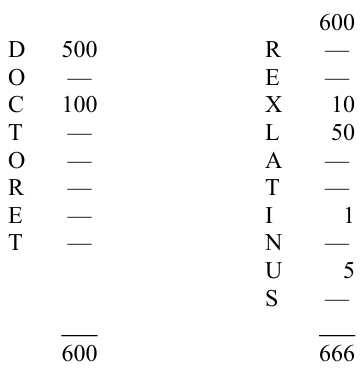
3. — By Clarke’s reference to Wolfius, I have had my attention drawn to an ingenious conjecture respecting this subject, originating with the celebrated and learned William Bedell, Bishop of Kilmore.
The solution itself is: —
PAULO V., VICE-DEO. To Paul V., the Deputy-God.
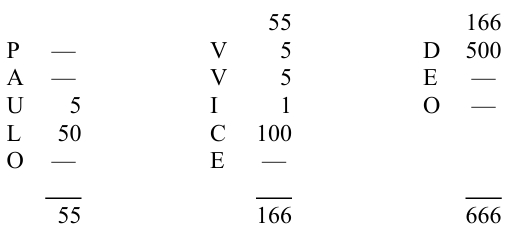
Wolfius refers the curious reader for information respecting this discovery, to the Acta Eruditorum Lipsiensium, [141] A.D. 1686, p. 244, and to Tenzelius’ “Dialogues” published in German, 1694, p. 36. He also refers to P. Bayle’s Dictionary, from which I translate, so far as the present subject is concerned: — “M. Bedell speaks of there having been discovered the number of the Beast, in the inscription of a Thesis, which had been dedicated to Pope Paul V. (See Bedell’s Life, p. 14.) It was found that the numeral letters of these words, PAULO V. VICE-DEO, amounted to 666; but although he was the author of the discovery, as was expressly declared by M. Walton to King James I., he never boasted of his having been so. He merely mentioned it as a thing which had been observed. Nothing could exceed the pleasure which he afforded to FRA PAOLO,” (Sarpi,) “and the other theologians of the Republic of Venice, when he made the matter known to them. — Bedell’s Life, by Burnet, p. 13.”129
129 “M. Bedell fait mention de la decouverte que fut faite du nombre de la Bête, dans l’ inscription d’ une These dediée au Pope Paul V. Vie de Bedell, p. 14. On trouva que les lettres numerales de ces paroles, Paulo V., Vice-Deo, faisaient 666; mais il ne se vante pas d’ être l’ auteur de la decouverte: il l’ etait pourtant. M. Walton en assura le Roi Jacques, La même. Et il fit un plaisir extreme à Fra Paolo, et aux autres Theologiens, de la Republique de Venise, quand il la leur communiqua. Burnet’s Vie de Bedell, p. 13.” — Dictionnaire de P. Bayle, tom. iii., p. 252, 8vo., Paris, Desoer, 1820.
To a note of Mr. Elliott, in the third volume of his Horæ Apolypticæ, third edition, p. 216, we are indebted for still farther information on the subject, derived by him from the above-quoted life of Bedell, written by his brother prelate, Burnet. The theses, which were the production of a Jesuit, were printed, it seems, in the form [142] of a tower, at the head of which was a picture of Pope Paul V. To this Pontiff the theses were dedicated, in an inscription, underneath the picture, couched in these words: “Paulo V., Vice-Deo, Christianæ Reipublicæ Monarchæ invictissimo, et Pontificiæ omnipotentiæ conservatori acerrimo.” To Paul V., Deputy-God, unconquerable Ruler of the Christian Commonwealth, and most able asserter of the Papal omnipotence. The day after the appearance of this work, with its blasphemous and absurd dedication, it was noised about Venice that the whole pointed to the Pope, as Anti-Christ. Bedell, then residing in that city, is allowed to have made the discovery of the fatal number involved in his name and title, and to have communicated it to Paolo and the seven divines, by whom it was brought under the notice of the Doge and Senate. Burnet says, that the conjecture “was entertained as if it had come from heaven.” — The fact of Paul V. having been the first of the Roman Pontiffs to whom the title of Vice-Deus (which, by the way, breaks the charm — 666 requiring the employment of either the dative case or the ablative, Vice-Deo,) was applied, I very much doubt.130
130 Since writing the above, my doubts have been confirmed.
Referring to Archdeacon Wrangham’s works, vol. ii. p. 411, I meet with the following additional piece of information respecting the subject: “Brocard finds, or makes, Pope Paul IV. equally convenient; first, as he was the sixth from Leo X.! as six is, secondly, contained in PaVLVs (being sixty in the Latin tongue!); and as I. and V. his ordinal number, — first disjoined, and then conjoined, — form the third six!” That is,
The first six, as sixth from Leo X.;
The second six, as having sixty in his name; and,
The third six, by conjoining five and one — 666. — Q.E.D.
“Well might the Sr. des Accords say, in his ‘Bigarrures,’ ‘Quelqu’un a été deux ans à rechercher tous les noms des Papes, mais jamais n’ a pu rencontre chose quivaille.'” Which may be thus Englished: — “Somebody has, it seems, been spending two years in an examination of the names of the Popes,” (hoping to find in one or other of them the long-sought-for word,) “but, as the result of his researches, he has not been able to stumble on anything that is worth a farthing.”
Our next is,
4. — Vicarius generalis Dei in terris, “Vicar-general of God upon earth.” “This,” according to Mr. Faber, quoted from him by Elliott, “was the appellation given [143] to the Pope in the Council of Trent.” To Mr. Clarke I am indebted for my first acquaintance with it.
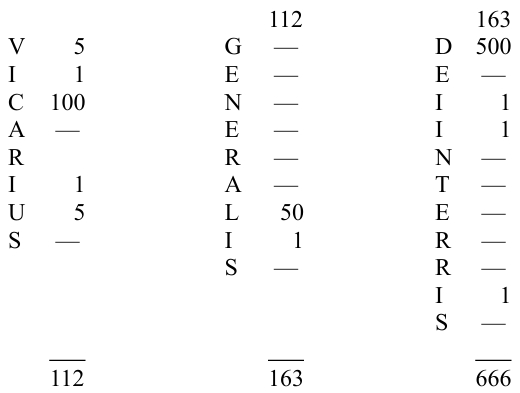
Calculated in this way, what a waste of letters we always encounter! Indeed, on this principle, in how many combinations of Latin words may not the required number be discovered?
5. — Mr. Clarke acquaints me, that in a little anonymous publication, entitled “The Tyrant of the Church,” published in 1816, the number of the Beast is found in [144] “Ipse Catholicæ Ecclesiæ Visibile Caput.” “He himself the visible Head of the Catholic Church.”
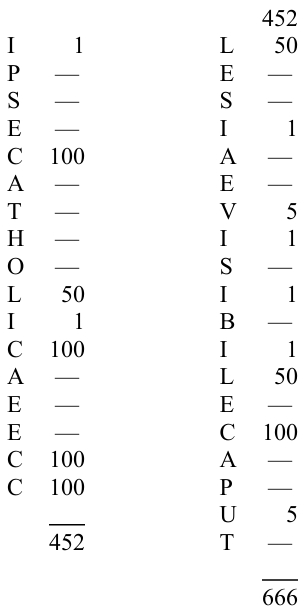
[145] 6. — Dux Cleri, applied to the Pope, is another Latin solution of the enigma. “The number of his” (the Beast’s) “name, according to the opinion of some men, is DUX CLERI, the Captain of the Clergy,131 because by that name he is named, and maketh his name known, and that name is six hundred and sixty-six.” Foxe’s “Acts and Monuments,” vol. iii., p. 185. Ed. London, 1837. The preceding words are extracted from one of the Exhibits of Walter Brute, in his trial for heresy before the Diocesan Council of Hereford, temp. Ricardi II., 1391. Those who take an interest in such matters, will find the whole trial, which occupies pp. 131-192 of the volume referred to, most interesting.
131 Note from the Errata. “Sarcastically denominated by Sandeman, ‘the first clergyman in Europe.'”
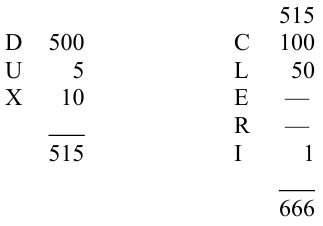
Here we have only two non-significant letters.
WORDS APPLICABLE TO THE ROMISH CHURCH.
Having finished the papal titles, we now turn to the Roman Catholic Church itself, which has been made to stand the battery of a similar mode of interpretation.
By Wolfius we are informed, that Antonius Driessenius, in Commentario Apocalyptico suo, p. 325, adduces the following papal inscription, as stamping the church of [146] Rome with the bestial character: Una, vera, Catholica, infallibilis ecclesia; “The one, true, Catholic, infallible church.”
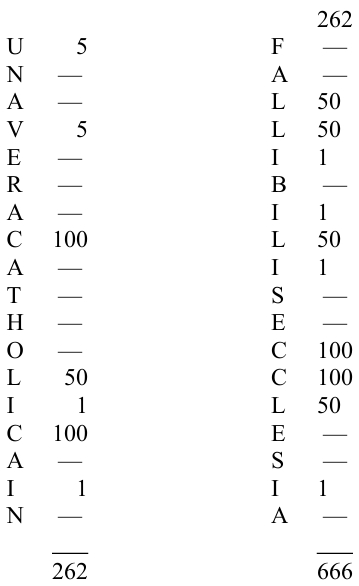
A glance at this, serving to shew how many letters necessarily count for nothing, exposes its worthlessness.
Such combinations as the preceding, it is obvious, may be formed almost ad libitum. As a proof of this, take the two following, aimed at the papacy.
1st. Auctoritas politica ecclesiasticaque papalis, “The papal civil and ecclesiastical authority.”
[147]
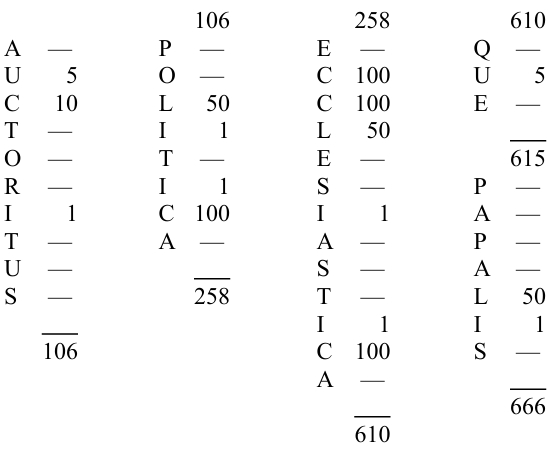
2nd. Auctoritas politica ecclesiasticaque Latina, “The Latin civil and ecclesiastical authority.”
Number calculated, independently of papalis,

NAMES OF EMINENT REFORMERS.
Notwithstanding her want of success in the application, the Roman Catholic church has not allowed the two great [148] leaders of the Reformation to escape an attempt to give them a pelting in Latin. For instance: —
Martin Luther has been converted into the Beast, as we learn from Calmet, by whimsically affixing to his surname the words, Ductor Gregis, or “Leader of the flock.”

The same favour has been conferred on Calvin, by adding to his Latin name, Calvinus, the words tristis fidei interpres, signifying “Calvin, baleful interpreter of the faith” or, “Calvin, interpreter of a baleful faith.”

[149] A mode of procedure this, which, by having the selection of the additional words in our own hands, might be adopted, — and successfully adopted, too, — in the case of any obnoxious human being.
I have been induced to put down all the preceding calculations (except one), at full length, by considering that, not only from the completely arbitrary nature of the supplementary words in several cases employed, but from the number of non-significant letters which every conjecture stated contains, the worthlessness of each and all of them might, at a glance, be rendered apparent even to the most unlettered reader.
Well is it observed by Archdeacon Wrangham, “But of these violent adaptations, which make the Chronogram they cannot find, there is no end. Scarcely a single controversy has started up, in which this accommodating number may not be ranged on either side. The Anti-Calvinist may adduce his ‘CaLVInVs trIstIs fIDeI Interpres;’ and the Calvinist, though Arminius is protected by his M, may attack a senior antagonist with ‘LVtherVs DVCtor gregIs,’ in Roman — numeration. Feuardentius, indeed, in his notes upon Irenæus, to retaliate upon the Protestants, expressly gives it to this most formidable foe of the Romish church, under his correct Saxon name of Martin Lauter, as interpreted by the key in the note p. 411.” (See afterwards ) “The Neptunist may refer his opponent to VVLCano eDItVs,’ (sc. orbis terrarum,) and may have retorted upon him in return, ‘oCeanVs è profVnDo tVLIt’! But it would be idle to chase the shadow any farther.”132 And with equal point and felicity [150] says Mr. Faber, ” In the arithmetical computation of such names as Vicarius filii Dei, or Vicarius Dei generalis in terris, there is nothing of what St. John describes as calculative wisdom. Whatever ingenuity there may be in the construction or the discovery of such titles, there assuredly is none in the bare reckoning up of their component numerical letters, when they are constructed or discovered. A computation of this nature requires no wisdom; the veriest schoolboy, with a slate and a pencil, is fully equal to the task. Hence, according to the remarkable phraseology of the prophet, no name of simple computation can be the name alluded to.” Sacred Calendar, vol. III., chap. iv., p. 237.
132 Wrangham’s Works, ii. 413. 5 + 5 + 50 + 100 + 500 + 1 + 5 = 666. 100 + 5 + 5 + 500 + 5 + 50 + 1 = 666. — Mr. Clarke informs me, that in Baxter’s Paraphrase on the New Testament are to be found ten abbreviated Latin phrases, containing each 666.
THREE ANOMALOUS LATIN CONJECTURES.
1. — DIC LUX, “say,” or “speak, light.”133
133 Ipse enim fatebitur se esse Lucem. Haymo. — For he himself, Anti-Christ, I presume, will confess that he is light, or the light. — I am indebted for this quotation to Wrangham.

Cardinal Bellarmine, I see, refers to these two words, in his “Disputationes,” in the following manner: “Rupertus, and before his time Haymo, have invented two [151] other interpretations, to wit, ——, and Dic Lux, a Latin one, the letters of which, when calculated according to the Latin method, make 666: D being assumed to be 500, I 1, C 100, L 50, U 5, and X 10.”134
134 Rupertus, et ante eum Haymo, excogitaverunt duo alia, nimirum, — et Dic Lux, Latinum, quod facit 666, si Latino more accipiamus D pro quingentis, I pro uno, C pro centum, L pro quinquaginta, V pro quinque, X pro decem. — Disput. R. Bellarmini, Paris, 1620, tom. i., col, 729.
” It is a remarkable fact,” says Bishop Bossuet, with a gravity which, if real, is inexpressibly amusing, “that Nicolas Lerinensis, when in search of an artificial name in which, according to the Latin mode of ciphering, the number 666 might be contained, could find none better adapted to his purpose than the phrase DIC LUX, invented expressly by him: a phrase in which unquestionably the number is found, and which, at the same time, agrees so admirably with the true name, Diocles,” (which Bossuet himself had invented,) “that one is ready to wonder why he did not discover it there”!135
135 C’ est une chose remarquable, que Nicolas de Lerins, cherchant un nom artificiel, où se trouvât, selon le chifre Latin, le nombre 666, n’ en a point trouvé de plus propre, que ce mot DIC LUX, inventé exprés, ou en effêt ce nombre se trouve; et en même tems il est si conforme au nom veritable, Diocles, qu’ on doit croire que c’ etoit là qu’ il falloit viser. — L’ Apocalypse, avec un Explication, ut supra, p. 164.
The Horæ Apocalypticæ of Mr. Elliott, in a note on p. 209, vol. iii., third edition, presents us with the following sentence: — “In case of an enigma of this kind, in Latin, the word ought to be one altogether made up of letters of numeral values: so as in the Dic Lux, pro-[152]posed by Albertus Magnus, as answering to the 666 of the Apocalypse, however otherwise objectionable and absurd the solution.”136
136 Quocirca etiam Rupertus Tuiticensis voculam DIC LVX, ab Ambrosio Arisberto conflatam, resolvens, &c., is Bengelius’ language in his Gnomon.
Lord Napier, likewise, in his Treatise on the Book of Revelation, it appears, makes mention of this solution. Not having been able to procure a sight of his Lordship’s work, I am unable to say what were the sentiments concerning it of the celebrated inventor of the Logarithms. But, writing so strongly and decidedly in favour of Λατεινος, as Mr. Clarke, in his “Dissertation,” p. 45, represents his Lordship to have done, I should suppose that what he says concerning Dic Lux can involve little more than a passing allusion.
“The number 666,” says Mr. Clarke, “Dissertation,” p. 62, “has been found — in Dic Lux; but what was meant by this phrase, I cannot discover.”
My astonishment is, that such a solution should ever for one moment have occupied the attention, excited the interest, or puzzled the brains of men so distinguished as those whose names I have quoted. Bengelius, in a few words, gives us at once its origin, its necessary no-meaning, and, let me hope also, its quietus. For any man of learning, after what he has said, ever again to bestow a moment’s thought on it, would argue something like a divorce, in his case, between his attainments and the plainest dictates of common sense. “From the letters DCLXVI. has, by an obvious transposition, been [153] derived Haimo’s anagram, DIC LUX,” is the cool and contemptuous way in which the great German critic mentions and dismisses the conjecture.137
137 “DCLXVI., unde Haimonis anagramma, DIC LUX.” The brevity of this, which comes in by way of a parenthesis, infinitely better expresses Bengelius’ contempt for the solution, than the paraphrastical manner of rendering his words, to which, for the sake of the mere English reader, I have been obliged to have recourse. See the note, pp. 825, 6, 7, on Apoc. 13:18, towards the end of the learned German’s edition of the New Testament, Tubing., 1734.
2. — LVDVVIC.
Ludweig, Ludovicus, or Lewis, I presume.
This, as I have previously hinted, I discovered in the course of an examination of Foxe’s “Acts and Monuments,” 1837. “Made-words, which signify nothing, as DIC LVX, or LVDVVIC, by Roman letters,” &c., is Foxe’s language, vol. iv., p. 106. Judging from this passage, I should suppose that Luduuic had been invented long before the learned martyrologist’s time, and might have been employed with reference either to French, or to Suabian and Austrian potentates.
Wrangham, since seen by me, quoting, I presume, from Foxe, notices it in his “Six hundred three-score and six,” works, vol. ii., p. 403.
Its almost sole merit is, that, like the preceding solution, it exhausts the Roman letters.

[154] 3. — The sum of the Roman Numerals.
The Most Reverend and highly accomplished Prelate, William Newcome, D.D., Archbishop of Armagh, in his “Attempt towards revising the English translation of the Greek Scriptures,” Dublin, 1796, has the following note on Rev. 13:18. — “Six hundred sixty-six. The letters in Lateinos form this number; a circumstance mentioned so early as in the time of Irenæus. רומיית is another Chronogram of this nature. See Bishop Newton, p. 671. Lowman suggests that 666, added to the time when the Revelation was written, may mark the year when the Beast was supposed to rise. I have heard it ingeniously observed, that the simple marks of the Roman Numerals, D, C, L, X, V, I, compose the number in the text. The Roman mark for a thousand is a compounded one, or D first reversed, joined to a regular D by a common perpendicular line.” [Written M, but properly ↀ.] “I greatly prefer this solution to either of the former.” — Vol. ii. p. 543.
Mr. Clarke acquaints me that in the “Critical Remarks on detached passages of the New Testament,” of the late French Laurence, LL.D., M.P., Oxford, 1810, (after observing that the values of the letters used by the ancient Romans for numbers, when added together, amount to 666,) there occurs this passage: “I + V + X + L + C + D = 666: the M, which we now use for 1000, being merely an error, derived from the ancient custom of [155] expressing it by a compound figure, ↀ, or two D’s, joined back to back.” Dr. Laurence, it thus appears, so far agreed with the learned Prelate.
To his most obliging quotation, Mr. Clarke is pleased to add: — “These six letters, when ranged according to their numerical values, beginning with the highest, thus, D, C, L, X, V, I, exhibit the Roman method of writing the number 666. When it is considered that the Anti-Christ of the Apocalypse is the DOMINION of the Latin church, it is singularly remarkable, that the DIPLOMATIC language of this empire should, in its numerical alphabet, exhibit 666, in the very curious manner just stated.”
Perhaps it would be improper to dismiss those solutions of the number of the Beast which have been proposed in the Latin language, without observing, that in addition to the grand objection of their not occurring in the tongue in which the enigma was uttered, and in which unquestionably it is to be solved; and also to the other objection of the great number of non-significant letters according to the ordinary mode of Roman computation; they are also worthless on the ground that I, X, and C, according as they are placed before or after, detract from or add to the value of the succeeding or preceding letters. The ambiguity thence necessarily resulting is, it strikes me, such a powerful preliminary objection, as is fatal to every interpretation of the Beast’s name derived from Latin words, and resting on common Roman calculations.
[156]
SUBDIVISION SECOND.
SOLUTIONS WHICH HAVE THEIR ORIGIN IN THE GREEK METHOD OF COMPUTATION.
These we take up and consider under two heads: first, such as rest upon the principle of Gematria, or ισοψηφια, which constitute by far the greater number; and, secondly, those which are derived from the initial letters of words, or come under the head of Notarikon.
Need I add, that as from an early period there has existed a strong and well-founded conviction of the solution, like the enigma itself, being Greek, the number of conjectures in that language is certainly a thing not to be wondered at?
1. — SOLUTIONS ON THE PRINCIPLE OF GEMATRIA.138
138 Professor M. Stuart’s remarks on this subject, in his Excur. iv., pp. 458, 459, are worth attending to; — “As to the solution of the mystical number by a resort to the Gematria of the Hebrews, which has sometimes been attempted, I must, with Ewald, wholly dissent. The tenor of the whole thing is different from that of Gematria. Nor do I doubt that this, and other like conceits of the Rabbins, were of later origin than the Apocalypse. There is no need of resort to such a source for explanation,” &c.
In considering these, the first place, it appears to me, is due to those of Irenæus.139 Their antiquity, if nothing [157] else, entitles them to this preference. They reach back, as has been already mentioned, to the latter part of the second century, A.D. 178 or 180.
139 Judging from the language of this Father, in Edit. Grab , p. 448, “Non propter inopiam nominum habentium numerum nominis ejus dicimus hæc,” these remarks of ours are occasioned not by any lack of names containing the number required, one would be apt to think that several more solutions of the enigma in question than the three which he has mentioned, were current in his day. Indeed, one has no occasion to indulge in inferences with regard to this matter. Immediately before the words quoted, Irenæus says expressly, Multa nomina inveniri possunt habentia prædictum numerum, “many names may be found, which, when calculated, involve this number.” The subject, it is clear, as early as the second century of the Christian æra, had attracted much notice, and set the wits of learned and ingenious men a-working.
Passing by, in the meantime, his Λατεινος, to be dwelt on under our third head of conjectures probably connected with the truth, the other two, ευανθας, and τειταν, now claim our attention.
Ευανθας
Is thus calculated: —

To what Mr. Clarke has so admirably said respecting this conjecture, it is almost impossible for me to add any thing of my own. “Irenæus gives us another word, namely, Ευανθας. But this he produces to shew that several names might be found containing the number of Anti-Christ, which cannot well be applied to him. It is very [158] difficult to determine what Irenæus intended by the word, whether the proper name of a person, or the adjective έυανθεες, or ἐνανθεῖς, flourishing: if the former, nothing can be concluded from it; and if the latter, the writing it ἐνανθὰς, for ἐνανθεες, or ἐνανθεῖς, is sufficient to overthrow it.” And in a note on the word ένανθὰς, he adds, “It is not altogether certain that this is the word intended by Irenæus; for in the different copies of Irenæus consulted by Grabe, it is written Ευαν, which is 210 short of the number said to be contained in it.” (Ε, 5, υ, 400, α, 1, ν, 50 = 456.) “It is for this reason that Feuardentius,” (whom Professor M. Stuart styles “learned,” and describes as “one of the leading editors of Irenæus,” see Excursus iv. of his “Commentary on the Apocalypse,” vol. ii., p. 454,) “added the third syllable θὰς.”140 Mr. Clarke has neglected to add, that for the word ἐυανθὰς, Grabe quotes the high additional authority of Vossius. — See Grabe’s note in loc., pp. 448, 449. — A word liable to so many and such insurmountable objections, as those just stated, seems to justify us in passing on to the next, with the slight notice which we have taken of it.141
140 The Words of Feuardentius, as quoted by J. E. Grabe in his edition of Irenæus, p. 449, are: “Primum nomen quod hic ab Irenæo ponitur est EYAN, in excusis codicibus, ut numerus 666 deficiens, et vetus codex palam arguunt, mendum subesse. Ideoque ex fide veteris codicis, et Græcis characteribus restituimus ΕΥΑ’ΝΘΑ’Σ, cujus elementa sigillatim sumpta numerum ab Irenæo quæsitum faciunt: ε 5, υ 400, a 1, v 50, θ 9, α 1, ς 200: summa 666.”
141 Irenæus himself, it is obvious, from the very cursory manner in which he notices Ευανθας, — if Ευανθας it be, — attached but very little importance to the word: — “Ευανθας enim nomen habet numerum de quo quæritur; sed nihil de eo affirmamus.” The word Ευανθας contains the number in question; but we pronounce no opinion whatever as to the validity of its claims.
[159] Having followed up his statement respecting Eυανθας, with a few words in regard to Λατεινος, afterwards to be considered, Irenæus proceeds, at some length, to specify and enforce his arguments in behalf of his favourite Τειταν.
Τειταν.
Prosy and gossiping his remarks unquestionably are. But, considering the importance which he professes to attach to this word, perhaps it is but justice to him to listen to what he has to say. One advantage, at least, we shall derive from so doing: it will serve to give us some idea of this ancient Father’s style of writing; indeed, of, with some few exceptions, Patristic composition in general.
First, however, let us exhibit the calculation of the word: —
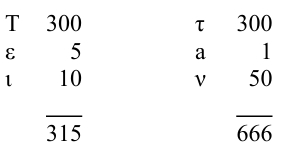
“Still farther,” says Irenæus, “we mention Τειταν,writing the first syllable with the two Greek vowels ε and ι.” (Otherwise, spelt Τιταν.) “This, I have no hesitation in saying, is, of all words which have the obtained currency among us, the most deserving of credit. Its claims to attention are many. It produces exactly [160] the requisite number — it contains six letters, divided into two syllables consisting each of three letters — it bears the stamp of antiquity — and it is somewhat unlikely to have suggested itself to the mind of the reader. None of our kings has borne the name of Titan. Nor does it belong to any of the idols which are objects of worship to the Greeks and Barbarians. Nevertheless, when mentioned, the word is seen to have something divine connected with it in common estimation. Titan is one of the names given to the Sun, by those who now hold the reins of authority. And when applied, as in the case before us, it brings under our notice, by its reference to the heathen mythology, the idea of one acting the part of an avenger, and punisher of the guilty: the being here spoken of pretending to avenge the cause of those who are subjected to ill usage at the hands of others. Such, then, is Τειταν, the word in question: from its antiquity worthy of credit; and still more so, as being the appellation of a king — rather, of a tyrant. Seeing, then, we have so many reasons, founded on probability, to induce us to prefer this name, Τειταν, to all the others which have been proposed for our acceptance, we may conclude it to be very likely that Anti-Christ, when he does make his appearance, will be so denominated. And yet, we will not hazard any direct or decided opinion, that this is destined to be his name; knowing, as we do,”142 — and so on.
142 Sed et Τειταν, primâ syllabâ per duas Græcas vocales, ε et ι scriptâ, omnium nominum quæ apud nos inveniuntur, magis fide dignum est. Etenim prædictum numerum habet in se, et literarum est sex, singulis syllabis ex ternis literis constantibus, et vetus, et semotum; neque enim eorum Regum qui secundum nos sunt, aliquis vocatus est Titan, neque eorum quæ publice adorantur idolorum apud Græcos et Barbaros habet vocabulum hoc; et divinum putatur apud multos esse hoc nomen, ut etiam Sol Titan vocatur ab his qui nunc tenent; et ostentationem quandam continet ultionis, et vindictam inferentis, quod ille simulat se male tractatos vindicare. Tale autem et antiquum, et fide dignum, et regale, magis autem et tyrannicum nomen. Cum igitur tantum suasionum habeat hoc nomen Titan, tantam habet verisimilitudinem, ut ex multis colligamus ne forte Titan vocetur, qui veniet. Nos tamen non periclitabimur in eo, nec asseverantes pronuntiabimur, hoc eum nomen habiturum: scientes, &c., &c.
Admirably abridged is this rigmarole by Professor Moses [161] Stuart: Irenæus “thinks, that of all the names current among Christians of his time, Τειταν proffers the fairest claims for admission. His principal reasons are, that this name itself has six letter; that it has two syllables, both consisting of three letters; that the name too is old, and is not in common use. Besides, it belonged to one of the giants who assaulted the gods, and may therefore well characterise Anti-Christ when he shall come. Still, Irenæus says, that he shall not venture on determining absolutely what name is meant, inasmuch as John would himself have disclosed it, had he wished it to be made public at that time.” Stuart’s Commentary, Excursus iv. , p. 453. — Clarke’s abstract, pp. 45-47 of his “Dissertation,” is similar: he, however, unhesitatingly rejecting the word on the score of orthography: according to his theory, Τιταν not Τειταν, being the manner in which it ought to be spelled.143 To Cardinal Bellarmine’s obser-[162]vations on this passage of Irenæus, I would refer those who are desirous to see how he labours to shield the Pope from the charge of being Anti-Christ; which, on it as well as on other grounds, might be, or had been brought against him. — Disput., Paris, 1620, vol. i., col. 730-732.144
143 Overlooking the fact, that Irenæus, living at a time when Greek was a spoken language, and himself an accomplished Greek scholar and writer, can scarcely be supposed to have been ignorant of the proper spelling of the word.
144 “Audiat igitur Chytræus Iræneum verecundè, piè, et eruditè disserentem, et non falsò illi imponat, quod nunquam dixit. Nec enim indicavit Irenæus,” &c.
Notwithstanding the decided preference given by Irenæus to Τειταν, the reasons which he assigns for so doing are so flimsy and far-fetched, and the word itself, except in the mere fact of the numeral value of its letters being 666, is so clearly inapplicable, that one has no hesitation whatever in rejecting it. It matters not that a fanciful German writer, Knittel, quoted by Michaelis, has undertaken to defend its claims, “considering it as an allusion to the prænomen of Domitian, which was Titus;” adding, that “the name of Titan was justly applicable to Domitian, because, towards the close of his reign, he insisted on Divine honours being paid him, and was therefore a θεομαχος, as the Titans were.”145 It matters not that Wetstein, a critic of the first order, from whom probably Knittel borrowed his idea, has also approved of the word in its twofold form of Τειταν, (666,) and Τειτα, (616 ) applying it in both cases to Titus.146 Independently [163] of all other objections, the total irreconcileability of the word with the text and context of Rev. 13:18, at once stamps its condemnation.147
145 J. D. Michaelis on the New Testament, vol. i , p. 526, London, 1802.
146 The singular remark of Wetstein, in a top-note, p. 805 of his edition of the New Testament, concerning a double writing of the number of the Beast, 616 and 666, by the Apostle John, in two distinct editions of the Apocalypse, “cum vero utraque lectio Titum Imp.” &c., has been already quoted. In two notes at the bottom of pp. 806, 807, beginning respectively, Eleganter et appositè Johannes Titum Flavium Vespasianum, patrem et filios, hoc nomine designat, primò quod ipsimet mathematicorum (of magicians?) artibus fuerunt dediti, &c., and Sin autem ex aliorum codicum lectione præferas, 616, &c., also already noticed, he shews a fixed determination that, coute qui coute — in whatever way read — upon the head of Titus, as having been aθεομαχος, or fighter against God, and therefore appropriately bearing the name, as he exhibited the character of the Titans of old, should descend the honour, or rather the dishonour of being the Beast of the Apocalypse.
147 Mr. Clarke, as we have already observed, most decidedly and unhesitatingly condemns τειταν, as he does also παπεισκος, on the ground of the employment of the dipthong ει in both words. Although I have already thrown out a hint as to this matter, — one which falls to be considered at some length afterwards, — I cannot help here again remarking, that it does appear strange to me, to find a learned, and able, and evidently sensible man, as Mr. Clarke is, so confidently, in the 19th century, when classic Greek has for ages ceased to be a spoken language, taking upon himself to correct the spelling, and pronounce the condemnation of a man like Irenæus, who, whatever might be his faults otherwise, spoke and wrote the Greek language as his own! How extraordinary and unaccountable the freaks, which even clever men, under the influence of peculiar theories, are found continually exhibiting!
Mr. Elliott, in his Horæ Apocalypticæ, although noticing Τειταν as one of Irenæus’ conjectures, dismisses it with the observation, that “the reasons which he offers” in support of it, “seem comparatively insufficient.” vol. iii. p. 209. It is mentioned, as has already appeared, by Professor Stuart, but merely as, what it really is, a worth-[164]less guess of the Father from whom we derive it, or of some one of his cotemporaries.
Perhaps I should not be doing justice to my readers, or to myself, were I to withhold what Wrangham has said on the subject. “With regard to the appropriation of this name to Anti-Christ, as authorised by Hesychius, see Henley’s ingenious ‘Dissertation on the controverted passages in St. Peter and St. Jude, (2 Peter 2:4,6, Jude 6,7,) concerning the angels that sinned, and kept not their first estate.’ These he interprets of the first apostacy and rebellion upon earth, carried on by the sons of Chus, under their imperious leader Nimrod, who took upon himself the sacred titles of Alorus, TITAN, and Orion; whence his followers, called ‘Titanians,’ and ‘Atlantians,’ might be designated as soi-disant Αγγελοι. Bishop Haymo, however, interprets it of ‘the Sun of Righteousness,’ more especially, who ‘rejoices as’ a giant ‘to run his course,’ and whose name, Anti-Christ would not fail to usurp.” — Wrangham’s works, vol. ii., pp. 407, 8.
I have made several attempts to procure the late Granville Sharp’s “Tracts on Prophecy,” but hitherto unsuccessfully. These productions I have been desirous to see, principally in order to ascertain what were the views of that able and eminent man with regard to the word in question. Happening to possess a copy of a work by the Rev. Nathanael Markwick, S.T.B., entitled, “A Synopsis, or a compendious view of the Apocalypse, grounded upon a new Hypothesis,” London, 1738, which copy, from his signature, and copious notes in his hand-writing, appears to have been once Mr. Sharp’s property; and observing Mr. Sharp’s autograph calculation of the value of Τειταν on the margin, curiosity to know what were his [165] sentiments on the subject has been aroused.148 Probably the suggestion of Irenæus struck him as too contemptible to deserve farther consideration. Having mentioned Mr. Markwick and his book, I may take this opportunity of dismissing both him and it with the remark, that scarcely ever have I, in the purchase of a book, been more disappointed. In general, it is little more than a miserable compilation. Scarcely any opinion of his own does the author propose. Indeed, was he competent to form one on the subject? The only thing which I can perceive in his book, entitled to the appellation of new, is his idea of the existence of two Babylons, “the one temporal, secular Babylon, respecting chiefly the condition of the Jews,” and “the other spiritual, mystical Babylon, respecting Jews and Christians much alike,” as being the grand idea proposed in the seventeenth chapter of the Apocalypse, and essential to our understanding of its meaning.149 In treating of this, he confuses himself as well as his readers. Mr. Sharp has devoted some long and learned manuscript notes to the correction of what he conceives to be his mistakes in reference to this point. But enough. Were it not for the pleasure and advantage of having been enabled to peruse Granville Sharp’s notes, I should consider the time spent in the perusal of Markwick’s “Synopsis” to have been entirely thrown away.
148 Mr. G. Sharp’s notes are in “red ink.” This kind of ink, it would appear, he was in the habit of using. See Miss C. Sharp’s letter to Dr. Adam Clarke, in the Life of the latter, vol. ii., p. 318. London, 1833.
149 See p. 177 of Markwick’s “Synopsis.” Also, the preceding and subsequent contexts.
Quitting Irenæus and his two conjectures, which, con-[166]sidering their worthlessness and absurdity, have detained us rather too long, I come to a whole batch of Greek solutions, all referable to an early period of ecclesiastical history.
Feuardentius, quoted by Grabe, in a note on his edition of Irenæus, Oxford and London, 1702, already copied in part, has given us the whole of these, at one coup d’œil. After having mentioned in order, as first, second, and third, Ευανθας, Λατεινος, and Τειταν, — concerning which last he says, “Arethæ Cappadoci Comment. in 13 Apocal. sicut Irenæo placet,” that it has been approved of by Arethas of Cappadocia, as well as by Irenæus, — he enumerates other nine, setting down the names of those by whom they have been respectively suggested, and calculating the number 666 as involved in each. The nine conjectures are: Αρνουμε, Λαμπετις, ὁ νικητης, κακος όδηγος, Αληθης βλαβερος, παλαι βασκανος, ἀμνος αδικος, Αντεμος, and Γενσηρικος. Grabe quotes Feuardentius as his authority, and then adds: “Cujus errores in numeris corregi, et αρνουμε posui pro αρνουμαι;” “whose arithmetical blunders I have corrected, and whose mistake in the case of aρνουμαι has been rectified by the substitution of αρνουμε.” Alas, for human fallibility! Grabe undoubtedly corrects the Greek word, “Αρνουμε, nego, (ε pro αι,)” but he follows this up by the following piece of computation: “Siquidem α 1, ρ 90, ν 50, ο 70, υ 400, μ 40, α 1, ι 10; summa 666.” A glance at this brings under our notice the following tissue of blunders: — First, the sum as set down is not 666, but 662; Secondly, after correcting the Greek word, he still calculates it as if it were aρνουμαι; and, Thirdly, he assigns to the numerical value of 90, whereas it [167] stands for 100! Truly the corrector requires to be himself corrected.
Let me present the foregoing solutions in order to the reader.
1. — Αρνουμε.
This name, the fourth which he enumerates, “has,” says Feuardentius, “been set down by Primasius, treading in the steps of Hippolytus:” Quartum, constituit post Hippolytum, Mart. Primasius.
To Hippolytus, Bellarmine also ascribes this solution: “Hippolytus Martyr, in Oratione de Consummatione Mundi, notavit aliud nomen, quod reddit illum numerum, nimirum, αρνουμαι, i.e., nego.“
“Hippolytus,” observes Mr. Clarke, “who lived at the end of the second century, finds the number 666 in αρνουμε, I deny;150 ‘For,’ says he, ‘Anti-Christ, when he comes, will openly deny the articles of the Christian faith.’151 But the orthography of this word, like the others already mentioned, is also improper; for it should be written αρνουμαι.”152 In proof of which Mr. Clarke refers to the different Greek Lexicons.153
150 I deny. — Professor Moses Stuart translates differently from Feuardentius, Grabe, and Clarke. “Primasius conjectures the Greek word AΡΝΟΥΜΕ (as he writes it) i.e., thou hast denied те.” Арос. Excurs. iv., p. 454.
151 De Consummatione Mundi.
152 Lacunza, in his “Ben-Ezra,” and the author of “Triplicity,” make αρνουμε to be a compound of αρνου and με, and to signify deny me; “which aptly denotes the desperate apostacy of that awful being, the man of sin, who is to bring on the great tribulation.”
153 The substitution of one vowel for another, and of a vowel for a diphthong, is extremely common in Greek manuscripts. Wm. Canter, of Utrecht’s, “Syntagma de ratione emendandi Græcos Auctores,” first published in 1571, and subjoined to Dr. Jebb’s edition of Aristides, 1730, goes at great length into this subject. This erroneous exchange of vowels has been denominated itacism. — Aι for ε, and ε for αι, are among the examples of it adduced by Canter, — e.g., Scribendum ανταιρειν pro αντερειν, εσθησε pro αισθησει. An abstract of Canter’s tract will be found in Granville Penn’s Expository Preface to his “Annotations on the Book of the New Covenant.” London, 1837.
[168] The calculation is,

Arethas of Cappadocia seems to have been endowed with no small share of inventive genius. At all events, whether his own or not, he has favoured his readers and posterity with no less than six conjectures, besides Τειταν, as to the Beast’s name.154
154 “Arethas of Cappadocia gives us several words or phrases containing the number 666. The first is Λαμπετις, (I suppose a proper name,) but it can be applied to nothing respecting Anti-Christ.” Clarke’s Dissertation, p. 49. “Arethas annotavit septem,” is Bellarmine’s language.
2. — Λαμπετις.
No translation of this word is given by Feuardentius or Grabe. Clarke, as appears from his quotation below, supposes it to be a proper name. Cardinal Bellarmine, in his Disputationes, vol. i., col. 729, translates it by the [169] Latin word illustris, shining, or illustrious. He writes it λαμπετης.155
155 Λαμπετις affords, I presume, another example of the itacism, — ι pro η, — a very common one. Λαμπετις should, I doubt not, be Λαμπετης: only, the latter word will not bring out the number.

3. — Ὁ Νικητης, the victor or conqueror.

This is, as Mr. Clarke remarks, “a character which, according to the Sacred Oracles, in a most eminent sense belongs to Anti-Christ; for ‘power is given him over the saints to overcome them.’ Rev. 13:7. But this word is insufficient in two respects: First, it is totally indefinite, as several persons have appeared in the world at different times who have been great conquerors. Secondly, it is the name of no particular person exclusively.” pp. 49, 50.
4. — Κακος ὁδηγος, a bad leader, or guide.
[170]
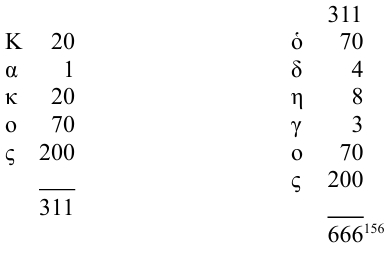
156 “This is also a striking character of Anti-Christ; yet the words can be applied to any person who publishes erroneous doctrines, or otherwise leads the people astray.” — Clarke.
5. — Αληθης βλαβερος, a true (truly) injurious person.
“This,” says Mr. Clarke, “ought to be written αληθῶς βλαβερος.” No doubt, if we are to read the former word adverbially: but to do so would vitiate the calculation. — Is it a specimen of the itacism?

6. — Παλαι βασκανος, envious of old time.
[171]

7. — Αμνος ἀδικος, an unjust lamb.

This completes the list of Arethas. The whole of the preceding six solutions, with Τειταν, are introduced by him in his commentary on Rev. 13:18.
Ticonius, as cited by Primasius, has
8. — Αντεμος.
Mr. Clarke says that it is “the name of a month” containing “this number,” that Primasius “gives us.” By Bellarmine, who also ascribes it to Primasius, the word is translated to signify contrarius, that is, opposed.157 By [172] Haymo, in Apocal. col. 1529, fol. 9, viii., honori contrarius.
157 Primasius addit aliud, αντεμος, id est, contrarius. Bellar. Disput., tom. i , col. 729. Bellarmine afterwards at greater length enters on the consideration of this word, which he represents as supported by Anselmus and Richardus, and refuted by Rupertus.— “Tertia opinio est multorum Catholicorum, qui suspicantur Anti-Christum vocandum Αντεμος, tum quia hoc nomen propriè illi conveniat, tum etiam quia reddat exactè illum numerum. Ita Primasius, Anselmus, et Richardus. Refutatur recte,” &c.

9. — Γενσηρικος.
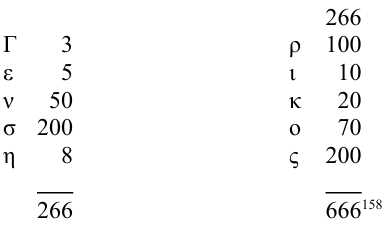
158 Singularly enough, this is the only one of the twelve enumerated by Feuardentius, (as quoted by Grabe) which is left uncalculated. Perhaps, by overlook — more probably, per tædium.
Mr. Clarke translates this word earth-born. He concurs with critics in general in ascribing it to Rupertus, or Rupert. It is represented by Cardinal Bellarmine as [173] having been derived by Rupertus from Haymo, and is spoken of by him as a Gothic name.159 Professor M. Stuart, referring to it, says, “Rupertus has Γενσηρικος, i.e., Genseric, a king of the Vandals, and the great scourge of Italy.” Such also has been the opinion of others.
159 Rupertus, et ante eum Haymo, excogitaverunt duo alia, nimirum, γενσηρικος, quod est nomen Gothicum, et Dic Lux, &c. — Disput. Bellar., tom. i., col. 729. — Mr. Clarke, in a private letter, states, obligingly, that Thomas Haymo informs us, that Γενσηρικος, Genseric, the celebrated Vandal monarch of the fifth century, also contains 666. See Aretius on the Apocalypse, p. 599. Bernæ Helvetiorum, 1608.
According to Mr. Elliott, in his Horæ Apocalypticæ, (note, vol. iii., p. 211,) Andreas, Archbishop of Cæsarea, one of the learned Greek Fathers, in his Commentary, contained in the Bib. Pat. Max., tom. v, is made to allude to several of the preceding solutions, and to one which follows, as given by Hippolytus: specifying, λαμπετῆς, (for λαμπετις,) βενεδικτος, κακος ὁδηγος, αληθης βλαβερος, παλαι βασκανος, and ἀμνος ἀδικος.160
160 After mentioning τειταν, as used for τιταν, ϖαϖεισκος, for παπισκος, and αρνουμε, for αρνουμαι, Bengelius says, contemptuously and severely, in his Gnomon, “Sed ejusmodi licentiæ, in re gravissimâ, nil loci esse debet. Alia nomina, Hippolyti exemplo, exercitii causâ, adjicit Andreas Cæsariensis, ejusve hâc in parte amplificatores.” — In a matter of such importance as that which we are now considering, to licenses of this kind no words should be subjected. Andreas, Archbishop of Cæsarea, or those who in this particular respect have taken on them to amplify his statements, has added other names, copying the example of Hippolytus, and as a mere exercise of ingenuity.
Objections to every one of the nine names just calculated, must have occurred to every reflecting reader. [174] They are all vague and indefinite.161 Like the Latin names which we have been already considering, they seem to require only some slight exercise of ingenuity, and of the power of combining letters with a view to their numerical value, to produce them in any abundance. The grand test of the truth of the name suggested, namely, that of its agreeing thoroughly and exclusively with the text and context, not one of them can abide. As the mere coinage of the human brain, therefore, we feel justified in unhesitatingly rejecting them.
161 With the exception of Γενσηρικος, if understood with reference to the Vandal monarch.
Εὺίνας.

This is a conjecture of St. Jerome, and appears among the Greek fragments of his Book concerning Hebrew Names, which are printed in the second volume of Martianay’s edition of his works, Paris, 1699. The passage is on page 158.
The whole is very briefly expressed. Ευινας έρμενευεται ὁ δειξας όφεις, ὁυ ὁ αριθμος χξς΄. Upon which the only comment extracted from St. Jerome himself is, “Naās, Serpens.” And Martianay gives as his translation, “Euinas is explained to mean, ‘one who points out serpents,‘ whose number is 666.”
[175] A note on the above Greek text, by Martianay, shews us more fully his sentiments in reference to the subject: “The number of the Beast here given is that which occurs in the Revelation of John, 13:18. It is worthy of remark, that the word Euinas is not read by us in the Sacred Writings themselves. From this the fair conclusion is, that it was got up by the Greeks, because, when calculated, it was found to amount to 666. For ɛ amounting to 5, &c. Among the hidden mysteries of the Hebrews, this mode of computing is denominated Gematria, and is that agreement in sense derived from an agreement in the numerical value of words, which the Greeks are said to have called the Tabula Pythagorica. It has not been in my power to remain ignorant of the great number of conjectures concerning the number of the Beast, which have been broached in every quarter; but as the greater part of these are obviously false, and unworthy of a moment’s notice, and the very best of them are incapable of imparting certainty to the mind, I conceive myself justified in declining to give any enumeration of them.”162
162 S. Eus. Hieron. Stridon. Presb. op., tom. ii., Paris, Anisson, 1699, p. 158. — I cannot take the trouble to quote the Latin original here. The reader may examine it if he pleases.
May we not suspect that Irenæus’ Ευαν (Ευανθας), and Jerome’s Ευινας are, after all, the same word?
Βενέδικτος.
The learned Bengelius, in his Gnomon, commenting on Rev. 13:18,163 brings under our notice the word Benedict, a name assumed by several of the Popes, as expressing [176] the required number, when written βενεδικτος; “an orthography,” says Mr. Clarke, “allowed by the Greeks.” Among the conjectures ascribed to Andreas, of Cæsarea, according to Bengel, “the most remarkable is βενεδικτος, a word occurring not only in the Codex Augustanus, which adds names to names, but also in the Editio Sylburgiana; not Benedictus Nursinus ——— but Benedict IX., one of the Roman Pontiffs. — This Benedict occupied the Papal throne, when exactly one thousand years from the passion of Christ had elapsed. This fact led many of our forefathers to suppose that the thousand years mentioned in the 20th of Revelation having expired, the reign of the Beast might be expected. And to some curious reader of Andreas, this expectation, combined with the circumstance of his finding βενεδικτος the name of the then reigning Pope to contain the number, suggested, it is extremely probable, his addition of it to the manuscript.”164 Mr. Clarke refers, besides, to Dosith. Patres Hierosol. Lib. viii. c. 10.
163 Also in Elliott, as we have just seen.
164 In his, maxime insigne est βενεδικτος, non solum in codice Augustano, qui alia aliis superaddit nomina, sed etiam in editione Sylburgianâ: neque tamen Benedictus ille Nursinus, de quo Andreas audire potuit, quemque Nic. Mulerius huc confert, a Græco quopiam Librario notatus videtur: nam Græcorum quoque menologium prid. Id. Mart. memoriam ejus habet; sed Benedictus IX. Pontifex Romanus. Non abludit, qui Casparo Hennischio in mentem venit, SILVESTER SECVNDVS. Etenim Silvester quum annus 1000 a nativitate Christi; Benedictus quum annus 1000 à passione Christi numeraretur, sedebant: et ad utrumvis annum millesimum quasi elapsi forent anni milleni capite xx. scripti, regnum bestiæ expесtaverunt veteres, (ut patet ex Andreâ, cujus curioso cuipiam lectori numerum 666 ille βενεδικτος, ut apparet, subministravit.) — Gnomon, p. 1171.
[177]
βενεδικτος, calculated, makes
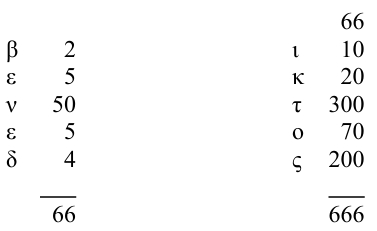
“It is evident,” observes Mr. Clarke, “if the Popes be intended by the Beast, that the name of any one Bishop, or set of Bishops, should not be selected for the purpose of determining what is meant by the number; but a name which comprises the whole of them.”
Βονιβαζιος Γ.
To the preceding we may add a rather ingenious conjecture of Valent. Ernest. Laescherus, “proposed by him,” says Wolfius, “in his Exercitatio Historico-Philologica de numero Anti-Christi.” He suggests, that the number of a man implies three things: —
1st. The age in which the man appeared;
2d. His characteristic number; and,
3d. His proper name.
These three, according to him, are found to coincide remarkably in pointing to Boniface III. as the Beast of the Apocalypse. For,
1st. We have the age of the appearance of Anti-Christ. It was in the year 606 of the Christian æra, that Boniface received the title of Universal Bishop, from the usurper, Phocas, then exercising the imperial functions. The assumption of this title, it had been understood and foretold, would mark the coming of Anti-Christ. But [178] 606 will amount to 666, if 60 years before the birth of Christ be taken into the account.165
165 Upon the principle, I presume, of Balæus and N. Stephens, who conceive that we are to consider 666 the number of the years of the Beast’s reign, and to reckon the commencement of the period from A.C. 60, when Pompey succeeded in reducing Judea into the form of a Roman province. — See Poole’s Synop. Crit. in loc.
2. The characteristic number, as well as name, is found in Λατεινος. And,
3. The number 666 will be found in Boniface’s own name, if written in Greek, with a few initial letters expressive of his order, rank, and title. That is, in a combination of Gematria with Notarikon. Βονιβαζιος Γ. Παπα Ξή, ε, ε, ά; which, uncontractedly, is Βονιβαζιος Γ. Παπα Ξή, επισκοπος επισκοπὡν πρῶτος, or, “Boniface the Third, the sixty-eighth Pope, and first Bishop of bishops.”166 Calculated, it is,
166 See Wolfii Curæ Phil. et Criticæ, vol. 4th, Ed. 2d, p. 548.

167 “I am not aware that βονιβαζιος, with respect to its orthography, is supported by a single authority from any Greek writer. I have only met with the Greek name for Boniface in two forms, viz., Βονηφατιος, and Βονιφατιος: the former in the Bibliotheca of Photius, — and the latter in Procop. Cæsar. de bello Vandalico, and in Constant. Porphyrog. de Them. Imp. orient. seu Antiq. C. Р.” — Clarke, 51, 52.
[179] Need a single word be uttered in confutation of such guesses as βενεδικτος and βονιβαζιος Γ.?168
168 Wrangham thus refers to it. “Wolfius bestows the praise of ingenuity upon the conjecture of Lœscher, (the conjecture, also, of Fleming,) who by various dexterities discovers the triple characteristic of date, district, and denomination in Boniface III. For, 1, he accepted from Phocas that title of Œcumenical Bishop, A.D. 606; and between that and B.C. 60, when Judea first became a Roman province! elapsed an interval of 666 years; 2, Λατεινος gives his local designation; and, 3, βονιβαζιος Γ. Παπα ξη΄. Ε. Ε., or Bonifacius III., Papa LXVIII., Episcopus Episcoporum, is his personal description.”! — Works, vol. ii. 409.
The principal reason why they are worth mentioning at all is, that they appear to have attracted the notice, and obtained the approbation of our British Solomon, King James I. So says the justly celebrated John Selden.169 And James, according to the author of the “Table Talk,” was well qualified to form an opinion in matters of this kind. Employing the courtly language of flattery, his learned cotemporary describes him as having been “exquisitely able,” and “of sharp judgment,” When “convented before” his Majesty, to use Selden’s own quaint phraseology, he “saw with wonder the characters of such a fraught of learning, of such a readiness of memory, of such a piercing fancy, joined with so absolute a judgment [180] in him, as if his greatness in all these abilities had been no less than in his hereditary titles.” The fact is, Selden, in his work on Tithes, towards the close of the first chapter, appears in some particulars to have unintentionally and unconsciously trodden on the toes of the then reigning monarch. James, among the other topics which at various times had occupied his kingly pen, had written on the subject of the name and number of the Apocalyptic Beast, with application to the Church of Rome. This particularly appears from his “Premonition to all Kings and States of Christendom.”170 In this “most divine and kingly” production, as Selden with the instinct of a courtier denominates it, Boniface III. and Benedict, (called Benedict II.,) had been honoured with his Majesty’s notice, as having been probably, — either the one or the other, for, as Selden remarks, the reader may “take which he likes best,” — the monster in question. Not to the exclusion of, but in connexion with Λατεινος; for “both stand with the sense” of that word, which “denotes what is of Rome.” Unfortunately for himself, Selden had, in the work previously mentioned, namely, that on Tithes, spoken with contempt of Rabbinical expositions connected with number in general, and with particular contempt of guesses at the number of the Beast founded on the principle of the calculation of numbers. He had charged such persons with unlimited liberty and trifling boldness. Calvin had been eulogised by him for having been “as judicious as modest,” in saying, when speaking of the author of the Apocalypse, “that he knew not at [181] all what so obscure a writer meant “171 Such language, on Selden’s part, considering the Royal productions and predilections, was very awkward. Especially, must he [182] have felt embarrassed, when honoured with three audiences on James’s part, two at Theobald’s, and one at Whitehall, [183] — all on this very subject. Selden, however, was a docile and a repentant pupil. “Among the many passages,” says he, “touching which I had the happiness to receive both instruction and admonition, from the clear light of so great a master of learning,” (James I.,) “three particulars occurred, which, (as it pleased him graciously to shew me,) might give some scandal in the church, if not more clearly either rectified or explained by me.” Employing all the resources of his kingcraft on this occasion, and, I presume, however much displeased, keeping his temper, James contrived to impress his learned subject with a conviction, not only of “the exceeding sweetness of his nature, which” he “largely tasted of,” but also of the propriety of making the amende honorable for the fault which he had committed. He asked his Majesty’s permission to make public the hints which had been graciously vouchsafed. This was readily granted. The result was, the composition of three short supplementary tracts. The first of these, — with which alone we have to do, — is entitled, “Of the Revelation.” It consists of two parts. In the former, Selden endeavours to do away with the impression, that his contemptuous language respecting the calculations of the number 666, could have had any application to his Majesty. In the second, he endeavours to get out of the scrape respecting Calvin. This last we have given at length. The whole winds up, with the following declaration, which may amuse [184] the reader: “But all that I intended was only this, that he” (Calvin) “expressly confessed a great difficulty in it, which the more commends the interpretations of it,” (the number,) “made according to the analogy of the text, and the order of times, among which his Majesty’s, specially in that his unimitable ‘Premonition,’ is as the clearest sun among the lesser lights.”172
169 See Selden’s Works, vol. iii., part 2d, col. 1402. The tract in which the passage occurs, is entitled “Of the Revelation.”
170 Præfat. Monit. ad Reges, &c.
171 See “History of Tythes,” Works, vol. iii., part ii., c. 1, sec. 4, col. 1081.
“Nor hath this dream of his” (Thomas, of Elmham’s,) “place here, otherwise than as an old pattern of trifling boldness, used in the late arithmetick of many, on that passage of St. John, in whom are tot sacramenta, quot verba;A and of whom the answer given by that Doctor, Calvin, was as judicious as modest. He, being demanded his opinion, what he thought of the Revelation,† answered, ingenuously, ‘he knew not at all what so obscure a writer meant.’ He might best have spoken it on this particular of the number; to which, found by arbitrary collection, whoever gives much credit, might unhappily, perchance, be induced to believe some mutual respect betwixt Abel’s offering, and Abraham’s tythes.”
Some of my readers may be desirous to know in what way the court eye-salve, applied by the royal leech, operated in restoring to the accomplished patient his mental vision, previously “in dim suffusion veiled.” The following piece of wriggling, as well as of almost nauseating flattery, may to such be acceptable. Painful is it to contemplate a man of Selden’s acknowledged genius and learning, in the crawling posture which, on this occasion, he thought proper to assume. Still, it may be useful.
“OF THE REVELATION.
“i. — On the passage touching the number 666.” — (Omitted: too long.)
“ii. — Of Calvin’s judgment on the Revelation.
“After these words of the number, speaking of the Book of the Revelation, I have a passage of Calvin’s answer touching it, which is related to have been, that he knew not at all what so obscure a writer meant.B And this answer of his, (which I use only in the by, to denote the obscurity and difficulty of that part of Holy Writ,) I then say, was as judicious as modest, my meaning being, as I profess from my heart, that it was as judicious to see the difficulty and obscurity of it, in regard of his own understanding, as it was modest to confess it. And it was far from me to think then, that his answer was such as would have become all men, as if no man had known what St. John meant. And there was perhaps a time, even in the strength of Calvin’s years, when he had no great reason to be very forward to adventure upon such difficulties in Holy Writ. For he spent a great part of his youth in the studies of humanity,C and especially of the civil laws, under those learned Stella at Orleans, and Alciat at Bourges, and in those times he might speak that of the Revelation, while he was yet of another profession. But also it might perhaps suit him without disparagement, even after he became a Divine. For he wrote his Institutions, and was made Doctor at Geneva, before he had seen twenty-seven years, which is not an age wherein a divine, especially one that comes but lately from another profession, (as he did,) should venture too boldly upon such difficulties. And the tradition among the Jews is known, that the prophecy of EzechielD is not to be read, much less expounded, by any man that is under the age of thirty, and that only for the supposed difficulty. Besides, though Calvin lived long after, till the fifty-fifth year of his age, and wrote divers commentaries on parts of the Holy Scripture, yet he never wrote on any part of the Revelation. But whether, or at what time, he gave that answer, I of myself affirm not, but only upon Bodin’sE credit, who could not but know him; both of them being in their several ways very famous, and of the same time and country. And Bodin speaks it as highly commending him also, valde mihi probatur, saith he, Calvini non urbana minus quam prudens oratio, &c. But all that I intended was only this, that he expressly confessed a great difficulty in it, which the more commends the interpretations of it, made according to the analogy of the text, and order of times, among which his Majesty’s” (James I.) “specially, in that his unimitable Præmonition, is as the clearest sun among the lesser lights.” — John Selden’s works, vol. iii., part ii., columns 1403, 1404.
A Hieron. Epist. ad Paulinam.
B Bodin. Method. hist., cap.7.
C Theodore Beza et Melchior Adam, in vitâ Calvini.
D D. Hieronym. in Prologo galeato.
E Method. Histor., cap. 7.
172 The whole forcibly reminding one of a similar conversion in high places, suspected of having happened under similar influences, and which is cleverly and humourously alluded to in the following smart epigrammatic parody, which appeared in the “Morning Chronicle,” January 1st, 1848.
“ΤΟ ΑΝΟΤHER BISHOP.
“So you’ve watched the flying crow,
Sam of Oxon — Sam of Oxon!
Sniffed the way the court winds blow,
Sam of Oxon — Sam of Oxon!
Trimmed your sails, and turned your coat,
Sam of Oxon — Sam of Oxon!
Thank ye, thank ye, for your vote,
Sam of Oxon — Sam of Oxon!”
B.
Ουλπιος.
One is perfectly astonished to find a name so greatly and so justly distinguished as that of Hugo Grotius, associated with one of the weakest conjectures ever stated in reference to this subject. ΟΥΛΠIOC, a name of Trajan, one of the Roman Emperors, successor of Nerva, is, in his estimation, the name in question. Not that Trajan was the Beast; but that it was during the period of Trajan’s administration of the imperial dignity, that “idolatry,” which he considers the Beast, “was to resume [185] its spirit and vigour.173 And therefore he thinks, that by means of one of Trajan’s names, the Holy Ghost pointed to the Beast as attaining its ascendancy, and exhibiting its savage ferocity in Trajan’s reign.174
173 Notet tempus idololatriæ animos et vires resumentis. — Grotius in Apoc. 13:18., Oper. tom. ii., vol. 2, p. 1205.
174 For, it is not idolatry merely, but “Idololatria ferino more sæviens,” which, in his estimation, is the Beast. Le Clerc, I observe, suggests, that without having altered his sentiments, he had somewhat changed his expressions with regard to the name selected by him: “Ibidem, Αριθμος γαρ, &c., Grotius interpretatur, in priori explicatione hujus capitis,” (xiii.) “nomen viri principis ex quo, post exutam libertate Rempublicam, tempora maximè cognoscebantur; idemque, aliis verbis expressit, in posteriore explicatione.” — Le Clerc’s Adnot. in Apoc. Joan., 1714, 2d edit., p. 687.
Counted, the number comes out as follows: —
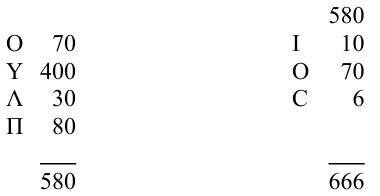
Defending which, he says: “ΟΥΛΠΙΟC is a very well known name of Trajan. And thus it is found written in a Greek inscription, copied in the 60th page of Gruter. This name amounts to DCLXVI: not, certainly, if you write at the end of it Σ, for that would be 200; but ς, as we are now in the habit of writing it when final, or C, as occurs frequently in inscriptions. For C is set down as denoting six, in an inscription composed in honour of Dato, [186] the son of Philo, as quoted by Gruter, page CCCXXVII.; as well as in many other inscriptions, which have been pointed out to me by a very able and learned youth, Isaac, son of that consummate scholar, Gerard Vossius. Besides, ς is always the representative of the same sixth number in the Paschal Canon of Hippolytus,” (is this the same as the Fasti Siculi?) “and in a manuscript of Ptolemy. Bede thus quotes from the ancients: The first” (nota, mark, I presume,) “is ς, which is called episemon, and is the mark of the number VI. In an old alphabet, which comes in after the Catalecta Virgilii, you have, in order, E, ς, Z. Whenever, indeed, the number six was a-wanting, there was no other way of denoting it, but by C or ς. And, most accurately, at the end of numbers, (as, for instance, in this verse of the Apocalypse,) there is set down the same mark, which we are in the habit of placing at the end of names. Is there not something remarkable in thus finding the same number in the units, tens and hundreds? See specimens of this kind of alliteration among the ancients. The fact is, the number six has a specific reference to the things of this world, just as the number seven is employed to designate the concerns of a higher and happier state of existence.”175
175 ΟΥΛΠΙΟC est nomen Trajani notissimum. Et sic scribitur in inscriptione Græcâ quam habet Gruterus, pagina LX. Id nomen facit numerum IOCLXVI, si in fine scribas, non Σ, quod valet ducentos, sed ς, ut nos nunc semper in fine scribimus, aut C, ut non rarò in inscriptionibus: Cenim pro senario ponitur ininscriptione factâ in honorem Datonis, Philonis filii, in editione Gruterianà, pag. cccxxvii., et in inscriptionibus aliis multis quæ mihi indicavit optimus et eruditissimus juvenis. Isaacus Vossius, viri summi, Gerardi Vossii filius. ς autem pro eodem numero senario semper ponitur in Canone Paschali Hippolyti, et in manuscripto Ptolomei. Beda ex antiquis, Prima est ς quæ dicitur episemon, et est nota numeri VI. In Alphabeto veteri post Catalecta Virgilii, habes E, ς, Z. Ubicumque senarius ad numerum deficit, is aliter signari non poterat, quam per C, sive ς. Et recte in fine numerorum eadem ponitur nota, quam ponere solemus in fine nominum. Habet autem aliquid insigne, numerus idem in singulis, denis, et centenis. Sic Fabii Maximi votum de sestertium trecentis, triginta, tribus. Denariis totidem apud Plutarchum. Tum vero senarius numerus res hujus mundi significat, ut septenarius res sæculi melioris.” Grotius in Apocalypsin 13:18, ii. tom., ii. vol , Op. su. pp. 1205, 1206.
[187] Thus has Grotius been allowed to speak for himself. And yet, what, after all, does his advocacy of his own cause amount to? Absolutely nothing.
Unhesitatingly and summarily has his solution been condemned, both by Le Clerc and Mr. Clarke.
The language of the former, after referring to ΟΥΛΠΙΟ, is, “The name of the Beast cannot be the name of any Sovereign Prince, unless we assume that Prince himself to be the Beast. To do so, however, would be adverse to Grotius’ interpretation: who merely introduces one of Trajan’s names as indicating the period of the Beast’s appearance, and makes the Beast himself to be idolatry fiercely raging and spreading havoc around him, after the manner of a wild Beast. Therefore, his solution must be rejected.”176
176 Grotius, qui in nomine ΟΥΛΠΙΟC, quod Trajani fuit, quæsivit numerum Bestiæ. Nam nomen Bestiæ non potest esse nomen Principis, nisi Princeps ille pro Bestia habeatur; quod non vult Grotius, qui Bestiam interpretatur Idololatriam ferino more sævientem, ad vers. 1 in Explic. hujus capitis,” &c. — Le Clerc’s Adnot. in Apoc, in his edition of the Vulgate, with Hammond’s notes, and his own additions. Francfort, 1714, p. 686.
[188] And Mr. Clarke, after remarking, “Grotius fancied that he found this number in Ουλπιος, a name of Trajan, the Roman emperor,” adds, “but in this he is certainly mistaken, as the final sigma, which he makes to stand for only six in the arithmetical computation of this word, was never so valued by the Greeks; as proof of which, we need only refer to the ancient examples, γραυς, Ιησους, and Λατεινος, which contain the respective numbers, 704, 888, and 666, the sigma being taken in each of the words for 200.” Clarke, pp. 51, 52.
Διος ειμι ἠ Ἡρας.
Le Clerc’s own interpretation claims our attention next in order. In his “Annotations on the Apocalypse,” 13:17, having had occasion to quote Dr. Hammond’s notes, he thus, under observation third, comments on them: “Much am I astonished, that this exceedingly learned man, who interprets the former Beast as signifying Roman idolatry, and especially that kind of it which was practised in the Capitol, was not induced to seek for the number of the Beast in the names of the deities who were there worshipped. For my part, assuming, with however moderate a degree of conviction, the views of Grotius and Hammond to be founded in truth, it is impossible for me to help conjecturing that the mark of the name, or of the number of the Beast, ought to be that number to which the names of Jupiter and Juno, — the divinities whose rites were principally celebrated in the Capitol, — when calculated, should amount; and should also be so constructed as to signify, that he who bore that mark was a worshipper of the divinities in question. Thus pro-[189]ceeding, I have discovered the number of the Beast, χξς΄, in these words, Διος ἐιμι ἠ Ἡρας; I belong to Jupiter or Juno.
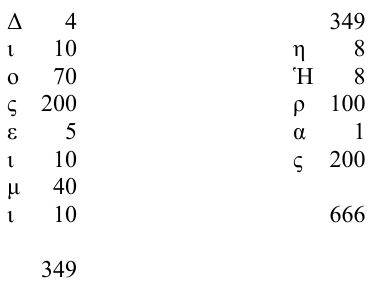
“Therefore, for any one to have marked on his wrist, χξς΄, letters amounting to 666, was the same thing as for him to be marked with the words, Διος ειμι η Ηρας, I am of, or I belong to Jupiter or Juno: words by the use of which persons professed that they were worshippers of the deities of the Capitol. This, or something like this, seems to have been intended. Not that this always literally took place, or that Christians were always compelled to receive the impression of such a mark, under pain of being interdicted from all the privileges and benefits of civil society: the utmost that I mean to convey being, that in this phraseology and imagery is implied the necessity of a public profession of idolatry, of which branding with such marks was understood to afford open and satisfactory evidence.”177
177 Miror virum doctissimum, qui priorem Bestiam interpretatur Idololatriam Romanam, et præsertim Capitolinam, non quæsivisse numerum Bestiæ in nominibus Deorum Capitolinorum. Ego, equidem, iis quæ habeat Grotius et Hammondus tantisper adsumptis quasi veris, conjiciens charagma nominis, aut numeri Bestiæ debuisse complecti numerum quem conficiunt literæ nominum Jovis et Junonis, qui in Capitolio potissimùm celebrantur; et significare eum qui id gerebat, cultorem fuisse horum Deorum; inveni numerum Bestiæ χξς΄, in hisce vocibus: —

Igitur, qui carpo inscriptum habebat χξς΄, quæ literæ faciebant 666, perinde erat, ac si ei inscriptum fuisset, Διος ειμι η Ήρας, Jovis sum aut Junoni; quibus profitebanturA se Capitolina Numina colere. Hoc aut simile quid significari videtur; non quod semper factum fuerit, coactique sint Christiani suscipere ejusmodi charagmata, ni vellent sibi aquâ et igne interdici: sed significatur publica professio Idololatriæ, cujus notæ ejusmodi inustæ, insigne erant argumentum. — Le Clerc’s Adnot. in Apocal. (Lat. vulg .) Francofurti, 1714; pp. 685, 686.
A Note from the Errata: Query, profitebatur?
[190] To confute Le Clerc is surely quite unnecessary, when, to the passage just quoted — indicating no small share of ingenuity — we find him immediately adding: “This conjecture of mine, I do not propose as affording certainty even to my own mind; for I confess that very few things, in prophecies of this kind, are clear to me: but merely as agreeing better with the other interpretations of (these) [191] eminently learned men, (Query, Grotius and Hammond?) than that of Grotius.”178 We therefore pass on.179
178 “Hanc conjecturam non profero quasi certam; fateor enim pauca in hisce vaticiniis clara mihi esse: sed quasi melius consentientem cum ceteris interpretationibus virorum doctissimorum, quam quod habet Grotius.” — Le Clerc, ut supra.
179 Considering the hesitation with which Le Clerc propounded his conjecture, Archdeacon Wrangham it strikes me has not, in adverting to it, acted altogether fairly towards him. To judge from the learned dignitary’s words, one would be apt to conclude, that the foreign divine had expressed himself much more confidently than he actually did: — “Clericus, in his Supplement to Hammond’s Paraphrase, with the true zeal of a system-monger, contends, that Διος ειμι η Ηρας, appropriates the number to Paganism, as Jupiter and Juno were the principal Capitoline Deities.” — Works, vol. ii , pp. 408, 409.
Η Μισσα ἡ παπικη.
“Alii,” observes De Dieu, in loc., “ex ἡ μισσα ἡ παπιση, circùm annum Christi 666 primùm cani cæptâ, eundem numerum eliciunt.” Others bring out the same number from Greek words signifying the popish mass, which first began to be chanted about A.C. 666. See Wrangham, vol. ii., p. 409.

[192] This is so obviously a mistake, that I presume the words, as written by De Dieu, to have been “ἡ μισσα ἡ παπικη.”
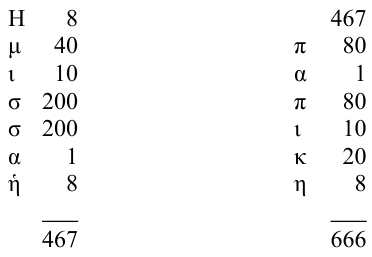
Λουθερανα.
Two attacks on the great German Reformer, Luther, as the Beast, through the medium of the Greek language, demand attention for a few moments.
One of these, given by John Selden, in the first of his three Supplementary Tracts, already alluded to,180 is Λουθερανα, mis-spelled Λουθερωνα: “a word,” as Mr. Clarke remarks, “made evidently for the purpose.”181
180 See pp. 179-184.
181 “Luther’s name in Greek is Λουτὲρος, and not Λουθερανα. See Dosith. Patres Hierosol., Lb. xi., c. 2, § 2, 3, 4.” — Clarke. Mr. Elliott (Hor. Apoc., vol. iii., p. 216, note,) says, ” The proper version of his name is Λυθερος, or Λουθερος.”
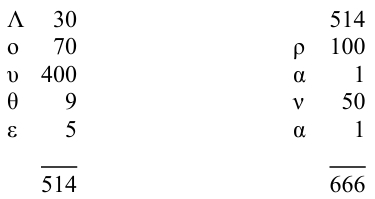
[193]
Σαξονειος.
The other, (along with the name of David Chytræus, in Hebrew,) I find cast in the teeth of Protestants by Bellarmine: “Addo, ergo, ingratiam Lutheri,” says the cardinal, exultingly and sneeringly, “nomen Σαξονειος, eundem numerum reddere: quod nomen ita convenit Luthero, sicut Papæ nomen Latini.”As I wish to do Luther a favour, I make him a present of the word Σαξονειος, Saxon, which contains the number in question: this name being just as suitable to him, as that of Latinus can be to the Pope. — Bellar. Disput. tom. i. col. 730.
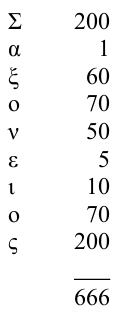
Speaking of the attempts which have been made by Roman Catholics to fasten upon Luther the character of the Beast, Mr. Elliott, I observe, says, after mentioning “Σαξονειος, the Saxon,” that “Σαξονικος” is “the proper adjectival form.”182 “Σαξονειος, for Σαξονιος.” — Wrangham.
182 Horæ Apocalypticæ, vol. iii., p. 216, note.
[194]
Βεζζα αντιθεος.
T. Beza has come in for his share in this rather untoward appellation. Βεζζα αντιθεος, Beza, God’s enemy, is supposed to fasten the charge on him.
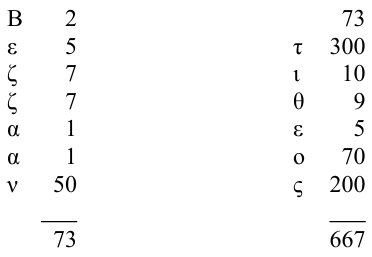
There is obviously a slight redundancy here. Qy, — Βεζζ’ αντιθεος? The initial of his christian name, T., would spoil the computation.
Ηἀλαζονεια βιου.
Mr. Clarke, in Selden’s Supplementary Tract No. 1, finds the number 666 mentioned by him, — without any reference, however,183 — as occurring in the Greek words, ἡ ἀλαζονεια βιου, (1 John 2:16, του omitted,) translated in our version “the pride,” and by Mr. Clarke “the evil vaunting of life.” Like Mr. Clarke, I am unable to make out of its letters more than 665.184
183 “Others, out of the ἡ ἀλαζονεια βιου.” Selden, tom. ii., part ii. , col. 1402.”
184 “Η ἀλαζονεια βιου, (665,) to which Alcasar ineffectually labours to add another unit.” See Wrangham’s Works, vol. ii., p. 418.
[195]

185 Could the word βιου have been written Βιαου? If so, we at all events have the number. Βιαου, being assumed as written for βιαιου, we should read, “The pride, or vain-boasting of the violent man,” who might be understood to be the Pope, or any other obnoxious party.
Μαομετις, or Μοαμετις.
Come we next in order to Μαομετις, or Μοαμετις, Mahomet.

This is one of the most celebrated solutions of the name of the Beast, and is much in favour with the Roman Catholics. Even in modern times, and among Protestants, it seems to have been adopted as the basis of Apocalyptic interpretation. At least, so says Mr. Elliott, in his Horæ Apocalypticæ, vol. iii., with reference to a writer in the British Review, No. 36, p. 424.
With whom the conjecture originated I cannot tell. I suspect it to be rather an old one. Mr. Elliott ascribes it to Massuet. In a note contained in Mr. Rabett’s [196] “Λατεινος,” p. 130, we read, “Feuardentius, so far as I know, was the first who struck out MAΟΜΕΤΙΣ, or ΜΟΑΜΕΤΙΣ, as the name of the Beast. Annot. in Iren. p. 486. But with wise caution he hesitates between the false prophet Mahommed, and the false prophet Luther; for he finds that, provided we write Martin Luther, MARTIN LAUTER, we shall equally produce the desired number 666.” Selden merely mentions the word Μαομετις as one of the solutions given.
Whatever may have been the origin of this guess, it has found in modern times one of its most strenuous supporters in the person of Dr. Walmesley, the late Roman Catholic Bishop of Bath and Wells, better known by his assumed name of Pastorini. See his “General History of the Christian Church,” chapter x. Mr. Clarke says distinctly that this prelate “copied from Massuet.”186
186 “Gen. Hist. of the Church, p. 366, Edit. 1771; and Iren. adv. Hæreses, a Domino Renato Massuet, Edit. Paris, 1710, p. 200, Varior. Annot.”
Mr. Faber, in his “Recapitulated Apostasy,” thus expresses himself, with regard to this solution, and the Bishop its supporter: —
“The name MΑΟΜΕΤΙΣ may rejoice in the rare felicity of having been adduced at divers times, both by Protestant and by Popish expositors. Yet, even independently of the falseness of the principle upon which they work, we may well ask, Where is the indisputably final authority, even for writing at all, still less therefore for exclusively writing, the Arabic name of the impostor with the precise Greek letters which compose the word ΜΟΑΜΕΤΙΣ?
[197] “By the Popish expositor, Bishop Walmesley, (who clumsily fancies, however, that his ΜΑΟΜΕΤΙΣ will be some yet future personal Turkish Anti-Christ, assuming or bearing the name of the Arabian impostor,) we are told that the word is thus written by Euthymius, and Zonaras, and Cedrenus.
“Now, even if Walmesley were accurate in his statement, what then? Other historians of the later empire express the name of the prophet of Mecca in various other forms. Why, therefore, for the purpose of arithmetical calculation, are we bound to take the alleged MAΟΜΕΤΙΣ of Euthymius, and Zonaras, and Cedrenus, rather than the ΜΩΑΜΕΔ of Nicetas, or the MEXMEΤΗΣ of Chalcondylas, or the MAXEMET of Joannes Cantacuzenus, or the MEXEMET of Ducas Michael, or the ΜΩΑΜΕΘ and ΜΑΧΟYMETHS of Joannes Cananus?
“By reason of the essentially different principles of alphabetic writing, which severally prevail in the east and in the west, scarcely any two occidentals, except by previous concert, will express a Hebrew or Arabic word perfectly alike in Greek or Roman letters. Consequently, since, down to the present day, the name of the grand impostor has been written in almost an endless variety of forms, those who seek for the number 666 in his name expressed in Greek letters, ought first to demonstrate, that the particular form MAOMETIS must, from some inherent necessity, be critically adopted; and that all the other forms must, from some inherent necessity likewise, be critically rejected. In fine, any person acquainted with Hebrew or Arabic will, from the very genius of these languages, readily perceive the utter impossibility that the [198] enigmatical name, alluded to in the Apocalypse, should be an Arabic word, written and numbered in Greek characters: because such a circumstance would make the absolute strictness of an arithmetical calculation to depend upon the inherent laxity of an alphabetical expression.
“Such would be the immediate objection to the word ΜΑΟΜΕΤΙΣ, even if Bishop Walmesley had been correct in his allegation; but, where the interests of their church either are, or are supposed to be concerned, the assertions of the Romish Priesthood must in no wise be implicitly received. Cedrenus writes the name ΜΟΥΧΟΥΜЕТ; Zonaras writes it ΜΩΑΜΕΘ; and Euthymius, like Zonaras, also writes it ΜΩΑΜΕΘ, or, (as it appears in a manuscript of the Panoplia, left by Bishop Fell to the Bodleian Library,) ΜΩΑΜΕΔ. Not one of them writes it ΜΑΟΜΕΤΙΣ, though Bishop Walmesley assures his wondering readers that such, with rare unanimity, is the orthography of them all.”
The exposure of the Bishop’s disingenuity, or, supposing him to have said what he has done on the authority of others, of his culpable negligence, by Mr. Clarke, is still more minute and searching: — “Dr. Walmesley, the late titular Bishop of Bath and Wells, copying from Massuet, approves of this word” Μαομετις, “and says, that its orthography is acknowledged by Euthymius, and the Greek historians, Cedrenus and Zonaras. But there is nothing more false than this assertion; for, of the seven different ways in which Mahommed’s name is written in Euthymius and the Byzantine historians, not one is the orthography in question. The seven different modes of writing this name are, Μωάμετ, Μωάμεδ, Μωάμεθ, Μουάμεδ, [199] Μουάμεθ, Μουχόυμετ, and Μαχόυμετ. These words, with the number contained in each, and the authorities by which they are sanctioned, are as below: —
Μωάμετ = 1186. Euthymius.
Μωάμεδ = 890. Nicetas, Cedrenus, Euthymius.
Μωάμεθ = 895. Cananus, Zonaras, and Euthymius.
Μουάμεδ = 560. Theophanes.
Μουάμεθ = 565. Cons. Porphyrogenitus.
Μουχουμετ = 1925. Cons. Porphyrogenitus, Euthymius, Cedrenus, Nicetas.
Μαχουμετ=1456. Cantacuzenus.”
The copious and minute references of Mr. Clarke, I do not copy. They may be seen by consulting his work, pp. 54, 55.187
187 Considering the complete exposure of Bishop Walmesley, and his Roman Catholic coadjutors, in the pages of Faber, Clarke, and Rabett, how are we to account for such language as the following, from the pen of Professor M. Stuart: — ” In the sequel, however, this editor,” Feuardentius, “does the justice to other renowned men of his church to mention, that they have conjectured the word Μαομετις, οι Μοαμετις, (as Euthymius, Zonaras, and Cedrenus write it,) i.e., Mahommed, the name intended by the Apostle; for the numerical value of its letters = 666.” Excur. iv. p. 454. Is Mr. Stuart merely quoting Feuardentius? or, does not his complete abstinence from all allusion to the detected falsehood of the learned Papist’s assertions, look as if the Professor so far acquiesced in their truth? Perhaps his language is the result of ignorance.
What I have to introduce with respect to this far-famed interpretation, Μαομετις, or Μοαμετις, may be fitly closed by the following quotation from Mr. Rabett. Speaking of Mr. Faber’s language, that gentleman says: “To the [200] foregoing observations of Mr. Faber, in answer to the Romish Bishop Walmesley, we may add another, which is, that the TERMINATION of the Name Μαομετις, as written by the said Bishop, is a LATIN TERMINATION, and not Greek; for, if it were the latter, it ought to be written with ος, or ης, as Μαομετος, or Μαομετης; and then the one would produce the number 726, and the other 664, neither of which would correspond with the sacred number 666; and this circumstance alone is sufficient to eject the name Μαομετις from further use, the ORTHOGRAPHY being spurious.” — Rabett’s “Λατεινος,” p. 132.188
188 Mr. Elliot observes, that in Pope Innocent’s Bull, convoking the fourth Lateran Council, A.D. 1213, the name of Mahomet is spelt in Latin, not Maometis, but Machomettus. See Hor. Apoc., vol. iii.
Μαομετης Β.
To my friend Mr. Clarke I am obliged for the information, that another Mahomet has, by one author at least, been made to share in the somewhat questionable honour generally bestowed on his more illustrious predecessor. “John Floyer tells us, in his ‘Exposition of the Revelation,’ p. 48, London, 1719, that 666 is contained in Μαόμετης β, ‘Mahommed the Second,’ the Turkish Sultan who took Constantinople from the Greeks, A.D. 1453.”
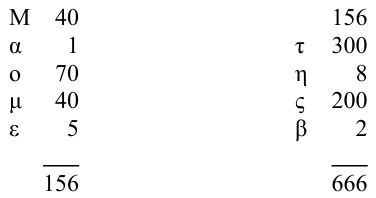
[201]
Θεος ειμι επι γαιης.
From Mr. Rabett we derive the following Greek conjecture: Θεος ειμι επι γαιης; I am God upon earth.189
189 See his “Λατεινος,” or “The Name and Number of the Beast,” pp. 118, 119.

This solution, I content myself with merely stating. [Sentence added from the Errata: It is one of those which are mentioned by Foxe, in his Eicasmi.]
Ιαπετος.
I am indebted to Mr. Clarke for the remarks contained in the following extract from a Worcester edition of Potter’s celebrated work,190 — the edition of it which is in my possession, being the original one printed at Oxford, in 1642: — “‘Abram, which signifies in Hebrew a mighty father, when written in Greek characters, contains, according to the amount of its numerical letters, the number 144. (Αβραμ.) See Gal. 5:1, &c., and Isaiah 12:2. In contradistinction, the papal territory was colonized by Japhet, whose name signifies seduction and latitude, and [202] contains, in Greek numerical letters, the number 666. (Ιαπετος).'” — Clarke, pp. 55, 56.
190 Published 1808.
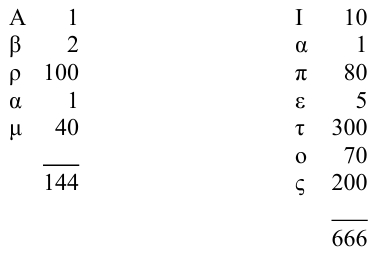
So that, according to the ingenious author of this solution, we must go back to our ancestor Japhet, in order to find the Beast of the Apocalypse! Comment upon such a notion is certainly unnecessary.
Παπεισκος.

Clarke, prosecuting his theory of the impossibility of employing the diphthongal form of ει to express the Latin i, at once rejects the word: “Grabe remarks, that the word Παπισκος is found in the Codex Claromontanus of Irenæus, instead of Τειταν:191 but this is evidently a [203] corruption. The word Παπισκος is the diminutive of Παπας, Pope, and only contains the number 666 by writing it with the diphthong ει.” Dissert. p. 48. — Mr. Elliott’s observations, (Horæ Apocalypticæ, vol. iii ., p. 215,) are: “Παπεισκος, (with the diphthong,) given in the Codex Claromontanus of Irenæus: Clarke, p. 48.” — “I give this for curiosity, not correctness; the proper word for Pope being, of course, Παπας. But what was the date of this marginal or interpolated reading? Was it before the twelfth century? And is it the memorial of an unknown Greek Christian, suspecting the true character of the Pope, as Anti-Christ, even before the Waldenses?”192
191 Irenæus adv. Hær. ed. Grabe. Prolegom. p. xv.
192 Wrangham also alludes to this word. “It is merely on the principle of comprehension that I introduce the conjecture παπεισκος, which may in some measure agree with Papa, or what we call in English, Pope.” Vol. ii., p 418.
Στυρμιι.
“Sturmius, in a German 8vo., upon the subject, (Rostock, 1716,) has collected many additional illustrations, all referring either to the name of some Pope, or to some badge or description of the Papacy; sometimes, indeed, trespassing a little in the idiom, or the orthography of his Greek, and sometimes in the numerical interpretation of the separate letters. This has been proved by an adversary, who finds in Sturmii (Qu. Στυρμιι) nomine et condititione, Græce descriptis, the all-pervading number.” — Wrangham, Works, vol. ii., 409.
Στυρμιι, so written, will not answer.
[204]

Nor will the word written ςυρμιι, using the contractions as identical with the episemon Fau. As witness,

Some Greek letter, ρ, perhaps, for Rostock, or two or three others, are required to make up the deficient hundred.
Διοκλασιανος.
Most ingeniously says Archdeacon Wrangham, in a note on Bossuet’s Diocles Augustus, “Διοκλασιανος, both numerically and as a persecutor,” [he might have added, “even as a Greek solution,”] “would have answered much better than Grotius’ Ουλπιος.”
And so it would.
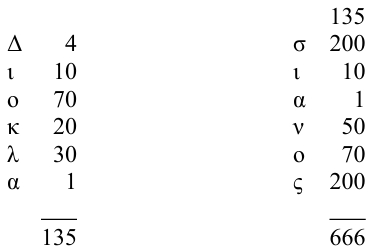
[205]
Χεινα.
The “Gentleman’s Magazine,” for February, 1753, pp. 89, 90, contains a letter, signed T. H., in which, after some prefatory observations, the following passage occurs: “The learned, many of whom have studied this point, have not hitherto, as I know, given any probable or plausible conjectures concerning it.” (The number of the Beast.) “Whether what follows is so, or not, I leave to the determination of the judicious and ingenuous. Thus much is certain, that there is a great empire in the world, I mean China, whose name, written most properly in Greek letters, (viz., Χεῖνα, with ει,193) gives exactly the number mentioned by St. John, six hundred and sixty-six.

193 “Thus Nilus is in Greek Νε̃ιλος, Crocodilus, Κροκοδε̃ιλος,”&c.,&c.
After repelling certain supposed objections, and mentioning the tradition of there having been an ancient Emperor of China, “called China, who gave name to the country,” the writer adds: “I could expatiate farther on this subject by observing, that the Beast in the Apocalypse is said to receive his power from the Dragon, and that a Dragon is the arms of the Emperor of China, and used by the Chinese as their chief ornament in sculpture and painting.”
[206] The author of the preceding solution, (not altogether destitute of ingenuity,) has, I perceive, inserted an explanation of the whole of the thirteenth chapter of the Book of Revelation, in the number of the same Magazine, for March of that year, (1753.) pp. 111-114. According to his amplified comment, the first Beast is China itself, (the sea out of which it proceeds, indicating the greatness of its population,) and the second Beast is its Tartar Government.194
194 To my young friend, Mr. William St. Clair, I owe having had my attention turned to the above solution.
Βραςκι.
“The family name of the late Pope Pius VI., in Greek, (Βρασκι,) amounting to 333, he, with his nephew, the Duke di Braschi, — which may imply the characteristical nepotism of the Romish Church, — jointly complete the sum. — Wrangham.
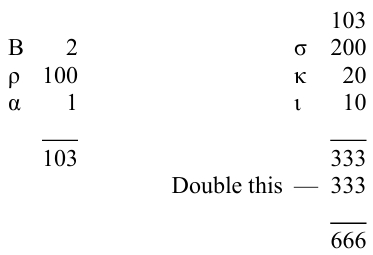
Ιον Παυνε.
When Dr. Geddes, “of Macaronic memory,” as Wrangham phrases it, has occasion to “record one of his friends, John Payne, as the
— Sacro prædictum in codice Payneum;”
[207] the learned Archdeacon conceives the following to be the solution:
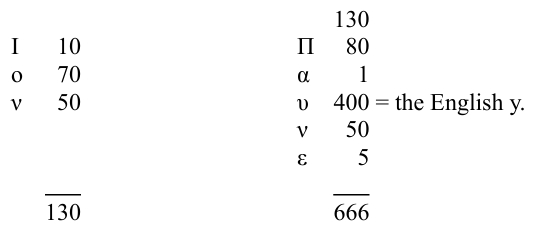
“By the same system of numeration,” observes the reverend dignitary, “the loyal subject finds the prophecy couched in ‘Tom Paine, Exile.'” — Works, vol. ii., 417, 418.
Κου-ποκς.
I presume that a mere reference is all that is required to “Cow-pox” adduced, or rather “asserted,” to be the Beast, “by a German physician at Francfort.” Wrangham. The Archdeacon’s suggestion, κου-ποκς, although certainly amounting to 666, when the final ς is assumed to be the episemon Fαυ,

is too obviously a mere joke, (awful is this trifling with God’s Word!) to merit a moment’s attention.
[208]
Βοννεπαρτη.
“Hioam finds the number 666 in the surname of the present French Emperor, by absurdly writing it Βοννεπαρτη.” Clarke, p. 55.195
195 Mr. Clarke published his “Dissertation” in 1814.

The observation of Archdeacon Wrangham is: “With a happy variety of orthography,” the fatal number has been found in the English vulgarism, and by the Greek notation, Βοννεπαρτη! (See motto to Hioam’s ‘Thoughts on Prophecy.’)” To which the learned writer from whom we are quoting adds, “another writer finds the three sixes in the eighteen letters constituting the name of that Chieftain!!!”
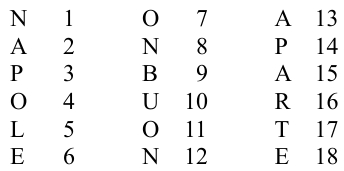
Να. Βουοναπαρτε.
“So late as 1815, a book was published in Germany, in which the writer proposed to bring Napoleon Bonaparte [209] within the meaning of 666, whose name he writes Nα Βουοναπαρτε, or Και—ρ [Καισαρ] Παρισιδι.” — M. Stuart, Commentary, Excur. iv., 455.
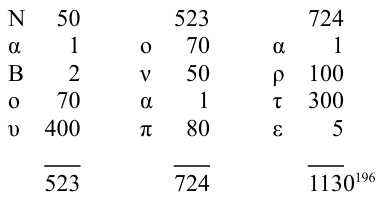
196 Here is obviously a mistake. Should it not be either Na Bοαανεπαρτε, οι Ν. Βονηπαρτε?
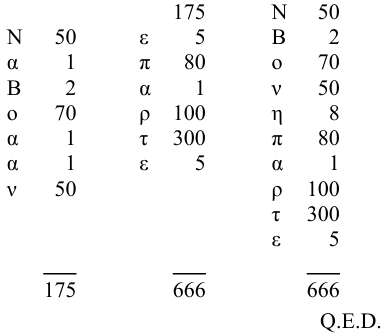
——————————————————

197 I cannot correct this. Any one who considers the matter worth determining, may here exercise his ingenuity. We want 120. — Upon second thoughts, are the Greek initials P and K to be added to Και—ρ? P for Ρομανος, or Ρωμανος,A and K for Καινος: meaning, “the new Roman Emperor at Paris?” Observe. I am merely suggesting an enquiry. In P, 100, and K, 20, we have the missing number.
A Note from the Errata. J. Foxe has employed Poμ(α)νυς, (see p. 386;) and Pομανος, or Ρωμανος, may be conceived to be modern ways of expressing the word Roman in Greek letters. The scholar, however, does not require to be told that Ρωμαιος is the classical word having that signification. Has any of my readers a Greek New Testament at hand? Let him turn to Acts 22:25,26,27,29.
[210]
Ευπορια.
I conclude my list of Greek guesses, coming under the head of Gematria, with the latest which has attracted my notice. I mean the word Ευπορια, wealth.
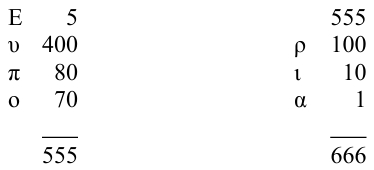
This conjecture appears in a small and unpretending, but cleverly-written volume, published anonymously by Samuel Bagster and Sons, London, 1844, and entitled, “Wealth the Name and Number of the Beast, 666, in the Book of Revelation.”
Having evinced much reading and much thought on the subject, in the preceding portion of his treatise, the author proposes the “Demon of Tyranny, and the Demon of Wealth,” as being the two Beasts of the thirteenth chapter of the Apocalypse. In the name of the latter he finds the number sought for.
It is due to the able inventor of this solution to mention, that, according to his own statement, he did not first select ευπορια, and then attempt to construct a theory for it: on the contrary, having observed “how active a [211] passion wealth is at this moment in England, among a people professing Christianity, and yet how contrary it is to that spirit which the Gospel inculcates,” at once, while engaged in such reflections, “the thought occurred to” him, “Can this word Wealth be, in the Greek language, that Name of the Beast which St. John describes, when he says it contains the number 666? On turning to the Greek,” he “found the word was ευπορια; the letters of which — formed, to” his “great surprise, when summed up, the exact number 666.” Pp. 2, 3. He afterwards found, that not only was it a legitimate Greek word, but that it is employed in the New Testament itself. Demetrius the silversmith, addressing those of his own craft, is represented in Acts 19:25, as saying, ‘Ανδρες επίστασθε, ὅτι ἐκ ταύτης τῆς ἐργασίας ἡ ευπορια ἡμων εστι; rendered in the common version, “Sirs, ye know that by this craft we have our wealth.” Pp. 4, 5.
2. — SOLUTIONS ON THE PRINCIPLE OF NOTARIKON.
With but a very few of these am I acquainted. Such as I know, have been derived by me from the pages of Wolfius, Clarke, Wrangham, and Elliott, with the addition of one from John Glas.
Notarikon is the method of solving a mystery by means of the initial letters contained in certain words; or, adopting Wrangham’s explanation, according to it, “letters are made to designate words.”
The best defence of having recourse to this method of solving the Apocalyptic enigma, — without saying anything as to the source whence he derived it, — is that given by Mr. William Jones, in his “Lectures on the Apocalypse,” [212] p. 438. “Before dismissing this subject, however, allow me to add, by way of meeting an objection which may be started by some against our considering these letters to be the initials of three words, that we have something like a sanction for it, in what you will find recorded Daniel 5:25-28. Here, you see, are three words, which stand for three sentences: ‘MENE, TEKEL, UPHARSIN. MENE, God hath numbered thy kingdom, and finished it. TEKEL, Thou art weighed in the balances, and art found wanting. PERES, Thy kingdom is divided, and given to the Medes and Persians.‘ Now, if the All-wise God thought fit to make these three words stand for three sentences, why may not the three initial letters be put for three words, especially in a motto? I cannot for my own part conceive of any well-founded objection to our thus considering the number of the Beast, viz., as a motto descriptive of his character, and of all who worship him.”
Χριςον ξενίζοντα ςαυρων.
According to Wolfius,198 and to Clarke, in this respect copying from him,199 “Mr. Henningius Huthmannus, in a German tract of his, entitled, ‘Tausend jahrige bindung des Satan’s,’ &c., interprets the letters χ, ξ, ς΄, standing for the number 666, to signify the initials of the words χριστον ξενίζοντα ςαυρῶν, ‘crucifying the hospitable Christ.'”200 Julian the Apostate, it seems, is the person understood by the learned author to be meant.
198 Wolfius’ Curæ Phil. et Crit. Hamb., 1741. Ed. Secund., p. 549.
199 Clarke’s Dissert. p. 66.
200 Or, more correctly, I think, according to Wrangham, “Christum hospitantem (apud se) crucifigens,” — Say, crucifying Christ the brief sojourner (upon earth.)
[213]
Χριστομαχος ξυσθεὶς ςεφανοφορος.
Wolfius and Clarke give a second specimen of the letters χξς΄ being assumed “to point out the initials of Anti-Christ’s name or actions.” This is a solution of Zacharias Portzigius. It occurs, it seems, in the “Collectio Novantiquorum Theologicorum,” An. 1733, p. 662. Treading in the footsteps of Huthmannus, in so far as the principle of his solution is concerned, Portzigius, satisfied that the letters refer to Anti-Christ, κατ’ έξοχην, would rather interpret them as the initials of χριστομάχος ξυσθεὶς στεφανοφόρος, the shaven, crown-wearing, opponent of Christ.
Χριστιανοι ξενοι ςαυρου.
The writings of John Glas, although in many respects most valuable, and the source from which Robert Sandeman and others have drawn much of their information, are at the present day little known, and but little consulted. In Glas’ “Vision of the Sealed Book,” contained in the 2nd volume of his Works,201 p. 390, I find a guess at the name of the Beast, founded on the principle of Notarikon. Χξς΄, according to him, “are the initials of three words, that give a true description of all the followers of the Beast, in opposition to the followers of the Lamb, and make up a character which will agree to none but the Beast and his followers.” The words are, χριστιανοι ξενοι [214] σταυρου, Christians strangers to the cross.202 “This description,” observes he, “will not agree to any that make not some profession of being Christians; nor to any but Christians falsely so called.” Whether or not Glas be original in his conjecture, I have not the means of ascertaining. Borrowed, I suspect it to be.203
201 The whole in 4 vols. 8vo., published by Donaldson, Edinburgh, and sold by Richardson and Dilly, London, 1761.
202 At page 397 of the same volume, and in a subsequent part of the same treatise quoted from in the text, Glas conjectures that the Greek letters ρ, μ, δ,, signifying 144,000, and applied in Rev. 14 to the company assembled on Mount Zion, “may make up a character and motto for the followers of the slain Lamb, directly opposite to the motto or description of the Beast and his company.” Pursuing this idea he finds ρ, μ, δ,, the initials of ρηματος μαρτυρες διωκομενοι, the persecuted witnesses of the word.
203 Glas is a tedious and prosy writer; and yet, what child of God, who has read it, can fail to bear testimony to the sweet scriptural simplicity, and edifying character, of his “Testimony of the King of Martyrs?” Vol. i., pp. 1-148. Е. Е.: exceptis excipiendis, or errors excepted, of course, as commercial men say.
What immediately precedes, was all that I originally wrote respecting Mr. Glas’ hypothesis. Since then, however, in consequence of a literary and respected friend, Mr. John Read, having drawn my attention to the “Lectures on the Apocalypse” of the late Wm. Jones, M.A., (author of the “History of the Albigenses and Waldenses,” &c., &c.,) published in 1830; and spoken of a very interesting solution, founded on Greek initials, as contained therein; I was induced to procure, and partly to peruse the work. The reader may easily conceive what was my astonishment, when, on turning to the remarks on Rev. 13:18, I found Mr. Jones adducing and appropriating to himself the solutions of Glas, which I have just [215] been noticing. I say advisedly, “adducing and appropriating to himself;” for although he does not say, in so many words, “I invented these solutions,” the manner of his introduction of them, the almost parental pride with which he speaks concerning them, and the whole scope of the passage where they occur, will bear no other interpretation than that they are his own. Not the slightest hint is given, as to any one else having either thought or spoken of such solutions before. It is one of the most decided specimens of the suppressio veri and suggestio falsi that I have ever met with. He has mentioned the guesses of Irenæus, Macknight, Faber, and Potter: referring each to its respective author, with something even like a parade of ingenuousness. Faber’s notions respecting αποςατης, he has carefully and neatly abstracted. The χριστιανοι ξενοι ςαυρου, and the ρηματος μαρτυρες διωκομενοι, — published as his by Glas, in 1761, — Mr. Jones sets down, in 1830, with an evident intention that they shall be received and regarded as his own. Neither Glas nor any other writer, as having preceded him in the discovery, is once referred to. Is it too much to say, that such procedure is disgracefully unfair? That it is a piece of gross literary plagiarism? — It cannot be pled, as an apology for Mr. Jones, that he was ignorant of John Glas’ writings. His “Autobiography,” lately edited by his son, and his “Memoir of Archibald MacLean,” prefixed to the sixth volume of A. M.’s works, (1823,) — now lying before me, — render such a supposition utterly untenable. “Perhaps he got the solutions from a source common to Glas with himself.” Then, why not say so? Why assume the solutions as his own? For upon this hypothesis, no [216] less than upon the other, the charge of plagiarism would remain. My own fixed and deliberate opinion is, from a comparison of his “Lectures” with Glas’ “Vision of the Sealed Book,” &c., that from Glas he directly took, — (stole, should I not rather say?) — merely abstracting and condensing. Why such disingenuous conduct on Mr. Jones’ part? I think that I could explain — but I would rather not. The facts are as I state them.
Χξς. — χρς.
Transcribing literally from Mr. Clarke, we read: “The opinion of C. A. Heumannus upon the number 666 is truly singular. He says, ‘the mark and character of the Beast is χξς΄. This,” adds he, “is not to be taken in the literal sense, as if the number 666 were intended; but the solution of the enigma is as follows: the false prophet has on his front and back the appearance of a Christian, (for X is the first letter of the name of Christ, and ς is the last, or rather the first letter of the second syllable,) and he will be accounted a guide of the Christian Church, and boasts himself to be the Vicar of Christ. But the snake lies concealed in the grass, i.e., he has the ξ, (which is the figure of the serpent, or devil, Apoc. 12:9, and 20:2,) in the middle, as if in his belly, or” as occupying the very inmost and central parts of his system. “The serpent, therefore, or the devil, animates him, governs him, speaks through him, and kills the saints.”204 Clarke’s information as to this, is, like my [217] own, derived from Wolfius’ Curæ Phil. et Crit., and Wolfius derived his from Heumann’s “Resolutio ænigmatis Apocalypticæ,” as given in the Biblioth. Bremen. cl. 1, pp. 864, sequent. Elliott, I observe, ascribes Heumann’s conjecture to Tichonius as its author; and seems to intimate that as χρς, displayed on the Labarum, or sacred standard, pointed to Christ, so did χξς, so similar, and yet involving the ξ of the crooked serpent, point enigmatically to his bitter and decided antagonist. — See Hor. Apoc., vol. iii., p. 218.
204 Sententiæ summa, p. 869, his verbis exhibetur: — “Signum Bestiæ et character est (sunt) χξς. Hoc non est capiendum sensu literali, quasi numerus 666 denotetur. Sed hæc est hujus ænigmatis mens: pseudo-propheta ille à fronte et à tergo speciem præbet Christianismi, (X enim est prima litera nominis Christi, et ς est ultima ejus litera, vel, si mavis, ς est prima litera secundæ syllabæ nominis Christi,) et vult haberi pro duce Ecclesiæ Christianæ, seque jactat esse vicarium Christi; verum latet anguis in herbâ, h. e., in medio; et quasi inventre suo, sive intus et in cute, habet το ξ, quæ est figura Serpentis, i.e., Diaboli, Apocalyps. 12:9, et 20:21. Serpens, igitur, sive Diabolus, animat eum, et gubernat, per eumque loquitur et Sanctos occidit.” Wolf. in Apoc. 13:18. — Cu. Ph. et Cr., vol. ii., ed. 1741, p. 549. — Extracted from an abridgment of Heumann’s ‘Resolutio ænigmatis Apocalypticæ,’ given in the Bibliotheca Bremensis,” cl. 1; pp. 864-869. Quoted by Clarke, pp. 67, 68.
Napier, following up somewhat more in detail the last-named conjecture, or rather proposing a similar one, is represented by Wrangham as thus expressing himself. “Xρς is contained in χξς; the two extreme letters agreeing respectively in one, and the small disagreeance of the middlemost, (to wit, between ξ and ρ̃,) being upon very necessity; for whereas St. John here speaks expressly of numeral letters, he could have no one numeral letter to represent both ρ and his crown; this was ρ̃, more like it [218] nor ξ, whereof the upper part represents the crown, and the nether part the figure of ρ. Moreover, there is yet greater affinity between ξ and ρ; for ρ, or rather ϱ, after this form in the Greek, and ξ in this Beast’s language and common written letter in Latin is X, which is all one in figure!” &c. — “As to the name of the cross, in Latin, crux, and in Greek ςαυρος, it is not possible for them to be expressed under so few letters more vively nor [than] they are here; for here have you their chief letters, even both their capital and their final — for by X and ξ have you in Latin C and X making crux, or CH and X, making, barbarously, chrux, as I have seen and heard it so in print and pronounced. And again, by the last letter, ς, have ye the Greek name of the Cross, ςαυρος, likewise expressed by his capital and final letters,” &c., &c. — Wrangham’s works, ut supra.
Let these few solutions, on the principle of Notarikon, suffice. Doubtlessly the ingenuity of man may easily find out a vast number of other Greek words, of which the letters χξς are the initials.
[219]
SUBDIVISION THIRD.
SOLUTIONS SUGGESTED BY THE HEBREW METHOD OF NUMBERING.
We begin with three furnished us by Vitringa, when commenting on Apoc. 13:18.
First.
רבת הגוים, a multitude of the Gentiles.
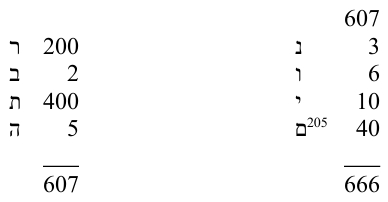
205 “The ם final,” Mr. Wrangham most correctly objects, “is [here] lowered to its medial value of 40!” See Hebrew numeration.
Secondly.
רובה ורברמה, high and magnificent.*

* Note from the Errata. Wrangham reads the second of the guesses, (the former of his,) רומה ורברבח. Thus
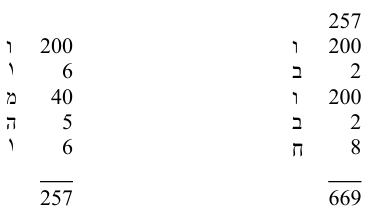
The Archdeacon meant, I presume, to read the last letter, ה, 5; which brings out the amount. — Wolfius, from whom, I suspect, the learned dignitary quotes, has the same words.
[220]
Thirdly.
אדניקם, Adonikam.
This is adduced by the learned and ingenious author, not on the ground of its letters amounting to 666; but on account of the number of the family of the person named, which returned from the Babylonish captivity, having been 666. This appears from Ezra 2:13: children of Adonikam, six hundred sixty and six.
Wolfius, in his Curæ Phil. et Crit., vol. ii. pp. 545, 546, enters at some length upon Vitringa’s observations as to this word. He concludes by saying, “Significatum verò illum mysticum, p. 635, ita exponit, quod idem sit, atque si dicas, ‘Dominus Insurgens,’ sive ‘adversarius,’ vel ‘adversarius Domini,’ quam notionem egregie quadrare putat ad nomen quo Anti-Christus, 2 Thess. 2:4, appellatur, nempe ὑπεραιρομενος, et ἀντικειμενος. — Sed vide quæ huic sententiæ, longius utique petitæ, opponuntur in Biblio. Theol. Select., part. LXXII., p. 1182.” That is, “in the Hebrew word Adonikam, Vitringa, finding the sense of ‘a Lord rising up,’ or ‘an adversary,’ or ‘an adversary of the Lord,’ fancies that he perceives in the word an agreement with the character of him who, in Thess. 2:4, is described as ‘opposing and exalting himself above all that is called God.'” Certainly had Adonikam numbered 666, which it does not, the coincidence would have been somewhat striking.
“This is also sanctioned by Hugh Broughton, whom Brightman calls ‘that learned man of our own country,’ and who is cited by Osborne, in his ‘Traditional Memoirs of the Reign of King James,’ as ‘manifestly painting the [221] fall of the Pope, to the oily fancies of his readers.’ But, alas! this number, in Neh. 7:18, is said to be ‘six hundred three-score and seven!‘” — Wrangham, ut supra.
The celebrated Brightman, referring to Broughton, has, in his Apocalypsis Apocalypseos, specially noticed and refuted this conjecture. He admits that “Adonikam is a very fit name for Anti-Christ, seeing he lifteth himself up as God above all earthly names.” And yet, he “cannot suppose it to have been the word intended, as John, in that case, would only repeat secretly, what Paul had already openly declared, 2 Thess. 2:4.”206
206 Apocalypsis Apocalypseos, Frankfort, 1609, 373-376. — A Revelation of the Apocalypse, London, 1644, p. 462.
That deeply-learned scholar and divine, Dr. Lightfoot, notices this as one of three solutions, in his comment on the Apocalypse, chapter 13. His language is, “In genealogical arithmetick, the number of Adonikam’s family suits with it,” the Beast’s number, “Ezra 5:[2:]13, which man’s name signifies a Lord rising up.” So interesting is the passage in which these words occur, that I have given it at length in a note below.207
207 “Another Beast ariseth like this” [Rome Heathen] “for power and cruelty, but far beyond him in consequence and delusion. Rome Heathen dealt openly, and in downright terms of bloodiness; professedly setting itself to destroy Religion. But Rome Papal is a mystery of iniquity; it goes to work by deceiving, and carrying fair pretences; therefore it is said, that it spake as a Dragon, but had horns like a Lamb. It revives the tyranny of Rome Heathen and Imperial, and none must thrive before it that will not bear its badge; either some mark, or its name, or the number of its name; which number was the number of a man, and his number is six hundred and sixty-six. In Hebrew numerals, Sethur, the name of a man in Numb. 13:13, comes just to this number; and which being interpreted, signifies hidden, or mystery; the very inscription of Rome itself, chap. 17:5. In Greek, Λατεινος, fits it, which is the old name of the Roman. And in genealogical arithmetick, the number of Adonikam’s family suits with it, Ezra 2:13, which man’s name signifies a Lord rising up.” See Lightfoot’s “Revelation of John,” in his “Harmony of the New Testament.” Works, vol. i. p. 348. London, 1684. It may be mentioned as one of Dr. Lightfoot’s peculiarities, that, in his opinion, Rome is not one of Daniel’s four great monarchies. These, according to him, are the Babylonian, the Medo-Persian, the Grecian, and the Syro-Grecian. These four, as itself containing the attributes of each and all of them, Rome, the fifth monarchy, supersedes.
[222] Mr. Rabett, also, has taken the trouble to expose the hollowness of the conjecture, at some length. “My first objection to the NAME ADONIKAM, is, that although it is the name of a MAN, nevertheless it ought to have been written in GREEK LETTERS, as Αδονικàμ, and not in HEBREW, as אדניקס, according to THE ORIGINAL TEXT of ST. JOHN — χξς, and the example of IRENÆUS, whose THREE Names are all of them written in Greek characters, as Τειταν, Λατεῖνος, Ευανθας. My second objection is, That although ADONIKAM is the name of a MAN, it cannot be applied in an APPELLATIVE or DESCRIPTIVE SENSE to any TEMPORAL or ECCLESIASTICAL POWER or KINGDOM whatsoever, either in St. John’s time or since; and that the individual Hebrew letters of the name of this man are very far from producing the number 666. The hypothesis of VITRINGA seems rather to set us upon finding the number of a Hebrew family consisting of 666, than the Greek number of a man’s name; for the [223] family of Adonikam, after their return from Babylon, were registered by Ezra at 666, (Ez. 2:13,) but by Nehemiah at 667, (Neh. 7:18,) therefore it will be necessary to decide which of the two prophets was the best” (better) “Registrar. But the individual letters of the Hebrew name Adonikam produce the number 765, consequently there is an end to the name at once, in reference to the words of St. John, which is to “count the number” contained in the name, and that number is 666″208
208 Rabett’s “Λατεινος,” pp. 10, 1 .
Well may Dr. Croly speak of this as “an extraordinary guess” and as supported by an “equally extraordinary reason.” And justly does he add: “the coincidence is curious, but altogether unimportant: for it has no conceivable reference to the text, and explains nothing.”209
209 The Apocalypse of St. John, by Rev. George Croly, (now LL.D.,) London, Rivingtons, 1827, pp. 223-225.
We pass on to
אדם אדומי, an Edomite.
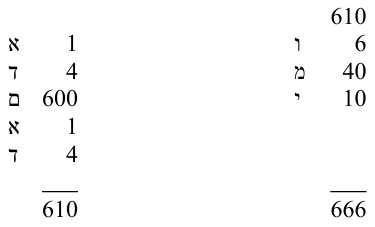
This, according to Wolfius, is a conjecture of Matthæus Hillerus. After having quoted the words from the Hiero-[224]physticus, Part i., p. 168, and expressed his opinion that Hillerus approaches nearer to the Cabbalistic Gematria than Vitringa had done, he thus proceeds: “These letters, by Gematria, bring out the number of the Beast: for final ם is 600; and the other letters summed up make 66. The fact being,” (with allusion to the meaning of אדם,) “that Anti-Christ, as the Beast, is red with the blood of the saints and of the martyrs of Jesus, Apoc. 17:6 and 13:7. And in her,” (Babylon,) “was found the blood of the prophets and saints, and of all who were slain on the earth. Apoc. 18:24. See, also, his other remarks on the subject.”210 This interpretation, adds Wolfius, our author has not been able to render satisfactory to many; his readers in general finding no small difficulty in understanding why two words signifying the same thing should be adduced. This may be. But for my part, I must confess, that, upon the supposition of Hiller, that Anti-Christ is here meant, an Edomite, or red man, or man of blood, is, after all, not so very bad a guess.211
210 “Hæc enim, inquit, literæ per Gematriam numerum Bestiæ complectuntur: ם enim finale 600 denotat; reliquæ in summam collectæ literæ 66. — Nimirum rubet Anti-Christus a sanctorum sanguine, et a sanguine martyrum Jesu, Bestia. Apoc. 17:6, et 13:7. In eâ sanguis prophetarum et sanctorum inventus est, et omnium qui mactati sunt in terrâ. Apoc. 18:24. Vide ibi plura.” — Wolfius, Cur. Phil. et Crit.
211 Sarcastically observes Wrangham, “Matt. Hillerus, in אדם אדומי, where, besides the inserted ו, the paragogic י performs a double function, by depressing the value of ם to 40, and supplying a needful 10!”
[225]
מכרות, things on sale.
James Hasæus, in the Bibliotheca Bremensis, Class ii., p. 1010, is spoken of by Wolfius as supplying us with the next Hebrew solution. In allusion to the words, “That no man might buy or sell, save he that had the mark, or the name of the Beast, or the number of his name.” Apoc. 13:17, מכרות, things on sale, is the phrase proposed by the author just named.
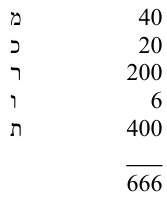
“Obvious is it,” says Hasæus, “that the mark of the Beast is, as it were, a tally or token, with which every man who has to buy or sell behoves to be provided. Reflecting on this fact, it struck me that מכרה denotes a thing on sale: which word in the plural makes things on sale. But this very word contains the number in question, namely, DCLXVI. Correctly, therefore, is this מכרות name, as a χαραγμα, or mark, given to the Beast, — a name which is a symbol of the city, (or of Anti-Christ dwelling in it,) where there is exposed to sale an abundance of all things which pertain to luxury.” Upon which Wolfius makes the sensible remark, that it is scarcely credible, that the Holy Spirit would have alluded to the buying and selling of things which belong to luxury, when he is treating of things of so much more importance, [226] especially of the fate of the church. To the original Latin of the whole passage, which will be found in Wolfius, vol. ii., p. 546, I refer the curious reader.
סרות, Apostasy.
Next in order comes Zacharias Portzigius, already mentioned, who, in the Collectio Novantiquorum Theologicorum, An. 1733, p. 662, prefers to other solutions that of the Hebrew word סרות, Apostasy, which he conceives to have a direct reference to the subject spoken of. This, however, he afterwards abandons for another.

212 As favouring his own conjecture, Wrangham thus expresses himself in regard to it: “Zach. Portzigius in, סרות, Apostasia, as MORE CONNECTED WITH THE SUBJECT;” (sic in orig.) “but he quickly leaves this true scent.”
ר. שמעון, Rabbi Simon, or Simeon.

[227] This, it seems, is a conjecture of John Gottfried Lakemacherus. His reason for so supposing is as follows: — Rabban Simon was, he says, constituted president of the Jewish Synagogue, by Herod Agrippa; and the moment a comparison is instituted between his proceedings, and what is said from chapter 13, verse 11, to the end, it will be discovered, that all the references are to him. We are informed that this occurs in his Observationes Philologicæ, part ix., pp. 33 and 47.213 Wolfius, from whom we derive our knowledge of this, adds quaintly enough, and somewhat unnecessarily, that “this solution, in an age like ours, is likely to give satisfaction to but few.“214
213 Wrangham says, “I. Goth. Lakemacherus refers it to ו שמעון΄, i.e., Rabban Simon, who was made prefect of the Jewish Council by Herod Agrippa, and, as he gravely states, was very like the latter Beast!“
214 De gustibus non disputandem, is an old and somewhat stale axiom. Rabbi Simon, it would appear, has found a strenuous supporter, almost in our own days, in the person of the celebrated Herder. So says Professor Stuart. “Herder, who makes every thing in the Apocalypse to point to the destruction of the Jews, finds the name that corresponds to 666 in Simon Gorionides, whose crimes are related by Josephus, Bell. Jud. vi., vii. To accomplish this, he prefixes the initial of the Rabbi (ו) to his proper name: thus ו. שמעון, which makes up the desired number.” — Excursus iv., p. 454. Judging from the manner in which the learned Professor expresses himself, one is apt to think that he was ignorant of the quarter whence Herder borrowed his idea.
סתור, Mystery.
This, it will be observed at a glance, consists of the same letters as סרות, Apostasy, already considered.

[228] By names so celebrated as those of Lightfoot, and Dr. H. More, has this solution been supported.215
215 Daubuz, also, as will afterwards appear, alludes to it.
Concerning the former, Wolfius thus writes: “John Lightfoot has sought for the number 666 in the word סתור. ‘The number of the Beast,’ says he, ‘is the number of a man, and his number is 666. According to the letters of the Hebrews, employed as numerals, Sethur, (the name of a certain man, Numbers 13:13,) contains this number; and something hidden, or mystical, behoves to come out of a word, which is inscribed upon Rome itself.'”216
216 “Numerus, inquit, Bestiæ est numerus hominis, et numerus ejus 666. Secundum Hæbreorum numeralia, Sethur, (nomen cujusdam viri, Num. 13:13,) hunc numerum implet; et quid crypteum, sive mysterium, reddi oportet id ipsum quod Romæ inscriptum est.” — Lightfoot, quoted by Wolfius. — See antea, pp. 221, 222.
The statements of the latter, with regard to סתור, will be found in the Epilogue to his Apocalypsis Apocalypseos. Clarke, p. 57.
This conjecture, Wolfius adds, the illustrius Petrus à Sarn has tried to dress up, and give currency to in Miscellaneis Duisburgensibus, tom i. p. 487. The arguments in its favour are thus by him summed up: “When, therefore, we consider that the number, name, tribe, [229] family, rank in life, transactions, offence, and punishment of Sethur, have a wonderful agreement with the person of the Roman Anti-Christ, Lightfoot’s notion, we would conclude, is not at once, and without due consideration, to be rejected.”217
217 Dum, itaque, Sethuri numerus arithmeticus, nomen, tribus, familia, conditio, res gesta, peccatum et exitus, apprimè in Anti-Christi Romani conspirant personâ, non ita protinus rejicienda videri poterit observatio.” — P. à Sarn, quoted by Wolfius.
Dr. Dodd’s Commentary on the Revelation, which I have not seen, is referred to by J. E. Clarke, as supporting the view in question.
Mr. Clarke’s statement, in reference to this word, is worth quoting: — “Sethur, one of the spies mentioned in Numbers 13:13, has been considered a representative of the Papal Anti-Christ; and it is very remarkable that there is some sort of resemblance between these two characters. Sethur’s name contains the number 666; and this is the number of Anti-Christ: Sethur is of the tribe of Asher, that is to say, the Blessed; so are the Papists of the family of the primitive Christians: Sethur was one of those who brought an evil report of the good land; so have the Papists, by their impieties, brought an evil report upon Christianity: Sethur’s name signifies mystery; and this is the name inscribed upon the forehead of the Mother of Harlots.” — Clarke, p. 57. Note.
Speaking of this, and of a preceding conjecture, Dr. Snodgrass says, very sensibly, “Others have gone cabbalistically to work upon this dark and difficult question, by interpreting the meaning of the name, or word, upon which they fix, such as Adonikam, which signifies a Lord [230] rising up, and whose family consisted of 666; and Sethur, Num. 13:13, [in whose name] the letters of this number are found, and which signifies hidden, or mystery. This mode of interpretation was introduced by Mr. Broughton, the great English Rabbi, in Queen Elizabeth’s time, and it has been adopted by Lightfoot, Vitringa, and others. It seems, however, as little satisfactory as the former. The circumstances of coincidence, in all the examples that have yet been proposed, are too slight and trivial to have been pointed at by the Spirit of prophecy in this important and instructive enigma.”218
218 Snodgrass’ “Commentary, with Notes on the Revelation of John.” Paisley, 1799, pp. 451, 452.
אבינו הקדוש אאפיפי, our Holy Father the Pope.219
219 This occurs in Calmet’s list.
“The last word,” however, Mr. Clarke says, “ought to be written אהפיפיור.” In proof of which he quotes the words האפיפיור מלח הגויים, “the Pope, King of the Gentiles,” from Hyde’s Syntagma Dissertationum, vol. i., pp. 115-117. Oxon., 1767.

220 It will be observed that Mr. Clarke has committed an oversight, in setting down the ק as 90.
[231]
המלכות העמים, the Kingdom of the People.
Another Hebrew solution, for which we are indebted to Mr. Clarke, is, “המלכות העמים, the kingdom of the people, considered in opposition to the kingdom of Christ.”
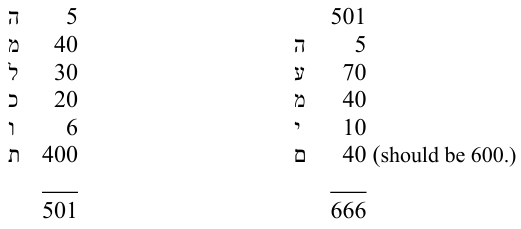
לולתר, meaning Luther.
Luther, after having been gibbeted as the Apocalyptic Beast, on the principles both of the Latin and the Greek methods of numeration, has also had a “shy made at him,” by writing his name in Hebrew characters. The same system of torture, however, which we found previously had recourse to, has not now been omitted; for, as his name, accurately written, would not have yielded the desired result, an additional letter has been forced on it: and it is not, until transmuted into Lulther, that he becomes the subject of prophecy.
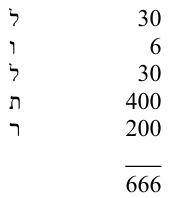
A missile for assailing the Reformer, so formidable as [232] this, was not likely to be neglected by the Roman Catholics. Accordingly, we find it taken up and employed by Bellarmine. That learned, though not over-scrupulous ecclesiastic, is careful to inform his readers that “Gilbert Genebrard, in the last book of his ‘Chronology,’ has pointed out a word in Hebrew letters, לולתר, which he considers to be the Hebrew name of Luther, as containing the number in question.”221
221 Gilbertus Genebrardus lib. ult. Chronologiæ notavit etiam nomen Lutheri Hebraicè numerum illum efficere, לזלתר. — Disput. tom. i. coll. 729, 730.
John Selden, I observe, from the first of his “Three Tracts” already alluded to, was acquainted with this solution — which he and Mr. Clarke very properly consider worthy of only a passing and contemptuous notice.222
222 “Some making it out of Luther’s name, by turning him into לזלתר, Loulther, in Hebrew characters,” is Selden’s remark; and “it has also been found in Luther’s name, by ridiculously writing it לזלתר, Lulther,” is Mr. Clarke’s.A
A Note from the Errata. It might have been mentioned that Wrangham notices both לזלתר and דביד כיתריו.
דביד כיתריו, David Chytræus.
The attack upon Luther by Bellarmine is followed up by another of his, also in Hebrew characters, upon the reformer, David Chytræus. דביד כיתריו.
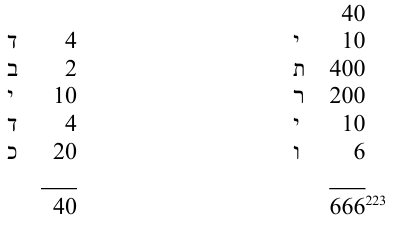
223 Bellarmine ut supra. “Addo, ergo, in gratiam Lutheri et Chytræi duo alia,” &c.
[233]
פ יורעש, P. Jurieu.
From a remark of Wolfius, Cur. Phil. et Crit., vol. ii. , p. 546, it would appear that the name of Peter Jurieu himself, written in Hebrew, yields the same result. Ex cujus tamen nomine Hebraicé scripto, eundem numerum elici posse, quidam Regis Galliæ legatus, præunte Rich. Simone, per numerum ære expressum docuit. Not having seen the calculation, I am unable to present it to my readers. Wolfius refers, as his authority, to “B. Benthemii Tract. Vernæ. de statu Belgii ecclesiastico et scholastico,” p. 431.
Since writing the above, I have seen Mr. Wrangham’s conjecture. It is עורעש. My own is פ יורעש .

Perhaps the Archdeacon meant יעוריעש, which will answer.
בעללארמינוס יעסואיטא, Bellarmine the Jesuit.
Surprising it would have been, upon the principle of “with what measure you mete, it shall be measured to you again,” if Bellarmine himself had escaped from the jaws of this ominous number. Nor has he. “The name ‘Bellarminus Jesuita,’ doth more elegantly by far yield us the number of the Beast, thus written in Hebrew, בעללארמינוס יעסואיטא; notwithstanding, I confess Bellar-[234]mine is not the Beast as yet, though, perhaps, he cleave to his horn.” — Comment. on the Revelation, translated from Paræus. — Cited by Wrangham.
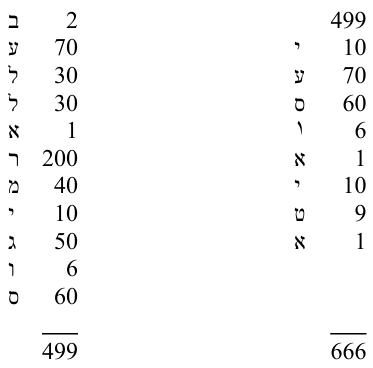
כרשכנוש, Corsican.
Professor Stuart, Excur. iv., p. 455, informs us of a solution by a German, published in 1815, which makes Napoleon Buonaparte, as כרשכנוש, the Corsican, to be the Beast.
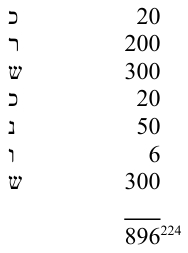
224 There is here obviously a mistake. Has the Professor copied correctly? Is it not rather כרסיכגוש?A Say —

A Note from the Errata. A ג gimel, instead of a נ nun, appears to have been used by the compositor.
[235] The Professor draws our attention farther to two Hebrew solutions, adopted, the one by Ewald, the other by Benary.
That of Ewald is,
קיסר רום, Cæsar of Rome.
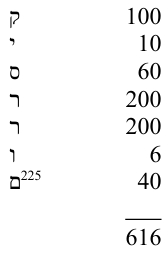
225 An obvious blunder in the value assigned to ם final, which should be 600.
This is proposed on the principle of 616 being, as Mr. Stuart says, “a good and apposite reading.” To which the Professor adds, “that the partial concealment obviously designed by John becomes more effectual, and on the supposition that he referred to a Hebrew mode of [236] reckoning, and to Hebrew words, or letters, as indicative of his meaning here, seems to be quite plain.” Excur. iv. Enough concerning this already.
That, or rather those of Benary are,
נרון קסר, and קסר נרו,
both having a reference to Nero.
Concerning the former, Benary, “it seems,” remarks, “that in the Talmud, and other Rabbinical writings, the name of Nero, in the form of נרון קסר, often occurs.” Counted, we have 666 as the result.
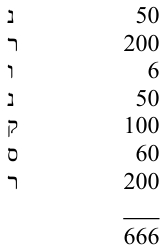
To the works of Ewald and F. Benary, and to Professor Stuart’s “Commentary on the Apocalypse,” especially to his iii. and iv. Excursûs, I must refer those who may deem it worth their while to enquire, upon what grounds the learned men just named have chosen to designate Nero, the Roman Emperor, as the Beast spoken of in Holy Writ.
“There was another method of writing and pronouncing the name of Nero, approaching nearer to the Roman method. This was נרו קסר, Nero Cæsar.” The number in this case, as we have already seen, is 616.
[237]

אדני יהוה קדש געליו.
Calmet has a Hebrew conjecture, which I have not met with elsewhere. It is אדני יהוה קדש געליו, Our most high Lord, the holy Jehovah. (The Pope, I presume.) To complete the number an ה before קדש is requisite.
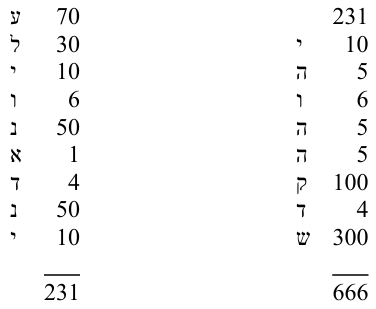
The above I have taken from C. Taylor’s edition of Calmet’s “Dictionary of the Holy Bible,” article “Anti-Christ,” London, 1823.
קעלויננעש, Calvinus.
“Some one has also found in J. Calvin, Hebraicé, (Query קעלויננעש?) an equal amount.” — Wrangham.
[238]
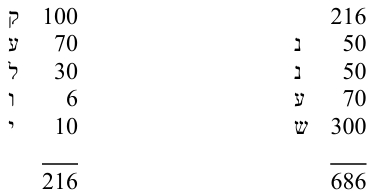
This is evidently incorrect. But as I feel disinclined to the task of reconstruction just now, any of my readers who pleases may attempt it. — Obvious it is that, by removing one of the נs (nuns,) and doubling the לs (lameds,) the solution (valeat quantum,) is accomplished!
ישו נצרי.
“The Jews,” we are informed, “affect to discover this mark of Anti-Christ in the divine name of JESUS OF NAZARETH, ישו נצרי.” See the “Key to the French Revolution,” by Triebner, who, in another work, entitled “Christ is Risen,” states, “that 666 × 3, (for 3 and its multiples, from considerations of the number of persons constituting the Elohim, are his favourites,) = 1998, which, increased by seven, the days of the first week, and an additional three, reaches from the creation to the birth of Abraham, 2005, (2008, query?); 666 × 6 + 7 (again, but without the 3) = 4003, the year of Christ’s conception,” &c. &c. — Wrangham, ut supra.

[239]
היה אלהים and יהוה שמש.
Speaking of a figure which he gives on p. 26 of his recently published work, entitled “Christianity, or the Catholic Faith Demonstrated,” and of the two Hebrew phrases which I have placed at the top of this, as respectively the Alpha and the Omega of the interpretation of the said figure, my friend, Mr. James Wapshare, the author, finds in both phrases the number χξς΄, or 666. Rev. 13:18.

Mr. Wapshare’s most profound and ingenious work must be perused, in order to perceive the application of this discovery.
מחחמוד, Mohamed.
“Lastly, Professor Hales, of Dublin, in his ‘Inspector,’ suggests מחחמוד, (Mohamed,) meaning ενδοξος, ‘celebrated;’ but makes it quadrate by a double artifice so obvious, that the most timorous Mussulman may feel himself perfectly secure upon the subject; viz., by an arbitrary duplication of the ח, and by assigning to מ initial, the value of ם final. The first of these licences, however, he defends by the high authority of Sir William Jones, who speaks of a double aspirate in Muhhamed, [240] (Asiatic Researches, i. 32;) and the second, by stating that ‘what is initial in Hebrew and Arabic, is final in Sanscrit and European alphabets!'” — Wrangham.
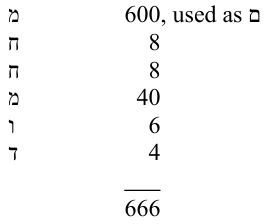
SUBDIVISION FOURTH.
SOLUTIONS OF A MISCELLANEOUS CHARACTER.
These may be presented under three different heads: 1st, Calculations of the number, from the letters of the name; 2ndly, Solutions on chronological principles; and 3rdly, Nondescripts. Some of them are ridiculous enough; but as my wish is to put my readers in as full possession of the subject as possible, they are here, in succession, brought under their notice.
1. — CALCULATIONS FOUNDED ON THE NUMBERING OF LETTERS.
Under this head two attacks upon celebrated Reformers shall take the precedence.
[241]
JOHN OLDCASTLE.
John Oldcastle, Lord Cobham, who was executed for Lollardism in the reign of Henry V., has been designated as the Beast, through summing up the Roman numerals which occur in his name. Our information as to this is derived from John Selden, who, in the most contemptuous terms, mentions the conjecture. Thomas Elmham, Prior of Lenton, having written the Chronicles of Henry V. in verse, — “most miserable verse,” it would appear to be, from what Selden says concerning it, — is either its inventor or copier. Fairness requires my adducing it among others. Let the Roman Catholics derive all the advantage from it which it is capable of yielding.226
226 The whole passage, as it occurs in Selden’s “History of Tythes,” chapter i. section 4., it may be worth while setting down at length; especially as it gave rise to the animadversions of our British monarch, King James I., previously referred to, and was the occasion of Selden writing the first of his “Three Tracts.”
THE HISTORY OF TYTHES.
Cap. i. Of them before the law. Sect. iv. vol. iii. part ii. col. 1081.
“But who sees not the vanity of such mysteries? Although, too, the unlimited liberty of our times, in so confidently daring to tell us the mystery of the number of the Beast, (Apoc. 13:18,) would make a man give the more regard to these collections out of numbers, every great clerk that deals with it hath, for the most part, his several word to make up 666. Some for us; some against us. And no doubt is (that one old one may be added,) but he, which, long before Luther, made Sir John Oldcastle’s name to fulfil that prophecy, thought he had been as near truth as the best of them. Out of IOHN OLDCASTEL in numerals,A he makes 701, and then subtracts the year of his age, wherein he so charitably and stoutly took part with the Lollards, and was condemned for heresy, that is 35, and the rest being 666, notes him out, says he, with the character of the Beast. Risum teneatis? This in most miserable verse he expresses. Nor hath this dream of his place here otherwise than as an old pattern of trifling boldness,” and so on, as in p. 181.
A Thomas Elmham, Prior of Lenton, in Chronic. Hen. V., in Bibliothecâ Bodleianâ.
[242] Mr. Clarke, besides referring to Selden, quotes the “Chronic. Henry V., in Bibliothecâ Bodleianâ.” This, it is probable, is merely Selden’s reference.

MARTIN LAUTER.
Ecce iterum Crispinus. Luther again. After having been tortured into the Beast in Latin, Greek, and Hebrew, he must submit to a similar infliction in his native tongue. Martin Lauter has been alleged to be his German name. And this has been shewn to contain the very number in question, 666, by means of a numerical alphabet invented for the purpose.
[243]

Calculated upon this principle,

which, of course, is the number required.
Concerning the origin of this “most rare conjecture,” I am in some doubt. Professor M. Stuart, in his Excursus iv., several times already referred to, has the following remarks: — “The learned Feuardentius, one of the leading editors of Irenæus, in his note on the subject before us, says, that he ventures to add the conjecture of a learned and most acute judge, J. Offhusius, in his Dial. Dubitant. This conjecture is, (to use his own words,) that ‘the manifold and horrid schism introduced by [244] Luther, will appear to all such as have revolved the subject, altâ mente, to answer in all its characteristics to the Apostle’s description of the Beast in the Apocalypse. The primary name of Luther [i.e., Martinus Lauterus, as he states it,] makes out the number of the Beast, being reckoned according to the laws of the Greek Alphabet;’ and therefore the learned author sees no good reason why this number may not be applied to the so-called Reformer.”227
227 The name must be calculated, not as Martinus Lauterus, but, as given above, Martin Lauter.
Bellarmine, however, says, “Of more recent writers on the subject, William Lindansis, in the third Book of his ‘Dubitant.,’ observes, that Martin Lauter produces the number 666, in the event of the Latin letters being counted after the fashion of the Greek and Hebrew ones.”228
228 Ex recentioribus, Gulielmus Lindansis, Lib. 3. Dubitant. notat, Martin Lauter reddere numerum 666, si literæ Latinæ accipiantur pro numero, more Græcarum et Hebraicarum, hoc modo: A, 1; B, 2; C, 3, &c.; I, 9; K, 10, &c; S, 90; T, 100; V, 200; X, 300; Y, 400; Z, 500.” — Disput. ut supra, col. 729.
The reference of Mr. Clarke is to the notes of Massuet on Irenæus, Book v., chapter 30.
The affair is certainly not one of any great importance. Notwithstanding, one feels somewhat annoyed at being unable to assign the exact paternity of the solution.229
229 Mr. Wm. R. Jones, of the Liverpool Athenæum, informs me, that he found this solution adopted, if not first proposed, in a very singular work, which some time since came under his notice, entitled, “Les Bigarrures et Touches du Seigneur des Accords.” (Est Tabourot.) — The first edition of this work was printed at Paris in 1572; the last, at the same place, in 1662, considerably augmented. To this work of the Seigneur des Accords, we have found Wrangham alluding. See pp. 143, 144.
[245]
VICARIUS FILII DEI.
We have already considered the Latin words, Vicarius Filii Dei, the Vicar or Deputy of the Son of God, under the head of guesses calculated according to the Roman method of computation. Another way of reckoning the same words, and bringing out the same result, it would appear, exists. Archdeacon Wrangham is my informant here.
At pages 410 and 411 of vol. ii. of his works, and in his “Six hundred three-score and six,” the learned dignitary says, “‘This mot d’ enigme,’ (remarks an anonymous writer,) ‘has also farther mystical applications; for singula in universum hujus nominis elementa, secundum numerum alphabeticum more Græcorum et Hebræorum disposita, tam accedunt propé, ut tribus saltem adscitis punctis eundem numerum expleant: qui tamen ipse defectus, quid mysterii in se contineat, et quo pacto ritè suppleatur, alio fortassis loco et tempore prodam!’” That is, “Having disposed and calculated the letters of Vicarius Filii Dei, on the same principles as we should have done had the letters been Greek or Hebrew; and having, by addition of the various items, ascertained the sum, there is so near an approximation made to the number in question, (666,) that by the adoption of three ciphers only, the whole is neatly and satisfactorily adjusted. Indeed, who knows but the very deficiency of the three ciphers may involve in it some sort of mystery? the way of solving which, perhaps, on some other occasion I may disclose.”
[246] The scheme of calculating Vicarius Filii Dei, above alluded to, is neither more nor less than that which has just been applied in the case of Martin Lauter; consisting of employing as our key,
a, b, c, d, &c., k, l, m, &c., t, u, &c.
1, 2, 3, 4, &c., 10, 20, 30, &c., 100, 200, &c.
Thus computed, the phrase in question amounts to 663, or 666 − 3.

I confess that, without claiming to be the magnus Apollo of the Archdeacon, or of the “anonymous writer” quoted by him, I see no difficulty in this case whatever. Only suppose the reduplication of the letter c in the word Vicarius, — thus, Viccarius — a practice so exceedingly common as to render unnecessary our pleading authority in its behalf, — and the whole is managed to a nicety. Assuming Vicarius to be written with one c, we have already,

WILL. LAUD.
In WILL. LAUD, the common signature of the noto-[247]rious Archbishop of Canterbury, before his elevation to the Episcopal bench, has been detected the ominous number.

This, it will be observed, is effected by having recourse to the ordinary Roman method.
NAPOLEON BUONAPARTE.
What inhabitant of Great Britain, that has lived fifty or sixty years in the world, remembers not Napoleon Buonaparte, as the great bug-a-boo by whom our imaginations were continually haunted? That he was the Beast of the Book of Revelation, was with some matter of absolute certainty.230 Representations of him in this character, in [248] Greek and Hebrew, we have already considered. Others, I know, existed. But either I have not seen them, or, in common with my contemporaries, I have forgotten them.
230 Can I here pass over a fact, of a personal nature? Well do I remember the oft-repeated convictions of one of the first Scotch classical scholars of his day, the late Mr. John Reekie, of Glasgow — perhaps some may recollect the dispersion of the Bibliotheca Reekiana, consequent on his death, between thirty and forty years ago, — that Napoleon was unquestionably the subject of more than one passage of the Book of Revelation: it having been particularly clear to him, that in distributing thrones, principalities, dukedoms, and other dignities, to German Electors, French Marshals, and others, the Emperor of the French fulfilled Revelation 19:17,18: the Emperor having been, according to him, the Angel who stood in the sun — the emblem of the French Monarchy — and who thence cried with a loud voice, saying to all the fowls that fly in the midst of heaven — his aforesaid dignitaries — Come and gather yourselves unto the supper of the Great God; that ye may eat the flesh of kings, and the flesh of captains, and the flesh of mighty men, and the flesh of horses, and of them that sit on them; and the flesh of all men, both free and bond, both small and great. Contradiction to my friend’s assertion, on this point, was out of the question. Its practical refutation he lived not to see. — Let no one ridicule poor Reekie, as if he stood alone in his hallucinations. Thousands of his contemporaries, — men like himself, of learning and ability, — were unable to disentangle themselves from the meshes of ephemeral politics, popular feelings, and fleshly delusions.
The only thing that occurs to me, respecting the ascription of the Bestial character to this extraordinary man, is, that it was attempted to be fastened on him by calculating his name, or his name and titles, somewhat on the same plan as has been adopted in the case of Martin Lauter and Viccarius Filii Dei. Whether as Napoleon Buonaparte, or as Napoleon I., Empereur, or as Napoleone ê Imperatore, or as something else, with the requisite additions or subtractions, I am totally oblivious. Perhaps the following, which I confess I have coined, and which has reference to him as Emperor of the French, and King of Italy, (1805,) will, as a specimen of this way of going to work, answer as well as any other.
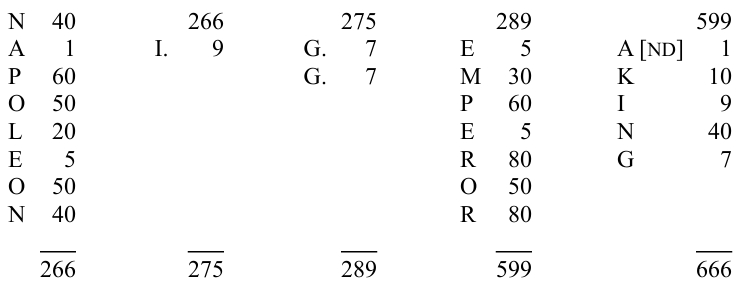
[249] That is, Napoleon the first, of the two Gauls, (Galliarum, i.e., Galliæ ulterioris, et Galliæ citerioris,) Emperor and King. I admit its worthlessness. It may serve, however, to shew “the stuff which such dreams are made of.”231
231 “By a similar key,” a, 1, b, 2, c, 3, &c., “varying only by making v = 110,and a few other accommodations, we have lately seen the fatal number applied to Napoleon Buonaparte.” — Wrangham. — How? I fancy there must be some mistake here. The number 666 can only be brought out by writing and calculating as Napoleo Buonaparte; and by reckoning u or v as 101.
ANTISTES.
Mr. Andrew Leighton has had the goodness to inform me, that in a “Lecture”, delivered in the chapel, Chapel-court, High-street, Borough, (Southwark, London,) January 6th, 1833, by the Rev. J. E. Smith, M.A., that gentleman suggests ANTISTES, a chief priest or prelate, (according to him, “a classical word for a priest of the Establishment, or priest clothed with political influence and authority,”) as amounting, when its letters are computed, to 666, and consequently as involving all who are members of the priesthood in the Bestial character. His calculation proceeds upon the same principle as that on which the Apocalyptic number has been detected in Martin Lauter. Only, instead of assuming k to signify 10, l 20, m 30, and so on, he introduces j into his alphabet, making it 10, k 20, l 30, &c., and, of course, s 100, t 200, and so on. In principle, and in other respects, the two modes of computing are the same.
[250] Thus reckoned, we have,

Αντιχριςος.
In a work, entitled “An Essay towards reconciling the Numbers of Daniel and St. John,” by the Rev. George Burton, M.A.,232 Rector of Elden and Herringswell, in Suffolk, Norwich, 1766, a publication which, I perceive, had come under the notice of Mr. Faber,233 the following occurs: — “The annexed opinion being duly considered, will probably render the following word more satisfactory; and as a further confirmation of Dr. Potter’s judgment with respect to the number of the Beast, if the calculation be admitted, it promises an easy solution to the whole; for Anti-Christos has more the appearance of a mystery, as it only offers the second, fourth, fifth, and tenth letters of the name, and by these means forms the number of the name, 666.
232 Not the later and somewhat better known Dr. Burton.
233 See “Dissertation on the Prophecies,” vol. i , pp. 4, 5, edition 1806.

[251] “But, as Dr. Potter has observed, the chief mystery seems rather to consist in finding another number, which is most properly and remarkably applicable to the Beast, and in this respect the present calculation seems perfectly to answer.” — Burton’s Essay, pp. 377, 378.
قطولكي لاتين
Mr. Elliott having given an Arabic solution of the enigma in his Horæ Apocalypticæ, which he says was communicated to him “by his lamented friend, Robert Money, Esq., of the Bombay Civil Service,” I may just mention it. Nobody, of course, can for a moment suppose, that in the Arabic language the solution either is to be sought for or found. The words are Catoolikee Lateen, The Catholic Latin Church, which قطولكي لاتين is calculated as follows: —

See Hor. Apoc. vol. iii. p. 216.234
234 There is in the third edition of Mr. Elliott’s work a transposition of the numbers 9 and 6, printed 6 and 9, which in subsequent editions should be corrected.
[252]
2. — SOLUTIONS ON CHRONOLOGICAL PRINCIPLES.
Several of these respect the rise and progress of Popery.
BALÆUS.
Balæus, as we learn from Poole’s “Synopsis Criticorum,” and from Wolfius, considering the number 666 to refer to the number of years which preceded the Pope’s having had the title of Universal Bishop conferred upon him by the usurping Emperor Phocas, namely, A.D. 606, begins his computation from the year 60 A.C., when Judea was by Pompey reduced into the form of a Roman province. 606 + 60 = 666.235
235 See Poole’s Synopsis, on Apoc. 13:18, Wolfius, Clarke, &c. The conjecture of Lœscherus, mentioned antea, pp. 177, 178, proceeds to a certain degree on the principle mentioned in the text.
BEVERLEY.
We are informed by Mr. Clarke, that “Beverley, by means of a computation unnecessary to be detailed here, supposes the 666 years to be ended in A.D. 725 or 726.” A reference occurs to his “Scripture Line of Time.” The rise of Popery is, of course, the principle of his interpretation.
Having particularly examined the opinions of Moses Lowman, and Dr. Bryce Johnstone, of Holywood, I find a very great coincidence between them, in reference to this matter.
LOWMAN.
The former writer, Lowman, after having in his “Paraphrase” on the passage in question, Rev. 13:18, stated [253] that “it will be a considerable point of knowledge, in this mystical description, to find out, by a given number, the name of the Beast, so as to know when this idolatrous tyrannical power shall arise,” proceeds in his “Notes” to open up and justify the opinion here suggested.
To quote at length is altogether out of the question. Readers desirous to see and weigh his statements and arguments, are referred to the work itself, his “Paraphrase and Notes on the Revelation of St. John.” The edition consulted by me was the third, 1773; and the passage will be found between pages 192 and 215.
Briefly, after having rejected other interpretations, he proposes to compute the 666 years from the time of the prophetical vision having been given to John, until the æra when the Papacy, having received temporal power, became the Beast, or was constituted the last government of Rome.
The starting point, or the time of the revelation to John, he supposes, might be A.D. 94. Counting from that period 666 years, we are brought to A.D. 760, which, according to him, is within four years of the time when the Beast arose. The small difference in point of number, he thinks may be easily accounted for, either, 1, by supposing some uncertainty as to the period of vision; or, 2, by allowing some small variation from the precise year, for the purpose of rendering the number exactly 666, which has more the air of a prophetical one than 662; or, 3, by assuming that it was the intention of the Holy Ghost to make the number take in, not merely the date of the investiture, A.D. 756, which would be 662 years, but that of the full and actual possession, on the part of the [254] Pope, of what was granted to the Church as St. Peter’s Patrimony, which was A.D. 760.
This way of counting Lowman considers to be sufficiently certain to point out who the Beast is; and to be to the full as satisfactory as the assumption that the seventy weeks of Daniel pointed to the coming and death of the Messiah.
BRYCE JOHNSTONE.
From Lowman, Dr. Johnstone, I suspect, directly borrowed his idea.
Having laid down the principle that it is not the number of the name of the Beast, but the number of the Beast, which we are to find out by the Apocalyptic key, 666, he assumes, almost copying Lowman, the year of our Lord 95 to have been the date of vision. But the vulgar æra begins four years after the Saviour’s birth. To 95, therefore, he adds 4, making A.D. 99 to be the true date, as he thinks, of the revelation having been vouchsafed to the Apostle. To this date he proposes to add the 666 years of the prophecy, reduced to 657. The result is, we are brought to A.D. 756, which he conceives, with Lowman, to have been the period of the Beast’s manifestation, and evinced to be so by the number 666 having then run out. The very obvious objection, as to why 99 should be calculated as common, and 666 as prophetical years, never seems once to have occurred to the learned Doctor.
Much as Dr. Johnstone’s work was pressed on my notice by men of sense and judgment in secular matters, as well as by persons distinguished by no small share of theological learning, and satisfied as I am of the great general abilities of its amiable and excellent author, there are very [255] few works from the perusal of which I have risen with less advantage than from his. Perhaps I had expected too much.236
236 The title of the work is, “Commentary on the Revelation,” by Bryce Johnstone, D.D. His observations on chapter 13:18, occur in vol. ii., pp. 68-80.
ERASMUS.
Erasmus entertained the opinion, that the number 666 points out the number of the years assigned for the tyranny of Anti-Christ. Having supposed that these ended in A.D. 1520, the year of the Reformation, consequently they must have commenced A.D. 854.
A LUTHERAN PRELATE.
“In a little anonymous tract, by a Prelate of the Lutheran Church, translated from the German, and printed in London, in 1797, the 666 years are dated from A.D. 1073, and are said to have ended in A.D. 1740.” — Clarke.
Still keeping Popery in view, another kind of chronological interpretation has been put upon 666. It has been supposed to refer A.D. 666, and to A.D. 1666.
A.D. 666.
To the former,
By Luther; who, it seems, says, that the Pope was first considered as uncontrollable about the year 666. See Trapp, in Apoc. 13:18.
By Fleming, in his “Apocalyptical Key,”237 by the Mag-[256]deburg Centuriators,238 and by the Rev. L. Gottfried Kohlreiffius. According to Wolfius, the last-named, in his Chronologia Sacra, p. 423, paraphrasing the words of Rev. 13:18, says, “Let him who has understanding compute, and with other chronological numbers of the Holy Scriptures compare the number of the Beast, which is the number of the year on which his power commences. For it is the number of a man, of the vulgar epoch running from the time when Christ was born as a man, and its number is the year of that epoch, 666.” Commenting on which, and referring to the authority of Balæus, in his Acts of the Roman Pontiffs, Book iii., n. 11, he goes on to shew, that the Beast, in the year above mentioned, first displayed vital energy, in the fact of Vitalian, who then occupied the Papal throne, having, in his “Ecclesiastical Rule,” ordained that the whole routine and ceremonial of public worship should be in Latin; as well as having, in one of his Papal rescripts, forbidden the marriages of Priests. That 666 was the exact year when independent sovereignty was assumed by the Pope, at the expense of the Imperial jurisdiction previously acknowledged, Kohlreiffius attempts to establish by a reference to a number of circumstances which will be found detailed in the accompanying note.239
237 London edition (supposed) 1793, p. 25, and Edinburgh edition, 1793, p. 22.
238 See Horæ Apocalypticæ of Elliott.
239 Having mentioned L. Gottfred Kohlreiffius as one of those who considered the number 666 to refer to the period of the origin of the Anti-Christian Beast, Wolfius thus gives his paraphrase: — “Qui habet intellectum computet, et cum aliis Scripturæ S. numeris Chronologicis conferat numerum Bestiæ, numerum anni, quo initium cepit ejus potentia. Numerus enim hominis est, illius epochæ vulgaris a Christo nato homine, et numerus ejus est illius epochæ annus sexcentesimus sexagesimus sextus.” Then, referring to the comment, “Id tempus, (ita pergit,) cumprimis vitale fuit Bestiæ, sedem Romanam tenente Papâ Vitaliano Seguino, qui ut Johannes Balæus, (Act. Roman. Pontiff. Lib. iii. n. 11,) narrat, Ecclesiasticam Regulam Scripsit, Horas Latinas, Ceremonias, missas, et Idololatrias Latinas omnes in Templis Latinè fieri disposuit. Reprehendit quoque conjugia sacerdotum, ut apparet ex Epistolâ ad Episcopum Cretensem in Centuriis Magdeburgensibus commemoratâ. Hujus Papæ temporibus, testante Anastasio, Constantinus Augustus, aliis, Constans II., venit Romam, indictione vi., h. e., Anno Christi 663, et occurrit ei obviam Papa cum Clero suo, milliario sexto ab Urbe Româ, et suscepit eum. Imperatoriam ergo potestatem adhuc agnovit Pontifex, quam et tunc Imperator ita ut cum maxime Rome exercuit. (Vid. Anastasium, de Vitis Pontif. Rom. n. LXXVII;) Sed et ultimus hic fuit jurisdictionis Imperatoriæ actus Romæ patratus. Ingressus, quidem, fuit Constans Siciliam, indict.vii. h.e., A.C. 664, et circa Syracusam vitam agens, quæ Joannis Zonaræ sunt verba, imperium etiam Romam veterem transferre voluit, &c. Horum consiliorum eversio, potestatis Papæ supra Reges eminentis primum fundamentum fuit. Quâpropter, Annus Christi 666, merito est primus illius potestatis in Apocalypsi Joanneâ numeratus.” Hactenus, says Wolfius, vir et ingenio et doctrinâ valens. — See the Cur. Phil. et Crit. — Referring to the original authority of Balæus, Dr. F. Laurence and Wrangham have likewise noticed this solution. If true, it certainly is a remarkable fact, that the Imperial authority, acknowledged by the Pope himself in A.D. 663 and 664, should have been superseded by the Papal in A.D. 666.
[257]
A.D. 1666.
To the latter,
We have it referred by Dr. Gill, on the text in question. “Others have been of opinion that 666 refers to the expiration of the Beast, which they thought would have been in the year 1666, the number of the thousand being dropped, as it is in the common way of speaking; as [258] when we say, the Spanish invasion was in 88, meaning 1588, and the civil wars began in 41, that is, 1641.”
BEVERLEY.
Others, with Beverley, (see his “Great Line of Prophetical Time,”) “have computed the 666 years, with the millennary added, from the time of Christ’s resurrection, and have therefore supposed that the Beast would expire in 1699.”
“Time,” unquestionably, as Mr. Clarke remarks, “has demonstrated the fallacy of both these opinions,” as it has of many others.240
240 Bellarmine, without entering at any length into the subject, represents Bullinger as supposing 666 to refer to the period of Anti-Christ’s advent, and the Magdeburg Centuriators, as supposing it to refer to the period of Anti-Christ’s death. See his Disput., several times already quoted, col. 728.
Chronological explanations of the number 666 have not, however, been confined to the Papacy.
BELLAMY.
We have Mr. Bellamy, singular in this, as in other respects, in his “History of all Religions,” pp. 207-213, London, 1812, informing us “that the number has no reference to kings, kingdoms, nor popes; but refers to the time when the Divine theocracy ceased in the true visible church of God among the Jews, to the establishment of the true visible church of God by our Lord Jesus Christ among the Gentiles.” “This,” he says, “was precisely 666 years; viz., from the destruction of Solomon’s temple [259] by Nebuchadnezzar to the destruction of the second Jewish temple by Titus.”
And then allusions to Mahomet, and the Mahometan æra, have been found in the number.
BELLARMINE.
By Bellarmine we are informed that some persons, understanding Mahomet to be Anti-Christ,241 conceive the number to refer to the period of his death, with whom Lyranus, he says, in some measure agrees; for although he does not suppose Mahomet to be Anti-Christ, he nevertheless thinks, that the number 666, in Rev. 13:18, points to the fact of Mahomet’s death having been destined to occur in the 666th year from Christ’s advent: an opinion which the able and learned Cardinal pronounces to be most absurd; resting his condemnation of it on reasons which are particularly strong and substantial. The principal and conclusive one is, that Mahomet did not die in the 666th year of the Christian æra.242
241 Quidam qui, teste Clycthoveo, in lib. iv. Damasceni, cap. xxviii., volunt designari mortem Mahumeti, quem dicunt esse Anti-Christum.
242 Hæc opinio est absurdissima. Primo, quia Joannes dicit se loqui de numero nominis Bestiæ. Secundo, quia Bestia, cujus est hic numerus, præcipiet omnibus mercatoribus, ut eo pro signo utantur in contractibus, ut patet Apoc. 13. Non ergo est numerus mortis Bestiæ, sed ad ipsum viventem pertinet. Tertio, quia etiám est falsum, Mahumetum mortuum esse anno Christi 666. Quidam enim dicunt eum mortuum anno Domini DCXXXVII, ut Mattheus Palmerius; quidam, an. Dom. DCXXX, ut Cedrenus, in Compendio Historiarum; quidam A.D. DCXXVIII, ut Joannes Vaseus in Chronico Hispaniæ.
[260]
ELLIOTT.
The Horæ Apocalypticæ of Mr. Elliott draws our attention to a very early application of the number 666 to the Mahometan æra, made by no less a personage than one of the Roman Pontiffs.
This, in the shape of assuming the number to designate the period of the duration of Mahometanism, it appears, is the view of Pope Innocent III. Speaking, in his Bull for convoking the fourth Lateran Council, A.D. 1213, of the Holy Land having been possessed by the Christians till the time of Gregory I., and even afterwards, he goes on to say, “Sed ex tum quidem perditionis filius Machomettus, pseudopropheta, surrexit. — Cujus perfidia etsi usque ad hæc tempora invaluerit, confidimus tamen in Domino, quòd finis hujus Bestiæ appropinquet: cujus numerus, secundum Apocalypsin Joannis, intra sexcenta, sexaginta, sex clauditur. Ex quibus jam pœnè sexcenti sunt anni completi.”243 Mr. Elliott refers to Harduin, viii. 3, as his authority. The event has served to bring into question the infallibility of Papal interpretations of Scripture.244
243 “Subsequently arose that Son of Perdition, Mahomet, the false prophet. To our own times has his perfidy continued in full force and vigour: but we trust in the Lord, that the end of this Beast approaches; our conviction resting upon this fact, that his number, according to the Apocalypse of John, is 666, — a number within the limits of which his existence is destined to be confined. Of these 666 years, nearly 600 are run out.” This was written, observe, in 1213.
244 “The inventor, so far as I have been able to discover, of the exegesis which refers 666 to the time or era of the Beast, was Pope Innocent III., who, in an address to all Christendom, exciting them to another crusade, adduces the consideration, that the close of the 666 years assigned to the Beast, i.e., to the Mahommedan power, was near, and therefore there was scarcely room for a doubt that God was about to free the Holy Land from the dominion of the Turks.” Mr. Stuart’s ivth Excursus.
[261]
DR. CROLY.
I must now take notice of Dr. Croly’s conjecture.
Having observed, p. 208, of his “Apocalypse of St. John,” that “in A.D. 533, idolatry revived; the Scriptures were forgotten or forbidden; the church was persecuted with a ferocity and slaughter altogether exceeding that of Paganism; and the power of the idolatrous persecutor was to continue in force during 1260 years;” and having also observed that “the period,” 1260 years, “had begun with the spiritual supremacy of the Pope in 533,” he proceeds to make this last number the foundation of another calculation connected with our present subject.
As I have no intention to make the slightest remark on what must be regarded, by every sane and spiritually-taught mind, as a mere play of fancy, I conceive that I shall do Dr. Croly full justice by quoting his language in pp. 227, 228, in which he is commenting on Rev. 13:18; and by referring to his vindication of his view, under the head of HISTORY, from p. 229 to page 249.
“It is to be remarked that dates and numbers are the frequent instruments of the Apocalypse; obviously from their use in fixing facts. ‘The 1260 years’ is so habitually applied to the Papacy, that the number is almost a substitute for the title; the 666 similarly applies to the Inquisition. The words Lateinos and Romiith are use-[262]less, and belong to a heap of merely curious coincidences. What can be learned by being told that the prophecy alludes to some Latin existence masculine, and some Roman or Hebrew existence feminine, supplying neither time nor circumstance? The 666 is not the name of a man, nor contained in a name of any kind: it is a date, and, to a certain degree, a description; its purpose is to mark the birth of the Inquisition, and to connect that birth with the Papacy.”
“The natural paraphrase of the verse (18) is thus: — The Inquisition has been, in the preceding verses, described and denounced by the Spirit of God; but to remove whatever doubt might arise from mere description, and to prove to posterity that it is the Inquisition which is here denounced and held up to the abhorrence of Christians by the Divine Spirit, the exact date of its origin shall be when the HEAD OF ALL THE CHURCHES, the impious name of the Beast, shall have reached its 666th year, ‘shall number 666.’ That name was given in 533. The Inquisition shall be born in 1198.”
“The prediction was exactly fulfilled. In the first year of Pope Innocent III., the first year of the complete supremacy, when the Papacy was enthroned spiritual and temporal lord of the civilized world, — in the year 1198, was the portentous offspring of its nature and its crimes, THE INQUISITION, issued to mankind.”245
245 Dr. Croly’s notion, that the number 666 refers to the origin of the Inquisition, in the 666th year of the Papal supremacy, was, I suspect, suggested to him by Vitringa, probably in the following passage, quoted by himself: — Per imaginem Bestiæ, et mihi persuasum est, hic esse intelligenda tribunalia Inquisitionis. I cannot help regarding the Tribunal of the Inquisition as intended by the Image of the Beast. — See Croly’s “Apocalypse of St. John,” p. 242.
[263]
DUPERT.
“With an equal violence to probability, Dr. Dupert, in his ‘Poetica Stromata,’ supposes it to contain some prophetical allusion to the great fire in London, (kindled, if we may trust the Monument,246 by Papists,) in 1666! A conceit frigid enough, if we may adopt the not less frigid conceit of the old Critic, to have extinguished the conflagration. (See Pearc. Not. in Longin.)” — Wrangham, vol. ii., p. 417.
246 Where London’s column, pointing to the skies,
Like some tall bully lifts it head and lies.
Thus wrote Pope more than a century ago. The offensive, and, I think, groundless charge has, since the Archdeacon published his “Six Hundred Threescore and Six,” been expunged from the inscription, by a vote of the Common Council.
KETT.
I find that I have omitted bringing in the following extract from Wrangham, concerning Mr. Kett’s Chronological solution, at the proper place. The fact is, that from the mass of ephemeral, superficial, and undigested notions on the subject of prophecy, with which the work of Kett, like those of Galloway, Zouch, Bicheno, &c., abounds, I have acquired a sort of dislike to it. Archdeacon Wrangham thus expresses himself: — “Mr. Kett thinks, with Lowman, Doddridge, &c., that 666 years elapsed between the time when St. John saw this prophetic vision, (which he thus fixes to be A.D. 90,) in Patmos, and the period at which ‘the Papacy received the temporal [264] power, and became the Beast, viz., A.D. 756;’ for then Pope Paul I. received the exarchate of Ravenna, as a donation from Pepin, King of France.”
M. STUART, quoting GENSLER.
Let me complete my list of chronological solutions, by the following quotation from the ivth Excursus of Professor M. Stuart: — “In 1813 Gensler published a work in German, called The Apocalyptic Secret in Rev. 13:18, revealed, in which, ——, he endeavours to shew that 666 refers to some era named after some celebrated man, or men: αριθμος ανθρωπου εστίν. Accordingly, he adopts the æra Seleucidarum, i.e., commencing with the reign of Seleucus, one of Alexander’s generals who reigned over Syria, which era was extensively used in higher Asia. This commenced 311 B. C., to which, if you add 355, so as to make up the number 666, you will come to the year in which Julian the Apostate was proclaimed Emperor, who might well be called the Beast and Anti-Christ by John, and the Wicked One by Paul.”
3. — NONDESCRIPT SOLUTIONS.
BOSANQUET.
A remark at the close of the anonymous work, entitled, “Wealth, the Name and Number of the Beast, 666,” was the cause of my procuring and perusing Mr. S. R. Bosanquet’s “Principia; a series of Essays on the Principles of Evil.” London, Burns, 1843. The eighteenth [265] of these Essays is entitled, “The number of the Beast.”
Gold, according to Mr. Bosanquet, is the Beast’s name. And “the number of his name is the number of gold; — for his name is Gold, and Mammon. His name is thrice the number of imperfection; even Six, Six, Six.247 The number of the Beast ‘is the number of a man,’ even Solomon; ‘and his number is Six Hundred Threescore and Six.'”
247 “As the imperfect ‘manner of the purification of the Jews,’ under the ceremonial law, was signified by ‘six water-pots of stone,’ while the purification of the Holy Spirit is always typified by the perfect number seven.” — Bosanquet.
After a series of singular and quaintly-expressed remarks respecting “Saul,” as the “Jewish Church;” and “Solomon,” as “the Gentile Christian Church, in the days of her glory,” Mr. Bosanquet thus sums up the whole: — “It was Gold which became Solomon’s God, and corrupted his mind, and took away from him his power and wisdom. What, then, was the number of Solomon’s gold? ‘Now the weight of gold that came to Solomon in one year, was SIX HUNDRED THREESCORE and SIX talents of gold.’ 1 Kings 10:14; 2 Chron. 9:13.”248
248 “I am fortified in this interpretation of the number, Six Hundred and Sixty Six, by an analogous interpretation of the “One Hundred and Fifty Three” fishes which our Lord’s disciples took in the lake of Gennesaret, after his resurrection. Sir George Rose, in his Scriptural Researches, interprets this of the final conversion of the Gentile nations; and he supports this opinion by the circumstance, that the number of strangers in Israel in the reign of Solomon, — which is typical of the pacific reign of Christ, — was One Hundred and Fifty Three thousand, and some hundreds.” — Bosanquet.
[266]
JOSEPH MEDE.
Similar in principle to, although in its phraseology somewhat differing from what has already been extracted from the pages of Grotius, p. 92, and Bellarmine, pp. 92, 93, and reminding one of the notion of the genius who discovered the three sixes in the three lilies of the old French arms, is the following, which occurs in Joseph Mede’s “Commentary on the Apocalypse of St. John,” edition 2, 1663, p. 635: — “At verò a Senario, qui DRACONIS illius Rufi, puta BESTIÆ, sexti capitis numerus est, facillimè; cum ex senariis totus, quantus est, conflatus sit, monadum, decadum, hecacontidum; quasi Draconis illius sperma, totum BESTIÆ hujus novissimæ corpus, omnesque artus ejus pervasisset.” That is, although, with reference to the Beast, you can make nothing of the number twelve, “yet, out of six, which is the number of the sixth head of the Red Dragon, — to wit, of the Beast, — you accomplish the matter with the greatest ease: seeing that of sixes, in the form of units, tens, and hundreds, he is entirely made up: as if the very seed of the Dragon, in the form of that number, had entered into, taken possession of, and pervaded every joint and every particle of the body of this last Beast.”
J. E. CLARKE, WRANGHAM, and BRIGHTMAN.
Turning to the pages of Mr. Clarke, we find him informing us, on the authority of a remark on Rev. 13:18, contained in L. Tomson’s English Bible, printed at Amsterdam, in 1633, that “Fr. Junius understands the number 666 in a way totally different from other com-[267]mentators; for he says it consists of sixes throughout; and as six is a perfect number, it shews that all parts of the Romish hierarchy agree with one another in the most perfect manner, in order to deceive the world. For an attestation of this opinion, he brings forward a case in which Pope Boniface VIII. commended by the number six those decretals which he perfected in the proem of the sixth book: ‘which booke, (sayeth he,) being to be added to five other bookes of the same volume of Decretals, wee thought good to name sextum, the sixt; that the same volume, by addition thereof containing a senarie, or the number of sixe bookes, (which is a number perfect,) may yeeld a perfect forme of managing all things, and perfect discipline of behaviour.”
Wrangham, having spoken of the same conjecture, and made the quotation, “This number” (6) “is perfect, and arising perfectly out of the parts thereof at some times; neither is there any part of the Pope’s law which is not confined to the head thereof, or is not contained in it,” adds in a note: — “This word perfect, Haymo correctly defines, qui primus in numeris completur partibus suis, i.e., sextâ sui parte, tertiâ, et dimidiâ, quæ sunt unum, et duo, et tria, quæ in summa ducta sex faciunt. And it is the first perfect number, because (if we may adopt the R. R. Commentator’s theory,) on that day God perfected his creation. That his notion, however, of ‘perfect numbers’ differed from those of modern mathematicians, appears from his proceeding to assign particular reasons for the perfectness of 10, 60, 100, &c.” — Wrangham’s works, vol. ii., p. 419.
Brightman, I observe, in his Apocalypsis Aроса-[268]lypseos, referring to this conjecture of Francis Junius, thus represents the matter: — “He,” Junius, “will have this number,” 666, “to be the Pope’s learning,”249 (scientiam,) “and the Canon Law,” (Jus Canonicum,) “now that the sixth book of the Decretals hath been added to the former five, by Boniface the 8th.” — “For this number is perfect.” — However, after the quotations from Clarke and Wrangham, it is unnecessary to proceed further. Brightman’s work, either in Latin or English, — in the former, pp. 373-376, and in the latter, pp. 462-465, — may be consulted by those who deem the subject worthy of being prosecuted.250
249 It was with some hesitation I thus translated scientia. I am happy since to observe, that, in the rendering, I am corroborated by the high classical authority of Archdeacon Wrangham. — Works, vol. ii., p. 418.
250 An opportunity I had of consulting both the Latin and English editions of Mr. Brightman’s work, in the Library of the Cheetham College, Manchester. — Apocalypsis Apocalyseos, i.e., Apocalypsis D. Joannis, analysi et scholiis, illustrata; per Thomam Brightmannum, Anglum. Frankfort, 1609. “The works of Thomas Brightman,” &c. — “A Revelation of the Apocalypse, containing an Exposition of the whole Book of the Revelation of St. John.” London, 1644.
M. TESTARD.
Mr. Clarke, quoting from Mede, says: “M. Testard, of Blois, in France, entertained the following opinion of the number 666. ‘The number of 666 ariseth from the multiplication of three units joined together, making up the number of iii. These three units set forth the three offices of Christ, which pertain to him incommunicably and [269] distributively, and conjointly considered; in which consists particularly his,’ the Beast’s, ‘Anti-Christianism. And this multiplication produceth the number of 666; as also the multiplication of 12 by 12, which is the Apostolical number, produceth 144,000.'” I confess that this is to me not particularly intelligible. However, it is as Mr. Clarke has given it.251 The view of M. Testard escaped my notice, when consulting Mede’s works.252 The treatise of Mede referred to, is his “In Sancti Joannis Apocalypsin Commentarius, ad amussim Clavis Apocalypticæ,” 2d edit. London, 1663.
251 Note added from the Errata. Is it not M. Testard’s meaning, that assuming iii, — or rather three ones, 111, — to be expressive of the three offices of Christ, — the prophetical, the priestly, and the kingly; and six to be the number of imperfection, or opposition to God; it was the intention of the Holy Ghost to point to the Anti-Christian Church, through the product of 111 × 6, just as he points to the Christian Church, through the product of 12 × 12? If so, his language is intelligible. Many obvious objections such a mode of interpretation is liable to. But it is somewhat ingenious. Perhaps it was suggested by Potter’s solution; Testard conceiving that the multiplication of the two numbers, 12 and 111, by 12 and 6 respectively, was a better mode of suggesting the Christian and Anti-Christian systems, than extracting the square roots respectively, of 144 and 666.
252 In the Cheetham Library, Manchester.
DURHAM AND GALLUS.
We must not overlook the fact alluded to by Bengelius in his Gnomon, p. 1162, of Carolus Gallus, and, before him, James Durham, having understood 666 in the sense of a definite for an indefinite number: signifying either the great number of Anti-Christ’s, or the Beast’s blasphemies and errors, which constitute one compact and well-knit-together body, all the parts of which have a mutual connexion and dependence; or that great number of the papal followers of Anti-Christ in which the Church of Rome glories, and in which she unquestionably surpasses all the reformed churches.253
253 Having perused with great care that part of Durham’s “Commentary upon the Book of the Revelation,” London, Company of Stationers, 1658, which treats of this subject, from p. 565 to 573, I must recommend the passage, notwithstanding its prolixity and frequent violations of good taste, to those who wish to make themselves thoroughly acquainted with the subject. The copy alluded to is in the Cheetham Library, Manchester.
[270]
BENGELIUS.254
254 Note from the Errata. With reference to the paragraph headed BENGELIUS, see note at the end of the Preface.
Speaking of Bengelius, we may mention two other interpretations with which, in the same passage, he favours us. One is, to understand the number 666 as having referred to the Roman Legion, which is said — Bengelius shews incorrectly — to have consisted of 6666 individuals, the thousands being dropped. And then, the Legion is understood to signify, that the enemies of the church constitute a very great multitude. — While another interpreter, Tacitus Nicolaus Zegerus, admitting that the number in question, 666, does allude to the Roman Legion, as consisting of 6666 individuals, seems to think that the taking away of the first 6, or that which stands in the place of thousands, from the number, points to the fact of Christ, by his mighty power, withdrawing from the Devil’s sway the greater part of the forces which formerly he had under him; so that he can no longer boast, and say as formerly, “My name is Legio!” Sebastianus Meyer, our author adds, has something similar in Ap., fol. 59.
BACHMAIR.
I am informed, in a valuable private letter, by Mr. Clarke, “that Bachmair supposes that the number of the Beast consists in the SUM of the numbers affixed to the names of the various Popes, by which the number of the Popes of any particular name is expressed. He begins the computation with Gregory VII., and supposes that the number of the LAST one will complete the number of the Beast.” Mr. Clarke obligingly subjoins, “When adding up, the other day, the numbers attached to the names of the Popes, from Gregory VII. to Pius IX., I find that, so [271] far from the number 666 not yet being filled up, the direct contrary is the fact, as the following accessions TOWARDS the number, in the different centuries, plainly shew: —
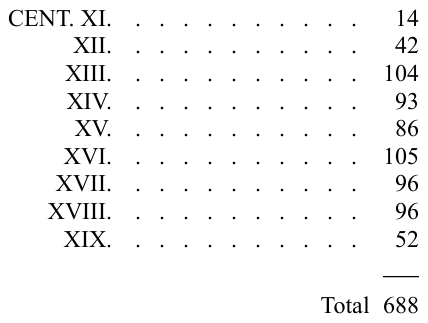
“Thus time has demonstrated the fallacy of Bachmair’s notion, that the phrase, ‘the number of his name,’ imports the SUM of the numbers ATTACHED to the names of the Popes. All the Pontiffs, from Gregory VII.” (Query: Why begin there?) “are here considered as ONE ecclesiastical personage; and the numbers attached to the papal names are, IN THEIR COLLECTIVE CAPACITY, contemplated as the NUMBER of this CORPORATION of successive dominant Pontifices Maximi. A very specious ground for argumentation at the time Bachmair wrote, when 666 wanted 30 to be filled up.”
J. H. URSINUS, &c.
Quoting from Wolfius, without directly mentioning his authority, Archdeacon Wrangham gives us, in his “Six hundred threescore and six,” the conjecture of J. Henr. [272] Ursinus, who finds in the number in question a reference to the 25 Idolators of Ezekiel 8:16; for that number being multiplied into itself, produces 625, to denote the body of the Beast; and having added to it 41, to denote his head and members, the sum is evidently the Apocalyptic number: and of another, who fancies that a remote allusion is intended to Dives and his five brethren, Luke 16:28; six being the element, of which the number in question is exclusively composed.
MAYER.
Mayer observes, “As this Beast is said to have a number, it is evident other beasts described in the prophecy are to be enumerated with it; and as beasts, in prophetic language, represent either civil or ecclesiastical governments, and it is said of the number of the Beast, that it is the number of a Man, therefore the Roman Emperors, from Julius Cæsar to Augustulus, (who are typified by the Bear and the Leopard, Daniel 7:5,6,) the Emperors of Germany, and the Sovereigns of those nations on the continent of Europe who are alluded to by the horns of Daniel’s fourth and John’s first Beast, with the Popes or Bishops of Rome from Linus to Pius VII., Sovereign of the Ecclesiastical State, (the horn that had a mouth speaking very great things, whose look was more stout than his fellows,) I suppose to be those referred to numerically by the prophecy, as they amount to the exact number of 665; and Buonaparte, the head of the French Government, who is represented by the second Beast, makes up the number 666! (‘Hint to England.’)” Wrangham, ut supra.
[273] Referring to the words, “Sovereigns of those nations,” &c., Mr. Wrangham very pertinently asks, “Does this include France, from Charles le Gros to Louis XVI.; Spain, from Pelagius to the present King, omitting Charles VI. (Why?); Portugal, Bohemia and Hungary, Poland, Denmark, as long as its princes continued Papists, and Sardinia and Naples?“
ARISTOBULUS EULABIUS.
Let me notice also the conjecture of one who assumes the pseudonyme of Aristobulus Eulabius, as stated in his “Meditatio.” Wolfius says that it occurs in the Bibliotheca Theologica Selecta, published in German, part 1xxii., pp. 1180, et sequen. Two fundamental propositions are, it seems, laid down by the author: 1st, That the number 666 has its foundation in the context of the passage where it is mentioned, and may, by proper investigation, there be discovered. And, 2nd, That the calculation of the number is one thing, and the explanation of its meaning is another. Having done this, we are by him referred back to the beginning of this 13th chapter, in which the first Beast, — the one supposed by him to be intended, — is represented as having 7 heads and 10 horns, and 10 crowns upon the horns. These preliminary statements having been gone through, he proceeds, at page 1194, to make his calculation. “The Beast itself,” he observes, “is a panther, having its own natural head, without which it would be, not a beast, but a mere trunk. To this Beast the number 666 is an appendix, having a reference to its secondary heads, their horns and crowns. For in addition to the primary head, there are 6 secondary [274] ones; upon each of these are 10 horns, making 60 in all; and upon each of these horns 10 crowns, making 600 in all: the whole, including heads, (secondary,) horns, and crowns, 6 + 60 + 600 = 666, the very number,” he remarks, “proposed by John.”255 Is this what Mede intended, in a passage already quoted? I doubt it. However, the idea of 10 horns and 100 crowns on each of 6 heads has, it will be observed, no foundation whatever in the text.
255 “Porro, ita calculum instituit. Bestia hæc est pardalis cum unico et naturali suo capite. Sine quo non fuisset bestia, sed truncus. Hujus Bestiæ numerus est appendix: et capitum secundariorum, et cornuum, et diadematum. Sunt autem jam ad caput primarium, secundaria 6; in quovis horum, cornua decem, h. e. 60; in quovis eorum, diademata decem, h. e. 600; ipse numerus a Joanne propositus, 666.” See the whole passage in Wolfius’ Curæ Phil. et Crit., ut supra.
WRANGHAM.
“I possess a thin quarto tract,”256 says Wrangham, “entitled, Romæ Ruina Finalis, Anno Dom. 1666, which, besides tracing this date in ALEXANDER 7 EPISCOPUS ROMÆ,” (L 50, X 10, D 500, I 1, C 100, V 5, M, 1000, = 1666,) “observes, that all the letters used as numerals by the Latins, M, D, C, L, X, V, and I, conjunctively make up the critical amount.” See antea, pp. 154, 155. “Of these, the three first are said to be adopted as initials of their respective values, (Mille, Dimidium-[275]Mille, and Centum,) and the four remaining ones form Luxi, the preterite, both of Luceo, (sc: “I have said in myh eart,” &c., “I sit a queen,” &c., Rev. 18:7,) and of Lugeo, (“for in one hour is she made desolate,” ib: 19.)!! Taken, however, by pairs, the first two of Luxi, added to the preceding three,” (50 + 5 + 1000 + 500 + 100,) “make up the very year of the publication, 1655, and thus appropriate the application to the Pope Alexander of that day, the Seventh; while the other two,” 10 + 1, “(but the author with unusual caution adds, quod divinare non ausim,) may indicate the precise duration of his Pontificate! The 1260 years, he suggests, reach from A.D. 406, when Honorius granted to Innocent I. rogatu hianti, efflagitationeque eblandienti, locorum prioritatem, suffragium, et super omnes censuram.” Wrangham, Vol. ii., 423. This, of course, makes the 1260 years to have run out in A.D. 1666; this date being intended as the explanation of the Apocalyptic number, 666.
256 “This tract, written in the reign of Elizabeth, and republished with a dedication to the Protector, by J. W. in 1653, was sent ad Anglos Romæ versantes, to repeat the warning, ‘Come out of her, my people,’ &c., Rev. 18:4. Its Epilogue, or Peroration, is signed W. A. — Т. Н. — R. W. — J. G. — S. S. — J. W.”
SULLAMAR.
“The Quadrature of the Circle, we are informed by Dr. Hutton, in his ‘Recreations,’ I. 365, Henry Sullamar, a real Bedlamite, found in this number.” — Wrangham.
A CONCLUDING ONE.
Time it is now to quit these baseless conjectures. And yet I cannot do so without expressing my surprise at not having met with one which appears to me sufficiently obvious. I do not say that the guess does not occur somewhere. Only, I have not fallen in with it. It is [276] founded on the fact of s being the sibilant, or hissing letter of the alphabet. In Hebrew, Greek, (not in the beginning of the word, to be sure, which is guttural, but in the word itself,) Latin, English, and many other languages, the word six, in its simple form, and in its multiples by tens, &c., involves the hissing sound of s. But the hiss is the characteristic sound of the serpent. And in six hundred and sixty-six, in many languages, we have the s, with its sputtering, hissing sound, assailing the ear in a triple, intense, and concentrated form. Considering these things, how happens it that the genius who suggested the three lilies of the French arms, or he who multiplied the six heads by the ten horns, and these again by ten crowns, or some other of the same stamp, did not suspect, in these three sixes, an allusion to the Old Serpent, and to the exercise of his baleful and malignant influence in the church? Perhaps, after all, this very solution actually somewhere exists.257
257 Are the disciples of Cuvier, Humboldt, and Buckland aware, that the words Το Μεγάθηρὶον, The megatherium, involve this mysterious number?

[277]
DIVISION II.
SOLUTIONS WHICH, ALTHOUGH MISTAKEN, ARE DISTINGUISHED BY SOMETHING NOVEL AND PECULIARLY INGENIOUS.
1. — POTTER.
AT the head of these I place, unhesitatingly, the learned, ingenious, and, notwithstanding all its imperfections and mistakes, most able interpretation of Francis Potter, B.D.258
258 “An interpretation of the Number 666: wherein not only the manner how this number ought to be interpreted is clearly proved and demonstrated; but it is also shewed that this number is an exquisite and perfect character, truly, exactly, and essentially describing that state of government to which all other notes of Anti-Christ do agree. By Francis Potter, B.D.” The edition consulted by me is that published at Oxford, (the original one,) by L. Lichfield, in 1642.
Concerning this I can speak with the more confidence, as I have gone twice through Potter’s work with the greatest care and attention. Masterly is it, as well in its conception as in its details. As a mere exercise of intellect, there are few books which can compete with it. The man who is desirous to sharpen his mental faculties, I recommend at once and decidedly to devote himself to its perusal. No wonder that it should have been so highly spoken of by Mr. Mede;259 and that almost all writers on the subject of [278] prophecy, who have lived since the time of its appearance, should have deemed it worthy of especial notice — some of them even of minute analysis.
259 “This discourse, or tract, of the number of the Beast, is the happiest that ever yet came into the world; and such as cannot be read, (save of those that perhaps will not believe it,) without much admiration.” — “I read the book at first with as much prejudice against the numerical speculation as might be, and almost against my will, having met with so much vanity formerly in that kind. But by the time I had done, it left me possest with as much admiration as I came to it with prejudice.” — Mr. Joseph Mede’s judgment of the treatise.
Having commended — honestly as well as decidedly — the ability displayed throughout the pages of this volume, what dare I say more? — Its facts are not destitute of value. Its reasonings are clever, and display amazing acuteness. Its diagrams are most ingenious. Altogether, as a work of rare talent, it must ever hold a high place among the stores of our English theological literature. But the interpretation itself, or rather the conclusion to which, by numerous admitted facts, the learned author would conduct us, is absolutely worthless. The idea of a square root to be found out from a given square, and this, as opposed to another square root and another square, elsewhere given, we might have tolerated. But the idea of a square root, which, after all, is not one,260 and which yet is to be received as one, appears to me to be drawing rather too largely upon human credulity. With most ingenious, and, in some respects, truthful premises, Mr. Potter’s conclusion is miserably “lame and impotent.”
Turpitur atrum
Desinit in piscem, mulier formosa supernè.
260 The actual root is a surd quantity. The square of 25 is 62; and the square of 26 is 676.
[279] My readers, annoyed by the mass of trashy solutions which I have brought under their notice, are probably by this time desirous of forming some acquaintance with the work in question — a work so long and so justly celebrated. Let me try to gratify them. For this purpose I have resolved to place before them the abstract of its contents, and the opinion pronounced upon its merits, which occur in Mr. Clarke’s “Dissertation.” At one time I had determined on drawing up a statement of my own. This determination, however, I was induced to forego. Instead of prosecuting it, I have adopted Mr. Clarke’s abregé, not only on account of my having taken that gentleman’s performance in some measure as my text-book and to save trouble, but also on account of the fulness and fairness with which he has treated the subject, and of the justness of the conclusion at which he seems to me to have arrived.261
261 Very full and admirable abridgments of Potter’s theory will be found in P. Jurieu, on “The Accomplishment of the Prophecies,” part i. chapter xv.; and in the “Introduction” to Rabett’s “Λατεινος,” pp. xxiii.-xxix. References to it, and even abstracts of it, will be found in almost every writer on prophecy since his time. I observe them in Wolfius, Turretin, Daubuz, John Glas, Wrangham, William Jones, and so many others, British and foreign, that to particularise farther is quite unnecessary.
“The foundation upon which” this interpretation “is laid is, that the number of the Beast is an αντιστοιχία to the number of the Virgin Company and New Jerusalem, which represent the true and apostolic church, whose number is always derived from twelve.” He “maintains, that as the number 144 mystically designates the church [280] and kingdom of Jesus Christ, and is sacred and mysterious only in its reference to the number twelve, which is the square root of it, and upon which it is founded; so, likewise, the number 666 is only mysterious, (reasoning ex adverso respondentia,) in its reference to 25, the greatest whole number contained in its root. This being allowed, he goes on to inform us, that as 144, the square of 12, represents the whole church founded upon the holy hierarchy of the Twelve Apostles; so also, 666 represents the whole Anti-Christian empire of the Papacy, founded upon the Anti-Christian hierarchy. To make good this assertion, he shews us, that as the number 12 is found in the entire structure of Jerusalem, which is the church and holy city, viz., twelve gates, twelve angels at the gates, twelve tribes written on the gates, twelve foundations, with names written on them, twelve thousand furlongs, the measure of the city, and twelve manner of fruits of the tree of life; so also the number 25 prevails in the Papistical hierarchy. As, first, in the number of Cardinals, which, at their first institution, were 25, considered in opposition to the Apostles, which was but 12.262 Secondly, in respect to the number of churches into which Christian Rome was originally divided, which were 25, in opposition to the Heavenly Jerusalem, which has but twelve gates, the churches in which baptism was performed corresponding to the gates of the city.263 Thirdly, in the [281] number of the parishes or tribes, which were 25 in Rome, in opposition to the Heavenly Jerusalem, which has but 12 tribes, as appears by the 21st chapter of the Apocalypse. Fourthly, in the number of the foundations of Rome, which are 25 Cardinals, originally constituting the Sacred College, which is called the foundation of the Church, in opposition to the Holy City, which has but 12 foundations, which are the 12 Apostles. Fifthly, in the number of the Angels, that is to say, of the head-pastors, which were the 25 Cardinals which constituted the Sacred College ; in opposition to the 12 Angels, or 12 head-pastors of the primitive Christian Church, which were the 12 Apostles. Sixthly, in the number of the gates of Rome, which were 25; in opposition to Jerusalem, which has but 12 gates. Seventhly, in the extent of the city of Rome, which was 25 thousand furlongs; in opposition to the extent of the Heavenly Jerusalem, which is but 12,000 furlongs.264 [282] Eighthly, in the number of the fruits of the tree of life, which are the articles of faith, because the righteous live by faith. The articles of the Christian faith are twelve; but those of the Papistical creed amount to twenty-five.”265
262 “See Potter, c. 19. The foundation of the Roman Pontiff’s subsequent greatness is dated by this author from the time of the removal of the imperial seat from Rome to Constantinople.”
263 “The gates of the ancient Jerusalem are thus reckoned by Villalpand, in his “Apparatus Urbis et Templi,” tom. iii., viz , Portæ, (gates,) 1, Fontis; 2, Stercoris; 3, Vallis; 4, Anguli; 5, Ephraim; 6, Vetus; 7, Piscium; 8, Benjamin; 9, Gregis; 10, Equarum; 11, Aquarum; et 12, Fiscalis. See Potter, p. 141. The names of the Roman gates are thus given by Onuphrius: viz., Portæ, (gates,) 1, Flumentana; 2, Collatina; 3, Quirinalis; 4, Viminalis; 5, Gabinia; 6, Esquilina; 7, Cœlimontana; 8, Latina; 9, Capena; 10, Ostiensis; 11, Portuensis; 12, Janiculensis; 13, Sextimiana; 14, Aurelia; 15, Querquetularia; 16, Piacularis; 17, Catularia; 18, Minutia; 19, Mugionia; 20, Sanqualis; 21, Nævia; 22, Randuscula; 23, Lavercalis; 24, Libitinensis; et 25, Triumphalis.” See Potter, p. 145. — These gates, Onuphrius says, existed between the times of Pliny and Justinian.
264 “Potter, c. 21. This point is not well maintained, as the author has assumed the circuit of Rome to be fourteen and a half miles, which is only the mean of different authorities upon this subject, no one historian having asserted it to be of this dimension.”
265 “Ibid. c. 22. The creed consisting of twenty-five articles, is that famous one agreed upon by the Council of Trent, and composed by Pope Pius IV.”
“Besides the eight principal divisions of similitude between the Christian and Papistical hierarchies, Dr. Potter observes that the number 25 prevails in all the dependencies of the Papacy: as, for instance, there were 25 Abbots in England, as Camden testifies, which had a vote in the Parliament; the number of the monks, friars, and singing mass-priests in several of their abbies, priories, monasteries, and other Papistical assemblies, were 25; the knights of the order of the Virgin Mary resident at Rome, in the Court of the Pope, were 25, and the same number at Loretto; the Penitentiary Court at Rome consisted of 25 officers; upon the top and high terrace of St. Peter’s, at Rome, is placed a gilded cross of 25 hand-breadths in height, upon a gilded globe of brass; in the forepart of this church are five gates which are commonly used, and another gate, called Porta Sancta, which stands open only one year in 25;” (at the period of the Jubilee;) “in the same church, (as also in that of St. Mary the Greater,) have been about 25 altars,266 besides the great [283] square altar or sepulchre of St. Peter, the measure of each side of which is precisely 25 feet, and upon which no man may celebrate mass, but the Pope only: upon almost all their altars they have 25 squares on each side, and in five squares of the upper side are imprinted five times five cinques, or round spots, in allusion to Christ’s five wounds: these five cinques are also accounted a symbolical device, and made armorial, and are inserted into the arms of the King of Spain, the Emperor of the Romans, and the Archduke of Austria; the Pope and Cardinals cause them to be imprinted in the frontispiece of several books published at Rome, for their better success, and their greater confirmation: their mass of Christ’s five wounds, five times multiplied and repeated, is pretended to have been commanded by the Archangel Raphael; their celebration of the Jubilee takes place every 25years; their priests, deacons, sub-deacons, &c., are not accounted of a perfect age till they have attained 25 years; their chief holidays are upon the 25th day of the month; upon the 25th day of December is the beginning of the Popish year, and the celebration of Christ’s nativity; upon the 25th of January is the conversion of St. Paul, &c., &c., &c. It is also observed, that the General Council of Trent was begun by 25 Prelates, continued 25 Sessions, and ended with the subscription of 25 Archbishops; and, last of all, the doctrine and faith decreed in this Council was afterwards by the Pope and his Cardinals reduced to a set form of words naturally branching themselves into 25 articles. Finally, the number 25 is thought by Dr. Potter to be peculiarly applicable to the Papacy, as this number has been esteemed, both by Heathens and Christians, a sign [284] of evil, as Jerome, Lyra, and Peter Serranus fully attest.”
266 “The twenty-five altars here mentioned are those that existed in the old cathedral of St. Peter’s at Rome; for, in consequence of the addition of building to this church in the sixteenth century, the number of altars has been considerably increased. See Potter, с. 25.”
“As to the objection why 666 is called the number of the Beast, as 25 is not the square root of 666, but of 625, Dr. Potter has given several very ingenious answers; the principal of which are the following: If the number of the Beast had been called 625, then the square root would be exactly 25, and in no respect could be called 26; which would give the Jesuits room to object, that the first number of Cardinals was 26, and not 25, as the Pope is also numbered among the Cardinals, it being customary to paint a Cardinal’s hat upon the Pope’s coffin, thereby pointing him to be one of their number. Secondly, if the number of the Beast had been called 676, then the square root could in no sense be said to be 25, but 26; in which case it might be alleged that the Pope is Vicarius Christi, and therefore not to be numbered among the Cardinals. Thirdly, if the number of the Beast had been called 650, that is, mid-way between the squares of 25 and 26, then the square root could not be properly denominated either 25 or 26. Fourthly, if the number of the Beast had been one of the numbers between 625 and 650, then the root could in no sense be called 26, which it was necessary it should, in order to meet the objection, that the Pope may be reckoned one of the Cardinals. Fifthly, of all the numbers between 650 and 676, there is none that could be chosen with so much propriety as 666, as not only the whole number of the root is 25, but the numerator of the fraction is also 25, the denominator being assumed 31, or more exactly” (in decimals,) “25.8069758.” Potter himself gives the [285] alternative of 806/1000, or 8069758/10,000,000. “Another reason given by the Doctor why 666 is chosen, is that it may also comprehend Λατε̃ινος, and divers other words which have an allusion to the Papacy.”
“Such is the general outline of Dr. Potter’s most ingenious interpretation of the number 666, upon which Mr. Mede has passed a very high and deserved encomium.267 That the number 25 has prevailed in the Papacy in many of the respects mentioned above, no person will attempt to deny; and that the foundation on which the Doctor builds his superstructure is very substantial, all must allow who consider that 12, the number used in the composition of the New Jerusalem, is similarly spoken of in the very book of prophecy, where the number of the Beast is revealed. The principal objection against this interpretation arises from the number 666 not being the exact square of 25; and, though it must be allowed that the Doctor has replied to this objection with very great ingenuity, as may be observed above, yet I am far from thinking that his arguments are conclusive. For it is totally incredible that the divine choice of the number 666, instead of any other between 650 and 676, should have been directed by the circumstance of its square root being 25, especially when it is considered that this is not the exact root, but only a very near approximation to it. It is also very improbable that 666 should have been selected in preference to any other between 650 and 676, because Λατεινος and some other words contain this number according to the rules of Gematria; for what relation has [286] the computation of the total value of the letters in Anti-Christ’s name with the extraction of the square root? Upon the whole, the interpretation, as it respects the surd quantity 25 25/31, is greatly complicated, and totally incompatible with the simplicity and consequent perspicuity necessary in a prophecy of Scripture.” — Clarke, Dissertation, pp. 70-77.268
267 See above.
268 Wrangham speaks most contemptuously of Potter’s theory. “Poole, after some intricate and unsatisfactory calculations from Forbes, has given an abridgment of Potter’s thin 4to. on the number 666, ushered in with a high and undeserved panegyric by More; and by Mede characterised as follows: — Nihil unquam felicius in illo tam difficili argumento in lucem prodiisse: nec librum hunc sine summo stupore, nisi ab incredulis planè, legi posse! In this work, a strong contrast is marked between the Christian number 144, with its root 12, and the Anti-Christian number 666, with the greatest integral root, 25. With regard to the surplus remaining in the latter case, ‘41/51, or 25/31, or 806/1000,’ he coolly remarks, perinde illud est; and assigns, as a reason for taking the number 666, rather than the perfect square 625, the necessity of ‘mystery to guard against the counteraction of the Beast,’ with some others equally valid!!” — Wrangham, ut supra. — See the whole passage.
Able as the preceding digest of Mr. Clarke is, the work of Potter itself must be read, and even studied, before any adequate idea can be formed of the merits and value of his theory.
2. — BENGELIUS.
Next to that of Potter, in point of elaborate ingenuity and wonderful and varied learning, appears to me to rank the system of Bengelius, as brought out in his “Gnomon Novi Testamenti.” The grand principle of this exposition is chronological.
[287] Speaking of this solution, Moses Stuart says, (Excur. iv. 455, 456,) “John Albert Bengel, the renowned critical editor of the N. Testament, and in high repute both for piety and learning, refers 666 to the number of years during which the Beast was to exercise his power, and not to any name significant of person or dynasty.”
—— He, “Bengel, — applied the era made out from 666 in his own way; and while he expresses his surprise that others had not hit upon it, he consoles himself with the pious reflection that flesh and blood do not attain to knowledge so wonderful, and it is only to the sovereign mercy of the Father of Lights that so unworthy a servant as he should be made partaker of such wisdom, hidden from ages and from generations. The only thing, he says, that makes him doubt in the least about his views of the Apocalypse is, that they had been given to one so unworthy as himself.269
269 I dislike exceedingly this sneering language of Professor Stuart. It is unworthy of him. Besides, on being examined, perhaps Benary’s and Ewald’s most worthless solutions, which he has thought fit to sanction with his approbation, might, in the hands of some one influenced by the temper of mind which he has exhibited in the above quotation, be turned, with great ease, and in a way not altogether pleasant against himself. With what measure ye mete, — the Professor can supply the rest.
“As to the era itself, all that need now be said is, that according to Bengel’s confident reckoning, in view of this, A.D. 1810 was to be the end of the forty-two months of the Beast. In 1832 the Dragon from the abyss was to begin his reign; within a few days after this, the Beast with seven heads and ten horns was also to commence [288] his; and in 1836 the beast was to be overcome and destroyed. ‘Should this year pass away,’ says he, ‘without some remarkable changes taking place, then there must be some radical fault in my system, and one must carefully investigate where it lurks.’ (As quoted by Lücke, p. 552.) But alas for Bengel’s toil! The present generation have seen that the changes have not taken place, which were predicted by him.”
True it is, that Bengelius’ system is radically defective, and that events have served to demonstrate this. Still, after a very minute and searching examination of it in the pages of the learned critic and commentator, which, judging by his quotations from Lücke, is more, I suspect, than Mr. Stuart has done, — I can testify, that it is far from deserving the contemptuous notice which the able and ingenious American Professor has chosen to bestow on it.
To go over the entire system, is out of the question. It would be unnecessarily to load my pages, and tax the patience of my readers. Those who feel inclined to understand the views of the celebrated German critic thoroughly, must consult the “Gnomon,” first, in reference to the 1st verse of the 13th chapter of the Apocalypse, and, secondly, in reference to the 18th verse. On both of these, Bengel is exceedingly copious and detailed in his observations. Besides, he himself, p. 1160, refers to a more laboured calculation of the Beast’s number, given by him in an “Exposition of the Apocalypse,” published in the German language, especially to what he has said in his “Introduction, section 45.” What appears in the “Gnomon,” in the form of aphorisms, is, it seems, merely a hurried sketch of the contents of the larger work.
[289] Many pages would be required to do justice to his observations on Rev. 1:1. I therefore pass these by, with a mere reference to some brief extracts which I have made in a note.270
270 He expressly asserts that “the Apocalyptic Beast, is the Roman Papacy;” (Bestia Apocalyptica est Papatus Romanus😉 fortifying his opinion to this effect, with the authority of writers before the Reformation, as Purvæus; as well as of eminent men who were contemporaneous with, or existed after that event, as Luther and Cluverus. Much importance is attached by him to the commencement of the Papacy of Hildebrand (Gregory), in 1077; particular attention being called by him to the first day of September, in that year.
The only other thing which I would notice is his anxiety to draw attention to the fact of the Beast’s seven heads not appearing all at once, but on the contrary following one another in succession (capita inter se succedunt): these heads commencing with and extending throughout the whole period of the Beast’s existence; whereas the ten horns do not make their appearance until the closing period of the Beast’s history. — But enough.
The whole of his remarks on chap. 13, verse 18, are condensed in twelve aphorisms, which, with their illustrations, occupy as many sections.
These may be still further condensed by observing that he assumes —
The number 666 to be certain and definite.
The mode of finding out its meaning to be, the discovery of some other number that agrees with it: the injunction being, not to number, (not αριθμησατο,) but to compute, (ψηφισατο.)
The number that agrees with it, to be the forty-two months, spoken of in the 5th verse of the very chapter [290] where the enigma occurs. And power was given unto him to continue forty and two months.271
271 Somewhat quaint is the author’s method of introducing this last number. After observing, that to computation, two numbers at least are required, and that in 666 we have the one number, he enquires, “But what is the other?” To this he answers: — “Hem! præsto sunt. 42 menses. v. 5. — Menses 42 sunt tempora: ergo, 666 sunt etiam tempora. Etenim, quæ accidentia, nisi tempora, numero 666 subesse posse, putet?“
And, thus, the forty-two months and the number 666 to be equal.
Following out these fundamental principles, and keeping in view his favourite theory of 666 in Greek having been expressed by words in the neuter gender, ἑξακοςια ἑξηκοντα ἐξ, with reference to ἐτεα, and in Latin, by words in the masculine gender, with reference to anni, both signifying years, he thus proceeds.
The forty-two months of the power which the Beast possesses, and the number 666 of the same beast, being asserted to be equal, it becomes necessary for us to enquire how it is that numbers which to all appearance are so decidedly at variance, as 1260 days, — the sum of 42 months multiplied by 30, — and 666, whether days or years, are to be reconciled?
This he proposes to do by introducing a distinction between ordinary and prophetic times or periods.
Ανθρωπου (αριθμος ανθρωπου,) of a man, is here indefinite; and is the substantive used for the adjective, — of man, for human. (The number of a man, or a human number.) The number, then, has a reference to human, that is, common or ordinary periods. These [291] may be days or years. — Days, however, are too short for the period of the Beast’s duration. Therefore, years, the greater times or periods of the world, are here meant. Calculated, then, as the number of a man, or a human number, the number 666 implies ordinary years. But the forty-two months, in the 5th verse, are not declared to be months of a man, or human months. Therefore, they are prophetical ones.
Thus, then, according to Bengel, we have ascertained that ὁ αριθμος του θηρίου, the number of the Beast, is the same as ὁ αριθμος των ἐτῶν του θηριου, the number of the years of the Beast — ἐτος, year, being the Greek substantive which agrees with 666.
To 666, thus ascertained to be years, the learned critic proposes adding a small fraction. (Appendicula.)
The number 666, of the 13th chapter, and the number 1000, of the 20th chapter, he understands to be the only two numbers employed in the Apocalypse, which, properly speaking, have a reference to common years. The former denotes the number of years of the Beast’s power; the latter, the number of years of the reign of those who have obtained the victory over the Beast. But 666 sustains to 1000 very nearly the ratio of 2 to 3. This ratio becomes perfect, if, dividing one unit of the 1000 into 9 parts, we assign 6 parts of it to the 666. We then get 666 6/9, or 2/3. That is, 666 6/9 : 999 9/9 : : 2 : 3. This little addition to the Beast’s number, Bengel can see no valid objection to. Nay, he fancies that the very ellipse of the word years, after 666, suggests the possibility of the other ellipsis also having taken place. And, thus corrected, how wonderfully do the two numbers, 666 and [292] 1000, tend to the illustration and confirmation of each other. We are, besides, he thinks, hereby guarded against the confounding of common with prophetic years. Nay, even against confounding ἐτος with ἐνιαυτός: for, as it is the former word, not the latter, which is employed with reference to the 1000 years, in the 20th chapter; so it is the former, not the latter word, which alone can agree with 666.
According to this ascertained ratio of 42 prophetic months, to 666 2/3 common years, all the minor periods of time are to be resolved: such as the 5 months of the first woe; the year, month, day, and hour of the second woe; and so on. Having laid it down as a fact, that the common year contains 365 97/400 days, and the common day 24 hours; and having observed that prophetic periods, of the same names, bear to these a fixed and definite ratio, he supplies us with a formula, by which at all times this ratio may be calculated. The origin of this formula is, of course, 1260: 666 2/3 × 365 97/400 : : 1 : the number required. As 190 10/21 to 1, or as 4000 to 21, so is any ordinary time or period, to the corresponding prophetic time or period.
And according to the same ratio, he resolves all the greater periods of time.
The following is the progression of these which he proposes, expressing 1000 as 999 9/9.
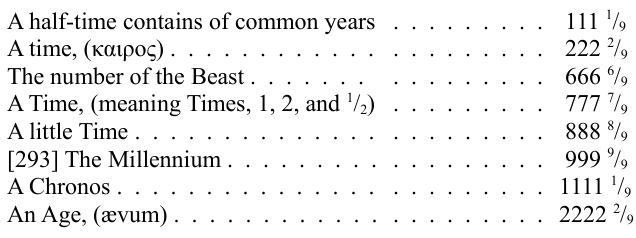
And so on.
Two grand reasons are assigned by Bengelius for his conviction of the truth of this mode of calculation: first, the analogy between 666 and the 1000 years, which it is the means of presenting to us; and, secondly, the connexion with the number 7, which thence results. “For,” observes he, “if all the articles in the above progression be resolved into days, with strict astronomical accuracy, the second article will give mere weeks of days, and the first will give as many half-weeks, which is the true reason why the first is called ἡμισυ καιρου, half a time, and the second, καιρος, a time. Then, whatever be the ratio of the first article, and the second, is likewise the ratio of all the rest, for they are all multiples of the first or the second article. Thus does it happen that the number 7, which Moses and the prophets, when treating of periods of time, and the Apocalypse, when treating of things, so frequently have recourse to, comes unexpectedly upon us, with reference to the times or periods of the Apocalypse themselves, when subjected to the test of a true analysis.”272 To another portion of his work, Bengelius refers for a more ample demonstration of this.273
272 Sic Septenarius, quem Moses et prophetæ in temporibus, Apocalypsis in rebus tantopere frequentat, de improvisò etiam ex temporibus Apocalypticis, insigni veræ analyseos criterio, emicat.
273 Sed proprius hujusce demonstrationis locus, est in ordine temporum, capp. xi. et xii.
[294] To what has gone before, Bengelius subjoins a justification of his prophetical day of about six months, distinguished not more by ingenuity than by a profusion of references, indicating the most extensive and well-digested reading. Napier, Aretius, and others, are quoted as authorities. Indians, Chinese, Thucydides, the Saxons, the Romans, the Gauls, Mathematicians, the Israelites, the interval between the commencement of John the Baptist’s ministry, and that of our blessed Lord, — all are laid under contribution, and made to supply him with illustrations. — Illustrations, I say. For he guards himself against being supposed to rest upon such authorities, and such facts, as demonstrating his position. “Non ad demonstrandam ipsam diei prophetici longitudinem hæc collegimus; sed tantummodò, ut ostenderemur, non tam paradoxam nobis eam longitudinem videri debere. — Ipsam demonstrationem aliunde deduximus.”274 Into the particulars of this very interesting section, I am, by a regard to space, and to the patience of my readers, precluded from entering.
274 Freely rendered — “Elsewhere I have given, and on its appropriate grounds I have rested my demonstration. In what precedes, I have had nothing more in view than to shew, that my notion as to the length of the prophetical day is not so very paradoxical a thing, as at first sight it might appear to be.”
Somewhat triumphantly, Bengelius follows up his preceding statements and illustrations, by representing his scheme as characterised by one great attribute of truth, its avoiding of extremes. Into extremes other interpreters had been betrayed. Protestants generally, in taking a prophetic day for a common year, appear to him to assume [295] a much longer period than the truth permits. Roman Catholics, in making a prophetic day to signify a common day, appear to him to assume a much shorter period than the truth permits. He refers to a German Introduction of his, in which he states that he has demonstrated “that from these two opposite and extreme principles, as from two grand fountains of error, all the false interpretations which prevail on the subject have taken their rise.” In the middle way which I propose, exclaims he, does the truth lie. He who condescends to walk in it, will find it to be to him the path of safety.
Having thus laid down his principles, established them, illustrated them, and proved their superiority over others, to the application of them the learned critic proceeds. — He has got a fixed and ascertained ratio between the months of the Beast, his number, and the number of his name. Deduced from this, is his grand conclusion. The beginning of the 666 2/3 years, which are equal to the months of the Beast, and the number of the Beast, and which are referred to in Revelation 13:1-5, is coeval with the commencement of the Pontificate of Cœlestine II., on the 25th September, A.D. 1143. While Rome was possessed of any power whatever, “the Beast,” according to our author, was not. Complete exemption from all other authority on the part of the papacy, was essential to “the Beast’s” existence. This immunity, until Cœlestine’s time, the Popes did not possess. Even Gregory VII., who enjoyed exemption from the yoke of the Roman Emperor, did not enjoy complete exemption from that of Rome. He was still subordinate in some respects. The last step Cœlestine took. All superior authority he shook off, [296] asserting and exercising a complete supremacy. Then was power given to the Beast, in the full and absolute sense of the term. And from that period, therefore, are we to date his “months” and his “number.” From that period did the 666 2/3 years begin to run. — Not so, however, “the number of his name.” That took its rise from Gregory VII. Its commencement was his confining the name or title of “Pope,” to the Roman Pontiff alone. And thus, while “the Beast” itself began with Cœlestine, “the name of the Beast” began with his predecessor, Gregory: that “name” embracing all who approved, as divine, the awful innovation of which he was the author; and “the number of the name of the Beast,” discovered by means of “the number of the Beast,” exceeding it by a very small quantity.
Such, as briefly as with a due regard to perspicuity I can sketch it, is an abstract of Bengelius’ system. To a full appreciation of its merits, and of the grounds upon which its learned author was so enamoured of it, a minute and searching examination would be indispensable. Persons who have a taste for such enquiries, will find in the “Gnomon” abundant materials for its gratification.
All that remains is to point to the refutation from facts which the learned critic’s surmises have encountered.

That is, the year 1810, was, according to him, the period of the Beast’s overthrow and destruction. — The [297] Beast, — that is, Bengelius’ Beast, — in A.D. 1848, still exists.
3. — IRENÆUS.
Not once to be compared with the explanations of either Potter or Bengelius, in point of deep thought, varied learning, ingenuity, and research — but still possessing some claim upon our notice from its antiquity, and from the character of its author, is the conjecture of Irenæus, that “the number of Anti-Christ was prefigured by the age of Noah at the deluge, connected with the height and width of Nebuchadnezzar’s image.” Having ascertained by examination the correctness of Mr. Clark’s quotation, I may continue to employ the language of that gentleman. “For, says he,” (Irenæus,) “that image which was erected by Nabuchodonosor, had indeed the height of sixty, and the width of six cubits, which image Ananias, Azarias, and Misael refused to worship, and were consequently cast into a furnace of fire, prophesying, by what happened to them, the burning of the Saints which is to take place towards the end of the world. For the whole of this image was a prototype of the coming of him who should command himself to be worshipped by all. The six hundred years, therefore, of Noah, in whose time the deluge happened, because of apostasy, and the number of the cubits of that image through which the just were thrown into a furnace of fire, point out the number of the name of that man, in whose person will be concentrated all the apostasy, injustice, wickedness, false prophesy, and deceit of six thousand years; and on account of which impieties the fire shall succeed the [298] deluge.”275 (Qu: “the deluge of fire shall supervene“? i.e., “superveniet mundum,” aut “homines” ?)
275 Illa enim quæ fuit a Nabuchodonosor instituta imago, altitudinem quidemhabuit cubitorum sexaginta, latitudinem autem cubitorum sex: propter quam et Ananias, et Azarias, et Misael, non adorantes eam, in caminum missi sunt ignis, perid quod eis evenit, prophetantes eam, quæ in finem futura est justorum succensio. Universa enim imago illa præfiguratio fuit hujus adventûs, ab omnibus omnino hominibus ipsum solum decernens adorari. Sexcenti itaque anni Noë, sub quo fuit diluvium propter apostasiam, et numerus cubitorum imaginis, propter quam justi in caminum ignis missi sunt, numerum nominis significat illius, in quem recapitulatur sex millium annorum omnis apostasia, et injustitia, et nequitia, et pseudo-prophetia, et dolus: propter quæ et diluvium superveniet ignis.
To Mr. Clarke we are indebted for quoting as much of the Greek of the preceding translation as is extant: — μεχρις ὅυ ἡ τὅυ Ναβουχοδονόσωρ ανασταθεισα ἐικὼν, ἡτις ὑψος μὲν ἐιχε πηχῶν ἑξηκοντα, ἐυρος δὲ πηχῶν ς΄. — ὅλη γὰρ ἡ ἔικῶν ἐκείνη προτύπωσις ἤν της τῷ ἀντιχρίςου παρουσίας. — Τα ὀυν χ΄ ἐτη τõυ Νῶε, ἐφ΄ ỗυ κατακλυσμὸς ἐγὲνετο, δια την ἀποςασιὰν, και ἡ πηχισμὸς τῆς ἐικόνος, — τὸν ἀριθμὸν, ὡς ἔιρηται, σημαινουσι, του ὀνόματος, ἐις ὅν, συγκεφαλαιοῦται τῶν ς͵ ἔτῶν πασα ἄποςασια — και ἄδικία, καὶ πονηρια, —
Iren. adv. Hæreses, lib. v. cap. 29, pp. 446, 447.
As Dr. Snodgrass’ view of the subject, although differing in some respects from that of Irenæus, has evidently been suggested by it, a quotation from the posthumous work of my learned countryman, and respected relative, in connexion with the foregoing, seems to be all the notice it requires. “In surveying the history of that ancient state,” Babylon, “the image on the plains of Dura, spoken of by Daniel the prophet, seizes our attention, as probably much to our purpose. It was sixty cubits high, and six cubits broad. It was made of gold. All nations were commanded to fall down and worship it. And, if any per-[299]son refused, he was to be cast into the midst of a burning furnace. Here was a superstition, great and magnificent. It was enforced likewise by a tyranny, severe and unfeeling; and it was attended with a blasphemy most audacious and shocking. For who is that God, said Nebuchadnezzar, that shall deliver you out of my hands? What a striking emblem is this of the leading characters of the Papal Beast. Let us blend, or incorporate it with his monstrous figure, as it is described at the beginning of this chapter,” (Rev. 13,) “and we shall see the number come out exactly as the apostle has stated it. Nothing can be more natural and simple than this operation. In multiplying the height of this image by the ten horns of the beast,” 60 × 10, “we have the number 600; and in multiplying the breadth of the image, by the ten horns, and by the last head of the beast, the only one which denotes Anti-Christ, that is to say, in multiplying the breadth by 11,” 6 × 11, “we have the number 66; the two together amounting to 666,” 600 + 66, “the very number that is here put down. By this easy operation, we see the spirit of ancient Babylon transfused, with increased energy, into her monstrous anti-type. By the first multiplication, we perceive that the superstition of mystical Babylon should be of a far more gigantic size than that of ancient Babylon, even as ten is greater than one; and by the second multiplication, we learn that this enormous superstition, together with the tyranny with which it was continued, and by which it was supported, was to extend, in one great body, over all the kingdoms which belonged to the Beast; and was to be entirely under the management of Anti-Christ as the governing head, which carried blasphemy upon it, as its [300] very name. Here, then, we have a solution of this very difficult question, which while it gives us the exact number of the Beast which the Apostle puts down, exhibits a most striking picture of Anti-Christ in all his distinguishing features. It shews that the Spirit of God does not deal in cabalistical conceits about names, and words, and letters, and the secret powers of numbers,276 according to the interpretations which have been commonly given; but that, while we have the number entire by which the Beast is denoted, we have it connected with a set of characters, which are not only applicable to him in the clearest manner, but which distinguish him from every other power which has appeared in the world.”277 For “the other circumstances,” by which Dr. Snodgrass conceives his interpretation to be corroborated, I must refer to his work itself.
276 Alluding to Potter’s interpretation. — D. T.
277 Snodgrass’ “Commentary on the Revelation of John,” Paisley, 1799, pp. 458-461.
4. — Παραδοσις.
Many interpretations are recorded, under my first head, which, on a superficial glance, may appear to be far more ingenious than this. A little reflection, however, may satisfy some at least of my readers, that the principle on which παραδοσις, as an explanation of the Apocalyptic number, rests, involves for its discovery no slender exercise of the reasoning faculties.
The Church of Rome is manifestly and mainly supported by tradition. Indeed, what she denominates the unwritten word of God, handed down from generation to generation, is by her placed upon a footing of equality with the [301] Scriptures themselves. To have found human traditions, as claiming divine authority, pointed at and stigmatised in the Book of Revelation, might, therefore, on the supposition of the Papacy being the Beast, have been anticipated.
But to find this done in a single classical Greek word, without needing to have recourse to squeezing or straining — this, to be sure, was a discovery scarcely to be looked for. And, farther, to find, after discovering the word, that it applied with surprising accuracy to the passage in which the enigma is proposed — this, should it happen, would be conclusive in its favour. In the word παραδοσις, tradition, these desiderata meet.
It is a good Greek word. It is not, like ἡ μισσα ἡ παπικη, a phrase invented for the purpose; being used in the New Testament itself. Col. 2:8. 2 Thess. 3:6. It requires neither addition nor subtraction, in order to bring out the Apocalyptic number. It constitutes the grand characteristic of the Romish Church. Tradition preferred to Scripture, does appear to be the leading feature of both Beasts: the former cruelly persecuting the members of the true church for rejecting it; and the latter constituting it the image, which it constrains all to worship. How astonishing the number of respects in which it may be made to agree with the language of inspiration! For my own part, it appears to me one of the most respectable solutions which previous times have supplied us with.
David Paræus, in his ” Commentary on the Revelation,” in loc., mentions the word; asking, emphatically, What is the Papacy, but a kingdom of traditions?”
And Archdeacon Wrangham, in his “Six hundred [302] threescore and six,” also briefly adverts to it, referring to Method. ii., &c., as his authority.
By many others it has been noticed. The grand objection made to it has been, that “it is not the number of a man.”

5. — Αποςατης.
This ingenious and beautiful solution was, as far as I have been able to trace it, first proposed by Archdeacon Wrangham. See his “Sermons, Dissertations, Translations,” &c., 1816, vol. ii., pp. 424-428. Nothing but his employment of ς to signify six, has prevented me giving it a place among approximations to the truth.
The learned Dignitary’s language is: — “The Beast having seven heads and ten horns, and upon his horns ten crowns, has upon his heads, (we are told, Rev. 13:1,) the name of Blasphemy.278 That this term, particularly in the Apocalypse,279 means renunciation of [303] Christ, or Apostasy, the late Mrs. Bowdler, in her ‘Practical Observations on the Revelation of St. John,’ has satisfactorily proved.
278 In allusion to the heathen custom of marking soldiers and slaves.
279 See likewise Acts 26:11. I compelled them to blaspheme; i.e., to deny the faith. Our Saviour, also, himself is charged by the Jews with blasphemy, i.e. Apostasy from God, in assuming the Divine Attributes.
“Thus, in the Old Testament, ‘Idolatry, as the root of all wickedness, is everywhere pointed out as the cause of God’s judgments on the Hebrews; and I think, to those who consider the book of the Revelation, it will appear as plain a fact that Blasphemy, (so interpreted,) is in the same manner the sin here pointed out, as being the characteristic of the latter times.’ ‘From its first chapter to its last, Jesus Christ the Lamb of God, his faith, his testimony, is the great object set before us.’ ‘He appears in the first, as in a state of glory. He claims the title of ‘Alpha and Omega,’ and the other attributes of God: He receives the praise and worship of all created beings: He claims them as his own: He unfolds mysteries, he commands, he promises, he threatens, as God.’ ‘Apostasy from him, therefore, is the Blasphemy here spoken of;280 and the causer of this offence is justly called Anti-Christ.’
280 Whosoever shall deny me, him will I deny. — Matt. 10:23, Luke 12:9. If we deny him, he also will deny us. — 2 Tim. 2:12. He that denieth the faith, is worse than an infidel. — 1 Tim. 5:8. See also 2 Pet. 2:1, 1 John 2:22,23, Jude 4; and particularly 1 John 4:2,3.
“Hence have I ventured to suggest, as the solution of this long-disputed passage,
“Αποςατης.
“In the identification of Blasphemy with Apostasy, Dr. Middleton, the learned Bishop of Calcutta, Professor Bridge, [304] of the East India College established near Hertford, and Mr. Faber, in private communications made to me, agree. The latter says, ‘Sir Isaac Newton appears to restrict the word too much, in confining it to Idolatry considered merely as apostasy from the worship of God;’ but he does ‘not see how Αποςατης can be called either the name of the Beast, or the name of some individual man. It is a word,’ (he adds,) ‘descriptive of the qualities of the Beast, see Rev. 13:1; and it is a word descriptive of the qualities of a man who is an Apostate; but it can scarcely be considered as ‘the name’ either of the Beast, or of any man. But I pretend not to say,’ (he proceeds,) that Αποςατης likewise, as well as Λατεινος, may not be hinted at. It certainly describes the character of the Beast very exactly; and agrees, in a very curious manner, with the very phraseology used by St. Paul, in 2 Thess. 2:3, and 1 Tim. 4:1.’ He farther approves of it, as having (in common with Λατεινος,) the advantage of being a Greek word; justly deeming it ‘in the highest degree unnatural, that St. John should write in one language, and compute in another.’ He prefers, however, his original favourite; as Λατεινος is at once the name of a man,281 the title of an empire, and the distinguishing appellation of every individual in that empire.
281 “Bishop Newton, it may be observed, remarks, that ‘the number of a man,’ may mean only a method of numbering practised among men;” and in this idea Pyle concurs. See Isaiah 8:1. Rev. 21:17, &c. &c.
“The Bishop of Calcutta, to whose piety, talents, and acquirements preferment has only done justice,282 objects — [305] if, indeed, he can be said to object — to my conjecture, merely from its obviousness; though it does not appear, as far as my reading has extended, to have occurred to any of the numerous commentators, who have written upon the subject.
282 This was written, I presume, about 1814, or 1815. — D. T.
“I forbear to transcribe the testimonies borne to it by Mr. Thurston, in his late publication; and in private letters, by the highly respectable Dean of Lichfield, Dr. Woodhouse, and the Rev. J. H. Bromby, Vicar of Hull.
“The plain English arguments of Mrs. Bowdler, unconnected with numerical calculations in Greek, (of which she was, probably, ignorant,) appeared to me so satisfactory, that, simply as a matter of curiosity, and with no sanguine anticipation of the result, I computed the amount — not Αποςασις, or Αποςασια, for the number of the Beast, we are told, is the number of a MAN, but — of Αποςατης, and found it to be exactly 666. If, then, it be farther considered, that this quaint enigmatising style, by which words and numbers are reciprocally commuted for each other, was in fashion in the decay of Greek literature;283 [306] and that there is no reason to suspect of prudential motives, in the concealment of a personal name, contemporary or remote, one who was shortly afterward a willing martyr, we shall perhaps deem the riddle least doubtfully solved by the generic word
“Αποσατης.”
283 “It was a method practised among the ancients, to denote names by numbers; as the name of Thouth, (Θωυθ,) or the Egyptian Mercury, was signified by the number 1218″ (9 + 800 + 400 + 9 = 1218); the name of Jupiter, as ῾Η Αρχη, or the beginning of things, by the number 717,” (8 + 1 + 100 + 600 + 8 = 717); “and the name of the Sun, as ήυς, Good, or ὑης, the Author of rain, by the number 608,” (400 + 8 + 200 = 608.) “St. Barnabas, the companion of St. Paul, in his Epistle ix., discovers in like manner the name of Jesus crucified, (sc. I H, the two first letters, and T, as the mark of the cross,) in the number 318,” (10 + 8 + 300 = 318.) “Newton’s Dissertations on the Prophecies, ii. 298. See also two papers in the Monthly Magazine, by Mr. Dyer, on the ἰσοψηφα, or verses containing equal numbers, x. 134, 212.”
The above was published in 1816. I have now lying before me, The Rev. George Stanley Faber’s “Dissertation on the Prophecies,” 2 vols., 1806; and the same gentleman’s “Sacred Calendar of Prophecy,” 3 vols., 1828. A quotation from the former work, afterwards to be made, will shew that he was once a strenuous contender for Λατεινος, as the Beast’s name. The above quotation from Wrangham indicates that about 1816, although pleased with Αποςατης, he still clung to his original favourite. The “Calendar of Prophecy,” however, places him among the principal supporters of the learned Archdeacon’s hypothesis.
Mr. Faber’s arguments in favour of his altered opinion will be found, vol. iii., between pp. 225 and 242. He dismisses Λατεινος somewhat abruptly, pp. 237, 238, considering the strength of his former attachment to it.
Having said, properly enough, “we shall vainly hope for success in explaining the sacred enigma, unless we attend most strictly to the terms in which it is conveyed,” he adds; “now these terms, I apprehend, may be set forth under the four following distinct articles.
“The name of the Beast is a certain mark, or stigma, [307] or character, which is figuratively said to be impressed upon him, which exhibits the component letters of his name, and by which he is emphatically distinguished.
“The name of the Beast is the name of blasphemy.
“The name of the Beast comprehends the number of the Beast; and that number is declared to be 666.
“The number of the Beast, or the number 666, produced by the letters of his name, is also the number of a man.”
These four distinct articles, or propositions, he works out and illustrates with great ability. Having observed, previously, that he was “much inclined to think, that, even independently of other objections,” (that is, to other words,) “the very phraseology of the Apostle shuts out every name which has been adduced as the name of the Beast, save only the single name Apostatès, he thus sums up his argument: —
“Hence, I think, we can scarcely doubt, that the man in the Apocalypse, whose descriptive name is Apostates, and whose number is 666, is no other than the person whom St. Paul denominates the Man of Sin, and whom he represents as presiding over a great apostasy from the sincere faith of the Gospel. In a word, the man who participates the descriptive name and number of the Beast, is the Roman Pontiff.” — Faber’s “Calendar of Pro-phecy,” vol. iii., p. 242.
To this conjecture Mr. Wm. Jones has adverted, in his “Lectures” on the Book of Revelation. He appears not to have seen Archdeacon Wrangham’s work.
By Mr. J. E. Clarke and Mr. Elliot this solution is condemned. The former says: “Wrangham has fancied it to [308] be contained in the Greek word Αποστατης, ‘an apostate.’ But in this he is certainly mistaken; for the Greeks, in their ἰσοψηφία, never counted the ς 6, but 500; as is evident in the word περιςερὰ, ‘a dove,’ which Irenæus informs us contains the number 801;” (80 + 5 + 100 + 10 + 200 + 300 + 5 + 100 + 1 = 801;) “but if the ς had been taken for 6, this word could only be said to contain the number 307.” And to this he subjoins a note in the following terms: — “If ς be reckoned only 6, this word will be thus numbered: π 80, ε 5, ρ 100, ι 10, ς 6, ε 5, ρ 100, a 1 = 307. Another example in which the ς is counted 500, and not 6, is found in Jerome’s Commentary on the eighth chapter of Zechariah, where ἑπτακισχιλιους and χριςιανους are said to contain each the number 1946. This is not an example of the ἰσοψηφία, unless we admit, with Scaliger, that ἑπτακισχιλίους must be written ἑπτακισχειλιους, and then both words only contain each 1941, as follows: — ε 5, π 80, τ 300, α 1, κ 20, ι 10, σ 200, χ 600, ε 5, ι 10, λ 30, ι 10, ο 70, υ 400, ς 200 = 1941. And χ 600, ρ 100, ι 10, σ 200, τ 300, ι 10, α 1, ν 50, ο 70, υ 400, ς 200 = 1941.” — J. E. Clarke’s “Dissertation,” p. 55. — Mr. Elliott, who seems to quote from Clarke, after having, I presume, seen Faber, expresses himself to the same effect. — Hor. Apoc., vol. iii., p 206.
Mr. Rabett, however, to whose work I intend more particularly to draw attention afterwards, is the principal author known to me who has set himself to the task of demolishing the Archdeacon’s hypothesis. Nearly a third part of his work, “Λατεινος, Latinus,” is devoted to this object. And, I must confess, as appears to me, successfully. Mr. Faber, in a long note contained in his “Sacred [309] Calendar of Prophecy,” pp. 235-239, had introduced a disquisition with respect to the manner “in which the contraction or cypher ς, came to be employed for the purpose of expressing the number 6.” This assumption of the contractions, and the cypher F, or ς, being one and the same thing, Mr. Rabett expressly assails. The two characters, as he attempts to shew, are not identical. The ς, or στ contracted, he maintains, is never employed to signify 6, but always 500. And, establishing this point, as I think he does, the solution falls to the ground.
Notwithstanding this, I could not help considering it to be worthy of a place among ingenious conjectures.
Its calculation is —
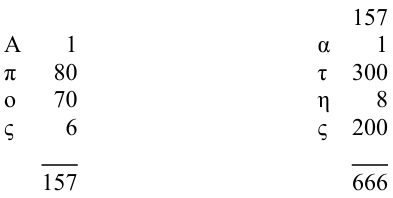
6 — לאטרענוש.
When examining Foxe’s “Acts and Monuments,” vol. iv., I stumbled upon the following passage, occurring p. 106: — “Some later writers, giving their conjectures upon the same,” (the Beast’s name,) “do find the name of Lateranus in Hebrew letters.” This, of course, establishes the fact, that the solution now under consideration is not Foxe’s own. It is rather ingenious. Evidently it was suggested by the circumstance of several (five) General Councils having been called Lateran, and by a desire to have [310] recourse to every expedient by which the Bestial character might be fastened on the Romish Hierarchy.
Archdeacon Wrangham, — whose works have come into my hands since I saw Foxe, and set down the foregoing extract, — alluding to this word, expresses himself in the following manner: — “A black letter writer quotes and rejects ‘Lateranus in Hebrew letters,’ (Query, לתהרהניוס?) ‘and LVDVVIC in those of Rome,’ adding, ‘and thus much by the way and occasion of Nicolaus de Lyrâ, Paulus Bergen, Matthias Dorinkus, the author of ‘Fortalitium Fidei,’ and other commentaries more of the same faction; who, writing upon this thirteenth chapter of the Apocalypse, and not considering the circumstances thereof, both are deceived themselves, and deceive many others; applying that to the Turk, which cannot otherwise be verified but only upon the Pope, as may appear sufficiently by the premises. Not that I write this of any mood or malice, either to the city of Rome, or to the person of the Bishop, as being God’s creature; but being occasioned here to entreat of the prophecies against the Turks, I would wish the readers not to be deceived, but rightly to understand the simple Scriptures, according as they lie; to the intent that, the true meaning thereof being blotted out, it may be the better known what prophecies directly make against these Turks; what otherwise.'”
The above quotation is from Foxe, if my memory serves me right. At all events, it is very like language which I remember perusing in that author.
That the mystery of the second Beast, rising out of the earth, having the horns of a lamb, and speaking as a dragon, cannot apply to Mahomet and the Turks, but [311] only to the Bishop of Rome and none other, is, if I mistake not, the proposition which he aims at establishing by a series of arguments, of which the names just mentioned constitute one.
If the Archdeacon’s Hebrew be correct, then the calculation is,

Which is 100 too much. The learned Dignitary had, I suspect, assumed the ר to denote 100, as the ρ does in Greek.
If I mistake not, לאטרענוש is the word intended by Foxe.
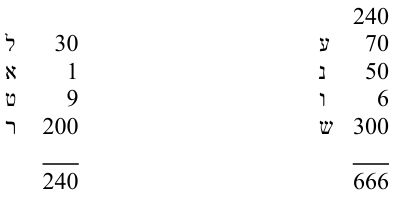
Certainly it is a singular circumstance, that the place from which have issued some of the wickedest and most infamous decrees that ever disgraced human legislation — some actually sanctioning the deposition of sovereign princes, and murder — should thus be capable of being designated by the ominous number!
[312]
7. — ZÜELLIG.
Zuellig’s interpretation of the subject which now occupies our attention, as abridged in the “Christian Observer,” for February, 1847, having come under my notice, and having struck me as characterised by a considerable measure of originality and ingenuity, I cannot help presenting it, in as condensed a form as I can, to my readers.
The author, it seems, makes certain preliminary remarks, such as,
1. That as mention is made of two Beasts, they are to be viewed as the antagonists of Messiah in his two characters of King and Priest — being anti-king and anti-priest.
2. That “the number of the Beast,” being declared to be “the number of a man,” — see verse 18, — we are to seek for it in a man’s name.
3. That Christ being the antitype of Moses, and the New Testament Dispensation the antitype of the Old, we may anticipate finding the typical Anti-Christ among the opponents of Moses, and of the Dispensation of which he was the head.
And, 4. That Vitringa, although unable to verify his supposition, had long ago suspected, that under “the number of the name” of this Beast, there “might be lurking a cabalistic Balaam.”
These things being premised, and having shewn previously, in his observations on verse 3, that Balaam had been slain with the sword, Numbers 31:8, Joshua 13:22, the learned author, it seems, proceeds to state the arguments by means of which he is induced to ascribe to [313] Balaam “the bad pre-eminence” of being the second Apocalyptic Beast.
1. The Old Testament Balaam, as having been the adversary of Moses, is considered by the ancient Jews to have been pre-eminently the wicked one; just so, it is a New Testament Balaam, or wicked one, who is to rise up in opposition to the Messiah.
2. Among the names given to Anti-Messiah by Rabbinical writers, occurs that of Armillus, or Armilaus, evidently a Greek translation, Ερημολαος, of the Hebrew Balaam.
3. John has prepared us for the appearance of a second Balaam, by his previous mention, Apoc. 2:14,15, of Balaam, and of the Nicolaitans, or Balaamites: Nicolaus, like Eremolaus, being intended to express in Greek the name Balaam.
4. The wound in the Beast’s head answers to an incident, preserved in the traditional history of Balaam. The latter is said to have been wounded in the head by Phinehas. Such an agreement is very remarkable. The death of the Anti-Messias, like the death of the Anti-Moses, is by a sword-stroke on the head.
Prepared thus to examine the name Balaam, by the application of the principle of Gematria, we find ourselves at first disappointed, the result being only 142.
But if, turning to Joshua 13:22, and finding there his name and full title, Balaam, the son of Beor, the Soothsayer, or Sorcerer, we repeat the attempt, to our surprise and satisfaction, it comes out the exact Apocalyptic number.
[314]

284 This reading is incorrect. The Hebrew is, הקוסם בלעם בן בעור.
285 Writing from memory, and from a few notes taken eight or nine months ago, if I should have committed any mistakes in the representation of Zuellig’s theory, the reader may be assured that they are quite unintentional.
8. — P. J. BAILEY.
To a most able, ingenious, and original conjecture, I reserve the last place in this division of my work.
When I say that the conjecture is by my dear and distinguished friend, Philip James Bailey, Esq., author of “Festus,” — one of the few poems which are destined to command the notice and admiration of future ages, — I can scarcely mention a fact better calculated to bespeak attention, and awaken interest in minds to which the suggestions of genius must ever be dear.
Assuming τον to be the old form of the neuter of the Greek article, my friend thus proceeds: —
“Revelations 13:18: ‘Ωδε ἡ σοφια ἐστιν· ὁ ἐχων νουν, &c. “Here is wisdom: let him that hath understanding,” &c.
“In this passage are three things specified: the Beast, [315] the Man, and the Number. By reference to the alphabetic numerals, in Greek, the following will be found to be the respective numbers of the Beast, (τον for τὸ θηριον,) and the Man, (κ᾿ ἀνθρωπος.)
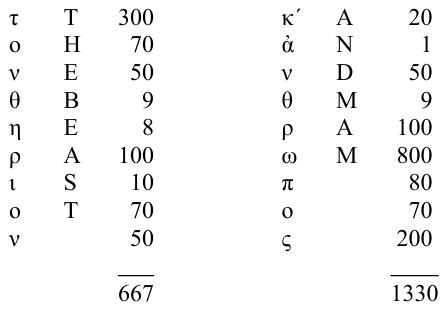
“But because it is said that the number of the beast is the number of a man, or of man, as it might have been translated, it is evident, that there are two parties to one name, and that they are both involved in the number of (the) man; and that the true number, 666, which is given, lies somewhere between them, and belongs to both of them.

The former equalling the given number plus 1; and the latter, being divided according to the requirements above stated, equalling the same, minus 1; 1330 ÷ 2 = 665; the two elements being added together, in order to the attainment of that unity of condition asserted in the text, 665 + 667 = 1332; and this sum being again divided by 2 [316] for the elimination of the ultimate number, we have as the product the required number 666.

which, being divided by 3, for the double nature of man, and the single nature of the Beast, 2 + 1 = 3, results as above,
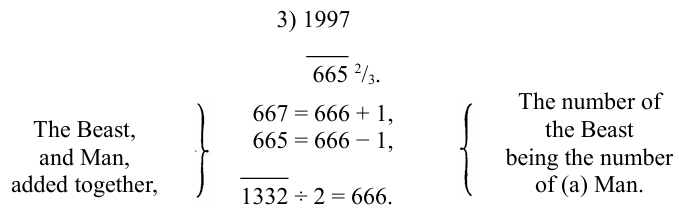
“The simplicity of this problem has been its mystery. Interpreters, for the most part, misled by an erroneous translation, have sought to identify the given number with the name of an individual; such as Mahommed, Lateinos, (considered by Protestants generally, and particularly by Bishops and other dignitaries of the Established Church, one of the most satisfactory, as clearly pointing to the Roman Pontiff,) and Genseric, the Goth, with a vast number of similar conjectures. Others, with a quality, as Lampetis, illustrious; or a character, supposed in opposition to our Saviour, as Antemos, contrary. Of all these, the futility is manifest. The text itself contains, in the very terms in which the enigma is couched, the solution of the enigma. The knowledge of this mystery is, however, the master-key of many most important scriptural [317] doctrines, relating to the existence of the soul; and the existence, character, and end of evil: as also of humanity in general; for it is the nature of the species which is alluded to, and not the quality or circumstances of any individual or institution; its reference is to the respective attributes and influences of the Jewish and Christian dispensations, and to the progressive, spiritual, and social condition of the world.”
Thus far Mr. Bailey.
Looking at this jeu d’ esprit — this clever emanation of genius — so far from being able to apply to my friend, the language which he puts into the mouth of his Student, in his own glorious and immortal production —
Poetry only I confess is mine,
And is the only thing I think or read of,
one is forcibly reminded of a passage, in which, in the character of Festus, it is scarcely going too far to think he is delineating himself: —
He brake spears with the brave till he quelled all —
So he applied him to all themes that came;
Loving the most to breast the rapid deeps
Where others have been drowned, and heeding nought
Where danger might not fill the place of fame.286
286 Festus: Second Edition, p. 233, and p. 245.
[318]
DIVISION III.
SOLUTIONS, WHICH, IF NOT THE TRUTH, AT ALL EVENTS MAY HAVE SOME CONNEXION WITH IT.
Explanations of the name of the Beast, founded on the principle of the Latin Church, or Papacy, having been, in the enigma in question, directly intended, have always been favourites with the Reformed. Not as if such explanations were confined to them. Nay, not as if such explanations had derived their origin from them. For one of the solutions, and that, too, the one most generally adopted, has come down to us from a writer who ranks among the earliest of the so-called Fathers. Protestants, however, have seized on them with avidity. Annoying and damaging to their Popish antagonists they have found them to be, and freely for this purpose have they been employed. Usque ad nauseam, even. For scarcely any modern Protestant work, on the subject of the prophecies, but has recourse to them.
The reverse of wrong, however, is not always right. Because it may happen that the Beast, and its number, embrace topics more comprehensive and more profound than Popery and its manifestations, it does not thence follow, that Popery and its manifestations are not in this enigma referred to at all. Protestants may have blundered. Their view of the subject may have been too narrow. They themselves may, to a degree which they have [319] no suspicion of, be involved in the condemnation which they so eagerly and unhesitatingly extend to others. And yet, these others may, notwithstanding, be the objects of divine condemnation. Et tu quoque, may be a clever retort from an adversary, and may tend to stop my mouth; but my charge against him may be perfectly well founded after all. So here, Protestants as well as Roman Catholics may find that the battery of divine truth is directly levelled against them both. But this very supposition leaves Roman Catholics condemned. — Such a possibility existing, while we are unsatisfied as to Latinus being the name of the Beast, is there no caution requisite before concluding, that the word is altogether inapplicable?
The fact is, that I do reject several explanations of this divine enigma, which have a direct reference to the Papacy, and upon which has long been stamped the approbation of the religious world.
While, however, I reject them, as inadequate to satisfy all the statements and requirements of the inspired record — as, indeed, so far from exhausting the subject, being characterised by an appearance of superficiality — nevertheless, there are circumstances connected with them, which have not failed to make a deep impression on my mind.
Should we discover, that the divine enigma proposed for solution, has a reference to human nature in general, and to all associations of human beings for religious purposes which are founded on human principles, then it is evident that, as the genus includes the species, any one man, and any one human association of a religious description, as being capable of having applied to it language which at [320] bottom has a still wider range and application, may be very easily and naturally mistaken for the only person, and the only body, of whom and which the language in question was intended to be predicated. To exhibit the contrast between the earthly and the heavenly — between human nature and the divine nature — between bodies of men associated upon human principles, and actuated by human motives, and a body of men brought together by God himself, and influenced by motives which are heavenly and divine — may be the object of the Book of Revelation in general, and of this remarkable 13th chapter in particular. In the prosecution of this plan, and the illustration of it, is it impossible for phraseology to have been employed, and views to have been presented, which with truth, and without any perversion or distortion of their meaning, may be shewn to characterise the constitution and procedure of the Church of Rome? Supposing me to be correct in this suggestion, then the grand error committed by those who have interpreted the denunciations of the Beast, contained in the Apocalypse, with reference to the Papacy, and its head alone, would be the confining to them what in reality has a wider and more comprehensive range of signification.
Still further. Can this very applicability of language really generic, to a specific case, have been overlooked by the Holy Ghost? To come closer to the point: — in constructing this Book, and proposing this riddle, may it not have been the very purpose of the divine author of the Apocalypse, so to express himself, as to draw attention to some particular individual and body of men, having a form of godliness, and professing a kind of Christianity, but denying the power thereof? May not the name of [321] the Beast, Rev. 13:18, which is in reality universal, have been intended to be susceptible also of a particular interpretation? Perhaps not. On a topic like this, where my basis of conclusion, however probable, is, after all, a mere conjecture, I assert nothing positively. But it does appear to me, to say the least of it, to be a remarkable coincidence, that the five solutions of the enigma, which I am now to submit to my readers, — one of them, reaching back to the remotest antiquity, — while they certainly come short of expressing the exact and entire mind of the Spirit, should, notwithstanding, be capable of an unforced and obvious application to a person and a community, in whom and which, more than in any others, the grand characteristics involved in the true solution have been most strikingly apparent.
1. ΛΑΤΕΙΝΟΣ.
This, as being one of the first and oldest conjectures respecting the name of the Beast, now under consideration, which have been put upon record, and as having obtained more notoriety and currency than any other, certainly claims precedence.
It occurs in the writings of Irenæus, one of the Fathers, who flourished about 170, or 180, of the Christian æra. And it signifies Latin one, or Latin person: unless we choose to understand it as the name of an individual, Latinus.
A very cursory glance is sufficient to shew us, that, when the values of the different letters of which it consists are added together, we have presented to us in their sum, the mystical Apocalyptic number.
[322]

The exact words of Irenæus, as they appear in the Latin translation, are: — “Sed et Λατεινος nomen habet sexcentorum sexaginta sex numerum: et valde verisimile est, quoniam novissimum regnum hoc habet vocabulum; Latini enim sunt qui nunc regnant.” — Iren., lib. v., c. 30, p. 449. But the word Λατεινος also contains the number 666: and that it should be the name in question is extremely probable, seeing that Latin is the appellation of the kingdom which is most recent: (Query, last?) the Latins being those who are now in possession of sovereign authority.
Probability — high probability — of its truth, valde verisimile est, is, it will be observed, all that Irenæus ventures to predicate concerning this explanation. And in proof of his being uncertain as to the matter, two other conjectures, Τειταν and Ευανθας, between which he places Λατεινος, have been suggested by him. These we have already considered, and have unhesitatingly dismissed. — Curious, certainly it is, that Irenæus should have associated Λατεινος with two words clearly so unworthy of the place which he has assigned to them. And calculated to [323] excite suspicions as to his having entertained any fixed opinion on the subject, such procedure is. If one living so near to the Apostolic age, as Irenæus did, could not express himself more positively than he has done — nay, if he places upon something like a footing of equality with the most plausible of his conjectures, others which are absolutely and palpably unworthy of the slightest regard287 — what confidence can we, whose lot has been cast in the nineteenth century, repose in his suggestion — for it is no more — that Λατεινος was very probably the word in question?
287 Indeed, as we have already seen, actually assigns to Τειταν α higher probability than he does to Λατεινος: — “Sed et Τειταν, primâ syllabâ per duas Græcas vocales, ε et ι, scriptâ, omnium nominum quæ apud nos inveniuntur, magis fide dignum est,” &c. — See the whole passage, with the translation, at pages 159-162.
Is it wonderful, under such circumstances, to find all the Fathers, subsequently to his time, who treat of the subject, sharing in his uncertainty? and in testimony of this, presenting us with that crude and undigested mass of conjectures, to which we have already drawn attention? “De re tam incertâ, nihil audeo definire,” — In a matter of such uncertainty, I venture to pronounce nothing decisive, — are the words of St. Ambrose.288 And Cardinal Bellarmine, (followed in this, of course, by a host of Roman Catholic writers,) seizing, with his wonted acuteness, upon the hesitating manner in which Irenæus has expressed himself with regard to Αατεινος, and upon his avowed preference of Tειταν, has made this circumstance the first of a series of arguments by which, in opposition to the [324] Protestants, he attempts to set aside entirely the solution, the merits of which we are now considering.289
288 Irenæus himself had said, Nec asseverantes pronuntiabimus.
289 The words of Bellarmine, in the first volume of his works, where he treats, Controversy third, Book third, columns 728, 729, of the Sovereign Pontiff, and of Anti-Christ, we may here set down. Having spoken of a conjecture of David Chytræus, that the Roman Pontiff was Anti-Christ, founded on the application to him of a Hebrew word afterwards to be noticed, he adds, “Idem docet Theodoretus Bibliander, tabul. 19, et propterea tabulam undecimam suæ Chronologiæ, quæ incipit ab anno DC, inscribit, Latinos Papas. Rationes eorum duæ sunt. Una, quia Irenæus, lib. v., docet verisimile esse, hoc futurum nomen Anti-Christi; altera, quia revera literæ hujus nominis efficiunt illum numerum, ut patet. (Here follows the calculation.) Hæc opinio est prorsus temeraria. Nam, imprimis, Irenæus dicit quidem nomen Λατεινος probabiliter posse accommodari Anti-Christo; sed addit, multo probabilius esse, nomen Anti-Christi non fore Λατεινος, sed Τειταν, quod etiam exprimit illum numerum, et est nomen multo illustrius, cum solem significet.” — Having thus turned the hesitation of Irenæus to account, Bellarmine proceeds to shew, by a variety of other arguments, such as, that not the Latins, but the Turks, Spaniards, and French, were, at the time he wrote, possessed of Sovereign authority, and that not Λατεινος, but Λατῖνος, was the proper spelling of the word, the groundlessness of the Father’s supposition.
Easily might this mode of reasoning be obviated, as indeed it has been obviated. For all this apparent hesitation on the part of Irenæus, and for his suggestion of the superiority of a really inferior word, very substantial reasons might be assigned, without supposing him to have actually cherished any very great doubts on the subject. One will occur to every reader. Latin was, under existing circumstances, an awkward term to apply to a prophetic monster of iniquity. It might have led to unpleasant consequences. Therefore, as to embroil himself with a Latin Emperor, and [325] to incur the resentment of a Latin Pontiff, could not have been deemed by the worthy Father desirable or convenient, a prudential regard to his own safety may easily be conceived to have dictated the ambiguous phraseology in which he has chosen to deliver himself. Nor, if correct in this suggestion of mine, would the procedure of Irenæus afford the only instance in which obnoxious opinions, really entertained, have been first put forward in the guise of doubt and hesitancy. The sincerity of the Father, some may think, is hereby impugned. Or, at all events, his worldly wisdom is praised, to the disparagement of his sincerity. This I admit. But who that is acquainted with Irenæus’ writings, and has brought the pure and perfect morals of the New Testament to bear upon them, would like to become sponsor for his thorough integrity? Besides, I am not sure but that his meaning is, as he intended it to be, tolerably transparent. Sat verbum sapienti, is not an uncommon maxim with even the most upright historians and controversialists. He might deem it quite enough to have proposed, as a conjecture, Λατεινος. Although placed between two inferior and even worthless guesses — although one of these last he had even apparently preferred to it — he might nevertheless consider that such was its own intrinsic weight, and such the significancy of the hint conveyed in his valde verisimile est, as to render it impossible for any, except the dull, the prejudiced, and those who from rank and station required to be conciliated, to overlook or mistake his meaning.290
290 The claims and pretensions of the so-called successors of St. Peter, were, even so early as the second century, characterised by such extravagance, and marked by circumstances of such decided opposition to the simplicity of the gospel, as to have been likely to rouse suspicions of their anti-Christian nature in minds far less learned and talented than was that of Irenæus.
[326] Whatever doubts, however, might have been entertained by Irenæus on the subject, many of our most eminent Protestant expositors have had none. Λατεινος is, in their apprehension, the very word. It, and it alone, designates the Beast. “The Latin one,” according to them, “fitly denotes the man with the triple crown, who so long presided over the religious destinies of the Latin or Western portion of the Roman Empire; and who, till the present day, reads the Scriptures, conducts his worship and services, and issues his decrees, in the Latin tongue. Looking at his procedure, secular and ecclesiastical, in connexion with these his Latinizing practices, we discover in it all those characteristics of tyranny and blasphemy, which justify, nay constrain us to recognise in him the Anti-Christ of the Apocalypse.” Another circumstance tends to strengthen their conviction. The number required is the number of a man. And Latinus was the name of the first monarch of that kingdom, which, after having been in the form of Kingdom, Republic, and Empire, secular for so many ages in the hands of the Pagan Romans, is now, in the form of the Papacy, spiritual or religious, in the hands of their so-called Christian successors.
Among the supporters of this view may be mentioned one gentleman, the Rev. Reginald Rabett, A.M., of Queen’s College, Cambridge, and Vicar of Thornton, Leicestershire, who has devoted an entire volume to the [327] establishment and illustration of it. That volume now lies before me.291 To it I have had occasion to refer in previous parts of this work. Considered merely in a literary point of view, it is not perhaps entitled to rank very high. Its style is diffuse, — its repetitions are incessant, — its logic can scarcely be complimented as vigorous, — it has sadly the air of being in many respects a compilation, — and it has been by far too hastily got up. A little more recourse to the file, on the part of the author, would have improved it exceedingly. With all its faults, however, the student who is desirous of becoming acquainted with this subject, will find the work in question serviceable.
291 “ΛΑΤΕΙΝΟΣ, LATEINOS.” See full title, p. 117.
Archdeacon Wrangham’s hypothesis of Αποςατης being the Beast’s name, in which he has the support of Mr. Faber,292 our author has assailed with several acute and well-put objections. A profusion of learning he has expended on the difference between the episemon ς, Fαυ, and the contraction of σ and τ, and on the impossibility of the latter being employed to denote the numeral 6. And he has adduced several examples in proof of “the want of identity in the word APOSTATES, as applicable to any particular lapsed church or person exclusively.” Sadly has he blundered in ascribing to Dr. Adam Clarke the origination of the hypothesis of ἡ λατῖνη βασιλεια.293 And somewhat loosely has he stated the argument in favour of 666, in opposition to the suggestion of 616, by Archbishop Laud and Dr. Lee. But [328] the latter part of the work, although exceedingly ill written, and proposing its arguments in a way which is far from being calculated to make a deep, and powerful, and permanent impression on the mind of a careless or prejudiced reader, contains in it statements respecting Λατεινος,294 and its application to the Pope and Roman Church, which, if not thoroughly satisfactory, no scripturally-taught and reflecting individual will consider himself justified in summarily rejecting, or even treating with contempt. His arguments in favour of Λατεινος are the common ones: derived of course from the correspondence of the sum of the letters of which the word is composed, with the number in question; as well as from the Latin origin, the Latin character, the Latin language, the Latin seat, and the Latinizing practices of the Church of Rome. Also, from the exact agreement between prophetic announcements, and the actual facts of the Papal history. There is some novelty in his illustrations. Various interesting circumstances connected with particular Popes, and with the manner of election to the Papal dignity, will reward the patience of the reader. — To the book itself, however, which is an 8vo. of somewhat more than 300 pages, I must refer for full and accurate information.295
292 In his “Sacred Calendar of Prophecy,” Vol iii., Book v., Chap. iv., pp. 225-242. London, Rivington, 1828.
293 In reality, the solution of J. E. Clarke, Esq., Dr. Clarke’s nephew.
294 רומיית is not forgotten.
295 Chapters xvi., xvii., and xviii., as to their matter — I wish I could add manner, but, indeed, it is insufferably prolix — well deserve a perusal.
To enumerate the great names which, without writing formal treatises on the subject, have expressed incidentally, to a greater or less degree, their approbation of Irenæus’ [329] conjecture, would occupy too much room. A few, however, may be cursorily noticed.
In the “Acts and Monuments” of John Foxe, vol. iv., p. 106, Cattley’s edition, 1837, we find the author thus expressing himself: “The letters χξς΄, — certain ancient fathers, who were disciples and hearers of those who heard St. John himself, as Irenæus and others, do expound, — conjecturally to contain the name of the Beast, and to be the name of a man, under the word Λατεινος; whereas also no other name likely of any person, either in Greek or Latin, will agree to the same, save only the foresaid name.” A reference is then made to some later writers, who think differently; and the whole is thus summed up by the learned martyrologist: “But of all names properly signifying any man, none cometh so near to the number of this mystery (if it go by the order of letters,) as doth the word Λατεινος aforesaid “
Lord Napier, in the 29th Proposition of his Treatise on the Book of Revelation, speaks concerning the word Λατεινος as follows: — “Here then, say we, that name is λατεινος, for these reasons. First, because the name of the Beast is — the name of the ten-horned Roman Beast, or Latine empyre in generall, and not of the Anti-Christ onelie, and so it must either be Romanus, or Latinus. But of these two, Latinus is the oldest style; for King Latinus, (from whom that people were called Latini, and their countrie called Latium,) was long before King Romulus, of whom the citie was called Rome, and the people thereof Romanes. — Secondlie, it must be the number of a man’s name, (saieth the texte,) [330] so is Latinus the name of a man, even the name of one of their first kinges. Thirdlie, forasmuch as the Græcians had a custome, in their mysteries and oracles, to observe the numbers of names, as ye shall finde in divers partes of Sybilla. And as in that countrey, the name of the flood Νειλος is celebrated as holie, because it containeth the number of the daies of the year, 365, as Carion testifieth, Chron. lib. 4, wher he describeth the Cottes and Hesses. Therefore, Sanct John, (observing the custome of them to whom hee writeth,) saith, that the number of the Beaste, or rather (as he termed it in the former 17 vers,) the number of the Beast’s name is 666. — Therefore, Λατεινος is the verie name of the Beaste, meaned by the saide number.” — Extracted from Clarke’s “Dissertation,” p. 45.
Joseph Mede, in his “Clavis Apocalyptica,” second edition, London, 1663, p. 634, has the following words: — “Sed ne diutius in generalibus istis immoremur, videamus, tandem, quodnam sit illud Bestiæ NOMEN, quo numerus quoque ejusdem à Spiritu Sancto notatus contineatur. Est vero, quod jam tum cùm Apocalypsis adhuc recens scripta esset, nonnulli suspicati sunt, decantatum illud Λατεινος. Hoc enim nomine, post Imperii divisionem, et decem reges in provinciis ejus exortos, neque priùs, pseudo-propheta Romanus, cum reliquis Occidentis incolis, discriminis ergô, appellatus est; idque, ab illis ipsis quibus Apocalypsis Scripta est, septem Asiæ ecclesiis. Namque Græci et reliqui Orientales, penes quos in dilaceratione illâ Imperii nomen manserat, seipsos solos Romanos dici voluere; nos, cum Pontifice nostro, et, sub eo, Episcopis, Regibus, Dynastis, fatali quodam instinctu Latinos dixere. Atque [331] hoc ipsum nomen, literis suis Græcorum et Hebræorum more subductis, numerum conficit a Spiritu notatum.”296 — All the remarks of this truly learned, deeply reflecting, and estimable man, with reference to the present subject, are well worthy of our most attentive consideration.
296 “But, passing from general remarks, let us proceed at length to inquire what may be that NAME of the Beast, in which the number graciously made known to us by the Holy Ghost is contained? Unquestionably it is that very word which, almost as soon as the Apocalypse had proceeded from the hand of its inspired author, formed the subject of Patristic conjecture. I mean, the oft-repeated and far-famed ΛΑΤΕΙΝΟΣ. By this name it was that, after the division of the Empire, and after its several provinces had come to be presided over by ten kings, and not before, the Roman False Prophet and the other inhabitants of the WEST were, for the sake of distinction, designated; and this, strikingly enough, by those very seven churches of Asia to whom the Book of Revelation was originally addressed. For the Greeks, and others having their abode in the EAST, with whom, during the long series of convulsions by which the Empire was torn in pieces, the name Roman had always continued, wished to have that name thenceforward appropriated to themselves alone; whilst upon us, Westerns, with our Sovereign Pontiff, and under him, our Bishops, Kings, and other authorities, they, as if by a kind of fatal instinct, conferred the appellation of Latins. It so happening, that the letters of the word, LATIN, when calculated according to the Greek and Hebrew fashion, produce that very number to which the Holy Spirit hath seen meet to direct our special attention.”
In the celebrated Apocalypsis Apocalypseos,297 of Brightman, we find him, first of all, laying down certain principles which he thinks are to guide us in our researches [332] on this subject: — “1. The name in question must be one which might be made manifest in John’s age, not to him by revelation merely, but to others by study. 2. It must be the number of a man: not the number of a name which is proper or limited to the Beast; but of a name proper to a people, and derived from one man, as from the head, unto the entire nation.298 3. It must be taught as a riddle, or enigmatically.” After referring to the conjecture of Francis Junius,299 — to Master Hugh Broughton’s Adonikam — and to the words Romiith, or Romanus, in the Hebrew, which he considers “to come nearest of all to the truth,” — he thus finally delivers his opinion: — “I think that Λατεινος is that name.”
297 Apocalypsis Apocalypseos, i.e., Apocalypsis D. Joannis, analysi et scholiis illustrata, per Thomam Brightmannum, Anglum. Francfort, 1609.
298 Gentile nomen, is the phrase employed in the Latin.
299 That it means the Pope’s learning, (scientiam,) and the canon law, (jus canonicum,) now that the 6th Book of Decretals has been added to the foregoing by Boniface VIII. See antea, pp. 267, 268.
Mr. Jones, Manchester, informs me, that the following translation from Whittaker’s Treatise “De Anti- Christo,” appeared in the “Protestant Journal” for 1833, p. 37: — “If it seemed probable to Irenæus that Λατεινος, Latinus, Latin, would be the name of Anti-Christ, this same thing ought to appear much more credible to us, who have recognised and explored this Latin Anti-Christ.”
Also, in the “Panstratia Catholica,” when speaking “Of the name and character of Anti-Christ,” Chamier, its author, it seems, observes, “B. xvii. c. 8. s. 7,” “I prefer the name Λατεινος, a Latin, to all the rest, of which Irenæus has published his opinion, when he says, ‘it is extremely probable.’ Because that Rome is shewn to be the seat of Anti-Christ, therefore without doubt he [333] ought to occupy the Latin Church: and the event has corresponded therewith. For who is ignorant that Christians have long since been divided into two classes, Greeks and Latins? Who knows not that the Roman Church is never enumerated with the Greek? Who, in fine, is ignorant that in all churches which are subject to the Roman Pontiff, nothing is done, unless in the Latin language? Therefore, if this reckoning by letters be admitted, I think the pre-eminence will be yielded to the name Λατεινος, or Latin.“
The great Sir Isaac Newton says, “His mark is † † †, and his name Λατεινος, and the number of his name 666″300
300 Works, Horsley’s edition, vol. v., p. 284.
Bishop Newton’s high authority, in matters of prophetic interpretation, none will dispute. The following is his language in reference to the word now under consideration: “No name seems more proper and suitable than that famous one mentioned by Irenæus, who lived not long after St. John’s time, and was the disciple of Polycarp, the disciple of John. He saith that ‘the name Lateinos contains the number of 666; and it is very likely, because the last kingdom is so called; for they are Latins who now reign. But in this we will not glory:’ that is, as becomes a modest and pious man, on a point of such difficulty, he will not be too confident of his explication. Lateinos, with ei, is the true orthography, as the Greeks wrote the long i of the Latins, and as the Latins themselves wrote in former times. No objection, therefore, can be drawn from the spelling of the name; and the [334] thing agrees to admiration: for after the division of the empire, the Greeks and other orientalists called the people of the western church, or church of Rome, Latins; and, as Dr. Henry More expresseth it, they latinize in every thing.” (I omit his quotation, as it will immediately afterwards, in a quotation from Faber, be brought in.) — Bishop Newton on the Prophecies, 4th edition, London, 1771, pp. 246, 247, 248.
One of the most popular works on the subject of Apocalyptic interpretation of the present day, is Elliott’s “Horæ Apocalypticæ.” Speaking of the subject now under consideration, its learned author says: — “The total failure of every anti-Protestant solution, and of every one, moreover, of which the object has been to turn away the application from the Popedom to some quite different enemy of Christ’s cause and church, has only served to make it the more remarkable and more convincing.” — Satisfied of this, although much pleased with Mr. J. E. Clarke’s interpretation, and adopting it so far as to regard it in the light of “an alternative solution,” nevertheless “the principal, and that which answers to every requirement of the sacred enigma, I fully believe to be Irenæus’ solution, ΛΑΤΕΙΝΟΣ.” — Η. A., vol. iii., pp. 216, 217.
Before adopting the word αποςατης as his explanation of the mystery, Mr. Faber had expressed himself so fully in favour of Λατεινος, that a quotation from the edition of his interesting work on the prophecies, which now lies before me, may not be unacceptable to my readers. “The ten-horned Beast, whose name is declared to contain the number 666, is certainly the temporal Roman Empire. [335] Of this Empire the second founder was Romulus; but its first real or fictitious founder was Latinus, the ancient King of Latium. Latinus, therefore, is the name of a man. It is likewise the name of the Western, or divided Roman Empire, and the distinguishing appellation of every individual in that Empire. Here it is observable, that the Gentile name of Latinus, or a Latin, was, in the victorious days of the Republic and Empire, almost lost in the more favourite Gentile name of Romanus, or a Roman. Preserved, however, it carefully was,301 though not so frequently used as the other; insomuch that, although the people were styled Romans, their language was denominated Latin. But when, by the arms of the northern nations, the Roman Empire was divided into ten kingdoms; when, by setting up a spiritual tyrant in the Church, and by lapsing into papal idolatry, it again became a beast; when Rome was governed by her bishops, under the wing of a new line of Emperors; and when Greece, formerly her instructor in the arts and sciences, was now become her rival in imperial and ecclesiastical domination, the old Gentile name of Latin was revived, and has ever since been the peculiar distinguishing title of the Papal Roman Empire, both temporal and spiritual. Such, accordingly, is the general appellation which the inhabitants of the West bear in the [336] Eastern parts of the world: the particular names of Spaniards, French, and Italians, are swallowed up in the common title of Latins. Hence Mr. Gibbon, in his account of the crusades, terms, with strict propriety, the people of the Western Empire Latins; and gives us, under this name, the history of the five Latin Emperors of Constantinople.302 Hence, also, the Papists are wont absurdly to style themselves Roman Catholics; the real name of their community, as contradistinguished from the Greek Church, the Armenian Church, or the Abyssinian Church, is certainly the Latin Church. Thus Thevenot, in his account of Mount Sinai, speaks of two churches, one for the Greeks, and the other for the Latins; and thus Ricaut, throughout his State of the Greek and Armenian Churches, discriminates the Romanists from all other professors of Christianity, by the appellation of Latins.303 ‘The Papists,’ as Dr. Henry Moore aptly expresses it, ‘latinize in every thing. — Mass, prayers, hymns, litanies, canons, decretals, bulls, are conceived in Latin. The Papal Councils speak in Latin. Women themselves pray in Latin. Nor is the Scripture read in any other language, under Popery, than Latin. Wherefore the Council of Trent commanded the vulgar Latin to be the only authentic version: nor do their [337] doctors doubt to prefer it to the Hebrew and Greek text itself, which was written by the prophets and apostles. In short, all things are Latin; the Pope having communicated his language to the people under his dominion, as the mark and character of his empire.’304 Here, then, we have a name which completely answers in every respect to the Apocalyptic name of the Beast. Lateinos is at once the name of a man, the title of an empire, and the distinguishing appellation of every individual in that empire: and when the sum of its numerical letters is taken in the Greek language, — the language in which the Apocalypse is written, and in which therefore the calculation ought evidently to be made,305 — it will amount precisely to 666. On these grounds, then, I do not hesitate to assert, that Latinus, and nothing but Latinus, is the name [338] of the Beast; for, in no other word, descriptive of the revived temporal Beast, or the Papal Roman Empire, can such a fatal concurrence of circumstances be discovered.”306
301 — “Latio, genus unde Latinum,
Albanique patres, atque altæ moenia Romæ.
* * * * *
Nec puer Iliacâ quisquam de gente Latinos
In tantum spe tollet avos.”
302 “‘Hist. Decline and Fall,’ vol. ii., pp. 243-304.”
303 “Cited by Mr. Granville Sharpe, in his appendix to three tracts, p. 126. I am indebted to this gentleman for the idea that Latinus is the name of that particular man whose appellation contains the same number as the name of the Beast.” This is candid on the part of Mr. Faber. The idea, however, did not originate with Mr. Sharpe.
304 “Mystery of Iniquity, Part ii., Book 1, Chap. 15; and Molinæi Vates, p. 500, cited by Bishop Newton.” What follows is a quotation from Mede, almost in the words already given, but taken from Poole’s Synopsis. Could it have been Mr. Faber’s intention to set that down? More’s words are: — “Missæ, preces, hymni, litaniæ, canones, decreta, bullæ, Latiné conceptæ sunt. Concilia Papalia Latiné loquunter. Ipsæ mulierculæ precantur Latiné. Nec alio sermone Scriptura legitur, sub Papismo, quàm Latino. Quapropter, concilium Tridentinum jussit, solam versionem vulgatam Latinam esse authenticam. Nec dubitant doctores eam præferre ipsi textui Hebræo et Græco, ab ipsis Apostolis et Prophetis exarato. Denique, sunt omnia Latina: namque Papa, populis à se subactis, dedit suam linguam, ut sui imperii notam et characterem.”
305 “I cannot but wonder that any should have thought of seeking the name of the Beast in a different language from the Greek. It is scarcely probable that St. John should write in one language, and mean the calculation to be made in another.”
306 “A Dissertation on the Prophecies that have been fulfilled, are now fulfilling, and will hereafter be fulfilled,” &c. By George Stanley Faber, B.D. London, 1806, vol. 2nd, pp. 280-283.
Mr. Faber’s handsome acknowledgment of the information which he had derived from Dr. Henry Moore, or More, in reference to this subject, enables me to add this learned and celebrated divine to my authorities in favour of Λατεινος. — Strange, that within a very few years afterwards, Mr. Faber should have been found to abandon a stronghold, behind which he appeared to be so firmly entrenched; and this, for the purpose of taking up a much less tenable position! Such is a specimen of the freaks of learned men.
Besides the writers already referred to, the word Λατεινος has been spoken of with approbation by a host of others.
Jurieu, in his “Accomplishment of the Scripture Prophecies,” Part I. Chapter 15; Dr. Doddridge, in his “Family Expositor,” (note in loc.); and Thomas Scott, of Aston-Sandford, in his “Holy Bible, with notes, observations, and marginal references,” (Rev. 13:18, “The word — Lateinos is, however, in all respects by far the most satisfactory,”) may be selected as specimens of the views commonly entertained by popular divines with regard to this matter.
Indeed by what Protestant writer on the Apocalypse, almost, has not Λατεινος been made mention of? And this, if not always with approval, as at all events deserving [339] of notice? To speak only of a few authors whose productions are lying on my table, or to which I have had access — we find it alluded to by Potter, (“Interpretation of the number 666;”) Bengelius, (“Gnomon Novi Testamenti;”) Piscator, (“Joan. Piscat. Comment., in omnes Libros N.T.;) J. Cluverus Stormarus, (J. C. S. Diluculum Apocalypticum, Lubeck and Stralsund, 1647, T. iii. p. 146;) James Durham,307 (“Commentary, p. 571, Edit. 1658;”) Lightfoot, (“Revelation of John,” “Works” vol. i., p. 348. “In Greek, Λατεινος fits it, which is the old name of the Romans;”) Wolfius, (“Curæ Philologicæ,” &c.;) Limborch, (“Theologia Christiana,” B. 7., c. 11, p. 836;) B. Pictet, (“Theologie Chretienne,” T. 2de, liv. 14e, p. 382;) Calmet, (Anti-Christ;) Markwick, (“Synopsis of the Apocalypse;” this writer, after having strenuously contended for Lateinos, having, like Faber, afterwards altered his mind in regard to it;) D. Paræus, (“Commentary on the Revelation;”) Fleming, Snodgrass, J. E. Clarke, Dr. Adam Clarke, Wm. Jones, (in his lectures,) M. Stuart, Elliott, Ashe, &c., &c. , &c.
307 Pleased, this ingenious writer expresses himself with Λατεινος, as affording “additional evidence that the Pope is Anti-Christ.” “Only,” adds he, with characteristic Scotch caution, and not without a proper regard to the facts of the case, “as is formerly hinted, there is this odds, — the name will not prove Anti-Christ without the other marks, (for it may agree to many,) and the other marks will prove him without the name, for they can agree to no other.”
Even Athanasius Kircher, Roman Catholic as he was, seems to have been struck with the word. This learned Jesuit’s Œdipus Ægyptiacus I have not been able to procure a sight of; but knowing something about it from [340] J. E. Clarke and other quarters, and having had an extract, respecting this very subject, sent me by my able, learned, and obliging friend, Mr. T. Jones, of the Cheetham Library, Manchester, I conceive that I cannot do better than present it to my readers: — “Tempus me deficeret, si omnia quæ in Rabbinorum libris passim occurrunt hujus farinæ machinamenta, adducere vellem. Hos Græci imitati, in quibusdam haud absurdè luserunt dicta methodo; ut dum illud Apocalypseos explicant: Et erat numerus Bestiæ, 666. Nam nomina Anti-Christi quæ in S. Irenæo sunt, Τειταν, λαμπετις, λατεινος, αντεμος, eundem numerum 666 continere, ex numero sub dictionibus latente demonstrant. Tale etiam est illud Sybillæ de nomine ΙΗΣΟΥΣ, et erunt nomen ejus octo monades, octa decades, et octo hecatontades: i.e., 888. Verum ne tempus in re omnium tritissimâ teramus, hic calculum quorundam dictorum nominum subjungamus: —
ANTI-CHRISTI NOMINA.
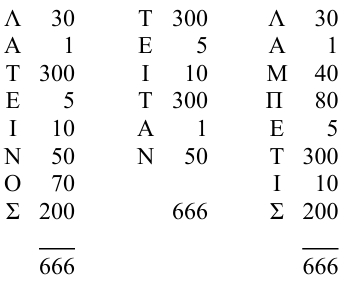
[341]
CHRISTI NOMEN.

308 “Time would fail me, were I to attempt to enumerate all the ingenious devices of this stamp which occur in the works of the Rabbins. In the Greeks they have found imitators; and some of their suggestions, founded on this principle, are far from deserving to be despised; such, for instance, as concern their explanation of that passage in theApocalypse; the number of the beast was 666. For they have been successful in shewing, that these names of Anti-Christ, τειταν, &c , which we meet with in St. Irenæus, contain this exact number 666, lurking, as it were, under the very letters of which respectively they are composed. Such also is the mode of interpreting that celebrated Sybilline Oracle, concerning the name of JESUS, which announces, that it will be found to consist of 8 units, 8 tens, and 8 hundreds, i.e., 888. But not to waste time about a trifle like this, let us proceed without further delay, to set down the calculation of some of these names.” See above.
Curious, no doubt, it appeared to the learned Jesuit, as it must do to every reflecting mind, that, assuming 7 to be the number of perfection, and 3 times 7 to express that number most perfectly, the number of Anti-Christ should come short of it by 3 times 1, and the number of Christ should exceed it by 3 times 1.309
309 For the gratification of the curiosity of those who may not have an opportunity otherwise of seeing the Pseudo-Sibylline verses above alluded to, I here subjoin them, taken from Mr. Clarke, with his translation: —
Ἥξει σαρκοφόρος θνητõις ὁμοιούμενος ἐν γῇ
Τέσσερα φωνήεντα φέρει· τα δ᾽ ἄφωνα δυ᾿ ἀυτῷ
Δισσῶν ἀςραγαλων· ἀριθμὸν δ᾽ ὅλον ἐξονομήσω.
Ὀκτῶ γαρ μονάδας, ὅσσας δεκάδας ἐπὶ τούτοις,
Ἠδ᾽ ἑκατοντάδας όκτὼ, απιστοκεροις ἀνθρώποις.
Ὄυνομα δηλώσει.
“He will come upon the earth, clothed with flesh, like mortal men; his name contains four vowels, and two consonants; two of the former are sounded together. I will declare the entire number; for he will manifest to incredulous men his name, containing eight units, eight tens, and as many hundreds.” — J. E. Clarke.
[342] Decidedly, however, as Λατεινοs has been supported, and strong as are its claims to respect on the score of internal evidence as well as of antiquity, by several commentators and critics of name, Protestant as well as Popish, it has had pronounced upon it sentence of condemnation.
Foremost among its assailants stands Cardinal Bellarmine, one or two of whose objections we have already had occasion to speak of. That he was an able, strenuous, and not over-scrupulous defender of the Holy See, his works abundantly testify; and it was not to be supposed that such a man would overlook or neglect to avail himself of any expedient, whereby he might rid himself and his church of a word, which, as employed by Protestants, had been found to be singularly galling and damaging. Nor is the supposition falsified by fact. Every conceivable argument against Λατεινος is by the learned Cardinal had recourse to. Spare no weapons, is here clearly his motto. Not satisfied with noticing Irenæus’ hesitancy, and the superiority in his own day of other nations to the Latins, he adduces as arguments against it, that, as a common word, [343] it is inapplicable to him whose proper appellation is Bishop, or Pope; that it was the name of only one short-lived Pontiff, who could not by any possibility have been Anti-Christ; and that in a great many other words the number 666 has been detected. Clever and ingenious are the arguments employed by the Romish Dignitary, and admirably are they arranged: but to me, I confess, they have the unpleasant and even offensive appearance of a piece of special pleading, got up by an advocate who was more than dubious of the merits of his own cause; and not that of expressing the sentiments of a Christian man, who spoke in the sincerity of his heart, and who rested his convictions singly on the ground of inspired, divine authority. Such as they are, however, to the work itself I refer him who is inclined and competent to the task of examining them in detail.310
310 R. Bellarmini Opera, Paris, 1620. Tert. Controv. Gen., de Supremo Pontifice, col. 729.
Marshalling his objections to the word Λατεινος seriatim, Bellarmine adduces one of a philological nature, to which, as having been much insisted on since his time, I would specially invite attention.
He pronounces that ι, iota, simply, and not ει, epsilon-iota diphthong, is the proper way of expressing in Greek, the Latin i; and consequently, that the spelling of the word Latinus in Greek is Λατῖνος, not Λατεινος — a change which, if established, would render the numerical value of the word only 661: — “besides, the word Latinus, when it signifies Roman, is not written with the ɛι, but simply with the ι; and then it does not bring out the number [344] required.”311 Tolerably magisterial and oracular, no doubt; only, the assigning of reasons, and substantial ones too, for a criticism so bold and dashing, would have been neither undesirable nor unacceptable.
311 Preterea nomen Latini, ut significat Romanum, non scribitur per ει, sed simplex ῖ; et tunc non reddit illum numerum.
What the learned and zealous Romanist has failed to do, laborious Protestant criticism has effected.
The celebrated critic Bengelius, — with a view to the establishment of that ingenious, but baseless theory, an abstract of which has been laid before my readers, — in his Commentary on Rev. 13:18, thus expresses himself: — “Audierant, Latinum fore nomen Bestiæ —— et id —— de ipso nomine Λατεινος interpretati sunt. Sive hoc, sive illud erat, Λατεινος cum ε sumi non debuit. Nam ει Græcum, subsequente consonâ, Latini quidem per I exprimunt, ut ἐικων, icon: sed I Latinum, Græcè non transit in ει; neque Λατεινος, analogiam habet. Non enim scribitur ακυλεινος, αλβεινος, κρισπεινος, κ. τ. λ., sed ακυλινος, αλβινος, κρισπινος, &c., &c. Apud ipsum Irenæum, Ιουστινος, &c., constanter per ι simplex: et sic Λατῖνος, quod ipsum in Sibyllinis etiam; modo productum, modo correptum habet. Putidum esset plura conquirere. Itaque in uno Andreæ codice MS., Λατῖνος, a librario emendante, contra Andreæ institutum, est repositum; in altero, ad Λατεινος additur, δια διφθογγου, apertâ licentiæ confessione, quæ ut apud Germanos in Germanicis, sic apud Græcos in Græcis eteostichis frequens est. Etiam ejusdem numeri 666 gratiâ fecere τειταν, ex τιταν; παπεισκος, ex παπις-[345]κος; αρνουμε, ex αρνουμαι. Sed ejusmodi licentia in re gravissimâ nil loci esse habet.”312
312 (I avail myself of Mr. Clarke’s version, so far as he has transcribed and translated the passage.)
“They had heard that the name of the Beast was to be Latin —— and this, ——, instead of supposing it to refer to his kingdom merely, they explained as an allusion to his proper name. But Λατεινος ought not to be spelled with the epsilon. For,” says he, “the Greek ει, when a consonant follows, the Latins indeed write with an I, as ἐικων, icon; but the Latin I is never written by the Greeks with an ει; and therefore Λατεινος has no analogy. For, instead of ακυλεινος, αλβεινος, κρισϖεινος,” (sixteen or seventeen other words are added,) “we find always written ακυλινος, αλβινος, κριςπινος,” &c, &c. “Even Irenæus himself constantly writes the Latin names Justinus, Valentinus, Hyginus, and Florinus, in the following Greek form, Ιουστῖνος Ουαλεντῖνος, Υγῖνος, Φλωρῖνος. And so Latinus is written Λατῖνος, in the Sibylline verses, with the second syllable in some instances long, in one case short. To adduce further proofs of the ordinary mode of writing the i in Greek, would be disgusting. Singular to say, in one manuscript of Andreas,” Λατῖνος ” is found without the diphthong, even contrary to the design of Andræas, the editor of the copy considering the diphthong improper. In another, Latinos is written Λατεινος, by an open confession of license; which sort of liberty, as it is common with the Germans, in their German eteostichi, so is it frequent in the eteostichi of the Greeks.” “It was in prosecution of their desire to bring out this very number 666, that they were induced to write τειταν, for τιταν; παπεισκος, for παπισκος; and αρνουμε, for αρνουμαι. Licenses of this sort, however, should have no place in a matter of such importance.” — Bengel’s Gnomon, p. 1171.
By no one have the views of Bellarmine and Bengelius in reference to this matter been more heartily adopted, and from no one have they received more effective support, than Mr. John E. Clarke. Improving on their hint, and [346] rendering it subservient to the establishment of an interpretation of his own, he devotes whole pages of his able and interesting treatise to prove that Λατῖνος, not Λατεινος, is the correct and legitimate mode of writing in Greek the Latin word Latinus; and that, generally, ι, not ει, is the Greek equivalent of the Latin i. To transcribe all that has been quoted and remarked, is out of the question. Let the curious reader go over carefully pp. 40-44, note, of Mr. Clarke’s “Dissertation on the Dragon, Beast, and False Prophet;” as also the additional remarks which he has introduced, when resuming the subject, at pp. 122-126. The industry and research displayed in all this are very commendable; and the tout ensemble is certainly very imposing. That Hesiod, Polybius, Plutarch, &c., should constantly have written Λατῖνος, and that “in every lexicon extant,” the word should never be found spelled with the ει, constitutes, it must be admitted, a very powerful body of evidence in favour of the view which Mr. Clarke contends for.
Strong as are the statements of Bellarmine, Bengelius, and Clarke, as to the matter of fact, they are far from being uncontradicted. Eichhorn, a critic of the very highest authority, asserts, as we learn from Rosenmüller’s Scholia in Novum Testamentum, Apoc. 13:18, that the Greeks did sometimes change the i of the Latins into the diphthong ει; in proof of which he adduces the words Sabinus, Faustinus, Paulinus, &c. as sometimes written by the Greeks, Σαβεῖνος, Φαυςεῖνος, Παυλεινος, &c. It would appear that Scaliger, also, allows the use of the ε in such words as Αντονεινος, Σαβεινος, and Λατεινος; although he censures it in others. See his animadversions on [347] Eusebius Pamphilus, p. 114. To these may be added the respectable names of Francis Turretin, Fleming, and Bishop Newton. The first thus expresses himself in his “Disputationes de necessariâ secessione nostrâ ab ecclesiâ Romanâ,” Genevæ, 1692, p. 197: “In vain is it for Bellarmine, and others, here to object, that the word Latinus, when signifying Roman, is written, in Greek, not with the ει, but with the iota merely; and that this is inconsistent with our finding in the word the number required. For, besides that Irenæus, who doubtlessly understood Greek better than they do, and indeed composed in the Greek language, has written and calculated the word as spelt with the ει,” (he might have added τειταν, also, as so spelled,) “it has long ago been matter of observation with grammarians, that the Greeks were in the habit of changing the ι into the diphthong ει, when it was their intention to lengthen the sound before the letter ν. This the celebrated Scaliger, in his Animadversions on the Chronicles of Eusebius, has taken notice of, and has confirmed by appropriate examples, the word Λατεινος being among the number. Besides, it is matter of notoriety, that the ancient Romans, instead of the long i which is now in use, wrote the diphthong ei; examples of which we have in the queis, for quis; the preimus, for primus; the capteivei, for captivi, of Plautus; and the ‘Quamprimum Caseci populei tenuere Lateinei’ of Ennius.”313 [348] Fleming’s language is, ” Whereas Bellarmine objects that Latinus should be rendered by a single iota, and not by ει , he is exceedingly mistaken: for not only Irenæus renders the word thus, but all the Greeks do the same ; as is plain in innumerable instances, such as in the names Αντωνεινος, Σαβεινος, which the Romans pronounce Antoninus, Sabinus. Nay, the ancient Romans spake the same way as the Greeks, as is plain in Plautus, and the fragments of Ennius, with whom nothing is more common than queis, for quis ; preimus, for primus ; capteivei, for captivi ; lateinei, for latini,”314 &c. And Bishop Newton, in a passage already quoted, is equally decided and explicit. ” Lateinos with ei is the true orthography, as the Greeks wrote the long i of the Latins, and the Latins themselves wrote in former times.315 No objection, therefore, can be drawn from the spelling of the name “316
313 “Frustrà Bellarm. et alii hȋc reponunt, nomen Latinus, ut significat Romanum, non scribi per ει, sed per simplex Iota, et tunc non reddere illum numerum. Nam preterquàm quod Irenæus, qui Græcè proculdubio meliùs novit, et Græcè etiam scripsit, hoc habet, Λατεινος nomen, inquit, valde verisimile est, quoniam verissimum (novissimum?) regnum hoc habet vocabulum; Latini enim sunt, qui nunc regnant; jamdiu observatum est, Græcos literam ι, in diththongum ει convertere solitos fuisse, quum eam ante ν producebant, ut Αντωνεινος, Σαβεινος, Λατεινος, ut celeb. Scaliger notat, animadv. in Euseb. Chron., p. 106. Et notum est veteres Romanos, pro i longo quo nunc utimur, diththongum ei usurpasse, ut queis, preimus, capteivei, apud Plantum, &c. Sic in Ennio, Quamprimum Caseei, populei tenuere Lateinei.“
314 Robert Fleming’s “Discourse concerning the rise and fall of Papacy,” p. 26, London, Terry’s edition, (supposed 1793,) and p. 23, Edinburgh, 1793.
315 Ennius, Lib. vi. 26: —
Quorum virtutei bellei fortuna pepercit,
Horundem me leibertatei poscere certum est.
And there are infinite examples besides.
316 Bishop Newton “On the Prophecies,” 4th edition, London, 1771, vol. iii., p. 247.
[349] When men so eminent and so well qualified to discuss questions of philology, as those whose names have just been mentioned, have differed so widely in their conclusions, why should I presume to interpose my opinion?
Non nostri est tantas componere lites.
Should I venture to make any remarks on the subject, however, they would simply be these: first, that the very fact of Irenæus, an accomplished Greek scholar, and himself writing in Greek at a period when it was a living tongue, having unhesitatingly written Aατεινοs and Τειταν with the ɛι diphthong, affords strong primâ facie evidence that the spelling was legitimate;317 secondly, that both modes of spelling appear to have been in use, and to have obtained the sanction of authority; and, thirdly, that the evidence of the later Greek writers, and especially of the Byzantine historians, does not, in my apprehension, carry much weight in this matter: the question being, not what men writing in a corrupted state of the language were in the habit of doing, but solely what was the usage in the days of the Apostles?318
317 I like exceedingly the good sense, not altogether without the zest of a quiet sneer, expressed in Turretin’s “Irenæus, qui Græcè proculdubio melius novit, et Græcè etiam scripsit.”
318 Since writing the above, I have seen Wrangham’s observations on Λατεινος, which, considering the high literary authority of that divine, and the impartiality with which he expresses himself in reference to the subject, it may not be unacceptable to quote, “Among the Greek solutions stands foremost Λατεινος, the name given by the Eastern to the Western branch of the Church, after the division of the empire. For the Oriental Romans, in compliment to their Mother-city, denominated Byzantium Roma Nova, and the surrounding country Romania. To the objection that we ought to write Λατεινος, is replied, that the ancients expressed i long by ei, as in queibus, captivei, &c.; and to those who allege the number of other isarithmetic appellations, Paræus and More have answered, that this alone combines with the other characteristics of the Beast its ‘seven heads,’ and its ‘ten horns.’
“This interpretation, by Irenæus (the hearer of Polycarp, who was the disciple of St. John,) pronounced probable, valde verisimile, Adv. Hær. V. 30, though Bellarmine of course vigorously opposes its pretensions, seems to have been by far the most generally adopted; and modern commentators of the highest character, — Napier, Brightman, Dent, Sir Isaac Newton himself, and his namesake prelate, Pyle, Lowman, Marsh, Faber, &c., still” (1816,) “continue to maintain its claim to preference. See also Rosemüller, Eickhorn, and Limborch, Theol. Christ., vii. xi. 19; who candidly adds, however, nihil certi definire presumimus — cùm incertum admodùm sit ex numero literarum alicujus nominis in unam summam collecto, certum quendam hominem, cui nomen illud applicari potest, definire velle; cùm videamus unumquemque, pro studio partium, nomen effingere in quo numerum hunc inveniat, et eo adversarios suos premere, aut saltem ipsorum argumentum ex nominis numero depromptum, retorquere.” — Wrangham’s Six hundred three-score and six, works, vol. ii. pp. 406, 407.
[350] Preceding remarks and quotations have served clearly to evince, that the opinion of those who have controverted the claims of Λατεινος to be the name of the Beast, is questionable on other besides philological grounds. The main objection to Λατεινος, seems to be that of Bellarmine, referred to by Turretin, and enforced by Clarke, which alleges the indefiniteness of its form. “Supposing it,” says the last-named writer, “to be a substantive, we are not informed from it what Latin is intended; and, admitting it to be an adjective, we cannot determine with what substantive it is designed to be connected.” — “Dissertation,” p. [351] 44. For my own part, I confess that I cannot see any great force in this objection. — I certainly do not believe that Λατεινος is the solution intended. Therefore, to me, the establishment, or non-establishment of it, is a matter of perfect indifference. “Latin one,” however, — had this been the name in question, — would, I should humbly conceive, be a mode of expression sufficiently definite to have justified, in a matter of prophecy, a reference to it by the Holy Ghost.
2. Ἡ ΛΑΤΙΝΗ ΒΑΣΙΛΕΙΑ.
This is the interpretation of the enigma proposed by Mr. J. E. Clarke himself.
Only second in point of value and importance to that of Irenæus, — if not indeed fully its equal, — does this beautiful and ingenious solution appear to me to be. Great are the obligations under which I conceive its author to have laid every student of divine Revelation by the discovery of it.
The manner in which Mr. Clarke paves the way for stating it, is interesting and highly instructive.
After having, in the three preceding chapters of his work, endeavoured to ascertain the meaning of the phrase, “counting the number of the Beast,” — enquired into the different kinds of numbering in use among the ancients, — examined various interpretations previously given of the number of the Beast, and shewn their insufficiency to solve the mystery; — after having, especially, in imitation of Bellarmine and Bengelius, done what damage he could to Irenæus’ “time-honoured” Λατεινος, and adopted Λατῖνος as the legitimate form of the Greek adjective; — he devotes [352] himself, in his fourth chapter, to what was one of the grand objects of his “Dissertation,” the statement of his own solution.
“Beast,” he first of all tries to establish, “is the symbol of a kingdom.” Then, the number 666 must be contained in the Greek name of some power, expressed in the most simple form of which the language is capable. And, last of all, the species of power represented by the Apocalyptic Beast must be regal or imperial. This is followed up, on his part, by one of the most splendid specimens of the process of exhaustion, which I recollect ever to have met with. He computes the number in question in the various kingdoms, or empires, that have appeared in the world, for which Greek appellatives can be produced. This he does, “in order to discover which is the Anti-Christian power spoken of by the Holy Spirit; and also to determine whether the number of the Beast be confined to one power.” p. 96. The process of exhaustion occupies 22 pages of the Dissertation: pp. 97–119. So important is this part of Mr. Clarke’s book, that only a regard to space and expense, as well as to the general reader’s patience, prevents me from transferring the whole to my own treatise. Let the work itself, if possible, be procured and consulted. His manner of proceeding is this. Taking the Greek words βασιλεια, kingdom, and πολιτεια, government, he first prefixes the article, and then combines each, in succession, with all the Greek national possessives, the declension of which is certain or uncertain, wherever he may have met with them, or in whatever way they may be imagined to be constructed. Opposite to each, he puts the amount of its numerical letters. In none of [353] the long list of names mentioned is the number 666 to be detected.
Mr. Clarke’s own remarks, after having completed his enumeration, are so striking, that I cannot help transcribing them. — “From a close attention to the numbers of the different nations set down in the preceding Classes and Orders, it will be sufficiently evident that there is not one which contains the exact number of 666. This must be acknowledged a very singular circumstance, when the great variety of examples produced are taken into the account. Yet the singularity is much more remarkable when it is considered that even the use of the double article will in no one instance produce the number; that is to say, whether ῾Η Ρωμαικη βασιλεια be computed, or Ἡ βασιλεια ἡ Ρωμαικη; Ἡ Περσικη βασιλεια, or Ἡ βασιλεια ἡ Περσικη; Ἡ Μακεδονικη βασιλεια, or Ἡ βασιλεια ἡ Μακεδονικη, &c., &c. For, in order that any kingdom or power noticed in Classes I. or II. might contain the number 666 when written with the double article, it is necessary that the number set down there should amount to only 658, the feminine prepositive article ἥ having a numerical value equivalent to what 658 is deficient of the number of the Beast. In Class II. I have added to the possessives the number contained in Ἡ πολιτεια, government, instead of that found in Ἡ βασιλεια, because I have not been able to determine the form of government of several of the nations there named, and the rest I have ascertained not to have been kingdoms. Πολιτεια contains 506, and βασιλεια, 259; consequently, the latter word has 247 less than the former. If the whole of the nations, therefore, set down in Class II., be considered as [354] kingdoms, we shall find even the subduction of 239 from any of the numbers, if the single article be used, or of 247, if the double, will not leave 666 for a remainder. For that this should be the case, it is requisite that the nation numbered in Class II. should contain 913, or 905. It is also worthy of remark, that if even the word πολιτεια, which is used by Aristotle for government in general, be applied to all the nations in Class I., instead of βασιλεια, there is not one which will amount precisely to 666, whether expressed with the single or double article. This necessarily arises from the following circumstance, that no kingdom noticed in the class contains 411, or 419: Hence no kingdom or republic set down in the preceding Tables contains the number of the Beast, whether it be written with one or two prepositive articles. And with respect to the two other forms used by the Greeks to express the name of a power, (a considerable number of examples of which have already been given in the preceding part of this chapter,) it is evident that the presence of the ω, whose value is 800, is sufficient to prevent the number of the Beast from being found in either of these two ways. Therefore, in no form whatever, which has been used by the Greeks, can the number 666 be shewn to exist in any of the nations mentioned, in the preceding Classes and Orders.” Pp. 120, 121.
This long quotation, in order to give the reader some idea of the ingenuity, and other merits of Mr. Clarke’s discovery, I have deemed it proper to make.
Perhaps, having quoted so much, I cannot do better than give Mr. Clarke’s conclusion, in his own words.
“It has been already proved that the Beast is some kingdom; and the passage in the sixteenth chapter of [355] the Revelation has been produced, in which the very term βασιλεια, or kingdom, is applied to the dominion of the Beast. This kingdom, therefore, can be no other than that which is purposely omitted in the first Order of the first Class, I mean Ἡ Λατινη βασιλεια, ‘The Latin Kingdom.’ It is thus numbered: —

Good reason, certainly, had Mr. Clarke to pride himself on this discovery. Nothing to be compared with it, in respect of originality, ingenuity, and plausibility, is to be met with among all the conjectures which even the most ingenious of Apocalyptic commentators have hazarded on the subject.319
319 Since writing the above — indeed, just as I was on the eve of finishing my work — I have been honoured with the correspondence of the learned and talented author of the “Dissertation.” He lives, I find, in retirement, or rather, in the undisturbed enjoyment of literary leisure, at Kennison-Green, Maghull, in the vicinity of Liverpool. To his kindness and gentlemanlike liberality of conduct, I confess myself much indebted. Several solutions he has supplied me with, which had previously escaped my notice. As the nephew of the celebrated Dr. Adam Clarke, (referred to, by the bye, in the “Autobiography” of that eminent person, vol. i. pp. 21, 22, and in vol. iii. p. 114, of the edition published by J. В. В. Clarke, London, 1833,) he evidently possesses in no small degree his honoured relative’s literary tastes, love of research, and general ability. Concerning the facts of this gentleman’s existence, of his being my neighbour, and of his relationship to the most learned and able writer whom Wesleyan Methodism has produced, I was, until within the last fortnight, (I write this, December 29th, 1847,) entirely ignorant. — Mr. Clarke has honoured me with the information, that the “ἡ Λατῖνη βασιλεια was computed by” him “on the morning of Thursday, June 1, 1809, although not published until 1814.”
[356] Comparatively recent as Mr. Clarke’s solution is, it has not been altogether unnoticed by subsequent writers on the subject of Apocalyptic interpretation.
Dr. Adam Clarke, for instance, I find referring to it, and adopting it, in his able, laborious, and learned Commentary. This circumstance has given rise to a very curious blunder on the part of Mr. Rabett. Having occasion to speak of the subject, the last-named gentleman devotes a whole chapter (xii.) of his work to “A REFUTATION of Dr. Adam Clarke’s hypothesis of ἡ Λατινη Βασιλεια, ΤΗΕ LATIN KINGDOM,” pages 144-158. Throughout the chapter, to Dr. Clarke alone the solution in question is referred. Not a single word oozes out, from which we might reasonably infer that Mr. Rabett was aware of the learned Dr. having adopted and sanctioned another man’s [357] discovery. How is this? If I remember right — for seven or eight months have elapsed since I last consulted Dr. Clarke’s Commentary, which was, I think, the edition of MDCCCXXX. — the learned author has, with great honesty, signed the name “JOHN E. CLARKE,” in capital letters, at the bottom of his borrowed statement. This, had Mr. Rabett referred to the Commentary itself, he could scarcely have overlooked. The report of others, I suspect, not his own personal examination of Dr. Clarke’s work, is the ground-work of his observations on the subject. Mr. Clarke’s “Dissertation” he had not even heard of; or, if so, he had confounded his name with that of his learned name-sake. Hence, doubtlessly, the mistake.
When perusing recently the controversy between Bishop Purcell, of Cincinnati, Ohio, and Mr. Alexander Campbell, of Bethany, Virginia, which took place in January, 1837, I found the latter gentleman referring, although not by name, to Mr. Clarke’s discovery. “We pause not to examine this matter,” (Bellarmine’s objection to the use of the Greek ει, as the equivalent of the Latin I,) “because we find a much more consistent and convincing exposition in the true and proper name of the Institution, which in Greek was always written in full.” Mr. Campbell then mentions ἡ Λατῖνη βασιλεια, and calculates the amount denoted by its letters.320
320 A Debate on the Roman Catholic Religion, Cincinnati, 1837, 8vo., p. 229.
The Horæ Apocalypticæ of Elliott, I have taken occasion several times already to allude to. In p. 216, I observe that the learned author calls “attention very spe-[358]cially to Mr. Clarke’s ἡ Λατῖνη βασιλεια, which is, indeed, so remarkable, that I cannot but think the Divine Spirit had it also in view as an alternative solution, involving the word Latin, in its more usual, though not the mystic orthography.”
Satisfied I certainly am of the amazing ingenuity, as well as research displayed by Mr. Clarke, in his notable interpretation; and with Mr. Elliott I agree in expressing my conviction, that between the truth and it, we have reason to think the Holy Ghost intended to establish a certain kind and degree of connection. Farther than this I cannot go. The true solution of the divine problem must be sought for and found elsewhere.321
321 Both modes of denoting in Greek the word Latinus, Λατεῖνος, and Λατῖνος, — and both evidently were in use — thus strikingly conduct to the same result. We have thus, as Mr. Elliott says, “an alternative solution.” Either way taken, Romanism or Latinism, is clearly involved. By the way, on pp. 123-126 of his “Dissertation,” Mr. Clarke has some learned and interesting remarks on the rise and progress of a new Greek adjective, Λατινικος, which he traces back to the time of Dio Cassius, about A.D. 230; and by which, soon after the 10th century, the possessive Λατῖνος was almost entirely superseded.
3. ‘ΕΚΚΛΗΣΙΑ ΙΤΑΛΙΚΑ.
John Piscator, in his “Commentary” on Rev. 13:18, has the following remarks: —
“Numerus Bestiæ, sive nomen in quo continetur nomen (query, numerus?) Bestiæ. — Computet numerum nominis Bestiæ. — Hominis. Qui ab homine possit reperiri et computari. — Numerus continetur in duabus his vocibus, [359] Εκκλησια Ιταλικα; in quibus observatur pronunciatio usitata Latinis, quia de Latinis sermo est. Alioqui, dicendum fuerit, Εκκλησια Ιταλικη.”322
322 “The number of the Beast, or the name in which the name (Query, number?) of the Beast is contained. — Let him calculate the number of the name of the Beast. — Of a man. Which by a man may be found out and computed. — The number is contained in these two words, Εκκλησια Ιταλικα, (Italian Church,) in which we are called on to take notice of the adjective being pronounced according to the Latin usage, because of Latins the Holy Ghost was speaking. Otherwise, Ιταλικη, with the η, would have been the word.” — Ioan. Piscatoris Commentarii in omnes libros N.T. — Herbernæ-Nassoviorum, 1638, p. 811.
By Brightman, this interpretation has been noticed. — See his Apocalypsis Apocalypseos, from which already a quotation has been made, on Rev. 13:18.
Twice has it been adverted to by Rabett, pp. 118, 119, and pp. 146, 147; and on both occasions he has given the calculation of it at full length. That calculation obviously is: —
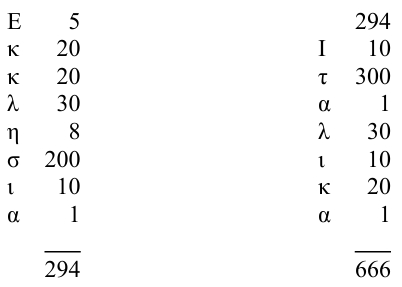
Dr. Fulke, in his Annotations on Rev. 13:18, con-[360]tained in his “Examination of the Rheimish Testament,” says strongly, “it is not by chance that ECCLESIA ITALICA, in the account of the Greeke letters, fulfilleth the same number.” To the same solution Mr. Clarke has a passing allusion: — “It is also discovered in the Latin words Ecclesia Italica, written in Greek characters.” Pp. 52, 53. Piscator and Fulke are by him referred to.
Concerning this very remarkable interpretation, Mr. Elliott thus expresses himself: — “Paræus gives Ιταλικα Εκκλησια. Here the Doric termination of Ιταλικα given, may perhaps be considered legitimate, the Latins being of Doric origin.” “I have tried,” adds our author, somewhat in the exhaustive style of Clarke, “the names of every other national Church, instead of Ιταλικα, viz., Greek, Nestorian, Eutychian, Jacobite, Abyssinian, Armenian, English, Lutheran, Swedish, &c.; but none else answers.”323
323 Elliott’s Horæ Apocalypticæ, ut supra.
What a pity that, when so near the truth, the learned author should have been incapable of suspecting and adopting a rather more enlarged process of generalization!324
324 Macknight’s “Truth of the Gospel History,” was carefully perused by me in 1819. Its contents, however, had in a great measure faded from my recollection. Owing to a reference to it, contained in Jones’s “Lectures on the Book of Revelation,” I was induced to write to my dear and distinguished friend, Thomas Mulock, Esq., who has kindly furnished me with the following extract from a copy of the work, which he found in the Library of the University of Edinburgh. — It occurs at page 589.
“And his number is 666. The whole strain of this prophecy shews that the Beast denotes an ecclesiastical, not a civil power. Wherefore, in the number here mentioned, the name of the church which became the eighth form of the government in the Roman Empire must be contained: that is to say, the vernacular name of that church, written in Greek letters, the letters of the language of the prophecy, must, according to the common method of noting numbers by the letters of the Greek alphabet, contain 666. Behold, then, the wonderful name, LATINA ECLESIA — the letters of which in Greek make exactly 666, as follows: —

In all, 666. Wherefore, by this also, as by all the other characters in the prophecy, the Latin Church is shewed to be the power represented by the body of the Beast in John’s vision.”
This solution is far too valuable to be classed under any of the preceding heads. It halts, however. Employing the ι, iota, instead of the diphthong ει , to express the Roman i; using α instead of η in the adjective; and omitting one of the κ’s in Εκκλησια, I feel that it is liable to strong objections.A Under all the circumstances of the case, I conceived that I should best answer the ends of truth and substantial justice, by giving it a place in this note.
A Objections not confined to myself alone; for some of them, it appears, had struck Mr. Wrangham. After bringing forward the solution in the text, he subjoins in a note, “Where one κ is omitted, and the diphthong is commodiously reduced to the simple ι.”
[361]
רוסיית .4
This very interesting solution comes next in order; a solution which, as may well be supposed, has always been a great favourite with Protestants. [362] Dr. Fulke says, “Yea, we see that רוסיית, the Hebrew name of the Beast, signifying Romane, hath the same number.” This occurs in his Annotations on Rev. 13:18, when exposing the tricks and other mal-practices of the Rheimists.
The language of Piscator is explicit: — “Idem numerus continetur etiam voce Hebraicâ, Romiith.“325
325 I. Piscatoris Com., 1638, p. 811. “The same number is contained also in the Hebrew word Romiith.”
Elliott, in his Horæ Apocalypticæ, refers to this interpretation — but hesitatingly. “The most famous [Hebrew solution] is רומיית, Romiith, or the feminine of רומי,” (as quoted by Lancaster, from Daubuz, it is רומיי, see page 433,) “said to mean Roman, and supposed to agree with Hebrew words for Kingdom, Beast, or Church.” Vol. iii., p. 216.
Time would fail me, were I to attempt any enumeration even of the names of the various authors who have made references to this word. It has come under my notice in Limborch’s “Theologia Christiana,” c. 11, sec. 19, p. 836, (edition 1686;) in Cluverus’ “Diluculum Apocalypticum, seu Commentarius Posthumus,” edited by his son, tom. iii., p. 146; in Doddridge’s Family Expositor, in loc.; in Bishop Newton’s work on the Prophecies, who expresses himself very strongly on the subject;326 in Calmet, (Anti-[363]Christ); in Jurieu, (Part I., chap. 15,) who seems to have been particularly taken with it; in Wolfius’ “Curæ Phil. et Crit.,” tom. v. p. 546, Basil, 1741; in Wrangham, Works, vol. ii., pp. 401, 402; in Scott, of Aston-Sandford’s, Commentary; as well as in Rabett, Fleming, and a host of others.
326 “They themselves,” the Papists, “indeed, choose rather to be called Romans, and more absurdly still, Roman Catholics; and probably the Apostle, as he hath made use of some Hebrew names in this book, as Abaddon, 20:11, and Armageddon, 16:16, so might in this place, likewise, allude to the name in the Hebrew language. Now Romiith is the Hebrew name for the Roman Beast, or Roman Kingdom; and this word, as well as the former word, Lateinos, contains the just and exact number of 666. It is really surprising that there should be such a fatal coincidence in both names, in both languages. Mr. Pyle asserts, Paraphrase, p. 104, and I believe he may assert very truly, that no other word, in any language whatever, can be found to express both the same number and the same thing.” Bishop Newton on the Prophecies, 4th edition, London, 1771, pp. 248, 249.
The person who has gone at greatest length into this particular solution, and has most heartily adopted it, is perhaps the celebrated Daubuz, (Charles Daubuz, M.A., Vicar of Brotherton, in Yorkshire.) His “Perpetual Commentary on the Revelation of St. John,” I do not happen to possess, nor have I been able to obtain a sight of it. Its abridgment, by “Peter Lancaster, A.M., Vicar of Bowden, in Cheshire, and some time student of Christ Church, in Oxford,” 4to., London, 1730, is now lying before me; and is, I should think, from the ability with which it is got up, and the very way in which it is printed, admirably adapted to supply the lack of the original. Having been indebted to my friend, Thomas Jones, Esq., Cheetham Library, Manchester, for copious extracts from Daubuz himself, I conceive that I shall afford a treat to my readers by putting them on record: —
“Rev. 13:18.
“I shall begin the exposition of this verse by that of [364] the number 666, which is the subject of the whole. This number has been the subject of great enquiry, ever since the prophecy appeared; and because the Holy Ghost has declared that it is contained in the name, they have gone about to find out words whose letters make up that number, without first considering what the Beast was, which had the name. But this cannot be right: we must first know what the Beast is, and who are its subjects or slaves, that bear the mark and the name: and if then we find that in the general name whereby they are, or affect to be called, the number 666 is contained in the letters thereof, then we may think that we have found it. Provided that, at the same time, all the matters which concern this name do exactly agree with the name containing the number.
“To begin, then: as we have found already that the most essential symbols of this book are taken from, and allude to the several matters contained in the history of the Old Testament; and that in particular the names of the Dragon, Beast, and False Prophet, as also the terms of their duration, are fetched from the same fountain; so I do not question but to find that the number 666 is taken from the same history. That is, that there has been a type of this number, and of its import, in the Fates of the Mosaical Economy, as that economy is in general a type of the Christian. We have observed before, that the corruption of the Church of Israel began in Solomon’s time, by idolatry; and that it was then that public slavery was brought upon the idolators; and that the corrupted Christians, in like manner, were brought into slavery at first by the Beast and False Prophet. Wherefore, in that very history, or nowhere else, must we find a type for this [365] number 666. And, indeed, so we do; for the sacred historians tell us so, in two several places; 1 Kings 10:14; and 2 Chron. 9:13. Now the weight of gold that came to Solomon in one year, was six hundred threescore and six talents of gold. That is, this is the sum of the tribute which was imposed upon the subjects whom he had made tributaries, which came by the year constantly, or thereabouts, to that sum. Whence that tax seems to have been distinguished from the rest of the funds, by the name of 666 talents, in the same manner as we now say, the four shilling tax, though some pay above, and some under. Or, as formerly a certain tax was called fifteen, which, indeed, was at first raised in that proportion, but afterwards quite another thing; insomuch, however, that a tribute tax, and fifteen, became synonymous words. I explain the words, in one year, בשנה אחת, by annually; for אחת, one, is here the same as each, every; έκαστος, as it is termed in 2 Chron. 9:16. If you should take the word otherwise for all the gold that Solomon acquired, the same being only three millions, six hundred forty-seven thousand, eight hundred and fifty pounds sterling, it is nothing in comparison of the idea given us of Solomon’s wealth.
“Besides, it being in both places mentioned together with the revenues of the customs, and the presents of the Arabian princes, the meaning of the place seems clearly to be, that the standing revenue arising from the tribute, was 666 talents of gold. So that they who were liable to that tribute, might be said to be marked, that is, inslaved in that 666 talents’ tax. Who they were that paid tribute we are informed in 1 Kings 9:20,21,22, that is, the [366] remnant of those nations whom the Israelites had destroyed; as also the new conquests of David in Syria, Moab, Ammon, Amalek, Edom, and the Philistines. Or else if you will say, that these nations were not included in this tribute, but that it was the governors who levied it there, and paid it separately, as is said, or hinted in the following words, 1 Kings 10:15, 2 Chron. 9:14, then the tribute mentioned in that sum was only imposed on the remnant of the nations not destroyed, as it is said in Joshua 17:13: the word used there for tribute is למס, which implies as well the bond service, or tribute of persons, as that of money. I wonder the learned Gousset should say, it is never used about money tribute, when it is plain that Jeremiah has used it so, Lament. 1:1, as it may be made out by comparing Jeremiah 39:10, with Nehem. 5:4. Besides that the origin of the word is more favourable to the latter signification: for מסה, signifies to melt or drop; and it is an easy metaphor, to say, that those who pay tribute are melted, or forced to drop their money or substance, since it is still used in modern languages.
“I take it, therefore, that the matter stood thus: the Canaanites, or at least a great part of them, had been made tributaries to pay money, long before Solomon. Josh. 17:13; Judges 1:33. But that Solomon not only levied a tribute of bond service, by taking as his slaves those that we have mentioned before, but also laying a tribute of money upon the rest that were not made the king’s slaves. So that those money tributaries were those upon whom the 666 talents were raised: if not wholly, yet in part. The rest being made out by such as they conquered, idolators. Whether the Israelites were [367] then or after brought into this tax, is not essential; it is sufficient for the type, that all the idolators were so. The Beast and False Prophet make all their subjects, and use them as idolators, and bring them under such a tribute. Now if we consider that the Holy Ghost afterwards describes the territories of the corrupted church as extending to one thousand six hundred furlongs, from the type of the land of the Israelites, which was contained within that measure, we shall easily conceive that the number of the 666 talents of tribute money was likewise a proper type to describe the tributaries to the Beast in the corrupted church; and that the False Prophet, or fac-totum of the Beast, is a Nogesh, נוגש, Raiser of taxes, or oppressor, of the members of the corrupted church.
“You may see how Cardinal Palavicini owns this, and vindicates it.327 History shews enough how the popes have pulled, as well as polled the subjects of Christian princes; and how they have fully made out the character the Holy Ghost gives them here.
327 “New Gospel of C. Pallavicini, chap. 3, articles iv. and v.”
“Further, the calculation of the letters of the name of the Beast, imposed by the False Prophet, agrees with the number alluded to. These are the second and third particulars, which must be made out together, because they are connected. But before we speak of that name, which is afterwards to be calculated, ’t is proper to determine in what language the Holy Ghost designed it might be done; and then, whether that language will admit such calculations. And first to consider in what language the Holy Ghost designed this should be written. It was not the [368] Latin tongue, then commonly spoken in the capital where the Beast and False Prophet were afterwards to set up their throne; because their letters were not all numbers, but very few of them. Isidorus:328 “Latini autem numeros ad literas non computant; sed sola verba componunt.”329 And so Martianus Capella could make no application of that art to the Latin tongue, but was forced to keep to the Greek, in which every letter is a number: “Omnes autem literæ apud Græcos, et verba componunt, et numeros faciunt,”330 says Isidorus: so that I can but wonder at the impudence of B. Bossuet, Bishop of Meaux, who pretended to find it out in the Latin names of Dioclesian Augustus, by the way of Eteosticks, DIOCLES AUGUSTUS; making, indeed, 666, but unluckily the whole matter is of a modern invention, unknown to the Romans in the time of St. John. Besides, that Dioclesian never had the character of the Beast and False Prophet; so that we must look out something else.
328 Origen, lib. i., cap. 3.
329 “The Latins make use of their letters, not for purposes of numeration, but to compose words.” — D. T.
330 “All the Greek letters, however, serve for numbers, as well as for the composition of words.” — D. T.
“There remain, therefore, only the Hebrew and Greek tongues, wherein it may be thought that the name is to be found. I determine it for the first, for these reasons. First, that the Holy Ghost alludes, for the most part, if not altogether, to the notions suitable to the Hebrew language, as we have made it out by several observations, and gives the names of some remarkable things in that language, as Abaddon, and Harmageddon; and, there-[369]fore, we may reasonably suppose, that it was intended this most remarkable enemy of the church should have his name in Hebrew; and that though the penning of the visions be in the Greek, yet the Hebrew notion and name is preferable. And this the more, if the observation of Salmasius be true, that St. John, not understanding the Greek tongue sufficiently to write,331 had, as it is certain of other apostles, some assistants, to whom he dictated in his language, and they thereupon turned and copied his writings, and thus set them out in the church, as we have them. So that if we can find the name of the Beast reaching all its subjects, and expressed in the Hebrew tongue, so exact as by its letters to make up this number sought, we shall not need to proceed any farther, but rest satisfied that this was principally intended; and so much the more, if the name found in another language, although agreeing as to the number, cannot answer to tell the intentions of the Holy Ghost. Therefore, the Hebrew name is to be preferred, unless we could be certain otherwise, that the Holy Ghost had determined it should be a Greek name; of which we can perceive no indication.
331 A curious compliment, by the way, to an inspired apostle, who had, of course, the gift of tongues. — D. T.
“Secondly. Let us now proceed to see whether the Hebrew tongue will admit such calculation. This question is necessarily to be decided before we proceed, because I find some learned men will not allow the use of letters to express numbers to be ancient; but say, there is no example of it in Holy Writ, and that it is modern among the Rabbies, who are all known to be later than St. John. [370] If it be meant absolutely that such Rabbies were the first introducers of it in that language, that is in my opinion absolutely false. But as it is not necessary for me to enter into that controversy, I shall content myself to shew that way of numbering in use in St. John’s time. The Greeks had most certainly then that very way of using letters arithmetically; and as it is certain that they had their letters from the Phœnicians, ’t is as plain that they had this way from them. Porphyry says that the Greeks had the science of numbers and proportions from the Phœnicians, as high as the times of Pythagoras. These sciences could not be without such an arithmetical use of the letters. Besides, ’t is evident by the order of proceeding, and the ἐπισημα, or adopted characters, jumping in with the Hebrew Alphabet, wherein the βαυς answers to the Hebrew ו, vau; the κοππα being the same as the ק, koph, inverted in the way of writing toward the right hand, and having the same name: that this is all taken from the Phœnician, or Hebrew Alphabet. Whence Dr. Edward Bernard says; ‘Numeratio Græca, vetus æque, cæterarum ferme omnium gentium ritu, secundum Alphabetum Phœnicium, ordine manifesto progreditur.’332 Farther, we find examples of this in the Samaritan text of the Pentateuch, at the end of the books, by way of Masoretical notes; and in their Targum, that is older than Christ’s time, as Bishop Walton thinks. And likewise that the Palmyrenians had this method, as it appears [371] by the conjecture of the ingenious Rhenferdius. And some learned men of late find, that in the Sicles written in the Samaritan character, the year is marked by a letter, as for ד four, and the like. Since then, all the neighbouring nations to the Jews, Phoenicians, Samaritans, Palmyreans, Egyptians, had this way, to think the Jews had it not, is ridiculous, especially considering the Alexandrian Jews, who spoke Greek, made use of all the cabalistical arts; and that the Gnostics after them, took up this way, not only in the Greek language, but also in the Hebrew, as it is apparent in Irenæus.
332 The Greek numeration, which has a similar antiquity, following the custom of almost all other nations, clearly has adopted for its model, and for the very order of its progression, that of the Phœnicians. — D. T.
“We may, therefore, proceed to find out the name of the Beast in the Hebrew language; and to find out the word, let us first find out the thing. The Beast, or tyrannical government, calls itself Roman; for it is said to have succeeded the Roman Dragon in his throne, power, and capital, and the False Prophet to speak like the Roman Dragon; that government has set up all the Roman pretensions, and the False Prophet obliges therefore all the subjects to call themselves Romans; not only because in reality they are to be under the direction of Rome, both in the West and the East, but also because the power he pretends to is grounded upon the rights of Rome, preserved in the Old Rome, and also communicated to the New. Formerly, the faithful Christians were contented with that name, which shews their relation to the Lamb; but the False Prophet, who pretends to have the horns of the Lamb, establishes them by speaking like the Dragon, and claiming to have the same right, must have them to bear that badge, which may shew his power to be Roman. So that, whereas the Christians, when heresies and schisms [372] arose, were obliged to own the Catholic Church of Christ, those that are deluded by the False Prophet must own their relation to the Dragon, by calling themselves Roman Catholic. Every thing, therefore, of any consequence in the corrupted church is Roman. The heads are still Roman; the language is called Roman; is Roman in the West, and is called Roman in the East. The Latin used in the church, as the token of submission in all the Divine Service to the False Prophet, is really the Roman language; and the modern Greek is now called Roman333 by themselves. As, indeed, all the Greeks call themselves Romans, and are so called by all the Eastern nations; and they say, too, that they are Romans, as well as the Italians, and that they are members of the same church. Here, then, will I find this name, being a general name, by which all men that have submitted to the Beast, or False Prophet, and have worshipped his image, are still, and have been called, to this day. So that, as to the thing, or notion of the name, we find it is Roman.
333 Romaie. Query? — D. T.
“As to the word itself, that is, the expressing of it in the Hebrew tongue, there are two grammatical observations to be made: —
“The first is, to know how Rome, from whence Roman comes, ought to be written. The name of the city of Rome is by some written רומא, but for the most part it is written רומי, as might be made out by several authorities,334 [373] and רומיים,335 are the Romans. In the Arabic writers,336 Rome is רומי too.
334 Targum Jonath. in Isaiah 34:9, in opt. editionib. Vid. etiam Eliæ Levit. Methurgeman. voc. וום. Gemara in Avodi Qura apud Wagens. R. D. Kimchi, apud Buxt., v. רומא.
335 Schilte Haggiborim apud Wagens.
336 Vid. Golii Lex. Arab., p. 1065.
“Again: we must see to whom the adjective Roman is to be applied. Not to the subjects, but to the Beast; for the subjects bear the mark of the name of the Beast. It must therefore agree with the Beast: if we take the Beast literally, ’t is in Hebrew, חיה; if symbolically for a kingdom, then it will be מלכות: and these two words being both feminine, the adjective רומיי must have the termination of the feminine gender, רומיית. This is the word which we must pitch upon; and the letters of that word taken arithmetically together, make just the number 666.

“Thus we have explained the allusion, the name, and the number, calculated out of it, which describes the Beast: so that all concur.
“It will not be improper to take notice here of a coincidence as to this name of the Beast, with the name which the Holy Ghost says, in chapter 17, ver. 5, the great whore, or capital of this kingdom bears. That name is [374] Mystery, μυστήριον; a thing that is kept secret, absconditum. Now the Hebrew word to that purpose is סתור; and it luckily happens that the arithmetical value of the letters contains also the number 666.
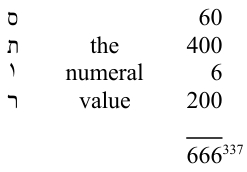
337 This interpretation I have already mentioned. Nevertheless its very striking nature, and the coincidence noticed by Daubuz, induce me here to extract that portion of the learned author’s book which refers to it. “And upon her forehead was a name written, MYSTERY.” Hebrew, סתור. Number, 666. — It is remarkable. — D. T.
“Irenæus saw very well the true method of finding out this number, and he went about it as we have done, by endeavouring, first, to find out the allusion to the histories of the Old Testament, and then he calculated the number out of the letters of the name. But in this he committed a mistake, that he split the number 666 into two parts, without any warrant of the Holy Ghost, that he might fetch the allusion from the 600 years of the age of Noah at the Deluge, when the wickedness of the old world [had come to a height]; and the 66 in the length and breadth of the image of King Nebuchodonosor. But what indication had he to divide that number? Is not ours better, which preserves the number entire in the allusion, and is taken from that very period of the Mosaical dispensation which exactly answers to the period in which the Beast [375] prevails? As for the calculation, he takes it in the Greek tongue, and finds it in the word ΛΑΤΕΙΝΟΣ, first; but yet at last prefers the word TEITAN, which is a word that has no manner of relation to any thing in the Revelation, unless it be by some allusion very far fetched. It appears, however, by this, that he was very uncertain about it; for though Irenæus had a certain tradition from Polycarp, who had been with St. John, that the number was 666; yet he owns he had no tradition to calculate it: and, therefore, when he speaks of the way to find it, he insists only upon his own reason, which is therefore but his particular conjecture. For he says, και του λογου διδασκοντος ἡμας, ὅτι ὁ ἀριθμος το ὀνοματος το Θηριου, κατα την των ῾Ελληνων ψηφον, δια των εν ἀυτῷ γραμματων ἐμφαινεται.338 However, though it must be owned there is a happy coincidence in this matter, in the word Λατεινος, which is the Greek name of the False Prophet in the West, who had indeed the greatest share of the power; yet it is not fully satisfactory, because it doth not reach the Bishop of Constantinople, who is certainly one of the horns of the False Prophet. Why should he then be excluded, when the Emperors of the East, before whom he prophesied, are owned to be part of the great Beast with ten horns? Latins, they are not, but Romans they are; and that very name which belongs to Constantinople as being “the New Rome,” is that which entitles them to speak like the Roman Dragon, in as ample a [376] manner as the Bishop of Rome himself; so that there is no other name, but that of Roman, to bring all in.”339
338 The word itself teaching us, that the number of the name of the Beast becomes apparent, through a calculation of the letters which it contains, according to the usage of the Greeks. — D. T.
339 The condensation of the last portion of Daubuz, after the calculation of סתור, by Lancaster, is as follows: —
“As for the word ΛΑΤΕΙΝΟΣ, (which Irenæus, looking for the name of the Beast in the Grecian language, thought might very probably be the name intended, upon the account of the last of the four kingdoms in Daniel being called the Latin kingdom, and those who then reigned at the time of his writing, the Latins,) it indeed contains the number 666, and suits with the Roman Empire in the time of the Dragon, but seems not so applicable to the said Empire in the time of the Beast, the Dragon’s successor. — For since the appearance of the ten kings, upon the dissolution of the Empire in the West, those only in the West have been called by the name of Latins; and this, by those in the East, who would appropriate the name of Romans to themselves. But those in the West call themselves Romans, as well as those do who are in the East: and both are called by that name. So that there is no other name but that of Roman, to bring them all in.” — Lancaster’s Daubuz, 4to., London, 1730, p. 434. — To persons who may be disinclined to go through my long and valuable extract from Daubuz’s own work, I would recommend a perusal of Lancaster, pp. 428-436. Much, unquestionably, is omitted. Enough, however, remains to satisfy the curiosity of ordinary readers.
Thus far has my friend Mr. Jones extracted. What follows, in reference to the subject, on the part of Daubuz, is an abridgment of Potter.
Long as the extract is, I make no apology for inserting it. Intelligent readers will find it replete with information. Even repetitions of preceding conjectures, as placing them in a new and interesting light, will I am sure be acceptable. To the learned, what higher treat could I present, than such an exhibition of combined research and ingenuity?
[377] To the correctness of this solution, רומיית, and its applicability to the Church of Rome, two men of learning have demurred — Cardinal Bellarmine and Mr. J. E. Clarke.
Precedence being due to the Cardinal, not only on account of his high ecclesiastical rank, but also as having lived two hundred years before the latter-named gentleman, I quote his words first: — “Secunda opinio est Davidis Chytræi, in cap. 13 Apocalyp., qui docet nomen Anti-Christi esse Λατεινος, vel Hebraicé רומיית, Romanus.“340 “Quomodo etiam refelli potest commentum de nomine רומיית. Nam Romanus non potest terminari in ת, cum sit nomen masculinum. Illa enim femininaram terminatio est apud Hebræos. Remotâ autem literâ ת, desunt CCCC ad numerum Anti-Christi.”341 To this the simple and obvious answer is: — true, the word is feminine, and can only agree with a Hebrew noun, such as the words signifying Beast and Kingdom, both of which are of the feminine gender.342 Chytræus’ blunder — if he did commit one — is, therefore, nothing to the point.
340 Query, Romana?
341 “The second opinion which I notice is that of David Chytræus, who, writing on the 13th chapter of the Apocalypse, observes, that the name of Anti-Christ is Λατεινος, or in Hebrew, רומיית, Roman.” (masc.) — “In a similar way, one may refute his fiction of רומיית being the word in question; seeing that Roman cannot, in Hebrew, when used in the masculine gender, terminate with the letter ת. That letter being, as is well known, the feminine termination of the Hebrews. Remove that ת, however, and there is a deficiency of 400 in the sum of Anti-Christ’s name.” — Bellarmine’s works, ut supra, vol. i., columns 728 and 729.
342 Fleming says, “sedes.” Vid. his “Discourse,” p. 26.
[378] Mr. Clarke says, pp. 58, 59, “But the most approved of all Hebrew interpretations is רומיית, a word mentioned by Piscator,343 and asserted by many to be the feminine of רומי,344 said to mean ‘Roman,’ and therefore supposed to agree either with מלכות, ‘Kingdom,’ חית, ‘Beast,’ or קחלה, ‘Church.’345 But that all this is false, I think is sufficiently evident from Buxtorf’s Talmudical Lexicon, where there is given a great variety of examples of the Hebrew word רומי, in all which this word signifies Rome, and not Roman.346 The words used by the Rabbins for Roman are רומאי and רומאה, the first of which is masculine, the other feminine.”347
343 See Wolfii, Tom. Curar. in Apoc. 13:18, and Fulke’s Rheimish Testament, ibid.
344 See Bishop Newton’s Dissert. on Apoc. 13:18.
345 See Bishop Newton and Daubuz, ibid., and Wolfius, Tom. Curar. v., p. 546, edit. Basil. 1741.
346 ןו מלכות וומי הרשעה, ‘this is the wicked Kingdom of Rome.’ — Talmud. on Lev., 6:2 et 9. — See Buxtorf’s Talmud. Lex. on the word דומי: the word רומא is also frequently used for Rome. See Hyde’s Syntag. Dissertat., passim.
347 See Buxtorf’s Talmud. Lex, coll. 2229, 2230.
Not being exactly the retained advocate of this interpretation, it was at one time my intention, after quoting Mr. Clarke’s words, to have left the whole to the discernment of my readers. Having more maturely reflected upon the subject, I thought that I might fitly take leave of this solution, by suggesting a few things in answer to Mr. Clarke’s objection. Such as,
1. — I have not seen ‘Daubuz,’ and have not been supplied with the Hebrew words as they occur in his work. [379] Lancaster, his abridger, gives me, however, as the masculine of Roman, רומיי, not רומו as stated by Mr. Clarke.348
348 P. 433 of Lancaster’s Daubuz, ut supra.
2. — Unless the Dictionary referred to by Mr. Clarke be the one about to be quoted by me, I have not seen it. There occurs in the “Lexicon breve Rabbinico-Philosophicum,” to be found at the end of John Buxtorf’s “Lexicon Hebraicum et Chaldaicum,” Basil. 1621, p. 942, the following brief reference to Rome, and Roman, which, it will be seen, is very far from bearing out the objector’s assertion. Having transcribed it with great care, I can vouch for its accuracy. The work may be consulted at the “Liverpool Athenæum.”
“רומי ,רום, Roma, Romanus, רומיים ,רומאי, Romani.“349
349 The learned will derive further information on the subject of ווס and רומי , from consulting the “Lexicon Heptaglotton,” of Edmund Castell, S.T.D., London, Roycroft, 1669, 2d vol., coll. 3549-3551.
3. — Why, independently of all authority whatever, suppose that the Hebrew word for Roman was always spelt after the same fashion? Is not the writing of proper names, in a foreign language, one of the most arbitrary things known to those who are conversant with grammar? I would, à priori, almost be prepared to find the word for Roman spelt indifferently, רומי, רומיי, and רומאי.
4. — Is it necessary to translate the passage quoted by Mr. Clarke, “this is the wicked kingdom of Rome”? Is not the version, “this is the wicked kingdom of the [380] Romans,” as good, and as capable of being sustained? And,
5. — Highly as I esteem Mr. Clarke, and great as is the instruction which I have derived from his valuable and ingenious work, I confess that in a matter of learning and criticism, the authority of Daubuz carries with it, to me, a weight at least equal to his own.
We proceed to the consideration of the last candidate for admission into the class which we are now engaged in enumerating; namely,
רמענוש .5.
This is evidently the Latin word Romanus, Roman, written in Hebrew characters.
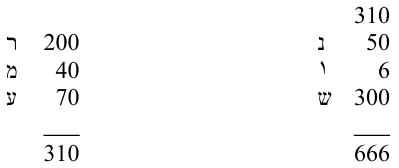
This word, whatever may be its merits or defects otherwise, is not open to the objection urged by Bellarmine against רומיית, that “it is feminine.” ומענוש is obviously masculine.
My attention was first drawn to it by Clarke, who, in his “Dissertation,” so often already referred to, p. 58, thus briefly expresses himself: — “And the Latin word ‘Romanus,’ ‘Roman,’ written by Foxe and Fleming in the following Hebrew characters, רםענוש.”
[381] Fleming, to my annoyance, I found was exceedingly meagre on the subject; merely stating and calculating the word, along with רומיית and Aατεινος, without quoting a single authority — what he says having been taken and abridged, as I suspect, from Turretin: — “Or רמענוש, Romanus, vel Latinus.” See his “Discourse concerning the rise and fall of Papacy.”350
350 London edition, (Terry,) p. 26; Edinburgh edition, (Ogle, 1793,) р. 23. — A new edition, I believe, has just appeared.
Prosecuting my researches with regard to this word, but long unable to repair to Foxe, whom I have since discovered to be its fountain-head, I first of all found mention made of it, along with some others, in the “Commentary upon the Book of Revelation,” by Mr. James Durham, of Glasgow. London edition, 1658, p. 571 .
Then in the posthumous and elegantly written Diluculum Apocalypticum (Lubeck and Stralsund, 1647, vol. iii., pp. 146, 147,) of Cluverus, the following passage attracted my notice: — “Ei respondet — vel Latinum [nomen] Romanus, Ebraicis Literis scriptum — רמענוש, in quibus numerus iste invenitur. Esto, igitur, Bestiæ nomen, Romana, Latina. Esto, capitis ejus nomen, Romanus, scilicet, Pontifex, Papa, Episcopus, Rex, et si quid vis adjungere Epitheton aliud.” — “To this will answer — the Latin word Romanus, written in Hebrew characters, in which the number in question is discovered. Taking, then, the feminine Hebrew form of Roman or Latin, with substantives, in the feminine gender,” (these he had previously enumerated,) “we make out the name [382] of the Beast itself; and taking the masculine adjective form of the Hebrew word for Roman, and combining it with substantives, such as Pontiff, Pope, Bishop, King, or some similar epithet, we, with equal ease and accuracy, indicate the name of the acknowledged head of the said Beast.”
F. Turretin, I found thus expressing himself, in his treatise “De necessariâ secessione nostrâ, ab Ecclesiâ Romanâ,” pp. 196, 197: — “Missis, ergo, istis sententiis,” i.e., the opinions of Grotius and others concerning the number of the Beast, “communiorem et vulgo receptam retinemus, quæ Pontificem, et statum, ac imperium ejus, rectè describi vult. Hoc, vero, quomodocunque computetur, sive Græcè, sive Hebraicê, ut duæ sunt linguæ, quibus dedit Deus oracula sua, et prophetias, ac mysteria sua inclusit, res eodem redibit. ” — “Si vero Hebraicis characteribus nomen istius numerari debuit, erit vel רומיית, Romana, scilicet, Sedes, vel רמענוש, Romanus, ut Ioh. Foxus, arbitratus est. Quæcunque enim de nomine illo dicuntur et istis nominibus proprié conveniunt. Nam Romanus, vel Latinus, nomen est prioris Bestiæ, et tale, quod Papa, cui omnes aliæ notæ Bestiæ ibidem additæ conveniunt,” — “omnibus imponit: quod denique continet numerum 666.” Then follows the calculation. After which the learned author proceeds: — “Sic optimé Pontifex Romanus, ejusque Sedes designantur. Is enim veré Latinus est, qui Latini Imperii reliquias, et Sedem antiquam obtinet, cultumque publicum non alio sermone quam Latino peragi patitur; nec alio Diplomata et Decreta sua emittit. Imo Ecclesia Romana Græcis appellatur Latina; et hæc distinctio adeò insignis erat, ut in Gene-[383]ralibus Conciliis, Occidentales Patres seu Episcopi, Latini, reliqui, verò, Græci, discriminatim appellantur; tam accuraté eventus cum vaticinio consentit. Sedem ejus Romam esse, res est in propatulo.”351
351 “Dismissing, however, such opinions, we prefer that which is more common, and has been more generally adopted, namely, that which regards the Holy Spirit as here furnishing us with a description of the Pope, his state, and sovereign authority. And this, whether the calculation of the Beast’s name and number be made in Greek or Hebrew: for, calculated in either, we are led to the same result; and both languages seem to have an equal claim on our regard, seeing that in both hath it pleased God to utter oracles and prophecies, and to communicate his mysteries to mankind.” — “Should we prefer making the computation in Hebrew characters, we shall find the number proposed, either in the word רומיית Roman (fem.); that is, See, or Seat: or in רמענוש, Roman (masc); which John Foxe has suggested. Whatever things are prædicated concerning the name of the Beast, will be found to answer exactly to any and to all of the names of which mention has been made: for Roman, or Latin, which is the name of the former Beast, is that which the Pope — to whom every other mark of the Beast specified in the prophecy applies perfectly — imposes on all who are subject to his sway. And besides, it contains the very number 666.” — “Thus most admirably and accurately are both the Supreme Pontiff of the Romanists and his seat designated. For truly is he The Latin One, who is in possession of what remains of the Latin Empire, whose seat is the old Latin capital, who permits public worship to be celebrated only in the Latin tongue, and who never issues a Bull, or any other public document, except in Latin. Over and above which, the Roman Church is called the Latin one by the Greeks; and so remarkably is the distinction carried out, that in the records of General Councils we find the Western Fathers and Bishops denominated Latin, the appellation given to the others being that of Greeks. Thus exactly do prophecy and event correspond. That the Pope’s seat is Rome, is a thing too notorious to be denied.”
[384] Vitringa, in his Apocalypsis Exposita, and Paræus, in his “Commentary,” both, likewise, take notice of רמענוש.
Brief is Mr. Elliott’s reference to the word now under consideration, in his Horæ Apocalypticæ: “Similar to which is that which Foxe gives in his Eicasmi in Apoc., רמענוש,” vol. iii., p. 216.
Brief, however, as this quotation from Mr. Elliott is, to him I am indebted for more assistance in regard to this conjecture, than to any preceding writer. By means of his hint, I have at last succeeded in tracing רמענוש to its origin. Previously to my meeting with his most respectable, learned, and instructive work, I had spent much time in searching for רמענוש in Foxe’s “Acts and Monuments.” Need I say, in vain. Having been shewn the right track by Mr. Elliott, I instantly began to follow it out. Long, however, was I baffled in my pursuit. To obtain a sight of the Eicasmi, in a provincial library, I found impossible. At last, in the British Museum, the work in question was met with; and an extract taken from it by Mr. Upton, of London — to whom I hereby acknowledge my obligations, and beg to tender my thanks — enables me to gratify my readers, as well as myself, by submitting to them Foxe’s own account of his discovery.
Mr. Upton mentions that the passage concerning רמענוש occurs in the copy of the Eicasmi Foxi consulted by him, at pp. 456-460. The translation of a small portion of it, will probably be enough for the general reader. For the sake of persons taking a deeper interest in the subject, I give the whole extract in a note.352
352 “SEPTIMA EVIDENTIA DE NOMINE ET NUMERO BESTIÆ.
“Restat porrò septima et ultima euidentia, qua Anti-Christus, qui verè sit, non incertis notis et circumstantiis rerum, locarum, temporum, figurisque proprietatum describitur, sed certò apertòque jam nomine suo, sine omni circuitionis ambiguitate luculenter exprimitur, adeóque omnium oculis conspiciendus producitur, ut nullus sit amplius de Anti-Christo, qui qualisque sit, unde sit, ubi regnat, dubitandi locus, aut disputandi necessitas. Arrigamus igitur aures paululum, mentesque attentiusculè accommodemus, ut quid diuinus hic vates, celesti edoctus afflatu, doceat, verbis sequentibus adnotemus prudenter.
“Hic, inquit, sapientia est, qui habet intellectum, computet numerum Bestiæ. Numerus enim hominis est, et numerus ejus χ ξ ς sexcenti sexaginta sex.
“De numero hoc multi multa dixerunt, plura inuenerunt nomina, in quarum literis plenus hic numerus continetur. Cujusmodi sunt, quæ apud Irenæum, Aretam, Andream Cappadociæ Episcopum, Rupertum, Primasium, Bedam, Thomam, Lyranum, Arisbertum, aliósque complures commemorantur, ut Lateinos, Teitan, Arnoume, Lampetis, Machta, Antemos, Gensericus, Dic lux, Benedictus apud quosdam; Ecclesia Italica, Θεος ἐιμι επι γαιης, Deus sum in terra, cæteraque id genus complura. Quæ omnia, quàm parum ad rem pertineant, non hîc disquiro, sed omnia suis relinquo autoribus. Ad posteriores venio, recentioris memoriæ, Theologicos. Qui nec minus et ipsi enarratione hujus mysterii, pro suo quisque talento egerunt sedulò. Quorum fidelem, in hac re, operam ut lubens amplector, ita si nobis vicissim liceat, æqua ipsorum venia ψηφιζειν, nostrumque post ipsos calculum apponere, dicam breviter, nostra quid fert opinio, nullius interim præjudicans sententiæ, sempérque salvo rectiori judicio. Neque ad mihi sumo, ut, miserorum infimus, plus cæteris in hac re sapiam. Absit ut hæc cogitatio animum unquam subeat. Sed id tantùm, ut quod videtur, pari cum cæteris libertate, aperire liceat. Scio maximam eorum partem, qui in enodatione hujus scrupuli, hactenus antegressi sunt, literas Græcæ linguæ numerales potissimum sequutos esse, propterea quòd in ea solùm lingua, ut ait Irenæus, conscripta sit hæc revelatio. Qua et ipse simul ratione adductus, diu multumque, me similiter diffatigavi, sed non multum promovens, dum nihil hinc certò elicere potui, quod placeret. Tandem ita in mentem venit, ut, relictis Græcis, ad Hebreos articulos me verterem: non sine precibus interim, votisque enixè ad Christum suspirans, ut qui visionem hanc prophetiæ immitteret, dignaretur alicui servorum suorum certam ejus intelligentiam impertiri, ne frustrà in mundum missa hæc Prophetia videretur. Quid multis? Vix primum cœpi calamum chartulæ admovere, ac figuras Hebræorum numerales attingere, mox ad votum annuente, ut reor, domino, successi. Comperi enim nomen quod nos Romano sermone (Romanum) dicimus, si per literas Hebraicas exprimatur, numerum integrum conficere χξs, 666.

“ROMANUS NOMEN ANTI-CHRISTI.
“Cujus nominis literæ, si ad numeros Hebraicos redigantur, summam nobis plenè perfectèque exhibent sexcenta sexaginta sex, ex quo numero, facilè ad nomen Bestiæ pervenitur, hac ratione. Quia etsi nomen ipsum certo quodam consilio supprimit Ioannes, at numerum tamen Bestiæ apertè indicat, ex quo numero facillima fit nominis collectio. Etenim posito hoc numero sexcenta sexaginta sex, quæcunque literarum elementa plenum hunc numerum perficiunt, eadem, recta nos ad nominis notitiam deducunt. At solæ hæ literæ apud Hebræos, quas dixi, Romanum exprimentes, numerum hunc 666 plenè ac solidè conficiunt: ergo solæ hæ sex literæ Romanum sonantes, nomen Anti-Christi clarissimè commonstrant. Eaque causa, rectè Ioannes cum nomine, numerum etiam hominis adjungit, ut excerta numeri positione, vera certaque nominis notitia patèfieret. At pulsat hic forsan mentis quorundam objectiuncula una aut altera. Primum quando prophetia hæc literis Græcis mandata sit ab Apostolo, consentaneum videtur, ut supputatio numeri non nisi à Græcis figuris suscipiatur, quemadmodum prædicat Irenæus.
“Respondeo cum pace Irenæi, ut hoc ei largiamur, evulgatam hanc fuisse prophetiam, Græco contextu, à Ioanne, quod ita ad popularem captum magis conducebat: at illud tamen haud dubium est, quin eadem hæc visio annunciata primùm Ioanni fuerit ab Angelo, ea in lingua in qua natus Ioannes, maximeque versatus est; Hebræus enim erat natione, non Græcus: et si nulla ei non nota esset lingua, nulla tamen ei familiarior quam nativa. Accedunt prætereà haud dubia argumenta, unde verisimile videatur, Hebraicè potius, quam Grecè dictatam primùm ab Angelo, prophetiam hanc fuisse Apocalypticam: tum ex dictionibus Hebraicis Abaddon, Harmageddon, Gog, Magog, ex crebra septenarii numeri usurpatione; tum ex tota ipsa locutionis phrasiologia, quæ propius Hebraismum, quàm Græcismum redolet. Quemadmodum et verba Christi ad Paulum — Saul, Saul, quid me persequeris? etsi Græco idiomate reddita sunt, Hebraicè tamen prolata fuisse à Domino probabile videtur.
“Accedunt huc et aliæ scrupulosæ quædam difficultates: primùm cum dictio hæc, Romana, proprium nomen non sit cujusquæ personæ, hinc non satis congruere eam prophetiæ hujus loco existimant.
“Verùm priusquam huic lemmati respondeamus, sciscitandum ab istis est, de Anti-Christo; utrum privatam eum personam statuant, an publicam? Si privatam affirment, fieri id non potest, ut unius hominis privata ac singularis persona, quæ mortalis sit, ac ævi brevis, tantillo spatio tot tantisque conficiendis malis sufficiat, ut sub externa Christi specie, mundo imponat, ut Bestiæ caput restituat, ut potentiam suam toto terrarum orbe diffundat, ut tot edat signa et miracula, quibus omnes seducantur populi, tantamque occupet in universa terra tyrannidem, ut qui characterem Bestiæ non suscipiat, occidatur. Quæ omnia si in unius hominis personam cadere nullo modo queant, reliquum est, ut Anti-Christum, non privatam, sed publicam fore personam fateamur. Si privata non sit persona, proprium igitur nomen sortiri non potest. Si publica, qualis ea futura sit, sive Christiana, sive Anti-Christiana, non ex proprio nomine, sed ex publica notatione, vel ex loco quo sedet, vel ex officii rerumque quas gerit qualitate, agnoscendus est. Quamobrem quum Anti-Christus propriè is sit, qui toto vitæ et doctrinæ genere, totaque potentia rebellat adversus Christum, sive una persona sive plures sint, imò quando una esse non possit, quæ tantas toto orbe tragædias excitet, non est satis ad nomen ejus proprium recurrere, ut verè noscatur Anti-Christus: sed facta inspicienda, sedes ubi regnat, professionis institutio, potentia quam exercet, tota denique vitæ series excutienda est. Ideoque ubi Joannes mentionem facit nominis Bestiæ, ut proprium nullum nomen edit, ita cum nomine numerum simul adjungit, eumque ad certa quædam elementa alphabetica restringit, quæ si numerentur, efficiunt numerum sexcenta sexaginta sex. Ita fit, ut ex numero literæ, ex literis nomen facilè eluceat. Quæ etenim literæ, in Hebraicis numeralibus, explent hunc numerum quem Propheta statuit, eædem literæ sex nomen exprimunt Anti-Christi: quas literas si Græcè, aut Latinè reddas, exit nomen, non proprium, sed appellativum, ut jam non Hebræus, nec Babylonius sit, (sicut multitota errantes opinione autumant,) sed solùm Romanus, ut ex numero literarum nominalium liquet, quæ Romanum esse oportere apertè prænunciant. Quod quum ita sit, videant proinde quid agatisti, qui ecclesiam suam Catholicam Romæ statuunt, quam sacræ Dei literæ, nusquam nisi Romæ collocant Anti-Christum.” — “Eicasmi Foxi,” pp. 456-460.
[385] After some preliminary remarks respecting the name of Anti-Christ, as now openly made known, and respecting [386] previous conjectures on the subject, with commendations of those who have attempted a solution of the enigma, [387] the learned martyrologist thus proceeds: — “Perhaps I also may be permitted to calculate, and briefly to state [388] the results of my calculation, without being supposed to interfere with the sentiments of any one: always leaving open an appeal to the tribunal of a better-informed judgment. Let no one think that I, holding the lowest place among mortals, assume to be more knowing in this matter than others. God forbid that such a presumptuous idea should ever find a place in my bosom! But I merely claim, in proposing my solution, to exercise a right of [389] which others have availed themselves before me. Well am I aware, that in the untying of this knot — the unravelling of this mystery — by far the greater part of those who have preceded me, have had regard principally to the numeral value of the letters of the Greek Alphabet, acting on the principle laid down by Irenæus, that only in the language in which the Book of Revelation was written, is the solution of its verbal mysteries to be sought for and found. Influenced by the same principle of interpretation, and following the general practice, long and earnestly did I labour to discover the name in Greek: but without success; for I could never hit upon any thing that was satisfactory. At length it occurred to me, that, abandoning Greek numerals, I should betake myself to the method of calculation adopted by the Hebrews; and this I did, not without prayers, supplications, and earnest breathings of heart, directed towards the Great Head of the Church, the burden of which was, that He who had granted to John the vision of this prophecy, would deign to impart to some one of his servants the meaning of it; so that the words of the prophecy might not seem to have been given to the world in vain. Why dwell on all this? Scarcely had I put pen to paper, and begun to calculate the numerical value of the Hebrew letters, when in a moment, — the Lord, as I cannot but think, hearing my prayer, and acceding to my request, — success the most unexpected and complete, crowned my labours. I discovered that the very word Roman, which when expressed in the Roman or Latin language is Romanus, has only to be clothed with Hebrew characters, and calculated, in order to bring out exactly the number proposed: χξς΄, 666.
[390]

“Romanus, רמענוש, therefore, is the name of Anti-Christ.”
The above translation, and the original passage as given below, thus serve to shew us, that to Foxe we are indebted for a double conjecture: the Latin word Romanus being calculated by him, not only in Hebrew, but in Greek letters; and, computed in both ways, being found to amount to the Apocalyptic number.
[391]
CLOSING REMARKS.
Before finishing the present division, and proceeding to solve this problem of problems, I would take leave respectfully to present to my readers, at one view, the conjectures deserving notice which bear on the Church of Rome.
1. — Λατεινος, Latin, Latin one.
2. — Ἡ Λατῖνη Βαςιλεια, the Latin Kingdom.
3. — Εκκλησια Ιταλικα, Italic, or Italian Church.
4. — רומיית, Roman, feminine.
5. — רמענוש, Roman, supposed to be masculine.
To which those who please may add the following:
1. — Αποςατης, Apostate.
2. — Λατῖνα Εκλησια, Latin Church.
3. — Παραδοσις, tradition.
4. — Ρομ(α)νυς, Roman, and
5. — לאטרענוש, Lateran
There are persons, besides, who may be disposed to attach more importance than I do to certain Latin, Greek, and Hebrew conjectures, to which I have assigned a place in my first division.
[392]
DIVISION IV.
THE TRUE SOLUTIONS.
Without any commentary, exposition, or justification of what I am about to submit, — every thing of that sort being reserved by me, if spared, for the second part of this work, — and only observing that, in this thirteenth chapter of the Apocalypse, we have set before us the two grand principles of human nature which have a reference to religion, the Sadducean, and the Pharisaical, — the former asserting the supremacy of the human mind, and the latter substituting the external, the ceremonial, and the shadowy, for the internal, the heartfelt, and the true, — I proceed to the statement of the solutions themselves.
THE FIRST BEAST.
REV. 13:1.
“And I stood upon the sand of the sea, and saw a beast rise up out of the sea, having seven heads, and ten horns, and upon his horns, ten crowns, and upon his heads, the name of blasphemy.“
By sea, we understand,
1. Peoples, and multitudes, and nations, and tongues. Rev. 17:15. That is, more limitedly, the Gentile world, as distinguished from the Jewish nation; and, in a more enlarged sense, human beings in general.
[393] 2. The internal.
3. The principle of the indefinite, or the creaturely internal, as distinguished, on the one hand, from the finite, or definite, that is, the creaturely external, and, on the other, from the infinite, or the divinely internal.
The connection subsisting among these three definitions of the sea, or abyss, (for sea and abyss in Apocalyptic language have the same meaning,353) will fall to be afterwards pointed out.354
353 “As earth in Apocalyptic language is the emblem of the finite, and the sea, or abyss, of the indefinite, so, in the same mystic phraseology, is the air the appropriate emblem of the infinite.“
354 Not a little struck was I, the other day, when reading that most magnificent, most original, and most artistical work, entitled “Modern Painters,” by a Graduate of Oxford, vol. i., part ii., section v., c. 1, Of Water, as painted by the Ancients, to meet with the following passage: —
“Of all inorganic substances, acting in their own proper nature, and without assistance or combination, water is the most wonderful. If we think of it as the source of all the changefulness and beauty which we have seen in clouds; then as the instrument by which the earth we have contemplated was modelled into symmetry, and its crags chiselled into grace; then as, in the form of snow, it robes the mountains it has made with that transcendent light which we could not have conceived if we had not seen; then as it exists in the foam of the torrent — in the iris which spans it, in the morning mist which rises from it, in the deep crystalline pools which mirror its hanging shore, in the broad lake and glancing river; finally, in that which is to all human minds the best emblem of unwearied, unconquerable power, — the wild, various, fantastic, tameless unity of the sea; what shall we compare to this mighty, this universal element, for glory and for beauty? Or how shall we follow its eternal changefulness of feeling? It is like trying to paint a soul.” — Third edition. P. 231.
The splendidly-minded man from whose work the preceding extract is taken, should he ever glance his eye over these pages, will be not only surprised, but perhaps also amused, to find language composed with a totally different object thus capable of an easy and unforced application to Apocalyptic enigmas.
[394] Bearing in mind what I have said, we discover the first Beast in
Ἡ ΦΡΗΝ, ΤHE MIND.
That is, not the mind of man with reference to any of its faculties separately considered, or viewed as a mere abstraction; but that mind considered as a whole, or as comprehensive of all its faculties of sensation, intellect, and volition, and as at once the shadow of spirit, and dependent upon flesh for its nature and manifestations.
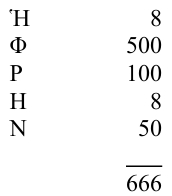
Though I might be justified in merely stating ἡ φρην, with my definition of its meaning, and the calculation, yet, in corroboration of the meaning which I have assigned to it, I subjoin the following accounts of the word, which I find in three lexicons which are lying beside me.
1. In the third part of the Novus Thesaurus Philolo-[395]gicus, sive Lexicon in LXX., et alios interpretes, &c. Hagæ Comitum, 1780, p. 557, we have,
Φρὴν, φρενὸς, mens, mentis, מנדע . Dan. 4:31,33.
2. In the Greek and English Lexicon of the New Testament, by John Parkhurst, M.A., London, Robinson, 1794, 4to., p. 754, we read,
ΦΡΗΝ, φρενος, ἡ.
ⅰ. — Φρενεςm — ων, άι. — This word seems properly to denote the præcordia, or membranes about the heart, including the pericardium and diaphragm. Thus Homer, Il. i. line 103,
—— Με̃νεος δε μεγα ΦΡΕΝΕΣ ἀμφιμελαιναι
Πιμπλαντ΄ ———
“Black choler filled his breast, that boiled with ire.”
POPE.
And Il. x., line 10, in fear the φρενες are said to tremble.
—— Τρομεοντο δε ὁι ΦΡΕΝΕΣ εντος.
They seem to be so called from the Hebrew, פרע, to free, set free, disengage, because they are so loose a structure as not to impede the motion of the heart, lungs, and arteries. And because the φρενες are much affected by the various motions of the mind; hence the word is used by the Greek poets for,
ii. — The mind itself; whence,
iii. — Φρενες in the Greek prose writers often denotes prudence, understanding, and is thus applied twice in 1 Cor. 14:20. Αδελφοὶ, μή παιδία γίνεσθε τᾶις φρεσίν· ἀλλὰ τῆ κακίᾳ νηπιάζετε· τᾶις δὲ φρεςὶ τέλειοι γίνεσθε.
[396] 3. In the well known and esteemed Novum Lexicon Græco-Latinum in Novum Testamentum of Joh. Fried. Schleusner, printed at Glasgow, by the Duncans, for Priestley, London, 1824, juxta editionem Lipsiensem quartam, vol. 2nd, p. 988, I meet with the following definition.
Φρην, φρενος, ἡ. Mens, animus, intellectus. Pluralis, φρενες, άι, idem. Bis tantum in N.T. legitur, 1 Cor. 15:20. — Alexandrini usi sunt hâc voce pro לב, cor, animus, Prov. 7:7, &c. — Et pro מנדע, cognitio, scientia, mens, animus, Dan. 4:31,33. Demosthen. p. 780, 21, ed. Reisk, νõυ και φρενῶν ἀγαθῶν και προνοίας τολλῆς. Hesych. Φρην· διάνοια, γνώμη. Telem. Φρενες, ἔννοιαι, φρονησεις, — φρεσι, διανοιαις.355
355 Upon the principle of scripture being its own best interpreter, the true explanation of Ἡ ΦΡΗΝ is to be found in inspired synonymes, or in such inspired phraseology as
Τὸ φρόνημα τῆς σαρκὸς, the mind, or minding of the flesh, Rom. 8:7; and
Ὁ νόος, or νοῦς τῆς σαρκος, the mind, or intelligence of the flesh, Coloss. 2:18.
THE SECOND BEAST.
VERSE 11TH.
And I beheld another beast coming up out of the earth, and he had two356 horns like a lamb, and he spake as a dragon.
356 “Ver. 11, horns like a lamb, κερατα ὁμοια ἀρνιῳ: — So read the Vat. and Mosc. MSS. without δυο — ‘two,’ which has been added under the error, that the description respected only form; whereas it chiefly respected power, and intended to represent a treacherous appearance of harmlessness, as is manifested by the contrast, ‘but, spake as a dragon.’ It is to be noted, that this symbolic figure rose in power, coincidentally with the fall of the sixth symbolic head of the septennary series, or third of Roman Empire, (above, pp. 482-3,)” Granville Penn’s Annotations to the Book of the New Covenant. London, 1837, p. 492. Some valuable remarks, by Mr. Penn, on the MSS. of the Apocalypse, occur pp. 476-478.
[397]
By earth, or land, we understand,
1. The people of Israel, or the Old Testament Church, or Dispensation.
2. The external.
3. The principle of the finite, or definite.
The connection subsisting among these three definitions, may afterwards be the subject-matter of explanation.
The Second Beast is
ΕΚΚΛΗΣΙΑΙ ΣΑΡΚΙΚΑΙ, FLESHLY CHURCHES.
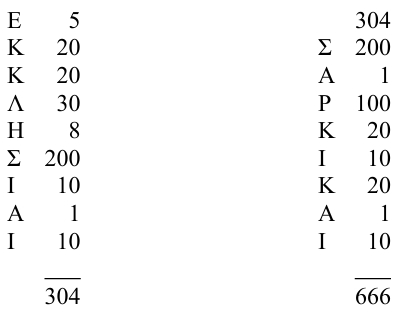
Thus is the number of both beasts the same: a circumstance which serves to account for the ambiguity of the [398] language of Rev. 13:18; and which has materially added to the difficulty of finding out the true solution.
HERE IS WISDOM. LET HIM THAT HATH UNDERSTANDING COUNT THE NUMBER OF THE BEAST: FOR IT IS THE NUMBER OF A MAN; AND HIS NUMBER IS SIX HUNDRED THREE SCORE AND SIX.
———-
D. MARPLES, PRINTER, LIVERPOOL.
———-
WORKS PUBLISHED BY THE AUTHOR.
1. — REMARKS, by the Rev. DAVID THOM, Minister of the Scotch Church, Rodney-street, Liverpool, on a Series of Charges recently preferred against him, before the Reverend the Presbytery of Glasgow, by certain individuals connected with the management of the said Church. With a copious Appendix. — 1825. 1s. 6d.
2. — MEMORIAL submitted by the Rev. D. THOM to the Presbytery of Glasgow, regarding the Theological Points of his Case. Second edition. — 1825. 8d.
3. — A LETTER to the Rev. RICHARD T. P. POPE, adverting to some important mistakes committed by him in his recent controversy with the Rev. THOMAS MAGUIRE. By OBSERVER. — 1827. 1s. 6d. (Out of Print.)
4. — THREE QUESTIONS PROPOSED AND ANSWERED, concerning the Life forfeited by Adam, the Resurrection of the Dead, and Eternal Punishment. — 1828. 2s. 6d. (Out of Print.)
5. — RECENT CORRESPONDENCE between the Presbytery of Glasgow and the Rev. DAVID THOM, occasioned by a second interference on their part with him. — 1828. 8d. (Out of Print.)
6. — The MIRACLES of the IRVING SCHOOL shewn to be unworthy of serious examination. — 1832. 1s.
7. — The ASSURANCE OF FAITH, or CALVINISM identified with UNIVERSALISM. — 1833. 2 vols. 8vo. 21s. (Out of Print.)
8. — THREE QUESTIONS PROPOSED AND ANSWERED, concerning the Life forfeited by Adam, the Resurrection of the Dead, and Eternal Punishment. Second Edition, altered, enlarged, and improved. — 1835. 5s. (Out of Print. This was nearly double the size of the former edition, and was in many respects a different work.)
9. — WHY IS POPERY PROGRESSING? — 1835. 1s. 6d. (Out of Print.)
10. — DIALOGUES on Universal Salvation, and topics connected therewith. — 1838. 5s. (Out of Print.)
11. — DIVINE INVERSION, or a View of the Character of God as in all respects opposed to the Character of Man. — 1842. 10s.
12. — THE THREE GRAND EXHIBITIONS OF MAN’S ENMITY TO GOD. — 1845. 16s.
13. — DIALOGUES on Universal Salvation, and topics connected therewith. Second Edition. Much enlarged, and in many respects altered: containing, among other things, a brief Memoir of Robert Thom, Esq. — 1847. 3s. 6d.
Such of the preceding works as are not out of print, may be had from H. K. LEWIS, 15, Gower-street North, London.
Preparing for the press. — THREE QUESTIONS PROPOSED AND ANSWERED, &c. Third edition.
———-
To the list on pages xxxii., xxxiii., let there be added the name of MACALPINE.
EDITED BY THE AUTHOR.
WITHOUT FAITH WITHOUT GOD; or an APPEAL to GOD concerning his own EXISTENCE, &c. By the late JOHN BARCLAY, A.M., Pastor of the Berean Assembly, Edinburgh. With a Preface by the Rev. DAVID THOM, Minister of Bold-street Chapel, Liverpool. — 1836. 2s. 6d.
———-
WORKS PUBLISHED BY THE AUTHOR’S BROTHER, now deceased, ROBERT THOM, Esq., Her Britannic Majesty’s Consul at Ningpo, China, Corresponding Member of the Royal Asiatic Society, London, Foreign Honorary Member of the Archæological Institute, &c., &c.
1. — WANG KEAOU LWAN PIH NEEN CHANG HAN, or the Lasting Resentment of Miss Keaou Lwan Wang. A Chinese Tale, founded on fact. Canton. — 1839. 4s. See Athenæum, August 1, 1840. — Translated into German by Professor Böttger. Leipsic, Jurany, 1846.
2. — ESOP’S FABLES, written in Chinese by the learned MUN MOOY SEEN-SANG, and compiled in their present form (with a free and a literal translation,) by his Pupil SLOTH. Macão. — 1840. 20s. Most favourably reported on to the Asiatic Society of Paris, by M. Bazin, ainé, Professor of Modern Chinese in the College de France. The report is inserted in No. 6 of the Journal Asiatique de Paris, for 1843.
3. — A VOCABULARY OF THE CHINESE LANGUAGE. Hong Kong. — 1843. 15s. A very high eulogium on this work, from the pen of M. Stanislas Julien, Member of the Institute, and Professor of Antient Chinese at Paris, appeared in the Journal des Debats, of the 24th June, 1844. See “Foreign Quarterly Review,” October, 1844, p. 260.
4. — THE CHINESE SPEAKER, or extracts from works written in the Mandarin Language, as spoken at Peking. Compiled for the use of Students. Part I. At the Presbyterian Mission Press, Ningpo. — 1846. 15s. Spoken highly of in “Allen’s Indian Mail,” Oct. 5, 1847, in “Hogg’s Weekly Instructor,” for November, 1847, “M’Phail’s Ecclesiastical Magazine,” January, 1848, “The Journal Asiatique de Paris,” by Professor Bazin, &c., &c.
Sold by ALEXANDER BLACK, Foreign Bookseller, 8, Wellington-street North, Strand, London. — May be had also from Mr. LEWIS.
———-
Mr. LEWIS is publisher also of —
1. — THE ULTIMATE MANIFESTATION OF GOD TO THE WORLD; addressed to believers of the Gospel. By DAVID WALDIE. — 1847. 1s. — A brief, but comprehensive little treatise, and an able and useful manual of Universalist doctrine. — Nottingham Mercury, July 23d, 1847.
2. — A few brief COMMENTS on a NAMELESS TRACT recently published, entitled, “Brief Scriptural Evidence of the Doctrine of Eternal Punishment: for plain people, with answers to some objections, by I. N. D ” — By PHILOMATH. — 1848. Price 6d , or, by post, 8d.
3. — A LETTER addressed to I. N. D., respecting his Tract on Eternal Punishments. By JOHN FAWCETT. — 1848. 6d.
And other publications.
NEW WORKS AND NEW EDITIONS
PUBLISHED BY
H. K. LEWIS,
15, GOWER STREET NORTH, LONDON.
MAY BE HAD OF ALL BOOKSELLERS.
———————–
BY THE REV. DAVID THOM, PH. D.
1. — DIALOGUES ON UNIVERSAL SALVATION, AND TOPICS CONNECTED THEREWITH. Subjects of the Dialogues: — 1. Election, and the Means of Grace. 2. Jesus the Son of Adam, as well as the Son of Abraham. 3. The Two Laws. 4. Eternal Punishment, not Eternal Torments. 5. The Second Death.
OPINIONS OF THE PRESS.
“We have had occasion, in times past, to bear testimony to the learning and talents of Mr. Thom; a mind well stored and cultivated, and with a philanthropy unbounded for the human species. As in former works, so in this, he expresses his opinion that Christ’s kingdom shall terminate in the ultimate subjugation, or salvation of the unregenerate. He further asserts, that Christ will raise the whole human race, at one period or another, either at the first, or at the second resurrection, either in time, or when time shall be no more, to be happy for ever. From these opinions of his we of course dissent.” — Gospel Magazine, December, 1838, pp. 568-572.
The Rev. T. J. Sawyer, then of New York, now President of Clinton Institute, also notices this edition of the Dialogues, in a long and elaborate review (29 pages,) of Dr. Thom’s then published works, which appears in the “Expositor and Universalist Review,” (American,) for May, 1840.
SAME WORK. Second Edition. Fcap. 8vo., 3s. 6d., considerably enlarged.
“The work itself is in every respect a most extraordinary production, and David Thom, its Author, is in every respect one of the most extraordinary men of the present age. There are, most assuredly, principles advanced in them which no Heaven-taught child of God can or will deny; and in David Thom’s deductions from these principles he exhibits alike the original thinker, the profound Biblical scholar, and the expert and skilful logician.” — Liverpool Chronicle, May 1, 1847.
“Mr. Thom is well known in the theological world as a fearless and highly original thinker, and we hesitate not to say, that whether right or wrong in his peculiar tenets, still, as a man of deep research, metaphysical acumen, and splendid genius, our town may well be proud of him. The present dialogues abundantly [2] attest Mr. Thom’s reputation. That the dialogues are fairly conducted, there is not the shadow of a doubt. In treating of themes such as Mr. Thom treats of, the positive meaning of many men would be quite opaque; our author makes his perfectly transparent, and this is the highest compliment we can pay him.” — Liverpool Albion, May 3rd, 1847.
“A remarkable theological book, full of intense thought, subtlety, and learning; and in which the extremest Calvinism is found expounded and enforced, in conjunction with the doctrine of Universalism. Not the least attractive feature of it is, the preliminary tribute to the memory of the author’s brother, Mr. Robert Thom, British Consul at Ningpo, a man of uncommon merit, for whom, if he had been spared, a distinguished career was in store.” — Manchester Examiner, May 22d, 1847.
“The peculiar characteristics of this work are profound thought, simple truth, and universal charity. — We earnestly commend the perusal of the volume above named; inasmuch as, if addicted to the use of reason and demonstration, readers will find in its pages a splendid and elaborate chain-work of the same, seldom if ever excelled; or, if preferring to rest upon strict scriptural affirmation, and the consequences legitimately deducible therefrom, a grand, simple, and harmonious system, resting solely on enlightened reason and divine doctrine.” — Nottingham Mercury, June 25th, 1847.
“Mr. Thom is highly esteemed, wherever known, as eminent in learning and piety; yet he occupies a singular position as a theologian, blending in his belief such extremes of orthodoxy and liberal opinions, that we hardly know any class of Christians in this country,” (America) “who agree with him in sentiment. He is a believer in the proper and underived divinity of the Saviour, vicarious atonement, election, and eternal rewards and penalties, though he rejects the idea that any will be eternally miserable, and maintains the ultimate salvation of all to happiness and bliss. Those who wish to see how propositions, thus apparently contradictory, are reconciled, and who would become acquainted with the system of the author, we earnestly recommend to consult the work.” — New York Weekly Tribune, August 21, 1847.
“This is a second edition of a very ingenious work, which first appeared in 1838. We have already, in our notices of the author’s ‘Divine Inversion,’ and ‘Three Grand Exhibitions of Man’s Enmity to God,’ indicated the peculiarities of his theology, and the distinguishing character of his intellect. By preserving inviolate the goodness of God, he makes Calvinism conduct him to Universalism, by the destruction in every descendant of Adam of human nature, ‘swallowed up in the divine and generous nature of the Son of God.’ Neither with his first principles, nor with his method of reasoning from words to things, have we any affinity, but the Calvinism of eternal torments he has met upon its own ground, and beaten to the dust. John Foster rejected this horrid doctrine on the ground of its absolute irreconcileableness with Christian sentiment, without attempting to explain all the scriptural expressions concerned in the controversy; our author is more bold and thorough, and conducts his argument by the letter of scripture,” — Prospective Review, August, 1847.
“Whatever may be thought of his,” the author’s, “peculiar opinions, there can be no question whatever of the sincerity of his convictions, or of the vigour and [3] activity of his mental powers.” — M’Phail’s Ecclesiastical Magazine, January,1848.
See also “Literary Gazette;” “English Review,” June, 1847, pp. 447-450; “Family Herald,” July 17, 1847, Answer to Truth Seeker, p. 169; “Nonconformist,” September 1st, 1847, &c,, &c.
2. — DIVINE INVERSION, OR A VIEW OF THE CHARACTER OF GOD AS IN ALL RESPECTS OPPOSED TO THE CHARACTER OF MAN. 8vo, cloth, 10s.
“The columns of the newspaper press form by no means, we are aware, the proper place for the discussion of topics like that involved under the title of the work above named; nor do we intend to enter into any doctrinal discussion upon the subject: we simply wish to introduce to the notice of the serious portion of our readers a most remarkable and powerful production, which has just made its appearance in this town. The object of the author is to exhibit a view of the Divine and human characters as essentially opposed to each other. Immense differences between the two are supposed to exist, and in some degree are pointed out in the schemes of popular religions, and even the philosophy of all ages of the world. But true wisdom and enlightenment shew that difference, after all, is not the word applicable to the case, but absolute contrariety. Human nature, if expanded, beatified, beautified, and glorified ever so — say by some patent moral or spiritual oxyhydrogen magnifying instrument, shewing objects 74,000,000 times larger than we can see them by the naked eye, would not, after all, be one atom nearer to Divine nature than at present, or one whit more estimable than it is — any more than a grub by the same process could be made like a man. This doctrine, thoroughly essential as it is, we are persuaded, to the due comprehension of the Scripture system of types and antitypes, preshadowing and prefigurative, inferior of superior things always, even by the rational and superficial reader merely, is clearly and irrefragably established from holy writ in the pages of the volume before us; and to those who are more highly and profoundly instructed in divine truth, who see below the surface of the word, and know the veins of truth and wells of life which lie below, this work, as presenting in a condensed and suggestive form the natural and unanswerable arguments, and the divine proofs and positions in favour of the important and (to coin a word) clavicular doctrine in question, will be truly invaluable.
“Recommending the work to the attention of the religious public, and regretting deeply our inability to do anything like justice in the present place to its many eminent merits, we shall conclude these remarks by transcribing from the table of contents the heads of the principal sections into which the work is distributed, viz.: The Doctrine of Inversion stated by Christ himself — The last shall be first and the first last — The principle of Divine Inversion — Divine revelation versus human reason — The wide gate and the strait gate — Is eternal life conditionally or unconditionally bestowed? — Natural order, the world in the first place, the church in the second; Spiritual order, the church in the first place, and the world in the second — Man attempts to overcome good with evil; God actually overcomes evil with good.” — Liverpool Chronicle, December 17, 1842. (Were it not that usage and a sense of propriety dictate reticence, one of the first literary characters of the day might be mentioned as the author of the preceding critique.)
[4] “Truly there is much that is acceptable in this volume, as setting forth the dignity and power of Jehovah, in opposition to the weakness and frailty of man. Mr. Thom opens his subject, and by a series of Scriptural authorities, in a simple yet forcible manner, establishes his proposed position. Here we travel side by side with him, and through several sections of his work see little, if any, cause to differ.” — Gospel Magazine, April, 1843.
Mr. Thom’s is “a mind qualified by nature for the pursuit of reality and truth.” He is “a man endowed with no common quantity of natural acuteness.” “Before taking leave of our Author, let us thank him for two things: first, for his clear, distinct, and forcible proof that the doctrine of eternal punishment is in irreconcileable opposition to God’s goodness; and, secondly, for a word of searching advice to ourselves. This relates to the defective popularity of Socinians — in which there is a hint which deserves to be deeply pondered by those whom it concerns.” — Christian Teacher, (now Prospective Review) April, 1843. (Pp. 14.)
“This is a remarkable work, by a man of no ordinary character. He is settled as pastor of an Independent Congregation in Liverpool, and is widely known by his published writings, as well as respected for his learning, ability, and piety.” — “The scope of the work before us is indicated by its title; but some of the sentiments which it aims to establish may not be so.” — After an analysis of the work, and statement of some of the leading points of the system, the critic observes: — “Mr. Thom regards the expulsion of man from Eden as an act of divine benevolence, dictated by a knowledge that he might put forth his hand, and eat of the tree of life, and become immortal in a state of sin; whereas his own highest good required that he should perish, and thence be raised, through divine grace, to a state of holiness and unending bliss.” — New York Weekly Tribune, April 8, 1843.
“The Author of this work has discovered a new and fundamental, or at least ‘a supremely important’ principle, which he has named as above; and to the history of its gradual discovery and the elucidation of its nature and bearings, an ingenious volume is entirely devoted.” — Tait’s Magazine, August, 1843.
“The ‘Divine Inversion,’ it must be conceded, is a remarkable book. It is characterised by learning and talent. In point of style it is, if we mistake not, the best of all our author’s writings, which, though often carelessly composed, have occasional passages of great power and beauty. The mode of thought is here peculiarly Mr. Thom’s.” — “The author’s chapter on the unconditionality of eternal life is worth more than all that we have now been considering. In his chapter on Good and Evil, or on the manner in which God overcomes evil with good, we find much to admire. Here we have able arguments, clear and forceful, in favour of the Divine goodness ultimately overcoming by annihilating evil, and introducing a state of pure, lasting, and universal happiness. On subjects like these, Mr. Thom exhibits himself to advantage. What he writes is good, substantial common sense, and we could quote page after page from this part of his work with pleasure. Mr. Thom has fine talents, a good education, extensive reading, vast ingenuity, and is industrious in a most commendable degree. He has no fear of the world; and would not swerve from truth, or what he believes to be truth, for his right hand. With his talents, and learning, and industry, what might not Mr. Thom effect in Great Britain?” — Universalist Quarterly and General Review, (American,) Oct., 1845. (Pp. 10.)
[5] Besides the preceding, very handsome notices of this work appeared in the columns of the “Glasgow Chronicle,” January 11th, 1843; of the “Devonshire Chronicle and Exeter News,” June 13th, 1843, (from the pen of J. C. Mence, of London,) and another, June 27th, same year; of the “New York Union;” the “Boston Trumpet,” &c., &c. See also “The Second Advent of the Lord Jesus Christ, a past event,” by Robert Townley, A.B., 1845; and “The Theory of Divine Inversion examined,” by Thomas Weatherill, M.D., 1843.
3. — THREE GRAND EXHIBITIONS OF MAN’S ENMITY TO GOD. 8vo., cloth, 16s.
“The literary merits of this work are of the highest order; the Author writes with a thorough conviction of the truth and of the importance of his principles; and never attempts to support them by logical sophisms. If he has provoked controversy, he shows that he is not afraid to meet it; for he states his propositions with a strength and clearness which leave no room for misrepresentation or evasion.” — Athenæum, March 14th, 1846.
“Starting with the necessary, inherent, constitutional, and ineradicable enmity of human nature to God, he ends with ‘the termination of man’s enmity,’ and the everlasting enjoyment of Salvation by all mankind.” — “One word, in conclusion, respecting the style and composition of this work. The separate sentences are remarkably clear and lucid. The Author is a perfect master of perspicuity. — We should be refusing to gratify our own feelings if we abstained from saying that we believe the Author to be a man of unimpeachable integrity, of universal kindness of heart, of a pure life, of a keen and vigorous intellect of the logical order, and of a noble and unworldly devotion to the cause of Truth. He has given proof that he is one of the few whose honesty and simplicity are too strong to yield either to the tyranny or to the cajolery of churches,” — Prospective Review, February, 1846. (14 pp.)
“The author of the volume bearing the above title, is the Rev. David Thom, minister of Bold-street Chapel, Liverpool.” — “We are not ashamed candidly to confess our inability to deal critically with a work of such deep theological reasoning, extensive scope, and vast design as that which we would fain recommend to the consideration of all readers who are desirous of being led to a close examination of some of the fundamental truths of our common faith as revealed in the Scriptures. The work displays great learning, extensive research, a zealous earnestness of purpose, and a vigorous, well-trained mind. Indeed, the power of fervid and sustained thought which it indicates, and of patiently working out conclusions through a series of intricate, but, ultimately, well-developed reasonings, is one of its most remarkable features. Its great object is to prove the antagonism which perpetually exists between man and his Creator, and to show how consistent such antagonism is with all that Scripture and accurate observation have revealed of man’s nature, as well as with the unchangeable love which the Almighty bears towards the erring being to whom he has given this world. ‘Having human nature,’ says Mr. Thom, ‘for my immediate theme, my great object is to open up one of the grand and essential characteristics of that nature. In Scripture the enmity to God of the carnal or human mind is laid down as an axiom. But, to what extent? Partial or total? And how is it to be made known? These and similar questions the following pages attempt to answer. The enmity of [6] man to God is complete. It extends equally to man’s intellect, to man’s will, and to man’s affections. And it makes its appearance in every case in which an opportunity is afforded to it to do so. God himself has afforded such opportunities for its display. The Scriptures constitute the records of these and of their consequences. And to the three grand forms in which opportunities for the display of man’s enmity have been divinely vouchsafed, and in which the enmity itself has thereby made its appearance, I am at present inviting attention.’ The work has received favourable attention from many eminent divines, of different persuasions, who have signified their approval of its views, and the pleasure with which they have followed the author through his varied but lucid reasonings.” — Liverpool Albion, February 2, 1846.
“In noticing recent publications, it is very seldom that we bestow any attention upon those which are essentially theological; neither our pursuits, nor our sympathies, inclining us to that species of literature. The book before us, however, shall be an exception.” — “The leading characteristics of this work are its originality and its boldness: the process by which the author conducts the reader along, through the periodical developments of man’s depravity and opposition to God, to the final result of present, unconditional, and universal salvation through Jesus Christ, constituting the book unique and sui generis. It would appear to us, without giving any decided opinion just now on the truth or falsehood of the doctrine of Universal Salvation, that the same cause which has operated on the strong philosophic mind of Mr. Thom, to conduct him to the embracing of this sentiment, was also the cause of converting thousands of the Puritans of New England to the same faith.” — “It is enough to say, that Mr. Thom, equally with the transatlantic Puritans, was indoctrinated into these subtle dogmas, insomuch that even his powerful intellect, combined with his philosophic research, were inadequate completely to burst the shackles asunder. The book before us teaches us this great moral lesson, viz, that no degree of reflection, in after-life, is sufficient wholly to free us from the prepossessions of early education. Were we to characterise this book of Mr. Thom’s, now under notice, we should say, that it was the high-toned system of predestination, philosophically carried out to its logical results. As well Mr. Thom, as the Puritans of New England, saw clearly that the old system, by selecting a handful out of the general mass of mankind, in order, not only to make them the exclusive favourites of heaven, but in subserviency to the consigning over of the rest of the human family to endless woe, represented the Almighty as a partial being — imputed cruelty and injustice to him — charged him with insincerity — made Christ a dissembler — rendered preaching and praying nugatory and abortive — and, finally, furnished a plea of justification to the reprobate, at the day of judgment, at once conclusive and unanswerable.” After a clever statement of his own religious sentiments, and exposure of what he deems erroneous in those of others, prosecuted throughout two long and ably-written articles, the reviewer thus concludes: — “Upon the whole, Mr. Thom’s book is a great original work, and whether we can subscribe to all his sentiments or not, we can heartily recommend the perusal of the volume to all classes.” — The National Reformer, February 28th, and March 7th, 1846.
“We know not whether our readers would thank us for devoting to this singular work a space proportioned to its extent, to the striking nature of its doctrines, and even to the talent which it undoubtedly exhibits. The title of the book is startling [7] enough.” — “We have thus endeavoured to give a sort of outline of the leading features of this singular scheme.” — “The author’s style is perspicuous.” — “While expressing our own entire dissent from his doctrine, we have no doubt that he makes his principles the basis of practical instruction and exhortation; for the book evidently proceeds from a pious, honest, and conscientious mind.” — Christian Reformer, or Unitarian Magazine and Review, January, 1847. (8 pp.)
“In days like these, of everywhere triumphant mediocrity, it is unspeakably gratifying to meet with a production stamped with the undeniable impress of a really vigorous and original intellect. Whilst we cannot of course profess to agree with Mr. Thom in all his conclusions, we can never refrain from admiring the ability with which he states his premises. Indeed, it is frequently more easy to disagree with than to overturn his arguments; and as regards many of his points, so far are we from wishing to overturn them, that we rather hail them with the most cordial expression of approbation, and profess ourselves equally delighted and edified by the consideration of them. We consider Mr. Thom fairly entitled to the credit of having with a masterly hand withdrawn much of the veil that rested on many scriptural difficulties of paramount import, and to have exposed fallacies, and held up to the light anomalies and misconstructions of Scripture, which have maintained their ground for ages, as doctrinal truths of the first import in the minds of the many.” — British Churchman, April, 1846. (3 pp.)
“This is a book which can neither be understood nor appreciated without close and attentive reading, accompanied by uninterrupted meditation. The author’s object is ‘to shew that man’s enmity to God is the platform on which is displayed God’s love to man;’ and this object is pursued with a closeness of reasoning, and a depth of argument, which, if they fail to convert such as may entertain opinions at variance with the author’s views on the subject, they must at least convince his opponents of his sincerity; for none but an author whose soul is engaged in the work could write with such an earnestness of purpose as we find displayed in Mr. Thom’s excellent volume.” After a statement of the author’s leading object, and a brief analysis of the volume, the reviewer closes by saying; “These several divisions of the subject are fully and ably brought out, the result being a work of unusual excellence, abounding in striking and original views on a subject of universal importance.” — Westminster Review, June, 1846. (Pp. 540, 541.)
“All who are led to the study of theology, or are interested in the interpretation of that dark book, Humanity, have reason to felicitate themselves on the spread of broad and free light in every direction. Nothing is clearer, indeed, to one anywise enlightened, than that all things are clearer. Instead of false and delusive commentaries, so called, many of them from commentiri, and in lieu of most dismal elucidations which were wont to leave the enquirer in the full blaze of the profoundest twilight, true and unmistakeable glimpses of the one and immortal light of truth are to be seen by those who have eyes. Enquirers are not seldom truly clever people; anxious to receive enlightenment from every object and from every quarter, they yet complain of the frigidity of original light, and boast that they can burn only by reflection: to such it might be useful to state that they will only find the sun in one place, that is in heaven; and that as distrust may well be entertained of the bi-polarity of spiritual light, the sincere believer will have no occasion to seek illumination elsewhere.
[8] “The book whose title we have placed at the head of these remarks we have perused with singular and hearty delight. It is full of deep truths and reflections of consolation. Many most serious, awful, and important passages of Scripture are treated of and interpreted according to the measure of the spirit of divine love, whereby strength is extracted out of weakness, and rock converted into water, for their good who need.
“In the three great points of this treatise, the triumph of human, carnal enmity to God, as exhibited in man’s disobedience of the law — Paradisaical, Mosaical, and Apostolic; the law prohibitive and imperative, the law of practice as well as faith; — in the crucifixion and rejection of our Saviour, and in the denial of the universal redemption; the common and Catholic salvation; — in all these points the author has shewn the greater — infinitely greater — triumph over human enmity of divine and eternal love; and the uninterrupted, unalterable, and all-involving procession of the decrees of Deity.
“To enlarge upon works of this kind through a medium like the present is fortunately not required; our duty being discharged in simply indicating, rather than in attempting adequately to discuss, the character and merits of the subject-work before us. We rejoice to hear, however, that several elaborate and liberal reviews have appeared in divers influential quarters, of this truly liberal, learned, eloquent, and religious work; and that it may meet from all lovers of serious reading that respect and attention which its object and contents so largely merit, is our concluding wish.” — Liverpool Chronicle, April 25th, 1846. (See a preceding remark.)
“The doctrine of this book is, that there have been three successive developments of the love of God to man, each fuller than the preceding — viz., in Paradise, under the law, and since the advent of Christ; that against this increasing manifestation of the love of God to man, there has been an increasing manifestation of the enmity of man to God; and that this present and last development of human enmity is to be followed by the victory of the divine love, the enmity of the creature being, finally and for ever, swallowed up in the love of the Creator. Evil is thus developed to the full, that good may ultimately be universal. But we must be allowed to say, that we cannot forbear to regard all theories in religion with suspicion, which are set forth as containing new views of the entire plan of the Almighty, worked out by the solitary thought of some separate mind. We expect no such results to be of sudden appearance, or to proceed from so narrow and humble a source. Time and multitude must be as parents to such theories if they are ever to be demonstrated as the truth. Novelty and ingenuity combined, have great fascination for some minds, especially when they seem to supply a scheme whereby to enter into the secrets of the Infinite, and to ‘justify the ways of God to man.’ But for ourselves, we never look with so much misgiving on the new and the ingenious as when they come to us in company of this sort. No one can read the book which Mr. Thom has published, without great respect for the manifest sincerity, and the grave religious feeling, of the writer. But his plan is too symmetrical, compact, and perfect, and in too great a degree a personal discovery, to be wholly trustworthy. Divine truth is no doubt harmonious and perfect; but we are not more sure that the relations of truth must be of that nature, than that it is not given to mortals to trace out these relations, and to comprehend the whole, in the manner attempted by Mr. Thom. The argument, [9] in our judgment, belongs to the department of philosophic-theological romance, embracing much truth, clustered upon a thread-work which is by no means sound.” — British Quarterly Review, May, 1846.
“An expert theologian alone could successfully attempt to analyze this treatise. Not that the general purport of the treatise is difficult to be understood.” — Tait’s Magazine, April, 1846.
“The volume, the title of which is given below, is a large octavo, of more than five hundred pages, handsomely printed, elaborately written, and the result evidently of much reflection. The author is undoubtedly a studious man, and an earnest seeker after truth. He belongs, apparently, to no sect.” — “It must be confessed, that the author carries himself through the immense labour of this volume, with great steadiness of nerve, with much amiability of temper, and as if, like Mr. Prynne, he could ‘write a folio much easier than a page.’ We are disposed to say much in praise of the work — of the industry, learning, ability, and candour which it displays.” — “Mr. Thom has certainly invented a new scheme of divinity; a scheme, too, which has all the merit of originality, though it borrows freely from several existing systems. In its combinations, and in the grand result, it is unique, and beyond all controversy Mr. Thom’s own.” — “Mr. Thom makes the total and universal enmity of man to God the foundation of his theory. We give his own forcible words on this point.” — “We commend Mr. Thom’s ingenuity, sincerity, and zeal, but cannot praise his system.” Although “wrong, in our judgment, it is preferable, on the score both of the arguments by which it is maintained, and of the spirit which it breathes, to that system, with its various modifications, which prevails so extensively in the church, under the name of Calvinism. In one, the love of God appears, striving with the horrible malignity of his creatures, and never abandoning them, but at last raising them up into his glorious kingdom. In the other, divine love easily exhausts its efforts, and retires to give place to that Almighty vengeance before which the guilty quail, and sink everlastingly into night and hell. Mr. Thom writes like a humane man, and a Christian.” (Initialed.) J. W. T. — Christian Examiner and Religious Miscellany, (American,) March, 1847. (Pp. 14.)
“This is one of the most singular books we ever read.” — “The work, altogether, is a new phenomenon to us.” — The author’s “sentiments are a mixture of Calvinistic error and Scriptural truth, and reveal — the extremes of false orthodoxy, and the cheering and delightful influence of a good nature, of a benevolent, Christ-like soul.” Mr. Thom “appears to cherish the heartiest good-will to all mankind. On some points we find him one with ourselves in opinion.” — “The first part of Boston’s Fourfold State, in which that author treats of man’s first state, Mr. Thom very correctly designates ‘a religious romance.’ He shews, at length, that God’s object in sending Christ, was not to restore men to what Adam lost, but to bring men to something, both far higher in character, and far richer in enjoyment. These views Mr. Thom explains and defends, at great length, and with great ability too. Indeed, it is plain to us, that neither Methodists nor modern Calvinists can have any success in contending with him on their own ground. They can never overthrow him, without overthrowing their own fundamental principles; and they can only differ from Mr. Thom, by being inconsistent with themselves.” — “If the common kind of orthodox people argue with Mr. Thom, they must either give up their usual rules of interpreting Scrip-[10]ture, — their usual mode of arguing, when opposing what they call heretics, — or else submit to be completely and most signally defeated.” — “We should have no objection to proceed further, for the work has suggested to our mind many important thoughts. But we have neither time nor space.” — “I cannot question the truthfulness or uprightness of the author of this work. From all that I have heard of him, from all that I have read of him, and from the work itself which lies before me, I should conclude, that he is a truly generous, just, and Christian man. Though his opinions differ almost infinitely from my own, I cannot but look upon him with respect and esteem, as a good and honourably-minded individual.” — The Christian, (J. Barker’s,) April, 1847. — (Pp. 424-427.)
See also the “Wesleyan Methodist Magazine,” February, 1846, pp. 184, 185; “Baptist Magazine,” March, 1846, p. 166; “The Theologian,” July, 1846, pp. xvii-xix.; “The Intellectual Repository and New Jerusalem Magazine,” February, 1847, pp. 68-75; La Revue Critique des livres nouveaux, redigèe, par Jöel Cherbuliez, for May, 1846, Paris and Geneva, pp. 167-170, (a capital abstract of the work is here given;) “The Tablet” (Roman Catholic,) April 25, 1846; “The Literary Gazette,” and “Spectator,” January 17, 1846; “The Torch,” February 28, 1846, &c., &c.
4. — THREE QUESTIONS PROPOSED AND ANSWERED, CONCERNING THE LIFE FORFEITED BY ADAM, THE RESURRECTION OF THE DEAD, AND ETERNAL PUNISHMENT. By the Rev. D. Tном, Рн. D. Third Edition. Preparing.
———-
WITHOUT FAITH, WITHOUT GOD; or, an Appeal to God concerning his own Existence; being an Essay proving from the Scripture that the Knowledge of God comes not by Nature, Innate Ideas, Intuition, Reason, &c., but only by Revelation. By JOHN BARCLAY, A.M. Edited by the Rev. DAVID THOM. 12mo., cloth, 2s. 6d.
THE ULTIMATE MANIFESTATION of GOD to the WORLD. Addressed to believers of the Gospel. By DAVID WALDIE. Fcap 8vo. 1s.
A brief, but comprehensive little treatise, and an able and useful manual of universalist doctrine. — Nottingham Mercury, July 23rd, 1847.
THOUGHTS ON THE POPULAR OPINIONS OF ETERNAL PUNISHMENT BEING SYNONYMOUS WITH ETERNAL TORMENT. By THOMAS CONOLLY COWAN, A.M. 12mo, Is.
THE DIVINITY OF JESUS CHRIST PROVED FROM THE DOCTRINE OF THE FATHER AND THE SON. In a Letter to a Friend. By T. C. COWAN, A.M.
THE HOPE OF ETERNAL LIFE IN JESUS CHRIST. 1s. 4d.
CHRISTIANITY, or the Catholic Faith demonstrated and made plain to the Understanding both of the Learned and of the Unlearned. In Letters addressed to the Rev. P. Hall, M.A., and inscribed to the Right Rev. the Bishop of Exeter. 12mo, sewed, 4s.; cloth, 4s. 6d.
[11] A MAP of the PURPOSE and DURATION of the REIGN of CHRIST; with Explanatory Notes: to which are added a Few Thoughts upon the Contrast between the First and Second Adam. 12mo, sewed, 6d.
AN ADDRESS TO SIR CULLING EARDLEY SMITH, BART., as Chairman of the Evangelical Alliance, and to the Members constituting that body, relative to the Seventh and Ninth Articles of the Doctrinal Basis. By J. OAKESHOTT. 3d.
A SECOND REPLY to an Inquirer, on the Doctrine of the Restitution of all Things. By JOHN OAKESHOTT. 9d.
A BEREAN’S STRICTURES on a Manuscript entitled The Punishment of the Wicked Everlastingly. By J. OAKESHOTT. 4d.
DIALOGUES (for the Prayerful Consideration of the Church of our Lord and Saviour Jesus Christ,) between a Calvinist, Arminian, and Berean. Nos. 1, 2, and 3; 1d. each.
A LETTER in Reply to some Remarks on Soul, Spirit, and Mind; Hades and Gehenna, &c. By ABIEZER. 6d.
A LETTER in Defence of the whole Counsel of God, against some objections by a Baptist Minister. By ABIEZER. 8d.
BABYLON ANATHEMA MARANATHA. By ABIEZER. 2d.
THE MILLENNIUM. By WILLIAM SEABROOK, Bethesda, Plymouth. Sixth Edition. 6d.
THE ANATHEMA EXAMINED, or the Question not to be Evade — Why ought any Man to love the Lord Jesus Christ, or, if not, to be Anathema? By WILLIAM SEABROOK. 2d.
LETTERS FROM BEREA, between Christians who differ on a Controversial Subject. By PAROIKOS. 2d.
The above contains a Correspondence between the Secretary of the Evangelical Alliance and a Universalist.
OBSERVATIONS upon a Letter respecting the Purpose of God towards Man. By PAROIKOS. 2d.
A TRACT for Tract Distributors, entitled, ” For the Finder.” 6d. per dozen.
MARANATHA. By JANE USHER HOBBS, Waterford. 2s. 6d.
BY THE SAME AUTHOR,
TRACTS FOR THE CHURCH. No. I. The origin, use, and remedy of Evil, scripturally considered. — No. II. The great problem, What is Truth? — No. III. The True Gospel of the Grace of God, shewing the nature, extent, and application of the value of the Atonement. 1d. each.
By MRS. SHERWOOD, Author of “Henry Milner,” “The Monk of Cimies,” &c., THE FAIRY KNOLL. 18mo., bd., 2s. 6d.

 THE REFORMED UNIVERSALIST